High Court rules in favour of climate group in Hunter Valley coalmine case
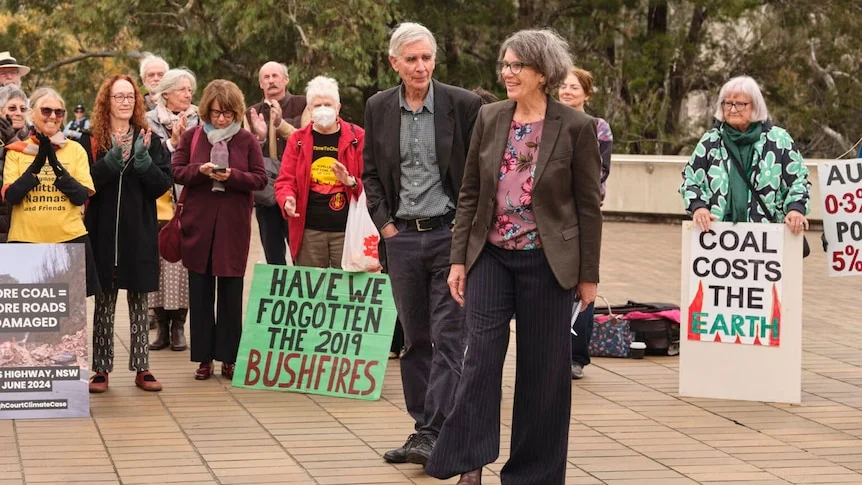
Tony Lonergan and Wendy Wales from the Hunter Valley community group which faught the case rally outside the High Court of Australia in Canberra. (Supplied: Zoe Lonergan)
A landmark ruling in the High Court has found planning authorities are required to consider the emissions caused by burning fossil fuels overseas when approving projects.
Three of the five judges found in favour of a Hunter Valley residents' group, which halted the Mount Pleasant mine expansion last year in the New South Wales Court of Appeal.
The High Court dismissed the appeal and found the project's planning approval needed to take into account scope 3 emissions, which are emitted when the coal is burnt, as opposed to scope 1 and 2 emissions, which are directly caused by the mine.
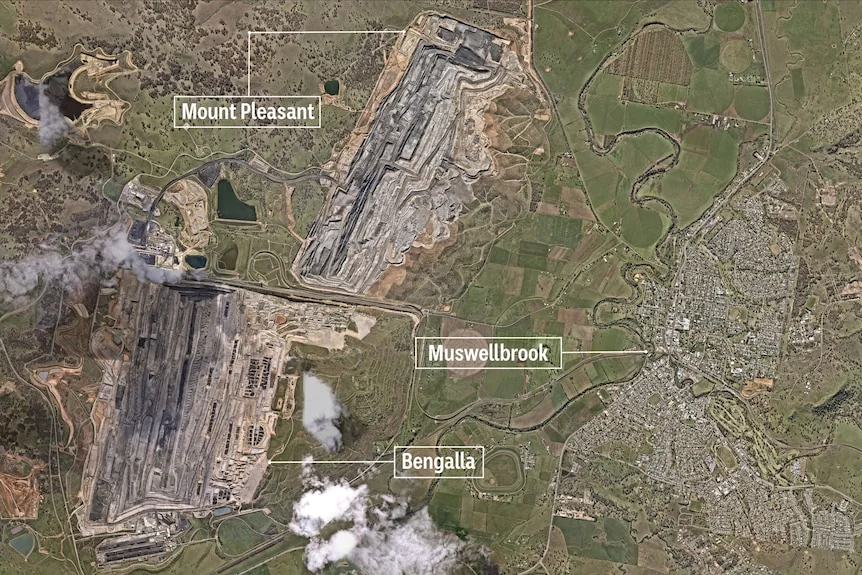
The extension of the Mount Pleasant coalmine would add roughly twice Australia's total annual greenhouse gas emissions to the atmosphere. (Supplied: Nearmaps)
The case is expected to have national implications for the way fossil fuel project approvals take global emissions and local climate change impacts into account.
The High Court case centred around an open-cut coalmine near Muswellbrook, which was approved for expansion by NSW planning authorities in 2022, before being halted through a community-led court battle last year.
MACH Energy, which operates the mine, wants to extract a total of 444 million tonnes of coal from the site, almost doubling the amount currently produced per year, until 2048.
Because the thermal coal is for export, the more than 870 million tonnes of carbon dioxide-equivalent emissions caused by its combustion will occur in other countries.
They are known as scope 3 emissions and are not accounted for in Australia's greenhouse gas inventory.
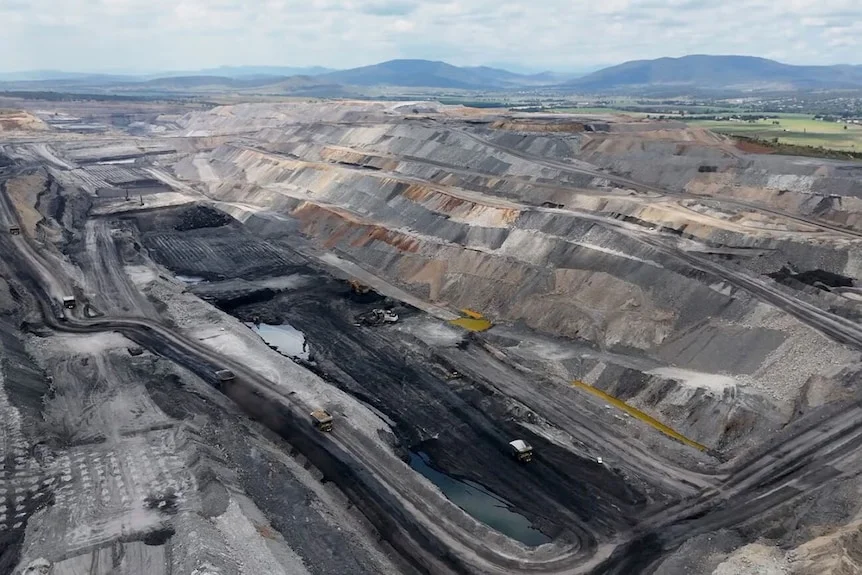
MACH Energy wants to extract more than 440 million tonnes of coal from the site. (Supplied: Climate Media Centre)
Residents from the Denman Aberdeen Muswellbrook Scone Healthy Environment Group (DAMSHEG) have fought to block the expansion on the grounds that those "downstream" emissions will also cause climate-related harms locally and should have been considered as part of the planning process.
In July 2025, the NSW Court of Appeal agreed that the project's global emissions would cause local climate change impacts and that the Independent Planning Commission's 2022 approval did not take this into account.
MACH Energy's appeal to the High Court sought to overturn that NSW Court of Appeal decision on the basis that scope 3 emissions from the project should be considered at a global scale through pre-existing obligations under the Paris Agreement.
Three of the five High Court judges dismissed that appeal, finding that the NSW Independent Planning Commission needed to "consider imposing conditions to minimise to the greatest extent practicable all greenhouse gas emissions, including Scope 3 emissions".
Decision could impact other projects
The case is expected to have national implications for the way fossil fuel project approvals take global emissions into account.
Legal experts say the case is the first time the High Court has dealt with questions about who is responsible for greenhouse gas emissions and the harm they cause, and whether local planning authorities have a duty to consider how fossil fuel projects contribute to the climate crisis.
Anita O'Hart, the principal lawyer who fought the case for the resident's group, said it was a historic ruling for Australian environmental law "and for the communities who have been fighting for accountability in the fossil fuel approvals process".
"The High Court has confirmed that planning authorities cannot ignore the chain of causation from a project's emissions through to real, local climate harm," she said.
"The Independent Planning Commission was required to consider those impacts, and that obligation is now binding across the NSW planning system."
Lawyers for MACH Energy were not available to comment on the court's decision, and representatives from the mine did not respond to requests for comment.
Ruling in line with jurisdictions overseas
The High Court ruling comes off the back of similar court decisions around the world.
The International Court of Justice (ICJ) issued an advisory opinion in July 2025 that put accountability for climate-related harm onto coal and other fossil fuel producers at the point of extraction.
It ruled that states like Australia remained accountable for emissions from fossil fuels even when they were shipped to and burned in another country.
"Obligations pertaining to the protection of the climate system do not rest exclusively with consumers and end users," the ICJ advisory stated, "but also include activities such as ongoing production, licensing and subsidising of fossil fuels."
The UK Supreme Court also ruled in 2024 that the future impact of fossil fuel projects must be assessed by planning bodies when deciding whether to approve projects, after a local campaigner pushed back against an oil drilling well in Surrey.
A submission was made to the High Court from the Massachusetts-based Union of Concerned Scientists along the same grounds, which stated: "Every tonne of CO2 adds roughly the same amount of heat to the system, whether it originates from the Scope 3 emissions of a coal mine in Australia or anywhere else."
The president of the DAMSHEG residents' group, Wendy Wales, said the High Court ruling only confirmed what they had long known.
"We cannot dig up coal, ship it overseas, watch it drive climate change, and then pretend the consequences have nothing to do with us and won't be felt by us," she said.
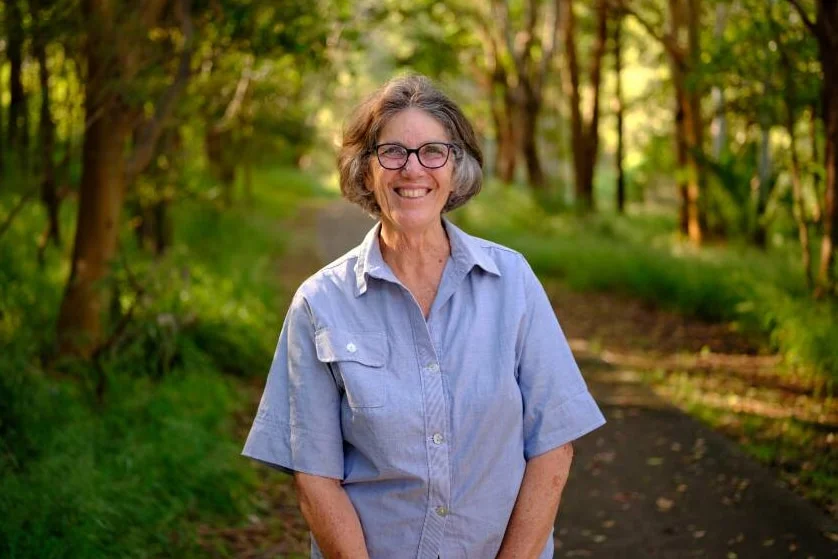
Former teacher Wendy Wales leads the environment group that brought the original case. (Supplied: Wendy Wales)
"The droughts, the bushfires, the floods are directly connected to greenhouse gases, and massive fossil fuel projects like Mt Pleasant Optimisation simply add fuel to the fire.
"Lawmakers now need to turn their full attention to finding unity of purpose in explaining and addressing climate change.
"It is not in our interests that our coal is burned anywhere.