After unpacking my bag in the bedroom I’d call home for the next month, part two of my European spring trip, I went downstairs. My friend and travel companion sat at the kitchen table, eyes on her phone. Without looking up, she held out a paperback.
“Here,” she said, glancing up as I took the book. “I bought this at the airport. I think you’ll love it.”
I examined the cover. It carried a minimalist hand-drawn portrait, the subject unmistakably a hare in profile, with long, spindly ears, a dusky coat, and a single hazel eye. The title, Raising Hare by Chloe Dalton, was set against its slender snout. I opened it, skimmed a paragraph, thrummed the pages, took in the font and generous spacing, then flipped it over to read the back.
I thanked her, but kept my real reaction to myself. Though it seemed like something I’d enjoy, I probably wouldn’t get around to it. Thanks to the Libby app, I already had half a dozen e-books waiting for me. I considered myself something of a Libby maestra, constantly orchestrating its features to perpetually remain near the front of the line for at least one title. I set Raising Hare on my nightstand and went to explore.
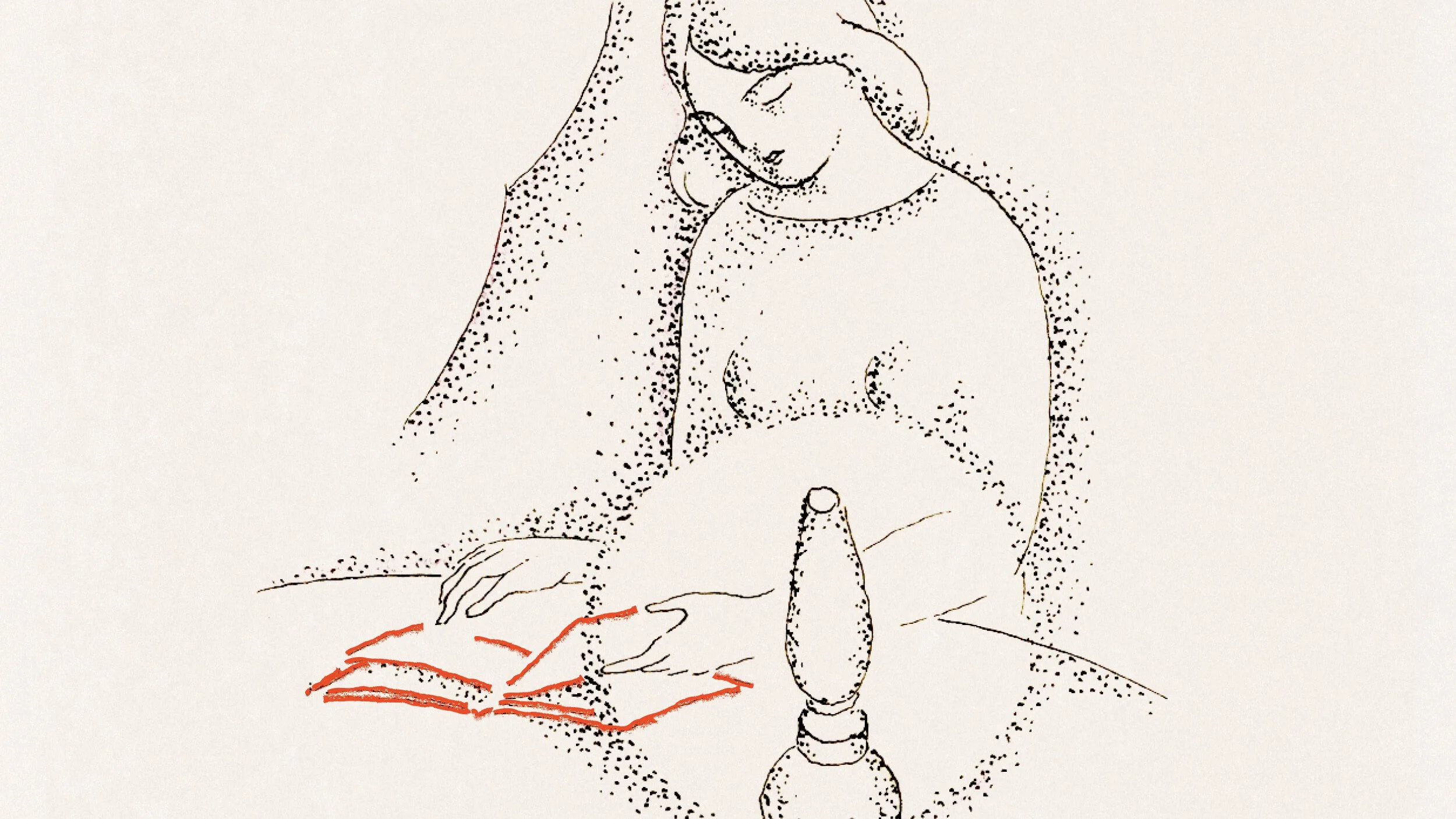
That night in bed, I put my phone down and did the once unthinkable: abandoned a good e-book midway through. The hare’s beady eye beckoned. I started Raising Hare and returned to it every night until I finished.
I’m an avid reader, but I hadn’t read a print book for several years, and the act struck me as strangely significant. It reminded me of my morning journaling habit, which at times seemed slow and unnecessary but was oddly satisfying. A quick search through the literature turned up plenty of evidence that reading print has proven benefits: Readers focus better, understand more, and remember more details.
But I suspect these benefits aren’t why people keep returning to physical books, especially for pleasure. I wasn’t drawn to Raising Hare by some out-of-this-world cognitive experience I wanted to repeat. I didn’t sense I’d absorbed Dalton’s book more thoroughly than any e-book I’ve read.
Afterward, I found myself crouched in front of the rental’s bookshelf, hunting for another title. Nothing there could compete with what was waiting on my phone. I was dying to read Tana French’s new novel, The Keeper (2026), and Kazuo Ishiguro’s Klara and the Sun (2021) had been on my list forever. Still, I kept pulling books, unsure what exactly I was looking for.
The science of the “somethings”
“Most people understand that there is something they do when reading in print that they don’t do when reading digitally,” Naomi Baron told me. Baron is the professor emerita of linguistics at American University and the author of Reader Bot: What Happens When AI Reads and Why It Matters (2026). Her name kept turning up in the research on reading I’d come across, so I asked her for help to get to the bottom of my print renaissance.
I lobbed some of my “somethings” her way: something about the way the book felt in my hands, something about the way my friend had given it to me, something about the way the book boasted one singular, obvious purpose — to be read.
I grew slightly embarrassed as I explained my profound discovery that books are nice to hold. But I knew I wasn’t alone. Print has made something of a comeback, supposedly in response to demand, with some publishers even marketing it as a superior alternative. An ad for a climbing guidebook put it bluntly: “A genuine, real-paper, no-BS-print guidebook. Gift it to a friend in need.” A clear jab at guidebook apps, which are often cheaper and can be more convenient — when they work properly.
“Despite the rise of digitization, humans don’t want to give up tangible items,” Baron said. “Moleskine started selling out because people wanted to write with a pen. Vinyl records are back. Print didn’t fall off a cliff.” Baron points to this broad pattern as evidence that these objects hold a value that’s hard to pin down and can’t be digitized away.
I switched to e-books because they made it much easier — and cheaper — to read while traveling. Then it just became a habit, even when I stayed put. But back home after my vacation, I wondered whether how I read deserved as much attention and thought as what I read.
A book in the hands
The distinction between a book and an e-book is semantically obvious — the latter is a modification of the former, with a clumsy E slapped in front to signal the difference. A book is just that: a physical item you hold and interact with. It is also a self-contained entity. Raising Hare weighs a certain amount, feels a certain way, and has a minimalist cover. No other book is quite like it; it is nothing more and nothing less than Raising Hare.
Obviously, your phone or e-reader is tangible, too. You can hold it, flip it around, and throw it against the wall if you’re feeling overwhelmed (not that I am condoning such action). But it’s also strangely insubstantial. A swipe is more artificial than flipping a page. It looks and feels like every other device on the market. They are less singular objects than portals, panes of fingerprint-smeared glass revealing a million different functions.
“There’s something about the physicality of a book that matters,” Baron said. “When we survey readers across countries and ask what they like most about print, many say it’s the feel of the paper, the weight of the book in their hand. Print feels like ‘real reading.’ It’s a description we hear again and again, across many languages.”
There’s also a benefit that’s easy to overlook in today’s digital age. Because a book is a self-contained object, it lends itself to experiences that go beyond its intended purpose. As with other tangible things — a toaster, a vinyl record, a car — if you want to find a book, you seek it out in designated places: a library, a bookstore, a friend’s bookshelf.
“What do you gain by being able to browse and handle physical books that you don’t get when you’re browsing some poorly designed algorithm on Amazon?” Baron asked. “You discover things you wouldn’t ordinarily come upon — books that turn out to be deeply relevant to you or something about a person from the notes they left in the margins. Those are the things we miss out on when we don’t have physical books.”
And when you’re done with the book, the choice of what to do next — keep it, lend it, sell it — is yours. That choice becomes, in a way, a reflection of who you are.
“In surveys with younger readers, I’ve heard from kids who read the Harry Potter books digitally, then saved up their allowance so they could buy the print books and put them on the shelf to show their friends,” Baron said.
I pictured my own Harry Potter collection, still lined up on the middle shelf of my old bedroom, starting with the thin maroon spine of The Sorcerer’s Stone, each book growing wider until the dark, menacing green of Deathly Hallows. Most of the plot details are long gone, but I do remember my uncle buying me the last book as a surprise. I stayed up all night reading it, eagerly checking the mail each morning for my admission letter from Hogwarts. Harry Potter represents some of the best parts of childhood — imagination, curiosity, magic.
Other books on my shelf tell stories that have nothing to do with the one on the page. My copy of Memoirs of Hadrian — a book my parents bonded over early in their relationship and one I struggled through in high school — still has my teenage handwriting in the margins. My copy of Merle’s Door isn’t a memory I’m holding onto so much as one I let go of — someone gave it to me, and I later gave it to someone else, the two of us bonding over a shared love of dogs.
“When people hold onto books or collect libraries, I interpret that behavior to mean, ‘These books are part of who I am now,’” explained Baron. Fair enough. But what about the decade I’d spent reading with literally nothing to show for it?
E-books at your convenience
Most of what I’ve loved reading over the last ten years, I’ve read on a screen — Sally Rooney’s collected works come to mind. I relate to some of her characters, and I love her razor-sharp writing style. I’ve reread her books multiple times, and they — along with plenty of others I’ve read digitally — inform how I approach my own life. It felt like a juvenile question, but I couldn’t help it: Would these books hit even harder had I read them in print?
Baron’s answer is maybe, but also it’s complicated. “In surveys, when we ask, ‘What do you like most about reading in print,’ people tend to describe becoming emotionally involved with the characters or feeling transported,” she said. “When we ask the same question about digital books, people point to convenience or cost. That doesn’t mean people aren’t engaged when they read digitally, but I take the consistency in responses as an indicator that, for whatever reason, people are more absorbed in the story when they read print.”
That gap may come down to the different reading patterns most people fall into. “When we read a book digitally, we read it faster,” she said. “We don’t go back and re-read an earlier passage. We don’t stop to look something up.” People know they’re reading faster, she added, and mostly assume speed is a good thing. “When I survey people and ask, ‘What do you like least about reading in print,’ many say, ‘It’s too slow,’ or — my personal favorite — ‘I have to concentrate too much when I’m reading in print.’“
Her analysis tracked with how I read things I used to read in print. For instance, when I read the news online, I am always tempted to click away once I’ve gotten the gist. The promise of something else is somehow more appealing than the thing in front of me. But it didn’t describe how I read books for pleasure, even e-books. I go back and reread lines, sometimes entire books. I keep folders of highlighted quotes — one for passages that hit me emotionally, another I call “inspo” for sentences I admire as a writer.
Still, the statistics suggest I was probably reading Raising Hare more slowly without trying, and the story may have had more time to simmer as a result. I don’t know if that’s true, but as Baron pointed out, we’re not reliable narrators of our own reading habits. And that’s kind of the point: If we can’t feel the difference, that’s precisely why the pattern is worth knowing. It hands us back a choice we didn’t know we were making in a practice we’ve performed for most of our lives.
Baron’s practical rule of thumb: “If you know you want to ponder a book, I suggest reading in print. If it’s going to be what I call a ‘one-off’ read, the medium won’t make much of a difference.”
On the surface, the benefits of digital reading — convenience and cost — sound utilitarian, stripped of the higher purpose a physical book seems to offer.
Still, let’s not poo-poo convenience or cost. For all the emotional transportation a print book can give, plenty of people want to literally travel to new places, and lugging around a ton of books isn’t exactly conducive to that lifestyle. Thanks to e-books, I’ve been exposed to hundreds of new authors, ideas, and ways of writing — all while pursuing other priorities in my life and without spending a dime.
Baron points to other reasons someone might prefer reading digitally: “For millennials and onward — who [tend to] value experiences, not possessions — the notion that I’d rather pay for a scuba diving trip off Okinawa than for some Japanese souvenir. Some children tell me they’re afraid of damaging a print book or that it costs too much to buy or ship books when they’re moving. People reading in a new language prefer digital books because they can easily look up words they don’t know.”
When choosing between print and digital, Baron’s question is simpler than any of that: “What is your goal in reading? What are you trying to get out of this? If you want to absorb a novel, print might be better. If you’re trying to get through a textbook, or you’re traveling a lot, or there are certain features that appeal to your situation, digital might be better.”
“The goal isn’t to sell people on ‘reading’ in the abstract,” she added. “It’s figuring out how to keep both formats open, and use each one where it actually delivers the most value.”
Passing it on
A few days after returning from my trip, I was sitting in another friend’s yard in Salt Lake City, drinking a late-morning coffee and watching the birds and squirrels flit around her garden. The night before, I’d finally clicked “borrow” on The Keeper and was a few chapters in. As I opened Libby to keep reading, I heard the screen door shut behind me, and Rosie came out to join me.
In the middle of our conversation, Oso, her yappy, lovable dog, perked up from where he’d been lying at our feet and took off after something. “He loves those rabbits,” Rosie said, already resigned to the futility of trying to stop him.
I put my coffee down. “That reminds me; I have something for you,” I said and walked to my car to grab Raising Hare. I handed it over, and her face lit up as she turned it over in her hands, flipped it over, and skimmed through it. Somewhere in the garden, Oso gave up on the rabbit and trotted back.
This article What you lose when you stop reading physical books is featured on Big Think.