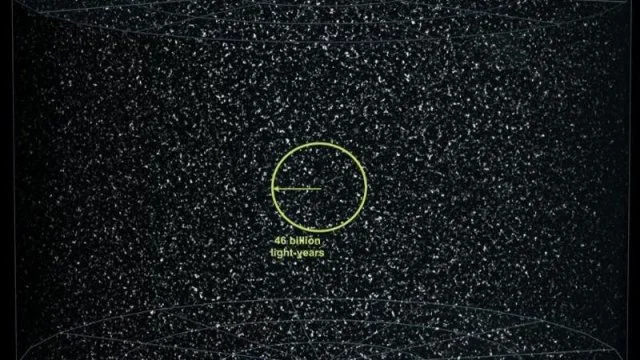
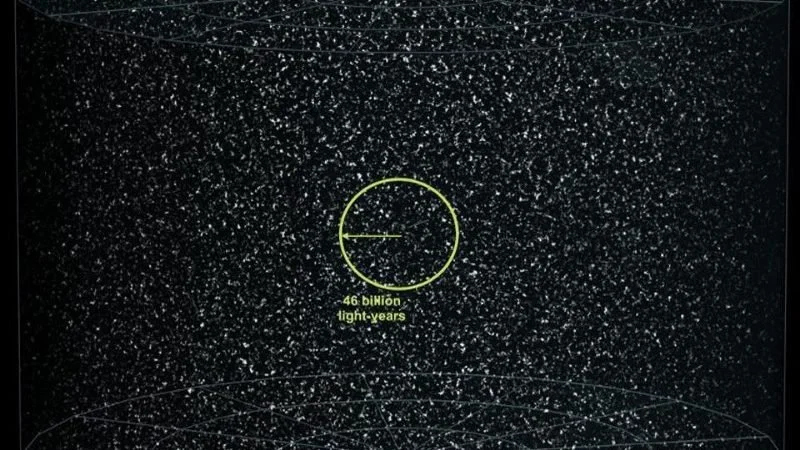
When we look out across the Universe, we see objects at all different distances. The planets we see all exist only within our own Solar System: right in our cosmic backyard. The stars that we see exist primarily within our home galaxy, the Milky Way, and can be up to tens of thousands of light-years distant. Our nearest galaxies are under a million light-years away, but the farthest ones that have been identified are over 33 billion light-years away. And when we look at the oldest, most distant signal we can access, the light of the cosmic microwave background, we know it sits at a surface located 46.1 billion light-years away: the farthest thing we can see.
While there are a great many uncertainties about many things in the cosmos — including the size of the full Universe beyond the limits of what’s observable — the size of the observable Universe isn’t just known precisely today, but all throughout cosmic history: at any moment over the past 13.8 billion years. But how do we know this so well, and what is it that sets the size? That’s what Bob Shackleton wants to know, writing in to inquire:
“How do we determine the size of the observable Universe at different times in cosmic history—for example, when we say that the Universe was the size of a soccer ball, or the size of a teenaged child?”
To understand how we come up with these figures, and our understanding of how the size of the Universe works, it’s important to go way back to the very beginning of the scientific story of the expanding Universe: back to 1922.
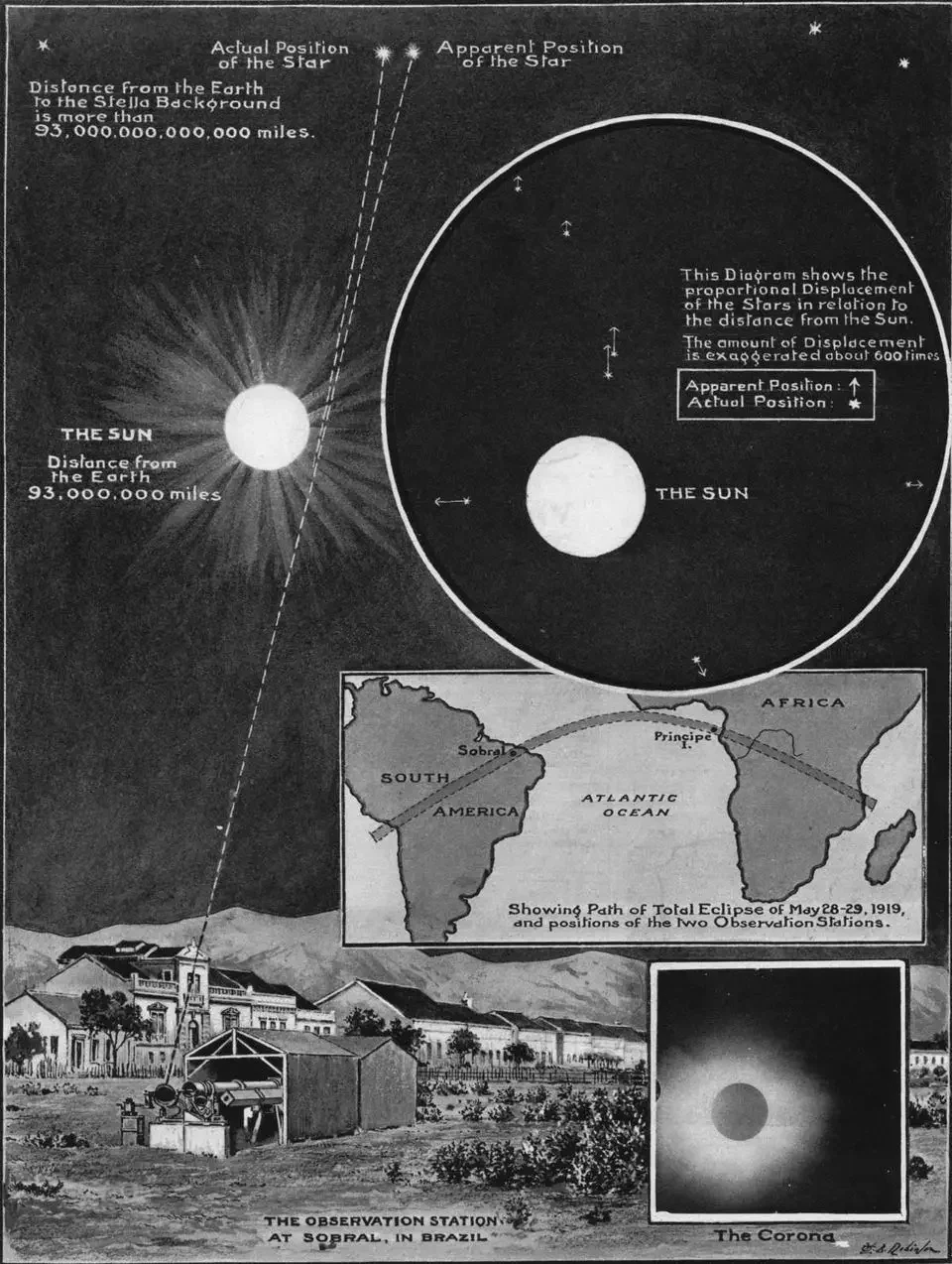
The Universe was only extremely poorly understood back in 1922. So much of what we understand about the Universe today was completely unknown. We were only in the infancy of making sense of our quantum reality, and general relativity was brand new, having only been released into the world in 1915 and observationally confirmed, by the gravitational deflection of starlight during a total solar eclipse, in 1919. We didn’t yet know whether the spiral and elliptical nebulae seen in the skies were galaxies outside of the Milky Way, or whether they were merely objects within our own galaxy. And so much of what we take for granted today:
- the expanding Universe,
- the Big Bang,
- dark matter,
- dark energy,
- and cosmic inflation,
wasn’t known of at all back in 1922.
But that’s okay, because the general theory of relativity, on its own, provides an enormous amount of fertile ground for exploration. The notion that the presence and distribution of matter-and-energy causes spacetime to curve and evolve, and then that curved, evolving spacetime tells matter-and-energy how to move, is incredibly powerful all on its own. Simply by starting with a set of initial conditions — where you have spacetime with zero or more masses and/or forms of energy in it — Einstein’s equations are then fully deterministic, and tell you how your spacetime, plus everything in it, will evolve as far into the future as you care to extrapolate.
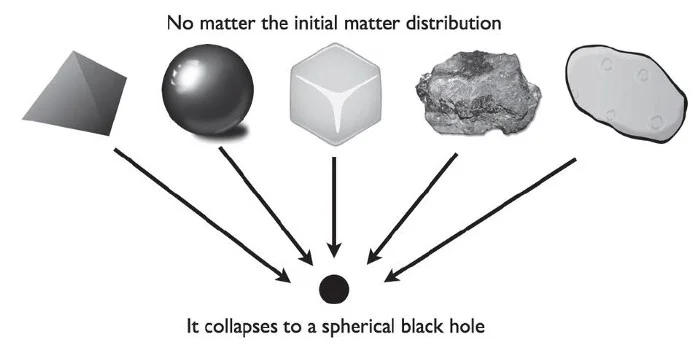
For example, as you can see above, if you start with any distribution of pressureless, stationary, massive dust in an initially static universe, the laws of Einstein’s theory of gravity will swiftly collapse that mass down to a non-rotating black hole: a Schwarzschild black hole. Einstein put forth general relativity into the world in November of 1915, and by January of 1916, Karl Schwarzschild had come up with this solution, the first exact, nontrivial solution within the context of general relativity.
Others would soon follow. Later in 1916, Hans Reissner obtained the exact solution for a black hole with both a mass and a charge: the Reissner-Nordström solution. By 1917, Willem de Sitter had introduced the exact solution for a spacetime with no matter, but energy everywhere set by a cosmological constant. In 1918, Josef Lense and Hans Thirring derived how spinning objects precess as a consequence of general relativity: the Lense-Thirring effect. In 1921, Theodr Kaluza extended Einstein’s general relativity into the fifth dimension, unifying classical gravity with classical electromagnetism, albeit with extra ingredients that weren’t found in nature.
But a truly enormous revolution would occur in 1922: when Alexander Friedmann, working in the USSR, derived the general solutions for a spacetime that was, at least initially, uniformly filled with an arbitrary amount of at least one form of energy: whether matter, radiation, a cosmological constant, or anything else.
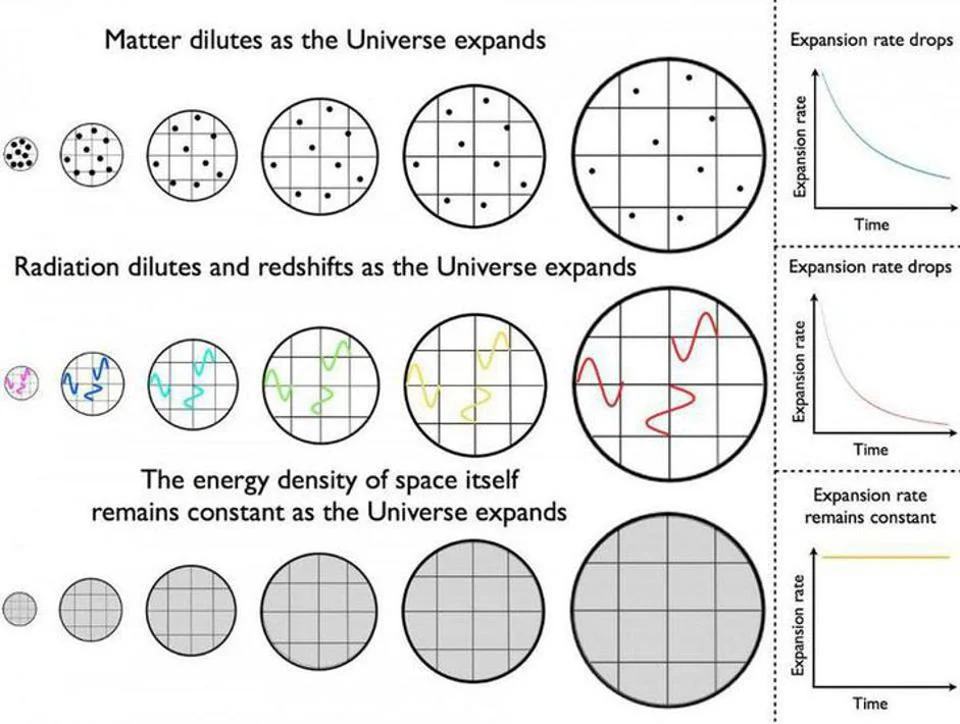
Friedmann’s exact solution led him to a series of equations that bear his name today: the Friedmann equations. These equations have often been called the most important equations in all of cosmology, as they pointed in a remarkable — and, at least to Einstein, an unexpected — direction. What Friedmann showed was that:
- no matter what form of energy your spacetime was filled with,
- no matter whether it was a single-species of mass/energy or multiple species together,
- no matter whether that mass/energy were stationary or in motion,
- no matter how much or how little of it there was,
- and no matter whether there was an intrinsic amount of spatial curvature (positive or negative) present as well,
that such a spacetime could not both be static and stable. Instead, as Friedmann’s work demonstrated, a universe that was uniformly filled with any form of energy at all was compelled to either expand or contract: the spacetime that underlied the universe itself would evolve.
Moreover, Friedmann showed there was a relationship between:
- the initial expansion rate (if there was an initial expansion),
- the overall matter-and-energy density of the universe,
- the spatial curvature/shape of the universe,
- how the universe’s expansion rate evolved over time,
- and what the ultimate fate of the universe would be (collapse, expand forever, or live in the “critical” case right on the border between the two),
that offered no wiggle-room at all. Simply by the virtue of being an isotropic and homogeneous universe, uniformly filled with some form of energy, there were no freedoms remaining.
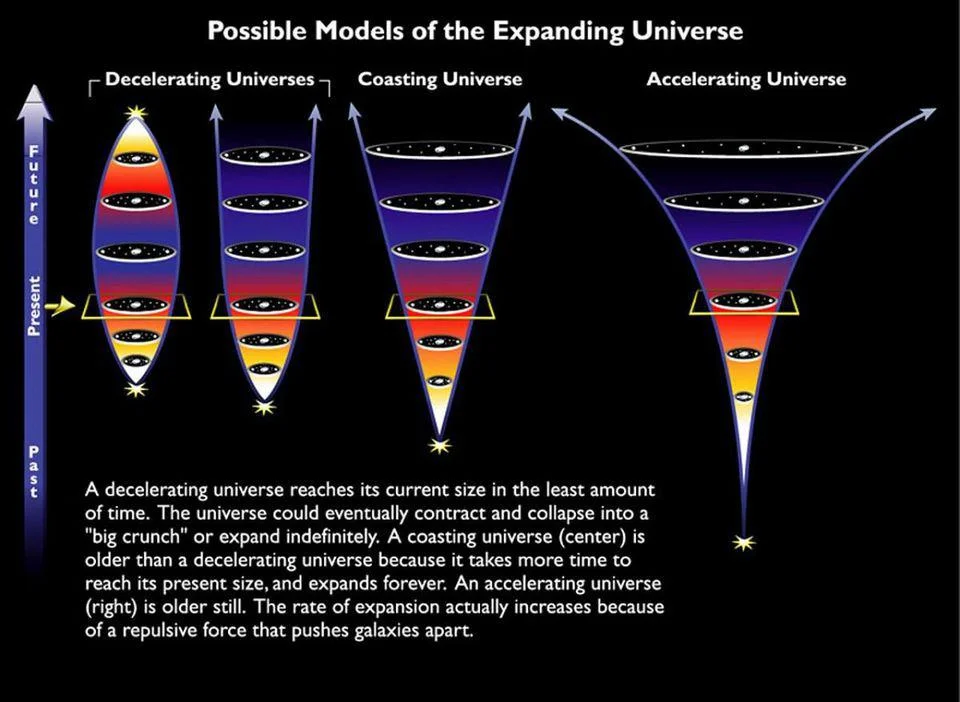
If you lived in such a universe that was indeed uniformly filled with one or more species of energy, were able to measure the expansion rate at any one moment, including the present one, and figured out what the various species of energy were that populated the universe and in what ratios, you’d be able to calculate the size, curvature, and expansion rate of the observable universe at any moment in cosmic history: past or present. It was an incredibly powerful, and yet an incredibly straightforward result. In fact, Friedmann’s equations and solutions persist today, entirely unchanged, as absolutely foundational to all of modern cosmology.
Although Friedmann died soon after publishing these equations — with typhoid fever claiming his life in 1925 — his scientific legacy would continue. In 1927, Georges Lemaître applied Friedmann’s work to the extragalactic distance work of Edwin Hubble along with the redshift data of Vesto Slipher, and was the first to reach the conclusion that our Universe was expanding. One of Friedmann’s former students, George Gamow, would go on to extend Friedmann’s work to found the theory of the hot Big Bang. And the solution that describes the spacetime metric of an isotropic, homogeneous universe bears his name before all others: the Friedmann–Lemaître–Robertson–Walker (FLRW) metric.
It’s those equations, the Friedmann equations, that allow us to determine the size of the observable Universe at any moment in cosmic history simply by observing things that we can actually measure today. In fact, you don’t even need all of the Friedmann equations to do it: just the first one is enough. Although it’s easy enough to write the equation down,
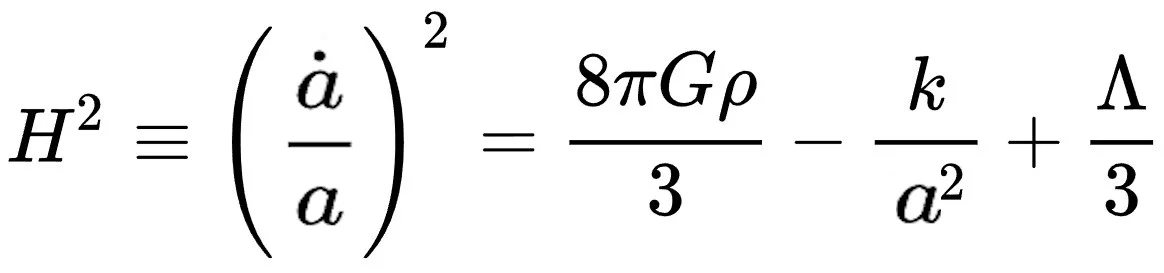
it’s worth stating what the terms of these equations actually mean in plain English.
- The first term, H², on the left-hand side, is the Hubble constant squared, or the expansion rate of the Universe, that you can measure at any moment in cosmic history, including today.
- The definition of the Hubble constant, H, is that it’s the derivative of the scale factor (ȧ) divided by the scale factor itself (a), so that the way it appears in the Friedmann equations, as H², is equal to (ȧ/a)². The scale factor, a, simply represents the distance between any two points in space, but it’s most useful if we take it to represent the distance from us, the observer, to the edge of the cosmic horizon.
- The first term on the right-hand side, 8πGρ/3, is just a bunch of constants (the 8πG/3 part) multiplied by ρ, which is the total energy density of the Universe — including all forms of matter, antimatter, dark matter, and radiation — at any particular moment in cosmic history.
- The second term on the right-hand side, –k/a², is the spatial curvature of the fabric of the Universe (where k < 0 is negative curvature, k > 0 is positive curvature, and k = 0 is a flat, uncurved universe), with a still being the scale factor.
- And the final term on the right-hand side, Λ/3, is just a constant (1/3) multiplied by Λ, which is Einstein’s cosmological constant. You can either keep Λ as is in the equation, and assume it is a constant, or you can allow it to evolve, as many of the flavors of dark energy do, and fold it into the first term as another form of energy density: ρΛ.
Then, to know what our observable Universe is doing, you simply have to go out and measure the expansion rate, the expansion history, and determine what the different forms and fractions of energy are in our Universe today.
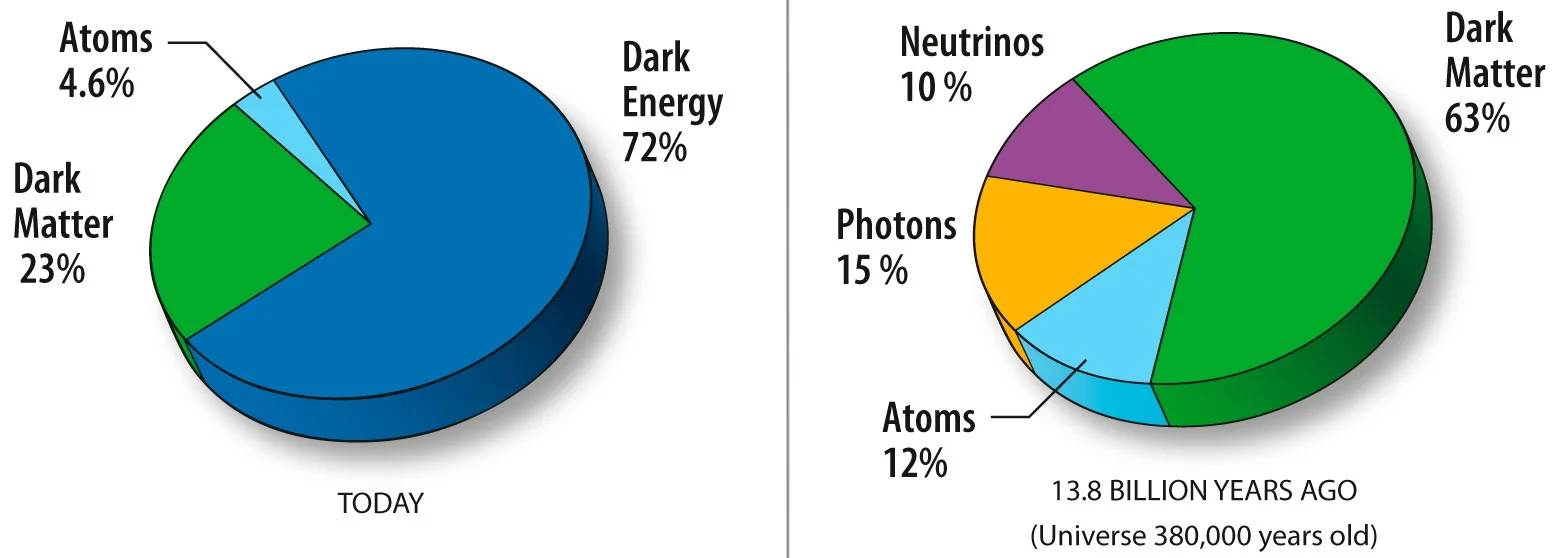
Of course, this is one of the great achievements of modern cosmology! Starting in the 1920s, we had the distance and redshift data to conclude that the Universe was expanding, which was first put together by Georges Lemaître. Starting in the 1940s, scientists — initially led by George Gamow, a former student of Alexander Friedmann — made predictions about the observable consequences that would arise from an early, hot, dense, rapidly expanding, rapidly cooling, and initially uniform state:
- An early period of nucleosynthesis, creating elements and isotopes other than hydrogen,
- A period where stable, neutral atoms formed for the first time, leading to a low-energy bath of leftover radiation,
- And the gradual appearance, evolution, growth, and mergers of stars, star clusters, galaxies, galaxy groups, and galaxy clusters.
In the 1960s, overwhelming evidence supporting the Big Bang came in with the observational discovery of that low-energy bath of leftover radiation directly: the cosmic microwave background. In the 1970s, strong evidence for dark matter emerged, and in the 1990s, dark energy joined it.
Today, we’ve built up a comprehensive picture of what makes up our Universe, how fast it’s expanding today, and how that expansion rate has changed throughout cosmic history. While there are still uncertainties over exactly how much of the Universe is dark matter vs. dark energy, and whether the expansion rate today is closer to 67 km/s/Mpc or 73 km/s/Mpc, those uncertainties are correlated, and all lead to identical pictures for our Universe’s size and age.

Credit: Planck Collaboration; Annotations: E. Siegel
Today, 13.8 billion years have elapsed since the earliest stages of the hot Big Bang. That can correspond to a Universe that’s:
- expanding at 67 km/s/Mpc,
- made of 32% (normal and dark) matter and 68% dark energy,
- that’s now 46 billion light-years in radius,
or it could correspond to a Universe that’s:
- expanding at 73 km/s/Mpc,
- made of 24% (normal and dark) matter and 76% dark energy,
- that’s now 47 billion light-years in radius.
The differences between these two scenarios are small, corresponding only to the tiny relative differences in the current speed of expansion and the ratios of matter (overall) to dark energy.
However, what the Friedmann equation tells us about this cosmic evolution is not just important, but universal to all scenarios.
- That, at cosmically late times, the matter and radiation densities will have dropped precipitously, leaving only any “constant” energy species, like dark energy or a cosmological constant, to dominate the expansion.
- That, at earlier times, the matter density would have been greater, because the matter density only decreases as the volume of the Universe expands. (Since the number of matter particles remains constant, and the volume of the Universe increases as a factor of the scale factor cubed: a³.)
- But that at the earliest times of all, the radiation density (like neutrinos and photons) was greatest, as the radiation density falls off even faster than matter does: as a factor of the scale factor to the fourth power: a⁴. This is because the number of radiation particles remains constant, but radiation’s energy is a function of its wavelength, and that stretches with the scale factor as well.
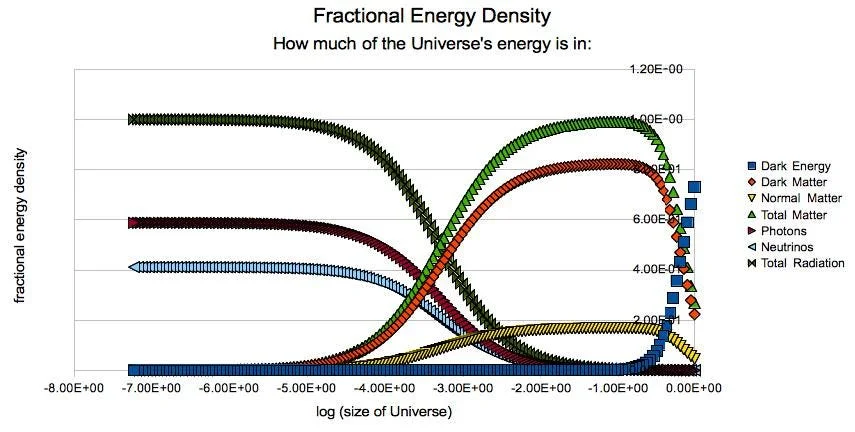
Dark matter has been largely important for extremely long cosmic times, and we can see its signatures in even the Universe’s earliest signals. Meanwhile, radiation was dominant for the first ~10,000 years of the Universe after the Big Bang. Note that in the future, when dark energy reaches a number near 100%, the energy density of the Universe (and, therefore, the expansion rate) will remain constant arbitrarily far ahead in time.
As a result, we can extrapolate back in time, and see which properties of the Universe — radiation, matter, or dark energy — dominate the cosmic expansion at each epoch. By using the Friedmann equation properly, we can even include all of the different components together, and calculate the Universe’s size at any epoch we care about. We can do this not only for our own actual Universe, with the measured parameters that describe our cosmos, but for any example universe we care to theorize about. For example, for a 13.8 billion year old universe:
- If our Universe were made out of 100% radiation, the distance to the cosmic horizon (in light-years) would be exactly twice the age of the universe (in years): 27.6 billion light-years.
- If our Universe were made out of 100% matter, the distance to the cosmic horizon would be exactly three times the age of the universe: 41.4 billion light-years.
- And if our Universe were made out of 100% dark energy, the distance to the cosmic horizon would be an exponential function: eHt, where H is the expansion rate and t is the age of the Universe.
Our actual Universe started out radiation-dominated for the first 9000 years or so, was matter-dominated for most of its history, until 7.8 billion years elapsed, and recently has been dark energy dominated, which is why our cosmic horizon is a bit more than 41.4 billion light-years away: more like 46 billion light-years away.
However, we can also use what we know today and rewind the clock backward, and ask, “when our Universe was a certain age, how distant was our cosmic horizon, also known as the edge of the observable Universe?”
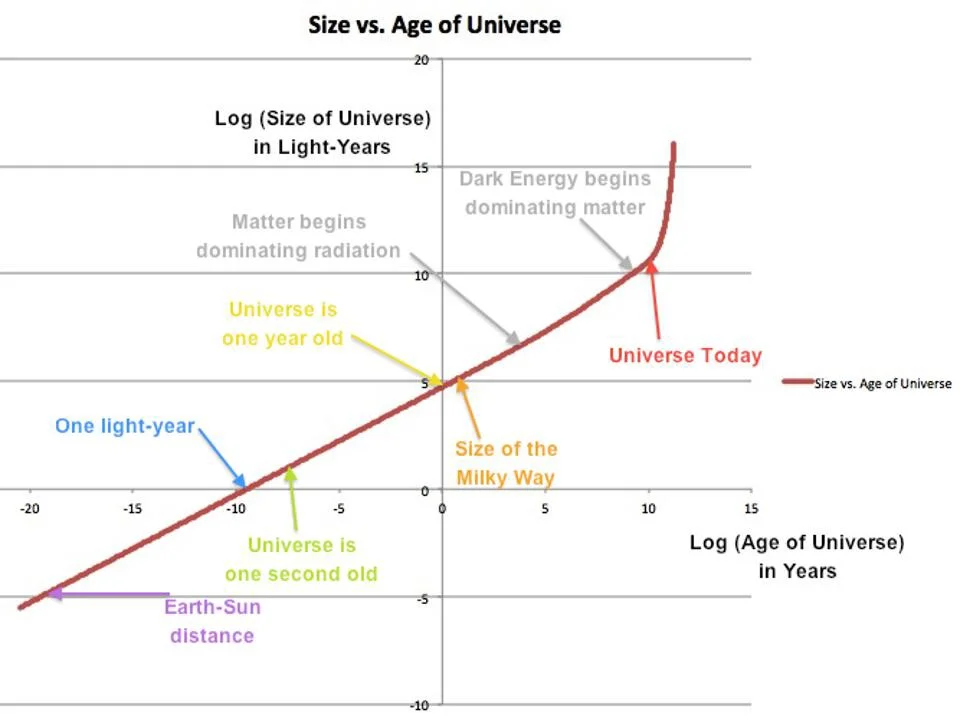
Again, it’s the Friedmann equations (which you must integrate numerically for the constituents of our actual Universe; there is no pure analytic solution) that give us the answer. Sure, it involves integrating a differential equation — a type of advanced calculus that math and physics majors learn as undergraduates, and then study more intensely, with worked examples, at the graduate level — but this is a task we’re up to. When we do, we find some fascinating milestones.
- 543 million years after the Big Bang, the observable Universe was 10% of its current size (4.6 billion light-years), and one-thousandth of its current volume.
- 17 million years after the Big Bang, the observable Universe was 1% of its current size (460 million light-years), and one-millionth of its current volume.
- 429,000 years after the Big Bang, the observable Universe was 0.1% of its current size (46 million light-years), and one-billionth of its current volume.
- 9 months after the Big Bang, the observable Universe was one-millionth of its current size (46,000 light-years) and one-quintillionth (one-part-in-1018) its current volume.
- 25 seconds after the Big Bang, the observable Universe was one-billionth of its current size (46 light-years) and one-part-in-1027 of its current volume.
- 1 second after the Big Bang, it was 9 light-years to the cosmic horizon,
- 13 milliseconds after the Big Bang, it was 1 light-year to the cosmic horizon,
- 3.25 picoseconds after the Big Bang, it was 1 astronomical unit (the Earth-Sun distance) to the cosmic horizon,
- and 1.45 × 10⁻²⁸ seconds after the Big Bang, it was only 1 km to the cosmic horizon.
Once you reach the radiation dominated era (prior to about 9000 years of cosmic age), for every factor of 100 (or 1/100th) you go back in time, you go back another factor of 10 (or 1/10th) in distance: an easy rule-of-thumb for the early Universe.
If you know the laws that govern the expanding Universe, as well as what the Universe is made out of and how fast it’s expanding at any one instant in history — including today — you can know what its observable size, age, redshift, cosmic volume, and a whole host of other properties were at any time: past, present, or future. The big advance that got us there, the Friedmann equations, have been with us since 1922. More than a century after Friedmann’s death, they still provide the foundation for how we know how big the Universe is, was, or will be at any moment in time.
Send in your Ask Ethan questions to startswithabang at gmail dot com!
This article Ask Ethan: What sets the size of the observable Universe? is featured on Big Think.