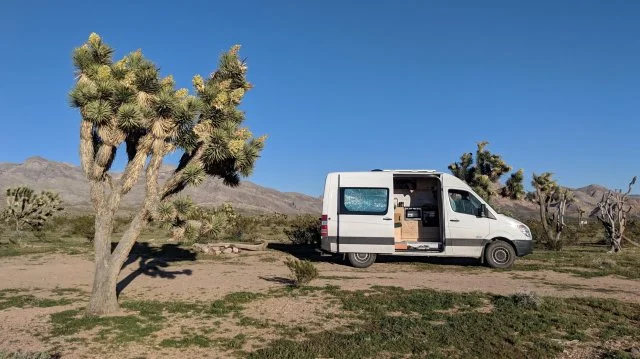
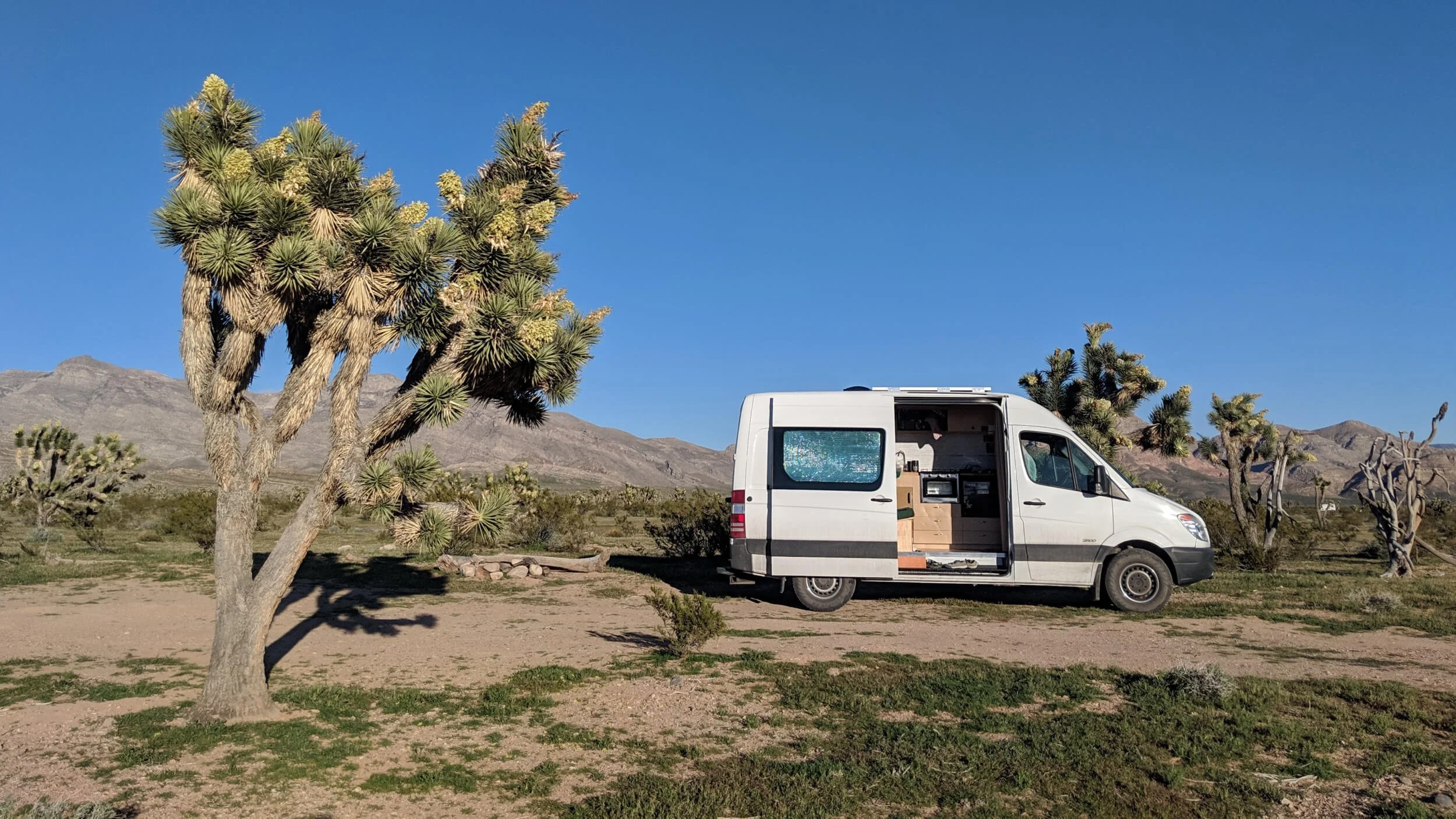
I woke up at 7 a.m. to a swift, hard knock on my door. Whap. Whap. Whap. I’d been living in my converted Sprinter van for nearly six years, and I knew that a knock usually meant someone — a cop, a ranger, a homeowner — wanted me gone.
I lay still for a moment, coming down from the immediate jolt of adrenaline. Where was I? Right: outside of St. George, Utah, on public land, surrounded by other vans, RVs, and trailers. I had played by the rules and bought an annual permit. I was allowed to be here.
I climbed out of bed and pulled back my curtain. The desert was quiet, the pale, early-morning light settling over a landscape that some days I viewed as vast and others as barren.
A man and a woman stood outside, clipboards in hand. I slid the door open. The woman waved curtly and smiled. “Hello! We’re here surveying the local homeless population…”
Homeless population? What? I blinked a few times, still waking up. My home was on display behind me: my kitchen, aka my living room, aka my office. My small, narrow bed was to my right.
“The homeless like to sleep in,” I said, immediately regretting it.
I watched him search his brain for answers: What wrong turn did someone with a PhD take to end up here?
I took a deep breath and explained that I chose to live in this (very comfortable) van, worked remotely, and was here to rock climb. Mostly, I didn’t feel comfortable representing people who were actually homeless.
As I spoke, the man glanced over my shoulder. I followed his gaze to my diploma. I had mounted it one night, amused by the idea of a van with a framed degree.
I watched him search his brain for answers: What wrong turn did someone with a PhD take to end up here? I urgently wanted to justify my presence and began to speak more quickly, each sentence less coherent than the last. The man crossed his arms and shook his head slightly, the way people do when they’re witnessing something tragic.
I imagined him thinking: “Look at the state of America. She doesn’t even know she’s homeless.”
But I wasn’t homeless. I’m not homeless. I also don’t live at a fixed address. I have opted out of the traditional housing system — and all the good and bad that comes with it.
Climb, work, repeat
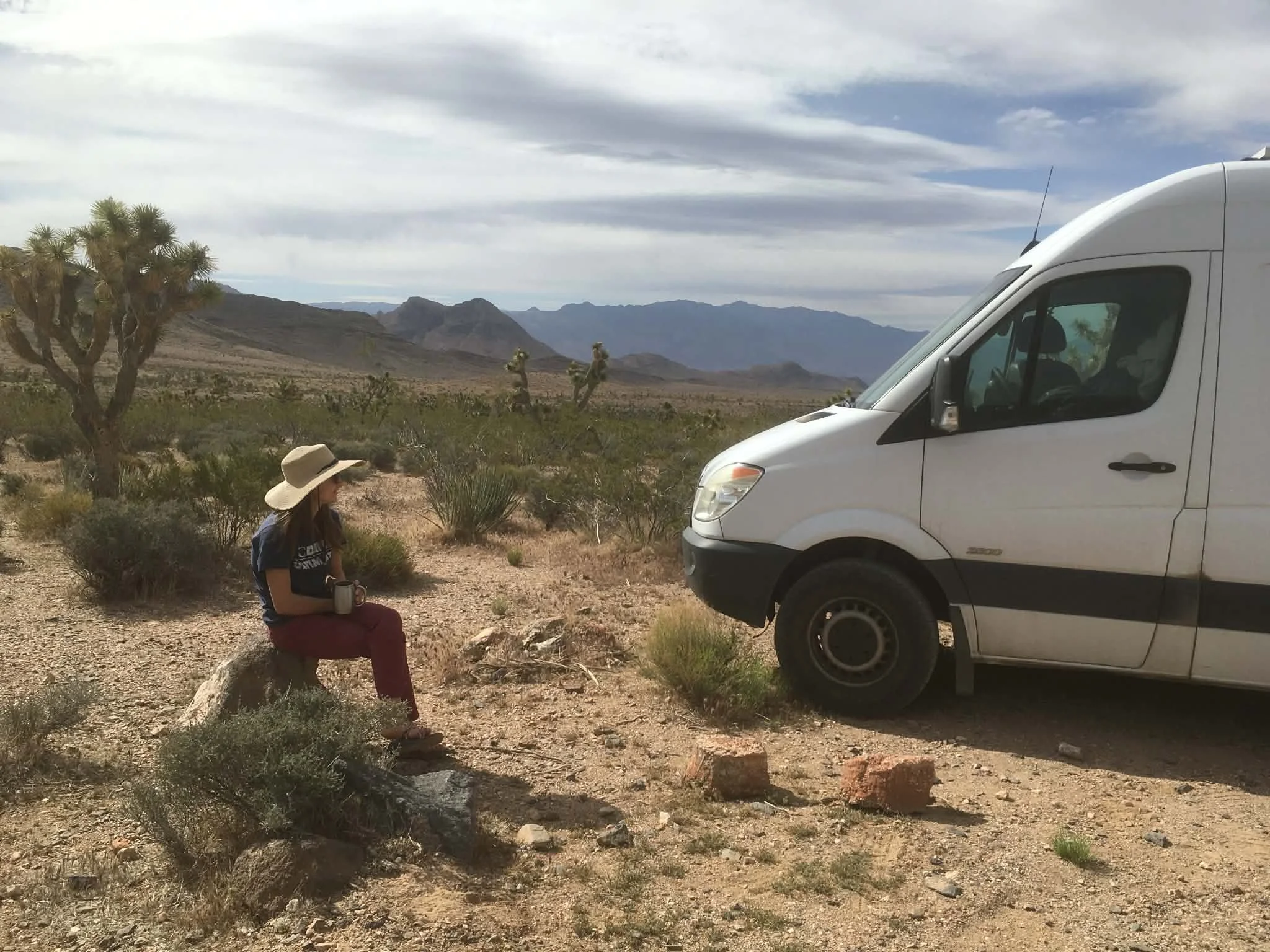
I moved into my van full-time in 2019, emboldened by the option to complete my PhD remotely and driven by an avid desire to rock climb. The van made that life possible. I could be close to climbing areas, while still having everything I needed to work, cook, and sleep. The van is big enough for me to stand upright — even extend my arms overhead — and move around comfortably.
Quickly, I slipped into a rhythm that clicked. Usually, I’d climb one day and work the next. Sometimes, I’d spend a day out climbing with friends and return to my parked van to work in the evening. Because my commute was practically nonexistent, I had the time and energy to do both.
For me, life is better on the road. There’s nothing like the equanimity of waking up, my home already situated in an enormous landscape or climbing area, and watching my friends spill out of their vans, cars, or tents, making coffee and laughing. In those moments, I feel I have arranged my life perfectly, like I’m exactly where I’m supposed to be.
The simplicity is also part of the appeal. Downsizing so everything I owned fit in my van was like paring away the unnecessary to get to the marrow. It made life leaner, and the space took on a quality that was uniquely mine.
The predictable trade-offs
But even in the best of times, there are predictable downsides to living in an 80-square-foot box, especially when you don’t have a van with all the bells and whistles.
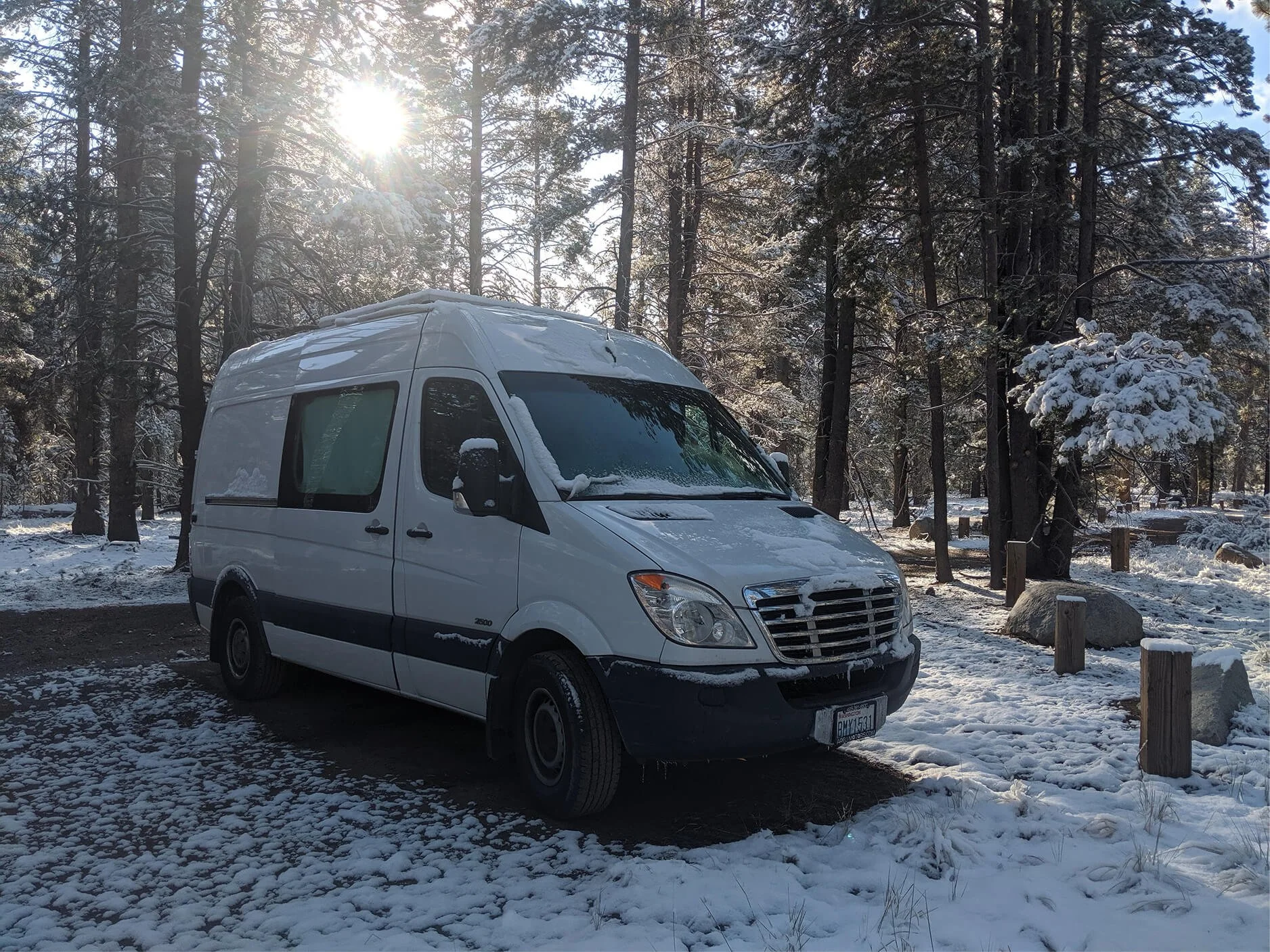
Basic tasks consume surprising amounts of time: doing laundry, finding a shower and water, trying to fit a week’s groceries into a tiny fridge. When you travel somewhere new, you live under a low-level logistical pressure: Where can I park? Will I have cell service? Is someone going to bother me? And things break. Before, I didn’t know how to use a drill. Now I can take apart a diesel heater and service it in an hour or two — a skill learned after a string of cold nights.
Those setbacks are frustrating, but they also force you to develop competence, and you gain confidence that you can solve the next problem.
When the van has a serious mechanical issue, you suddenly are homeless. One friend slept on a cot in a basement for two months while a mechanic tried to diagnose his van’s mystery problem. The “freedom of the road” hits differently when you’re suddenly dependent on other people for shelter or when the “van life is cheap” argument collapses under the weight of repair bills and temporary housing.
Relatively early on in my time on the road, I ran up against another problem: In the U.S., most administrative systems assume you live and operate within a single state.
Except for emergencies, my health insurance only applies in the state where I’m a resident. I’ve considered changing residency to areas I frequent more often, like Colorado or Nevada, but I’d run into the same problem: I need an address, and once I have one, I’m tied to that state’s system and access. Friends who live in vans in Europe don’t seem to encounter this problem. Within much of Europe, healthcare access isn’t as tightly bound to a single region, and distances between countries are shorter, which makes it easier to move around without disrupting basic services.
Still, none of these costs are particularly surprising; they’re the price you pay for flexibility, even if they sting more than you expected or drag on longer than you’d like.
The deeper trade-offs reveal themselves with time. Live on the road long enough, and you’ll eventually see how life beyond logistics — finding community, navigating relationships, feeling grounded — plays out differently when you don’t stay in one place.
The lonely road
Traditional housing comes with built-in communities: You see people, interact with them, and become part of a place. It sounds obvious, but being physically rooted somewhere matters if you want close, long-lasting connections.
Van life is different. I’d recommend it for people who enjoy alone time, because you’ll have plenty of it. But the isolation isn’t straightforward. In my experience, van life swings between periods of intense socializing and stretches of solitude.
By virtue of climbing, I often return to places where I’ll see the same faces. Areas like Rifle, Colorado, can be “adult summer camps,” with tight, energetic social scenes. The climbing lifestyle takes all the elements you need to spark a relationship, like continual contact and shared experience, then douses them with gasoline.
As I grew older, I began to wonder what all the movement was building toward.
Still, those communities are seasonal. No matter how strongly you connect with someone, there’s an ephemerality to the relationship because you will leave, and so will everyone else. You might cross paths again, but the continuity that builds deeper relationships is harder to maintain.

For many years, I traveled with a partner who had his own van. Our “double van life” worked well; we each had our own space, but we weren’t alone. After we split, the loneliness became harder to manage. And as I grew older — I was 28 when I moved into the van and am 35 now — I began to wonder what all the movement was building toward.
Not every place comes with a built-in scene, either. I’ve spent long stretches alone, still climbing, but parked outside small towns, close to the people living there but still on the outskirts. Those periods have been deeply rewarding, and I’ve often relished the solitude. But there were also times I questioned whether I chose to be alone or simply drifted into it.
Life as a “fugitive”
For every day that I woke up feeling like I was in the “right” place, there was another where I woke up on a random street, scrambling to leave because I feared the dreaded whap, whap, whap. Even when I was following the rules, I’d get the sense that I was breaking them — after all, many associate big white vans with people up to no good.
One night, a cop didn’t just knock — he banged. With his siren wailing outside, he made me sit on the floor of my van while he ran my ID. I was on public land, but it turned out to be a “special restriction” area that wasn’t clearly marked. The real problem, he told me, was that a nearby homeowner had seen me driving in from their street and didn’t like it.
Another time, I arrived late to a friend’s neighborhood, parking in front of her house around midnight, only to be startled awake at five in the morning by neighbors letting me know I wasn’t welcome by — you guessed it — banging on my door.
Even when I was following the rules, I’d get the sense that I was breaking them.
These situations are rare, but still alarming. It doesn’t take much to internalize the idea that your presence is contingent on someone else’s tolerance. In some sense, I get how long-term residents may perceive a van-lifer as someone who is using their space without contributing much back. But the line is blurry. I pay my taxes, follow the rules, and contribute to local economies. And many of the places I’m drawn to are public and, in theory, part of a long-standing American ideal of open land and freedom of movement.
I’m particularly sensitive to feeling like I’m a “fugitive” and under constant, low-level scrutiny. I’m now more likely to stick to places where I know the rules and where it’s less likely someone will bother me. Avoiding the hassle has made me less inclined to explore, which contradicts the very lifestyle the van is supposed to make possible.
Opting out of van life (for a bit)
A few weeks after the knock in St. George, I drove two hours south and rented a friend’s place in Las Vegas. I had already spent a few months alone, and though my climbing life was active, I began to dread another night in solitude. Las Vegas might seem like an odd choice, but it has an active climbing scene, I had a few local friends, and I was lucky enough to have access to cheap housing.
I expected to enjoy the obvious amenities of a house, like access to a shower and a bigger fridge. But the little conveniences were delightfully surprising: I forgot how handy closets and hangers are, and I was disproportionately excited that I could put my trash in a bin outside and someone would take care of it.
Las Vegas doesn’t suit me — it’s like living in a strip mall — but thanks to a welcoming community, I found my way into the climbing scene. By the end of my time there, what I valued most wasn’t related to amenities at all. It was something so simple I had forgotten it could feel like a luxury: the ability to spontaneously call a friend who lives five minutes away and invite them over.
If I have any advice for someone considering van life, it’s this: Have something real at the center of it.
I didn’t abandon the van; I parked it nearby and used it for short trips. The first time I returned to it for one of those trips, I sat on the floor and cried, caught off guard by how much it felt like home, how much I missed it, and how unprepared — and unwilling — I was to let that part of my life go.

For now, I’m straddling both worlds. Still, when I see Instagram posts about #vanlife that feature perfect bivvy spots, a beautiful build, and talk of “calming the nervous system,” I have the urge to sit people down and describe all the shitty places I’ve parked, the nights my nervous system was in full alarm mode, the days that slipped by without talking to another person, the times my van’s roof leaked or something critical — electricity, heater, water pump — failed.
If I have any advice for someone considering van life, it’s this: Have something real at the center of it. I moved into a van because it was the best way to climb and work full-time. It wasn’t about opting out so much as opting into something that fit what I wanted from life. The van, the trailer, whatever you choose should be a means to an end — not the end itself.
This article Van life looks like freedom. It can feel like exile. is featured on Big Think.