Bolivian President Rodrigo Paz warns country at 'breaking point' after weeks of protests
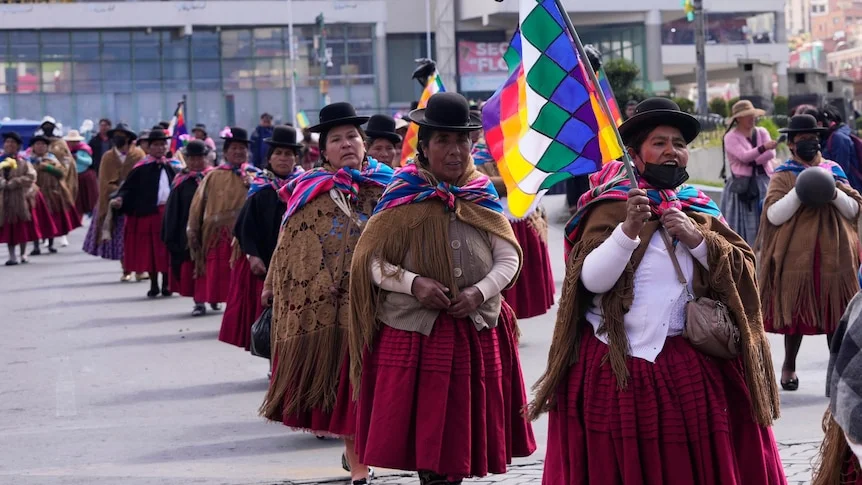
Indigenous Bolivians have marched in protest of the government in La Paz. (AP: Juan Karita)
Bolivia is on the brink. President Rodrigo Paz has stated that the country is nearing a "breaking point," underscoring a dire situation after weeks of intense protests that have resulted in significant shortages of essential goods like food, fuel, and life-saving medications.
The heart of this turmoil is La Paz, where working-class citizens and members of the Indigenous population are demanding the president’s resignation, expressing their growing discontent over his administration's path.
Just a few months prior, Paz's ascension to power was marked by optimism. After enduring Bolivia's most severe economic downturn in decades and a long stretch of socialist governance, he was seen as a potential harbinger of change.
This brief period of hope has quickly deteriorated into chaos, marked by violent protests and blockades that have left cities paralyzed and critical resources running out, bringing mounting pressure on an administration that was once buoyed by renewed international relations.
Demonstrators have resorted to using dynamite during clashes and erecting blockades, halting the flow of supplies and amplifying public frustration. Those who supported Paz's campaign, particularly Indigenous and rural communities, feel betrayed as policies intended to transform the status quo have seemingly forgotten their promises.
Amid escalating unrest, Congress has cleared the way for a potential state of emergency, allowing President Paz to call in military support to restore calm.
The president's public address from La Paz conveyed his sense of urgency: "The country needs order, and is reaching a breaking point," he asserted, while urging for dialogue with opposing factions. Yet, he is keenly aware that failure to engage or respond appropriately could lead to irreversible consequences.
Paz grimly acknowledged the crisis, stating, "We have deaths because of the blockades. Someone has to answer for that," pointing to the dire human cost of ongoing disruptions.
"We have deaths because of the blockades. Someone has to answer for that."
Former supporters feel sidelined
Discontent is surfacing among former allies of Paz, particularly those from the now-dominant Movement Toward Socialism party (MAS). They are increasingly vocal about feeling neglected by a government they once supported.
Shortly after taking power, Paz aligned himself with right-wing congressional factions, alienating his broader base, including the vice president whose popularity had significantly contributed to his electoral success.
No representatives from the Indigenous majority have been appointed to senior government roles, and policies like the controversial land reform bill aimed at agribusiness have raised alarms among small-scale farmers worried about losing their land.
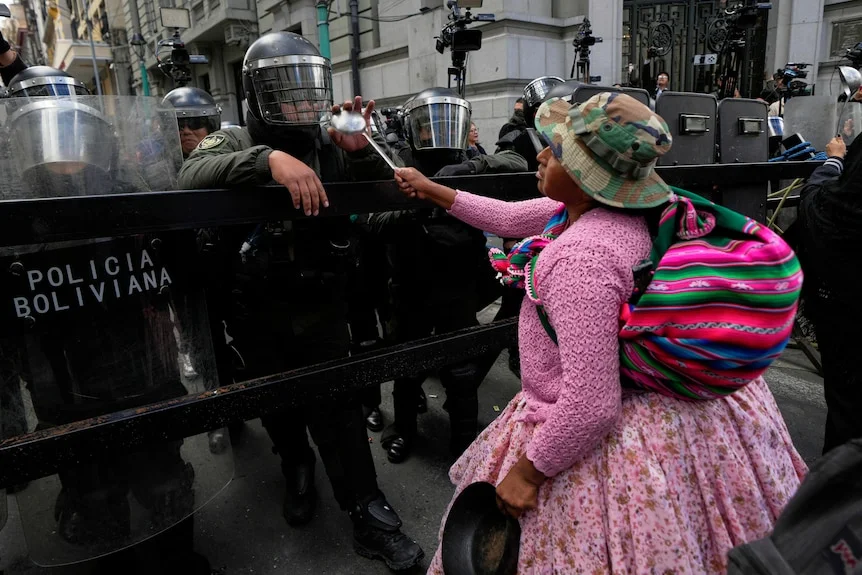
A demonstrator near the government palace during an anti-government protest in La Paz, Bolivia. (AP: Juan Karita)
Paz's administration eliminated fuel subsidies, resulting in a staggering rise of nearly 90% in fuel prices, exacerbating the public's dissatisfaction as vehicles encountered issues related to contaminated gasoline.
To address economic challenges, he initiated cash transfers to help struggling families and a 20% increase to the minimum wage. However, the refusal to satisfy further demands for increases prompted outrage from labor unions.
"It's not that from one day to the next he was asked to resign," said Mirian Huarina, a protest leader. "He had time to provide a solution to these problems and to the demands of different social sectors."
High-stakes blockades as a political weapon
The geography of La Paz gives the current protests a unique potency, as blockades have the ability to cutoff access to more than 1.6 million residents in the city and its vicinity — a staggering 13% of Bolivia's total population.
Historically, Indigenous factions have harnessed blockade tactics as an effective means of protest, a strategy rooted in their past revolts against Spanish colonization.
Similar actions in 2003 and 2005 successfully removed pro-Western governments over approaches to Bolivia's natural gas resources, leading to the rise of Evo Morales, the former president and founder of MAS.
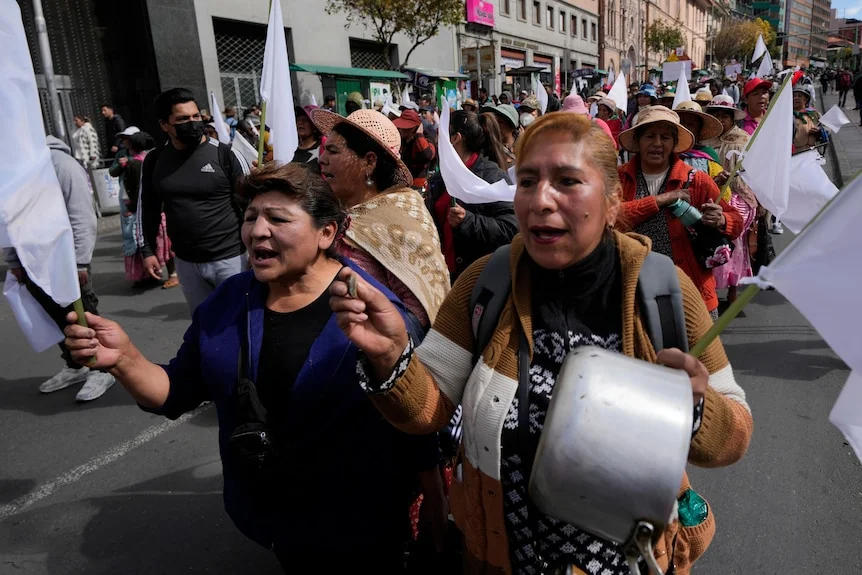
Shop vendors bang on pots during a march against protesters blocking access to the city. (AP: Juan Karita)
After nearly a month of road blockades, vital supply lines have become critically compromised. Trucks carrying food and medical supplies are stuck on highways, contributing to dire shortages of essentials like beef and eggs, with some items completely disappearing from store shelves. The government even resorts to military aircraft to deliver food aid into La Paz.
Reports indicate that hospitals are struggling to function as supplies dwindle, with a tragic toll emerging: at least four fatalities blamed on the current unrest due to lack of medical care.
Growing unrest amongst shopkeepers and transport workers highlights the urgent need for a solution. Participants in their marches echo a unified chorus: "We want solutions! We can't take it anymore!"
Growing calls for government action
Despite security forces employing tear gas and making over 120 arrests, President Paz is hesitant to escalate the situation further by resorting to a stronger crackdown. He’s aware that any violent suppression could inflame the volatile atmosphere and exacerbate the crisis.
To that end, he has pursued dialogue, convened meetings with select social groups, and offered improvements to educators while also reorganizing his cabinet to reflect Indigenous representation.
Calls for a state of emergency are becoming louder. Recently, Congress approved measures that would allow the military to restore order, which puts the ball in Paz's court to act. He has described deployment as a last resort, but the pressure is mounting.
Morales lurks in the background
Evo Morales, the former president who served as Bolivia's first Indigenous leader, has been observing the present crisis from the sidelines, calling for early elections as he critiques the current administration.
In a recent statement, he asserted that Paz must choose between "militarisation or an election in the next 90 days," reflecting the high-stakes nature of the political environment.
Currently hiding in the Chapare region to avoid a human trafficking arrest warrant, Morales's claims of political persecution resonate with some of his former supporters, even as dissent against Paz's governance rises.
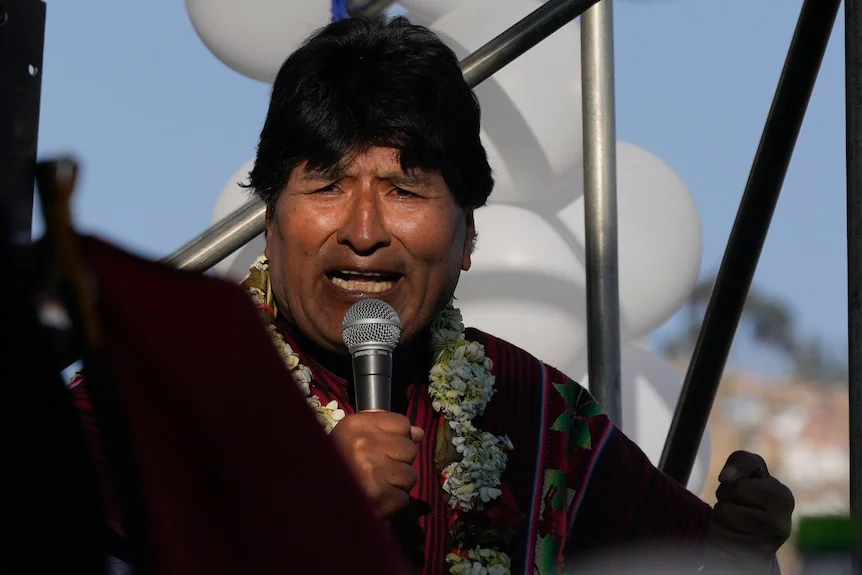
Evo Morales speaks to supporters after marching to La Paz, Bolivia in 2024. (AP: Juan Karita)
While many groups opposing Paz have their roots in alliances forged during Morales's time, the current climate is distinct; mass mobilizations have brought together a diverse array of interests pushing back against the present administration. Morales's camp has been accused of financially backing protests, a charge he has vehemently denied.
International reactions underscore deep divisions
Latin American leaders aligned with the Trump administration have rallied to Paz's side, condemning the protests as threats to regional stability. In stark contrast, President Gustavo Petro of Colombia has characterized the unrest as a "struggle for Latin American dignity," a viewpoint that has put him at odds with other regional leaders.
Meanwhile, the United States has taken a firm stance, labeling the protests as an attempted coup against a democratically elected government.
"We will not allow criminals and drug traffickers to overthrow democratically elected leaders in our hemisphere," declared U.S. Secretary of State Marco Rubio, reinforcing America’s commitment to Paz's administration.
As tensions mount, the U.S. Embassy in La Paz announced temporary closures amid rising unrest.
AP/ AFP