This content is locked. Please login or become a member.
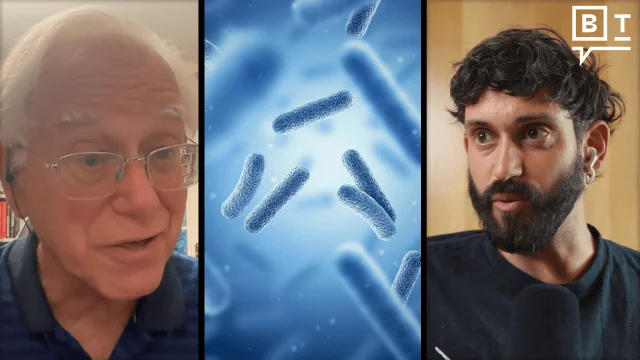
There's a mass extinction happening inside your body. Dr. Martin Blaser is a physician and microbiologist who has spent over 30 years studying the microbes that live on and in us. He's also the author of "Missing Microbes" and co-author of the 2025 paper "The Invisible Extinction."
Martin Blaser: Farmers feed antibiotics to their farm animals to fatten them up. At the moment I said that, I thought to myself, well, I wonder if that's what we're doing to our kids. Because of changes in human society and human medicine, we have been losing more and more of our ancestral microbes. And that loss has consequence. You can make a list of what are the diseases that have risen dramatically since World War II. If you change the microbiome during early life, there's the potential that there'll be some kinds of mismatches. It takes time for big ideas to take hold.
Marvin Liyanage: This is Curiosity Lab on Big Think. And today I'm talking to Dr. Martin Blaser. He's a professor who has been working for over 30 years to study small organisms that live on and in our bodies. And he's also the author of a book called Missing Microbes. Thanks for taking the time to talk about your research.
Marvin Liyanage: Most of us have heard that there's a mass extinction happening. We are losing plants and animals because of how humans are changing the planet. But most people don't know that there's another hidden mass extinction happening, and it's happening inside all of us.
Martin Blaser: I mean, that's the key point. Just to reiterate, we humans have been living with a certain group of microbes for our whole human history and prehistory and going back. into our ancestors millions of years, and they have been our partners. They keep us alive, and they keep us healthy. In recent years, it's been clear that we have been losing more and more of our ancestral microbes. And I can go into why this is happening, but I began to be interested in this because I began to think, maybe this is why we have all these new diseases that are appearing.
And I began to have that idea about 25 years ago. At that time, it was kind of a far-out idea. But now there's more and more evidence that it's correct.
Marvin Liyanage: When we're talking about losing these organisms, these microbes that live inside us, are we talking about... We're losing diversity of microbes. Are we talking about we're losing a few species of microbes in industrialized populations like the U.S.? Or are we talking about global extinction of microbes?
Martin Blaser: All of us have microbes living in us, but the composition has changed. It's like if you went to a zoo and it had a lot of different animals, and then over time, you know, there were fewer lions in the lion cage and there were fewer monkeys and fewer different species of birds. That's the kind of thing that's happening.
Marvin Liyanage: I read that when immigrants moved to the U.S. Within six to nine months, their native gut microbiome loses diversity. Is that true?
Martin Blaser: There have been some studies that have shown that. In part, it depends how old they are when they come here. See, when a baby is born, they have no microbes. They're starting at zero. And then they're rapidly acquiring microbes. And that combination of microbes is very plastic. It can change quite dramatically.
Marvin Liyanage: One of the stories that stood out to me was research into populations that are really separated from these industrialized countries, like in Tanzania, where their microbiome oftentimes is more diverse.
Martin Blaser: I was on the expedition that got the samples from Tanzania, so I'm very familiar with it. But I'll tell you about a study that my wife did. There's a part of Venezuela that is essentially the Amazon jungle in the southern part of Venezuela. And there's a tribe of people called the Yanomami. One day, an army helicopter in Venezuela was flying over a zone, and it spotted a village it never had seen before. So the helicopter went down, and they took samples from these people. It was the first time they had any contact with medical doctors or anybody.
And they found that the amount of diversity in their poop was double what we have. Either they gained organisms, or more likely, we've lost organisms. It implies that we have lost half of our diversity. And that was the first and most substantial study. But other studies have been filling in the gap. And it's pretty clear that with industrialization, we've lost a lot of our biodiversity. The cages in our zoo are having fewer and fewer animals.
Marvin Liyanage: I think the average person might know about the microbiome from probiotics and gut health and nutrition, or they might know about bacteria oftentimes as the bad things we're trying to wash off when we wash our hands. Why is it so bad that these microbes are disappearing?
Martin Blaser: In the beginning of my book, Missing Microbes, I quoted the great biologist Stephen Jay Gould, who said something like, we live in the age of bacteria as it was since the beginning of life and as it will be until the end of the world. We live on a bacterial planet. And so all of us, plants and animals, we have learned to live with bacteria. In some cases, we're fighting against them. In some cases, we're cooperating with them. In some cases, we're doing both. So we have very complex, deeply evolved relationships with bacteria. And so if we're losing diversity, the first thing to say is this is a new thing.
This didn't exist before. There's a big change in human biology. And by the way, it's happening to many animals, many domesticated animals as well. It's happening to our farmland as well. The microbiome of soil, the farmland has changed dramatically. So we're seeing big scale ecological change. So I guess point number one is it's happening on a really... big scale. The second question is that you have asked or will ask is, so what? Who cares? And in theory, it's important because we have evolved with these microbes since before we were humans. And so if they're not there the way they used to be, it implies that there's going to be some differences.
And unfortunately, the evidence is that there are health consequences to this.
Marvin Liyanage: I read that there's a sugar in breast milk that can't be digested by the baby. And it's entirely made for the microbes in the baby's gut. To me, that's such a clear sign of how important the relationship is that we have with microbes.
Martin Blaser: Yeah. Well, the first thing to say is it's not just one sugar. There are many sugars in our human breast milk that moms are feeding to their baby. And you would say, well, why would mom feed baby a sugar that the baby can't use at all? And as you say, the evidence is nature designed it so that it would feed the good microbes. You mentioned earlier, you know, we mostly think of microbes or bacteria as bad as germs. And there are some that are, but our body is full of microbes that have benefit for us.
The fact that we make sugars that... Exclusively feed bacteria. is kind of evidence for that. And it's not just us humans, it's every mammal. Every mammal has sugars that are there for the benefit of the developing microbiome of the next generation.
Marvin Liyanage: So we're seeing this big disruption in an evolutionary relationship that we've had for hundreds of thousands of years.
Marvin Liyanage: More than that. And at the very least, we should pause and go, what's going on here? How bad is this going to be? What is the effect going to be? You came up with this hypothesis called the disappearing microbiota hypothesis. Can you talk about that?
Martin Blaser: Well, we have been talking about it with this conversation. The idea is that because of changes in human society, in human medicine, for example, and sanitation, we are losing some of our ancient partners. And that loss has consequence, has health consequence. And that, as I said, is becoming more and more apparent.
Marvin Liyanage: Can you explain a little bit more about that connection? We're losing diversity. And then at the same time, we're seeing a rise in chronic diseases.
Martin Blaser: Yeah, I can. And it was a kind of eureka moment for me. It's about 25 years ago. I'm the chair of medicine at NYU. A young doctor came to me and he wanted some career advice about what he should study. And in fact, he was thinking about coming to the University of California in San Francisco.
And he said, you know, I'm interested in endocrinology, the system of hormones, etc.
But there are many researchers there in San Francisco who are working on obesity, and I don't find it that interesting. And I said to him, I said to him, well, you know, farmers feed antibiotics to their farm animals. As growth promotion to fatten them up so they'll get to market sooner. They'll be bigger and get to the market sooner. And at the moment I said that to him, I thought to myself, well, I wonder if that's what we're doing to our kids. And that's kind of where obesity is coming from. And I've been working on that ever since then.
And again, there's a growing body of evidence that that is correct.
Marvin Liyanage: Obesity was the starting point where you thought these two things might be related. We have a huge obesity epidemic in the United States, increasing rates of obesity.
Martin Blaser: Not just in the United States, it's global.
Obesity is happening all over the world. It started in the industrialized countries, but the non-industrialized countries are catching up. They're lagging about 30 years behind. But if you look at the statistics about overweight children, most of the overweight children in the world today are in developing countries. Because that's where most of the children are. Obesity is a much bigger problem in most developing countries than malnutrition. So this has happened over the last 30, 40 years. It's not an epidemic, it's a pandemic.
Marvin Liyanage: Are there other chronic diseases that you ended up connecting to the hypothesis later on?
Martin Blaser: Yes, and I will also tell you why. You know, you can make a list of what are the diseases that have risen dramatically since World War II. And that might include asthma, food allergies, eczema, or what's called atopic dermatitis.
Autism and other neurodevelopmental diseases. These are all the diseases that have become epidemic to varying degrees in different countries, roughly in the period since World War II, and in general, continuing to increase. So the question is, how is it possible that microbes could have something to do with all of these different ones? And I'll give you an answer. The first point to say is that the change in the, I don't think that the change in micro, that these epidemics are entirely due to the change in the microbes, but I think it's an important factor. In each of the ones that I mentioned.
Martin Blaser: And it's simple, and it goes back to something I mentioned to you before. And that is that when babies are born, they have no microbe, microbiome. And then they get most of their early microbes from their mom. It happens, it begins when they pass through the birth canal and the water breaks and they start entering the world of bacteria. They're covered with mom's vaginal microbiota. And they swallow it as they're coming out. And that's the foundation. And then that population develops in the formerly essentially sterile human body. Those microbes begin to fill up all the little microscopic niches in the intestine and the skin and the mouth.
And there's a normal choreography. If you look at the names of the microbes that develop over at one month and two months and six months, and you look at kids all over the world, it's essentially the same. This is part of human evolution. And so what we can say is that in the first months and couple of years of life, the human microbiome is evolving from its infant form to its adult form. And while it is developing, The baby is developing too. The baby is getting bigger. But the baby has three really important systems that they... They have to develop.
First, they have to develop their metabolism. They have to develop a way. Do they use energy or do they save energy? They have to develop their immunity.
Is something a friend or a foe. They have to develop their brain and their neurologic system. Again, in a simple sense, is somebody a friend or a foe? And how do we begin to think? So all of the key parts of human development are heavily weighted toward early life.
And if you change the microbiome during early life, there's the potential that there'll be some kinds of mismatches.
Marvin Liyanage: That leads me to a follow-up question I have, which I've been wondering about, which is how different are our microbiomes? Like if right now I got a test to see what my microbiome was like and you got your microbiome tested, how similar would they be?
Martin Blaser: Before I answer that question. I want to tell you that this whole field of microbiome is very much in the commercial zone, and people are trying to sell everything. Most of it is untested or the test results are equivocal. There are very few products out on the market that really do anything, but it is a multi-billion dollar industry. That's why I asked you whether you had sponsorship, because many of these programs are sponsored by people who have something to sell.
Marvin Liyanage: Or the people coming on them are sponsored, right? Because they have new trends. nutrition companies or whatever else. That's right.
Martin Blaser: A lot of people have nutrition companies. They're selling their products, their advice, et cetera. And so, as I learned at a young age, caveat emptor, let the buyer beware. So the question is, how similar are our microbiomes?
The answer is it depends. And it depends on, you know, when you're flying in an airplane and you're flying over, we'll just say Kansas, and you look down, all the land looks pretty similar. You know, it's all kind of. Wheat fields or just it all looks pretty similar. But then when you descend to like 20,000 feet, you start picking up more differences. And when you go down to 10,000 feet, you see more differences. And as you get closer and closer, you see the differences more and more. And that's the answer to your question. At a very broad level, we're quite similar.
All humans are similar. Basically, all primates are similar. But as you go down at a taxonomic level, you find that we differ more and more. It's just kind of like if you look at our body, if you look at our fingerprints, you know, most of us have 10 fingers, but our fingerprints are all different.
Marvin Liyanage: So give me an example of that difference in our bodies. So do we have... have, you know, do me and you maybe have a different proportion of a certain key microbe, but overall, the amount of fiber eating microbes we have is probably somewhat similar. What's the what does that difference look like?
Martin Blaser: Yeah, actually, your example is good.
And this has been very well studied. Again, if you look, so there are two considerations. One is called taxonomy. What are the names of the organisms we have? And the other question is function. What are these microbes doing? And if you look at your taxonomy and my taxonomy, we might find a lot of differences. But if we look at the function of what the microbes are doing, they're much more similar, much more similar. And even if we look at our function and the Yanomami, Out in the jungle, there's a lot of similarity, but there still are differences, and the differences are growing.
Marvin Liyanage: Do we know that there are other ways that the disruption of the microbiome is affecting potential chronic diseases in the future other than obesity?
Martin Blaser: Yes. So about 10 years ago, I was a visiting professor at the Mayo Clinic. We studied all the children born in all Olmsted County over about a 10-year period. In total, we studied about 14,000 children. We had all their medical records until they're about age 14. And basically, we asked two questions.
First question was, were they exposed to antibiotics in the first two years of life. And the second question was, after that period of exposure, the age of two, which kids developed some of these chronic diseases? And we studied 10 different conditions. We studied asthma, hay fever, eczema, which is atopic dermatitis, food allergy, celiac disease, overweight, obesity, autism, hyperactivity disorder, ADHD, and learning disabilities. Those were the 10 conditions we studied. And these are all problems that have become more common in recent years. And so then we crunched all the numbers and we did a statistical analysis.
And one of the analyses we did is that we calculated what's called an odds ratio. And in general, an odds ratio of one is neutral. That there's no difference between kids who develop a disease or who don't develop a disease in terms of a certain exposure, in this case, exposure to antibiotics. So odds ratio of one is neutral. And you would expect if it was all random, half the diseases would be less than one and half the diseases would be greater than one. In fact, all 10 of the diseases, the odds ratio was greater than one. And eight of the 10, it was statistically significant.
We studied it further. We asked, does it matter how many courses of antibiotics they had before the age of two? And the answer was yes. The more courses of antibiotics, the higher the odds ratio, the more likely they were to have disease. I want to tell you two more things.
Martin Blaser: So we did that study with the Mayo Clinic. That involved 14,000 kids. Then we did a study of all the children born in Denmark, 500,000 children. And we asked many of the same questions. And we found very strong associations with asthma and allergy. We confirmed that. And then following that, we did a study of more than a million children in England, and we found associations with asthma, allergies, and again, learning disabilities.
Marvin Liyanage: So you're stacking all this evidence. Right.
Martin Blaser: These are large. By the way, these are large. Blinded independent studies all pointing in the same direction, all consistent with the a priori hypothesis.
Marvin Liyanage: All of these studies in the cases that you spoke to showed significant correlation between the early antibiotic use and the disease later on in life.
Marvin Liyanage: And then as well, then you're looking for causality in the mouse studies to support the correlational studies. And that's how you're making the... case for causation also in people.
Martin Blaser: Let me ask you a question. Does smoking cause lung cancer?
Martin Blaser: Yeah. Most people say yes. And why do you think so?
Marvin Liyanage: There was this book that I read when I was in high school called Merchants of Doubt that was about the people that were kind of paid off in industry to cast doubt on scientific studies. I'm not sure if this answers your question, but they would point to these studies in humans that would develop cancer and smoke or not develop cancer and not smoke. And say, well, that's correlational evidence. There's no proof there, et cetera. And then that we had mouse studies, but they would cast out on that and say, well, it's mice. And so the and they were oftentimes paid off by by the cigarette industry.
Martin Blaser: Yeah, your point is very good. And again, when there are commercial interests involved, people are trying to stretch the truth in whatever direction they want to or they're paid to do. But let's just go back to smoking and lung cancer. Smoking is a risk factor for lung cancer. It's a very strong risk factor for cancer. And the more you smoke, the higher your risk. And the more years you smoke, the higher the risk. That's how an epidemiologist looks at causality. And, you know, no one ever... did an experiment forcing people to smoke or not smoke and then waited 40 years to see if they got lung cancer.
That experiment has never been done, thank God. But they've had smoking machines for mice and they can show that when they had enough smoke, many, but not all of the mice, developed lung cancer. So you build up a body of evidence. It's kind of like a trial before a jury. And the scientific jury kind of decides over time. It took years for the linkage between smoking and lung cancer to become an established fact.
Marvin Liyanage: How sure are you right now of the evidence that you have stacked up here?
Martin Blaser: This is a lot more popular than it was 25 years ago. I can just tell you that my own scientific work is like highly cited. My work's been cited like 200,000 times. So people seem to believe some of the things that I say. But, you know, it took years. The link between smoking and lung cancer is so obvious. It took years. Actually, when do you think the first paper was published that really showed definitive evidence of climate change?
Marvin Liyanage: Maybe over 100 or 50 years ago at least?
Martin Blaser: I mean, really strong evidence. I would say 1938.
And actually, when I was in high school, I was learning about climate change. We called it the greenhouse effect. That was like 60 years ago. And as you know, today there's still people who doubt that. So not that they're correct, but it takes... takes time for big ideas to take hold. This is a big idea. There's an increasing body of evidence implicating causality. And I can tell, I mean, that's what I've been working on for 25 years. And in fact, today, we just had the successful graduation of a PhD student of mine who defended her dissertation, looking at the mechanism by which early life antibiotics makes mice fat. So we've been working on this. I can tell you about her experiments. I can tell you about our work on autism, on asthma, allergies as well.
What mouse studies reveal about antibiotics and fat
Marvin Liyanage: Yeah, anything that you think viewers, listeners would love to hear, I would love to hear even just one or two examples.
Martin Blaser: I told you that my thinking about this began when I remembered that farmers use so much antibiotics on the farm to fatten up their farm animals. And the farmers discovered three things that I found that were really key. The first thing is that just about any antibiotic they used. worked. Antiviral drugs do not work for growth promotion. Antifungals do not work. Very specific for bacteria. Point number one. Point number two is that growth promotion works for just about all the animals that it's ever been tried on. In fact, it even works for insects. If you get insects, you change their metabolism effect.
So it's a very broad, conserved principle across many different species. And as I said, the smoking guns point toward bacteria. And the third thing that they observed is that the earlier in life you start the antibiotics, the more profound the effect. So that already suggests that we're talking about something developmental. Based on those ideas, we began to do studies in mice. In our first experiments, we gave antibiotics or not to mice at the level that the FDA allows for use on the farm. And that was our first evidence that the mice were putting on more fat.
We also saw, by the way, that they were also gaining more bone. They were getting taller, which you may remember was one of the chapters in my book about why we're getting taller.
So then we wanted to see, well, what happens if we gave mice not just antibiotics, but we put them on a high-fat diet? We know that a high-fat diet will make mice fat. So the question is, if you do them both together, will they cancel each other out, or will it be 2 plus 2 equals 4, or will it be 2 plus 2 equals 9? And to make a long story short, 2 plus 2 equaled 9. That the antibiotic potentiated the effect of the high-fat diet.
Marvin Liyanage: So do we know in more detail? kind of how some of these microbes might be affecting obesity? Are they impacting how nutrients get absorbed? Are they impacting hunger, all of the above? Do we know any of that?
Martin Blaser: Yeah, we do. When you take antibiotics, antibiotics are selective force. They kill some bacteria, but they don't kill others. One of the things that we found is that the antibiotics select for a microbiome that is more energy efficient. When you eat an apple, you're digesting the apple, you're digesting a lot of calories from that apple, but there are some calories that your body just can't digest, and those materials go into your colon, and then they're there for the bacteria to act on. And there are bacteria that can work on that apple fiber and create calories.
And some of those calories go to them and some of them go to you. That kind of colonic fermentation accounts for 5% or 10% of our total calories. So if you just change that a little, especially at a critical time of life, you can change the trajectory. And then the work of my graduate student who just defended today, she's been looking at some of the hormones in the body that affect growth. There's a hormone called insulin-like growth factor 1. IGF-1 is very important early in life, and insulin is less important. And later, as people mature, then insulin becomes very important, and IGF-1 isn't.
So she has just shown evidence that it is quite perturbed when we put young mice on antibiotics and we change their microbiome. And she has shown that the antibiotics select for one particular organism and select against another one. And so we think that there may be some key species that are dialing up this energy story. One is more in an energy saving mode and the other is more in an energy spending mode.
Marvin Liyanage: I think one thing I kind of want to dig into more is what are all of the early childhood interventions that you would say are implicated? Because you've mentioned early antibiotics. You mentioned C-sections. Are there other things that are impacting the microbiome?
Martin Blaser: Yeah, yeah. Well, not being breastfed is really, remember, we were just talking about breast milk. Nature designed milk as the ideal food by which mammals feed their young. And milk has very specific compositions. And milk is also dynamic. It's not the same when a baby is one week old and when it's six months old. Milk has a lot of complexity. And formula doesn't measure up. It has many good features, but it hasn't evolved with us over the last 50 million years. So this is certainly a problem.
I'm going to tell you something else that we found that was about 17 years ago, I wrote a paper with a colleague. It was called, What are the consequences of the disappearing microbiota? That paper has been cited many times. It's about the transmission of the microbiota from generation to generation. I told you that we get a lot of our microbes from mom. Mom is the most important. And our idea is that in the old days, mom would transmit her microbiota to her infants. But if she happened to lose microbes, before that transmission event, and then the infant is born, that infant would be born with fewer. And let's say that infant happened to be a girl, and then she grows up and then she loses some more microbes, and she's a mother, and now her infant has fewer. And so our idea was that things were stepping down across generations. So, you know, one of the risk factors is being born, being born now as opposed to being born 200 years ago. And unfortunately, there's more and more evidence about this step down across generations. And we, in places like the United States, we're kind of like seven generations into the modern era. Places like India and China, maybe they're only four generations in, but they're doing things, so they're catching up in a hurry.
And it tells us something. It gives us a new story about heredity. Heredity is not just the genes we get from mom. It's about the microbes we get from mom and their genes.
Marvin Liyanage: There's so much of the story that you're telling that sounds outside of our control? Is there anything that is within people's control going forward? What do you think people can do?
Martin Blaser: Yeah, so, you know, this is life 101. There are some things in our control and a lot of things that aren't in our control. But the first way to solve a problem is to be aware of it. And, you know, what I say is that we've been digging a hole with our microbiome, you know, for the last 80 or 100 years. And we have to stop digging and start filling in. And stop digging means that we have to take antibiotics much more conservatively, much more cautiously and ask the doctor. Doctors give antibiotics because they think that their patients want the antibiotics.
Sometimes the patients come to the doctor and says, give me an antibiotic. So we have to educate the public that antibiotics have cost. We thought for a long time that there was no cost to antibiotics, but that's clearly incorrect. There is cost. And we have to, we doctors have to balance cost and benefit. You know, in Sweden, they use only 40% of the antibiotics that we use in the United States. And people are not dying in Sweden. They're not dying of sepsis. The kids are not becoming deaf because of ear infection. They're just using antibiotics better.
In the United States, doctors in the southeast are using antibiotics at twice the level of doctors on the West Coast. That's the practice of medicine. That's the culture of medicine. So one thing is we have to use our tools much better. And then ultimately, we're going to have to figure out how to restore the missing microbes. We're going to have to understand, for you and me, it's probably a little too late. But maybe for your child or your grandchild, we'll have to figure out which microbes are they missing and which ones do we have to give back to them.
And it may not be exactly the same for your grandchild or my grandchild. So this is where we have to do science.
Marvin Liyanage: When you say give them back, you mean that there might be interventions that we come up with for kids that, you know, are born of C-section to try to make sure, I mean, there already are ways, some ways to try to.
Martin Blaser: Yeah, actually, my wife developed this thing called vaginal seeding, where kids who get C-section, they take a swab from the vagina and swab it about the baby. And they've shown that they can partially restore their microbiome back to normal. So that's a very straightforward intervention for those groups of people. But ultimately, we're going to have to restore because we have lost so much.
Marvin Liyanage: What would you say to people that say, okay, I should start eating fiber and fermented foods?
Martin Blaser: So fiber is a great food for your microbiome. If you ask me what's a good food to eat, Number one on the list is fiber. Number two on the list is fiber. And number three on the list is fiber. That's really what I can say. And the other thing is to have a very diversified diet because every berry that you eat, if it's a blueberry or raspberry, chemically, they're all quite different. And so there are microbes. In the body that can use blueberries, but not blackberries and vice versa. So you want to feed your diversity so that you have a very healthy, so diverse is important.
And some of the substances that we use to preserve food in the supermarket so that it has a long shelf life, They're antibacterial. So nobody's exactly studied what happens when you eat, what's happening to the microbiome when you're eating all those antibacterials? What happens to your microbiome when you drink chlorinated water? Chlorinated water has been a huge health benefit to humankind for the last 110 years. But I think there are some costs to it too.
Marvin Liyanage: This has been so fascinating. Thank you so much for talking to me. I still have so many questions for you, but I'm going to let you take your time back here.
Martin Blaser: If you ever want to have a repeat in some months, let me know. As you can see, I'm very passionate. This has become my life's work. My goals are to do the science and to talk to the public. into the scientific community about these findings.
There's a mass extinction happening inside your body. Dr. Martin Blaser is a physician and microbiologist who has spent over 30 years studying the microbes that live on and in us. He's also the author of "Missing Microbes" and co-author of the 2025 paper "The Invisible Extinction."
Martin Blaser: Farmers feed antibiotics to their farm animals to fatten them up. At the moment I said that, I thought to myself, well, I wonder if that's what we're doing to our kids. Because of changes in human society and human medicine, we have been losing more and more of our ancestral microbes. And that loss has consequence. You can make a list of what are the diseases that have risen dramatically since World War II. If you change the microbiome during early life, there's the potential that there'll be some kinds of mismatches. It takes time for big ideas to take hold.
Marvin Liyanage: This is Curiosity Lab on Big Think. And today I'm talking to Dr. Martin Blaser. He's a professor who has been working for over 30 years to study small organisms that live on and in our bodies. And he's also the author of a book called Missing Microbes. Thanks for taking the time to talk about your research.
Marvin Liyanage: Most of us have heard that there's a mass extinction happening. We are losing plants and animals because of how humans are changing the planet. But most people don't know that there's another hidden mass extinction happening, and it's happening inside all of us.
Martin Blaser: I mean, that's the key point. Just to reiterate, we humans have been living with a certain group of microbes for our whole human history and prehistory and going back. into our ancestors millions of years, and they have been our partners. They keep us alive, and they keep us healthy. In recent years, it's been clear that we have been losing more and more of our ancestral microbes. And I can go into why this is happening, but I began to be interested in this because I began to think, maybe this is why we have all these new diseases that are appearing.
And I began to have that idea about 25 years ago. At that time, it was kind of a far-out idea. But now there's more and more evidence that it's correct.
Marvin Liyanage: When we're talking about losing these organisms, these microbes that live inside us, are we talking about... We're losing diversity of microbes. Are we talking about we're losing a few species of microbes in industrialized populations like the U.S.? Or are we talking about global extinction of microbes?
Martin Blaser: All of us have microbes living in us, but the composition has changed. It's like if you went to a zoo and it had a lot of different animals, and then over time, you know, there were fewer lions in the lion cage and there were fewer monkeys and fewer different species of birds. That's the kind of thing that's happening.
Marvin Liyanage: I read that when immigrants moved to the U.S. Within six to nine months, their native gut microbiome loses diversity. Is that true?
Martin Blaser: There have been some studies that have shown that. In part, it depends how old they are when they come here. See, when a baby is born, they have no microbes. They're starting at zero. And then they're rapidly acquiring microbes. And that combination of microbes is very plastic. It can change quite dramatically.
Marvin Liyanage: One of the stories that stood out to me was research into populations that are really separated from these industrialized countries, like in Tanzania, where their microbiome oftentimes is more diverse.
Martin Blaser: I was on the expedition that got the samples from Tanzania, so I'm very familiar with it. But I'll tell you about a study that my wife did. There's a part of Venezuela that is essentially the Amazon jungle in the southern part of Venezuela. And there's a tribe of people called the Yanomami. One day, an army helicopter in Venezuela was flying over a zone, and it spotted a village it never had seen before. So the helicopter went down, and they took samples from these people. It was the first time they had any contact with medical doctors or anybody.
And they found that the amount of diversity in their poop was double what we have. Either they gained organisms, or more likely, we've lost organisms. It implies that we have lost half of our diversity. And that was the first and most substantial study. But other studies have been filling in the gap. And it's pretty clear that with industrialization, we've lost a lot of our biodiversity. The cages in our zoo are having fewer and fewer animals.
Marvin Liyanage: I think the average person might know about the microbiome from probiotics and gut health and nutrition, or they might know about bacteria oftentimes as the bad things we're trying to wash off when we wash our hands. Why is it so bad that these microbes are disappearing?
Martin Blaser: In the beginning of my book, Missing Microbes, I quoted the great biologist Stephen Jay Gould, who said something like, we live in the age of bacteria as it was since the beginning of life and as it will be until the end of the world. We live on a bacterial planet. And so all of us, plants and animals, we have learned to live with bacteria. In some cases, we're fighting against them. In some cases, we're cooperating with them. In some cases, we're doing both. So we have very complex, deeply evolved relationships with bacteria. And so if we're losing diversity, the first thing to say is this is a new thing.
This didn't exist before. There's a big change in human biology. And by the way, it's happening to many animals, many domesticated animals as well. It's happening to our farmland as well. The microbiome of soil, the farmland has changed dramatically. So we're seeing big scale ecological change. So I guess point number one is it's happening on a really... big scale. The second question is that you have asked or will ask is, so what? Who cares? And in theory, it's important because we have evolved with these microbes since before we were humans. And so if they're not there the way they used to be, it implies that there's going to be some differences.
And unfortunately, the evidence is that there are health consequences to this.
Marvin Liyanage: I read that there's a sugar in breast milk that can't be digested by the baby. And it's entirely made for the microbes in the baby's gut. To me, that's such a clear sign of how important the relationship is that we have with microbes.
Martin Blaser: Yeah. Well, the first thing to say is it's not just one sugar. There are many sugars in our human breast milk that moms are feeding to their baby. And you would say, well, why would mom feed baby a sugar that the baby can't use at all? And as you say, the evidence is nature designed it so that it would feed the good microbes. You mentioned earlier, you know, we mostly think of microbes or bacteria as bad as germs. And there are some that are, but our body is full of microbes that have benefit for us.
The fact that we make sugars that... Exclusively feed bacteria. is kind of evidence for that. And it's not just us humans, it's every mammal. Every mammal has sugars that are there for the benefit of the developing microbiome of the next generation.
Marvin Liyanage: So we're seeing this big disruption in an evolutionary relationship that we've had for hundreds of thousands of years.
Marvin Liyanage: More than that. And at the very least, we should pause and go, what's going on here? How bad is this going to be? What is the effect going to be? You came up with this hypothesis called the disappearing microbiota hypothesis. Can you talk about that?
Martin Blaser: Well, we have been talking about it with this conversation. The idea is that because of changes in human society, in human medicine, for example, and sanitation, we are losing some of our ancient partners. And that loss has consequence, has health consequence. And that, as I said, is becoming more and more apparent.
Marvin Liyanage: Can you explain a little bit more about that connection? We're losing diversity. And then at the same time, we're seeing a rise in chronic diseases.
Martin Blaser: Yeah, I can. And it was a kind of eureka moment for me. It's about 25 years ago. I'm the chair of medicine at NYU. A young doctor came to me and he wanted some career advice about what he should study. And in fact, he was thinking about coming to the University of California in San Francisco.
And he said, you know, I'm interested in endocrinology, the system of hormones, etc.
But there are many researchers there in San Francisco who are working on obesity, and I don't find it that interesting. And I said to him, I said to him, well, you know, farmers feed antibiotics to their farm animals. As growth promotion to fatten them up so they'll get to market sooner. They'll be bigger and get to the market sooner. And at the moment I said that to him, I thought to myself, well, I wonder if that's what we're doing to our kids. And that's kind of where obesity is coming from. And I've been working on that ever since then.
And again, there's a growing body of evidence that that is correct.
Marvin Liyanage: Obesity was the starting point where you thought these two things might be related. We have a huge obesity epidemic in the United States, increasing rates of obesity.
Martin Blaser: Not just in the United States, it's global.
Obesity is happening all over the world. It started in the industrialized countries, but the non-industrialized countries are catching up. They're lagging about 30 years behind. But if you look at the statistics about overweight children, most of the overweight children in the world today are in developing countries. Because that's where most of the children are. Obesity is a much bigger problem in most developing countries than malnutrition. So this has happened over the last 30, 40 years. It's not an epidemic, it's a pandemic.
Marvin Liyanage: Are there other chronic diseases that you ended up connecting to the hypothesis later on?
Martin Blaser: Yes, and I will also tell you why. You know, you can make a list of what are the diseases that have risen dramatically since World War II. And that might include asthma, food allergies, eczema, or what's called atopic dermatitis.
Autism and other neurodevelopmental diseases. These are all the diseases that have become epidemic to varying degrees in different countries, roughly in the period since World War II, and in general, continuing to increase. So the question is, how is it possible that microbes could have something to do with all of these different ones? And I'll give you an answer. The first point to say is that the change in the, I don't think that the change in micro, that these epidemics are entirely due to the change in the microbes, but I think it's an important factor. In each of the ones that I mentioned.
Martin Blaser: And it's simple, and it goes back to something I mentioned to you before. And that is that when babies are born, they have no microbe, microbiome. And then they get most of their early microbes from their mom. It happens, it begins when they pass through the birth canal and the water breaks and they start entering the world of bacteria. They're covered with mom's vaginal microbiota. And they swallow it as they're coming out. And that's the foundation. And then that population develops in the formerly essentially sterile human body. Those microbes begin to fill up all the little microscopic niches in the intestine and the skin and the mouth.
And there's a normal choreography. If you look at the names of the microbes that develop over at one month and two months and six months, and you look at kids all over the world, it's essentially the same. This is part of human evolution. And so what we can say is that in the first months and couple of years of life, the human microbiome is evolving from its infant form to its adult form. And while it is developing, The baby is developing too. The baby is getting bigger. But the baby has three really important systems that they... They have to develop.
First, they have to develop their metabolism. They have to develop a way. Do they use energy or do they save energy? They have to develop their immunity.
Is something a friend or a foe. They have to develop their brain and their neurologic system. Again, in a simple sense, is somebody a friend or a foe? And how do we begin to think? So all of the key parts of human development are heavily weighted toward early life.
And if you change the microbiome during early life, there's the potential that there'll be some kinds of mismatches.
Marvin Liyanage: That leads me to a follow-up question I have, which I've been wondering about, which is how different are our microbiomes? Like if right now I got a test to see what my microbiome was like and you got your microbiome tested, how similar would they be?
Martin Blaser: Before I answer that question. I want to tell you that this whole field of microbiome is very much in the commercial zone, and people are trying to sell everything. Most of it is untested or the test results are equivocal. There are very few products out on the market that really do anything, but it is a multi-billion dollar industry. That's why I asked you whether you had sponsorship, because many of these programs are sponsored by people who have something to sell.
Marvin Liyanage: Or the people coming on them are sponsored, right? Because they have new trends. nutrition companies or whatever else. That's right.
Martin Blaser: A lot of people have nutrition companies. They're selling their products, their advice, et cetera. And so, as I learned at a young age, caveat emptor, let the buyer beware. So the question is, how similar are our microbiomes?
The answer is it depends. And it depends on, you know, when you're flying in an airplane and you're flying over, we'll just say Kansas, and you look down, all the land looks pretty similar. You know, it's all kind of. Wheat fields or just it all looks pretty similar. But then when you descend to like 20,000 feet, you start picking up more differences. And when you go down to 10,000 feet, you see more differences. And as you get closer and closer, you see the differences more and more. And that's the answer to your question. At a very broad level, we're quite similar.
All humans are similar. Basically, all primates are similar. But as you go down at a taxonomic level, you find that we differ more and more. It's just kind of like if you look at our body, if you look at our fingerprints, you know, most of us have 10 fingers, but our fingerprints are all different.
Marvin Liyanage: So give me an example of that difference in our bodies. So do we have... have, you know, do me and you maybe have a different proportion of a certain key microbe, but overall, the amount of fiber eating microbes we have is probably somewhat similar. What's the what does that difference look like?
Martin Blaser: Yeah, actually, your example is good.
And this has been very well studied. Again, if you look, so there are two considerations. One is called taxonomy. What are the names of the organisms we have? And the other question is function. What are these microbes doing? And if you look at your taxonomy and my taxonomy, we might find a lot of differences. But if we look at the function of what the microbes are doing, they're much more similar, much more similar. And even if we look at our function and the Yanomami, Out in the jungle, there's a lot of similarity, but there still are differences, and the differences are growing.
Marvin Liyanage: Do we know that there are other ways that the disruption of the microbiome is affecting potential chronic diseases in the future other than obesity?
Martin Blaser: Yes. So about 10 years ago, I was a visiting professor at the Mayo Clinic. We studied all the children born in all Olmsted County over about a 10-year period. In total, we studied about 14,000 children. We had all their medical records until they're about age 14. And basically, we asked two questions.
First question was, were they exposed to antibiotics in the first two years of life. And the second question was, after that period of exposure, the age of two, which kids developed some of these chronic diseases? And we studied 10 different conditions. We studied asthma, hay fever, eczema, which is atopic dermatitis, food allergy, celiac disease, overweight, obesity, autism, hyperactivity disorder, ADHD, and learning disabilities. Those were the 10 conditions we studied. And these are all problems that have become more common in recent years. And so then we crunched all the numbers and we did a statistical analysis.
And one of the analyses we did is that we calculated what's called an odds ratio. And in general, an odds ratio of one is neutral. That there's no difference between kids who develop a disease or who don't develop a disease in terms of a certain exposure, in this case, exposure to antibiotics. So odds ratio of one is neutral. And you would expect if it was all random, half the diseases would be less than one and half the diseases would be greater than one. In fact, all 10 of the diseases, the odds ratio was greater than one. And eight of the 10, it was statistically significant.
We studied it further. We asked, does it matter how many courses of antibiotics they had before the age of two? And the answer was yes. The more courses of antibiotics, the higher the odds ratio, the more likely they were to have disease. I want to tell you two more things.
Martin Blaser: So we did that study with the Mayo Clinic. That involved 14,000 kids. Then we did a study of all the children born in Denmark, 500,000 children. And we asked many of the same questions. And we found very strong associations with asthma and allergy. We confirmed that. And then following that, we did a study of more than a million children in England, and we found associations with asthma, allergies, and again, learning disabilities.
Marvin Liyanage: So you're stacking all this evidence. Right.
Martin Blaser: These are large. By the way, these are large. Blinded independent studies all pointing in the same direction, all consistent with the a priori hypothesis.
Marvin Liyanage: All of these studies in the cases that you spoke to showed significant correlation between the early antibiotic use and the disease later on in life.
Marvin Liyanage: And then as well, then you're looking for causality in the mouse studies to support the correlational studies. And that's how you're making the... case for causation also in people.
Martin Blaser: Let me ask you a question. Does smoking cause lung cancer?
Martin Blaser: Yeah. Most people say yes. And why do you think so?
Marvin Liyanage: There was this book that I read when I was in high school called Merchants of Doubt that was about the people that were kind of paid off in industry to cast doubt on scientific studies. I'm not sure if this answers your question, but they would point to these studies in humans that would develop cancer and smoke or not develop cancer and not smoke. And say, well, that's correlational evidence. There's no proof there, et cetera. And then that we had mouse studies, but they would cast out on that and say, well, it's mice. And so the and they were oftentimes paid off by by the cigarette industry.
Martin Blaser: Yeah, your point is very good. And again, when there are commercial interests involved, people are trying to stretch the truth in whatever direction they want to or they're paid to do. But let's just go back to smoking and lung cancer. Smoking is a risk factor for lung cancer. It's a very strong risk factor for cancer. And the more you smoke, the higher your risk. And the more years you smoke, the higher the risk. That's how an epidemiologist looks at causality. And, you know, no one ever... did an experiment forcing people to smoke or not smoke and then waited 40 years to see if they got lung cancer.
That experiment has never been done, thank God. But they've had smoking machines for mice and they can show that when they had enough smoke, many, but not all of the mice, developed lung cancer. So you build up a body of evidence. It's kind of like a trial before a jury. And the scientific jury kind of decides over time. It took years for the linkage between smoking and lung cancer to become an established fact.
Marvin Liyanage: How sure are you right now of the evidence that you have stacked up here?
Martin Blaser: This is a lot more popular than it was 25 years ago. I can just tell you that my own scientific work is like highly cited. My work's been cited like 200,000 times. So people seem to believe some of the things that I say. But, you know, it took years. The link between smoking and lung cancer is so obvious. It took years. Actually, when do you think the first paper was published that really showed definitive evidence of climate change?
Marvin Liyanage: Maybe over 100 or 50 years ago at least?
Martin Blaser: I mean, really strong evidence. I would say 1938.
And actually, when I was in high school, I was learning about climate change. We called it the greenhouse effect. That was like 60 years ago. And as you know, today there's still people who doubt that. So not that they're correct, but it takes... takes time for big ideas to take hold. This is a big idea. There's an increasing body of evidence implicating causality. And I can tell, I mean, that's what I've been working on for 25 years. And in fact, today, we just had the successful graduation of a PhD student of mine who defended her dissertation, looking at the mechanism by which early life antibiotics makes mice fat. So we've been working on this. I can tell you about her experiments. I can tell you about our work on autism, on asthma, allergies as well.
What mouse studies reveal about antibiotics and fat
Marvin Liyanage: Yeah, anything that you think viewers, listeners would love to hear, I would love to hear even just one or two examples.
Martin Blaser: I told you that my thinking about this began when I remembered that farmers use so much antibiotics on the farm to fatten up their farm animals. And the farmers discovered three things that I found that were really key. The first thing is that just about any antibiotic they used. worked. Antiviral drugs do not work for growth promotion. Antifungals do not work. Very specific for bacteria. Point number one. Point number two is that growth promotion works for just about all the animals that it's ever been tried on. In fact, it even works for insects. If you get insects, you change their metabolism effect.
So it's a very broad, conserved principle across many different species. And as I said, the smoking guns point toward bacteria. And the third thing that they observed is that the earlier in life you start the antibiotics, the more profound the effect. So that already suggests that we're talking about something developmental. Based on those ideas, we began to do studies in mice. In our first experiments, we gave antibiotics or not to mice at the level that the FDA allows for use on the farm. And that was our first evidence that the mice were putting on more fat.
We also saw, by the way, that they were also gaining more bone. They were getting taller, which you may remember was one of the chapters in my book about why we're getting taller.
So then we wanted to see, well, what happens if we gave mice not just antibiotics, but we put them on a high-fat diet? We know that a high-fat diet will make mice fat. So the question is, if you do them both together, will they cancel each other out, or will it be 2 plus 2 equals 4, or will it be 2 plus 2 equals 9? And to make a long story short, 2 plus 2 equaled 9. That the antibiotic potentiated the effect of the high-fat diet.
Marvin Liyanage: So do we know in more detail? kind of how some of these microbes might be affecting obesity? Are they impacting how nutrients get absorbed? Are they impacting hunger, all of the above? Do we know any of that?
Martin Blaser: Yeah, we do. When you take antibiotics, antibiotics are selective force. They kill some bacteria, but they don't kill others. One of the things that we found is that the antibiotics select for a microbiome that is more energy efficient. When you eat an apple, you're digesting the apple, you're digesting a lot of calories from that apple, but there are some calories that your body just can't digest, and those materials go into your colon, and then they're there for the bacteria to act on. And there are bacteria that can work on that apple fiber and create calories.
And some of those calories go to them and some of them go to you. That kind of colonic fermentation accounts for 5% or 10% of our total calories. So if you just change that a little, especially at a critical time of life, you can change the trajectory. And then the work of my graduate student who just defended today, she's been looking at some of the hormones in the body that affect growth. There's a hormone called insulin-like growth factor 1. IGF-1 is very important early in life, and insulin is less important. And later, as people mature, then insulin becomes very important, and IGF-1 isn't.
So she has just shown evidence that it is quite perturbed when we put young mice on antibiotics and we change their microbiome. And she has shown that the antibiotics select for one particular organism and select against another one. And so we think that there may be some key species that are dialing up this energy story. One is more in an energy saving mode and the other is more in an energy spending mode.
Marvin Liyanage: I think one thing I kind of want to dig into more is what are all of the early childhood interventions that you would say are implicated? Because you've mentioned early antibiotics. You mentioned C-sections. Are there other things that are impacting the microbiome?
Martin Blaser: Yeah, yeah. Well, not being breastfed is really, remember, we were just talking about breast milk. Nature designed milk as the ideal food by which mammals feed their young. And milk has very specific compositions. And milk is also dynamic. It's not the same when a baby is one week old and when it's six months old. Milk has a lot of complexity. And formula doesn't measure up. It has many good features, but it hasn't evolved with us over the last 50 million years. So this is certainly a problem.
I'm going to tell you something else that we found that was about 17 years ago, I wrote a paper with a colleague. It was called, What are the consequences of the disappearing microbiota? That paper has been cited many times. It's about the transmission of the microbiota from generation to generation. I told you that we get a lot of our microbes from mom. Mom is the most important. And our idea is that in the old days, mom would transmit her microbiota to her infants. But if she happened to lose microbes, before that transmission event, and then the infant is born, that infant would be born with fewer. And let's say that infant happened to be a girl, and then she grows up and then she loses some more microbes, and she's a mother, and now her infant has fewer. And so our idea was that things were stepping down across generations. So, you know, one of the risk factors is being born, being born now as opposed to being born 200 years ago. And unfortunately, there's more and more evidence about this step down across generations. And we, in places like the United States, we're kind of like seven generations into the modern era. Places like India and China, maybe they're only four generations in, but they're doing things, so they're catching up in a hurry.
And it tells us something. It gives us a new story about heredity. Heredity is not just the genes we get from mom. It's about the microbes we get from mom and their genes.
Marvin Liyanage: There's so much of the story that you're telling that sounds outside of our control? Is there anything that is within people's control going forward? What do you think people can do?
Martin Blaser: Yeah, so, you know, this is life 101. There are some things in our control and a lot of things that aren't in our control. But the first way to solve a problem is to be aware of it. And, you know, what I say is that we've been digging a hole with our microbiome, you know, for the last 80 or 100 years. And we have to stop digging and start filling in. And stop digging means that we have to take antibiotics much more conservatively, much more cautiously and ask the doctor. Doctors give antibiotics because they think that their patients want the antibiotics.
Sometimes the patients come to the doctor and says, give me an antibiotic. So we have to educate the public that antibiotics have cost. We thought for a long time that there was no cost to antibiotics, but that's clearly incorrect. There is cost. And we have to, we doctors have to balance cost and benefit. You know, in Sweden, they use only 40% of the antibiotics that we use in the United States. And people are not dying in Sweden. They're not dying of sepsis. The kids are not becoming deaf because of ear infection. They're just using antibiotics better.
In the United States, doctors in the southeast are using antibiotics at twice the level of doctors on the West Coast. That's the practice of medicine. That's the culture of medicine. So one thing is we have to use our tools much better. And then ultimately, we're going to have to figure out how to restore the missing microbes. We're going to have to understand, for you and me, it's probably a little too late. But maybe for your child or your grandchild, we'll have to figure out which microbes are they missing and which ones do we have to give back to them.
And it may not be exactly the same for your grandchild or my grandchild. So this is where we have to do science.
Marvin Liyanage: When you say give them back, you mean that there might be interventions that we come up with for kids that, you know, are born of C-section to try to make sure, I mean, there already are ways, some ways to try to.
Martin Blaser: Yeah, actually, my wife developed this thing called vaginal seeding, where kids who get C-section, they take a swab from the vagina and swab it about the baby. And they've shown that they can partially restore their microbiome back to normal. So that's a very straightforward intervention for those groups of people. But ultimately, we're going to have to restore because we have lost so much.
Marvin Liyanage: What would you say to people that say, okay, I should start eating fiber and fermented foods?
Martin Blaser: So fiber is a great food for your microbiome. If you ask me what's a good food to eat, Number one on the list is fiber. Number two on the list is fiber. And number three on the list is fiber. That's really what I can say. And the other thing is to have a very diversified diet because every berry that you eat, if it's a blueberry or raspberry, chemically, they're all quite different. And so there are microbes. In the body that can use blueberries, but not blackberries and vice versa. So you want to feed your diversity so that you have a very healthy, so diverse is important.
And some of the substances that we use to preserve food in the supermarket so that it has a long shelf life, They're antibacterial. So nobody's exactly studied what happens when you eat, what's happening to the microbiome when you're eating all those antibacterials? What happens to your microbiome when you drink chlorinated water? Chlorinated water has been a huge health benefit to humankind for the last 110 years. But I think there are some costs to it too.
Marvin Liyanage: This has been so fascinating. Thank you so much for talking to me. I still have so many questions for you, but I'm going to let you take your time back here.
Martin Blaser: If you ever want to have a repeat in some months, let me know. As you can see, I'm very passionate. This has become my life's work. My goals are to do the science and to talk to the public. into the scientific community about these findings.
Members go deeper — they get unlimited classes, early releases, zero ads, and our quarterly print issue.