If you want to go to space for any significant duration of time, you should be prepared to suffer from a number of maladies. The zero-gravity (or microgravity) environment of space is catastrophic, in many ways, to the normal, everyday functions of the human body. Without that gravity to orient ourselves, pull down on our organs, and provide that resistance that forces our body to build and maintain strong bones and muscles, all sorts of problems arise for human bodies: problems that compound and worsen the longer we remain in space. There’s a big reason that most astronauts only spend a relatively short period of time in space: our bodies degrade in a great many ways in the zero-gravity environment of space, leaving us less fit to succeed at life on Earth when we return.
One way around that problem would be to generate artificial gravity in space. After all, one of the biggest insights that Einstein ever had was the equivalence principle: the recognition that gravity was just another form of acceleration, and that an observer experiencing that acceleration would have no way of telling whether it was gravitational or non-gravitational. So could we use a specific type of rotating, low-cost artificial acceleration — with two separate craft connected by a tether — to provide that artificial gravity? That’s what John Tomlinson wants to know, writing in to ask:
“How long would a Kevlar cable need to be for astronauts to feel centripetal acceleration as comfortable as gravity? Why don’t we send up a mile-long Kevlar cable, stretch it between two capsules, spin it up, and have artificial gravity?”
In principle, we could do it. In principle, we could even make it equivalent to Earth’s surface gravity in strength. But in practice, it faces some major obstacles. Here’s what’s at stake.
NASA has long known that the long-term, cumulative effects of spaceflight on the human body are both profound and overwhelmingly negative. In fact, when they quantify them in modern times, they use the acronym RIDGE, for the adverse effects of:
- Radiation, including electromagnetic and particle-based radiation,
- Isolation, including from people and also from being in a confined space,
- Distance, which specifically is the distance from planet Earth,
- Gravity, with the reduced (zero/micro) gravity that arrives when you depart from Earth, and
- Environment, which means spending time in a hostile, small, enclosed space.
Radiation can be dealt with by providing significant layers of shielding and by remaining inside the influence of Earth’s magnetosphere and van Allen belts. Isolation has been shown to only affect a selection of astronauts, and only over the short-term, as the current record-holder for the longest duration in space for a single spaceflight, Valeri Polyakov, demonstrated aboard Mir from 1994-5. Distance and environment are not necessarily dealbreakers, as these are largely psychological effects that can be mitigated with any number of interventions, or simply by selecting people who aren’t as adversely affected by them as most.
But gravity, the “G” in RIDGE, is a real problem for astronauts both physically and psychologically.


There are many functions that gravity serves here on Earth, and removing that gravitational force — or, more accurately, removing the normal force that pushes us back up in Earth’s gravitational field — removes or hinders our ability to perform those functions. They include the following.
- Proprioception, or being able to know where our body begins-and-ends and giving us an understanding of how the forces we apply to our body relates to our body’s motion. Without the orienting force of gravity, our brains have to re-learn all of those things anew.
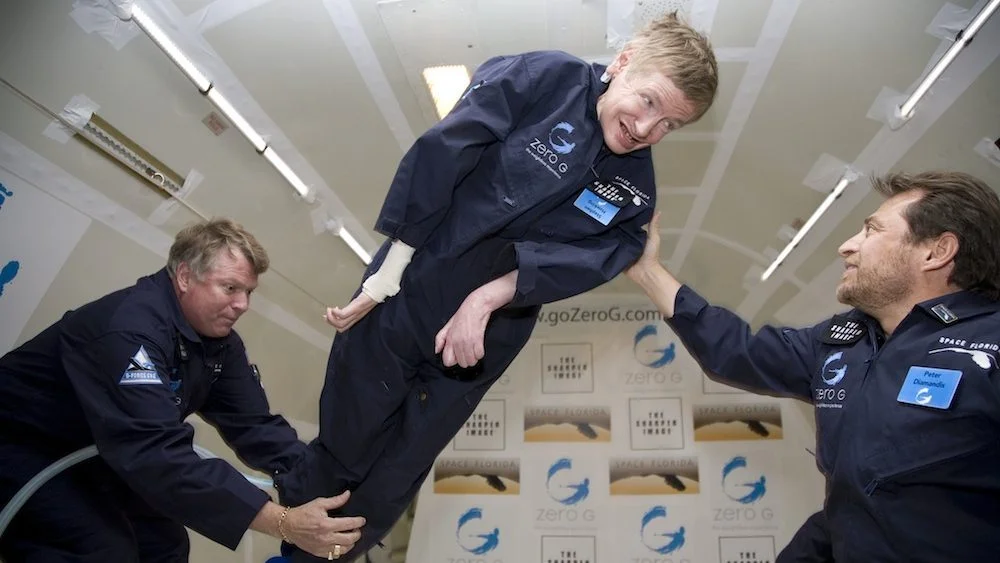
- Having a normal force pushing back up on us whenever we lay down, sit, stand, walk, or run provides resistance, strengthening our muscles and bones and providing us with our sensation of having a stable equilibrium. Similar to being in free-fall on a roller coaster, astronauts in zero-gravity have a continuous feeling of nausea: like their stomachs are in their chests.
- Enabling us to better achieve sleep when we recline. In zero-gravity, there is no “down” and hence, there is no reclining position that is comfortable for human bodies. NASA introduced their “pillownaut” program earlier this century, and found that simulating zero/reduced gravity by inclining beds at a downward angle, participants were far less successful at falling and staying asleep.
- And gravity enables our bodily fluids to achieve an equilibrium position within our body. Disruption of that equilibrium affects everything from space anemia to sinonasal illnesses and our ability to see at all to our body’s urgent need to urinate, risking dehydration continuously.
Over long periods of time, this leads to many maladies, including osteopenia — severe bone density loss (at the rate of 1.5% per month) — and the atrophy of the body’s muscles at a much faster rate, losing 10-20% of their lean muscle mass within weeks. Very few long-term astronauts are capable of even walking under their own power when they return to Earth.

However, Einstein gives us a way to rescue ourselves from this. Humans could indeed spend long periods of time in space — far longer than the current 14-month record — if instead of spending time in the natural gravity found on Earth’s surface, we spent time accelerating in a spacecraft located either in Earth’s orbit or elsewhere in interplanetary space. Einstein’s equivalence principle states that, for any observer in a closed environment (like an elevator or a rocket ship), there’s no way to tell the difference between gravitational acceleration, which accelerates everything downward toward Earth’s center, and any other type of acceleration. Both types can orient you equally well, providing a direction to that acceleration.
The simplest case is for linear acceleration: where a rocket fires continuously, accelerating everyone inside at a continuous acceleration, potentially even at the equivalent of Earth’s g, or 9.8 m/s². If one were to provide that acceleration, continuously, the astronauts inside would experience the same forces — both the same normal force from their environment and the same physiological forces within their body — that are normally found at rest here on Earth’s surface. It would be the simplest, most straightforward way to provide artificial gravity, but it also requires using an awful lot of energy in sustained fashion: providing continuous thrust to deliver that linear acceleration.


The alternative is what we’re asked to consider: what if instead of using linear acceleration, we used rotational acceleration? This is a clever solution, and one that’s been considered since at least 1929, when a man known as Noordung — real name Hermann Potočnik — wrote a book entitled The Problem of Space Travel, whose English translation is provided by NASA here. Although there are many possible designs that would take advantage of this concept, the simplest is to have a large cylinder or wheel-like space station that rotated about its central axis: weightless in the center, but with rotation providing an inward-pushing, or centripetal, force everywhere along the outer edge. (This was famously used as the concept for a space station in the 1968 film, 2001: A Space Odyssey.)
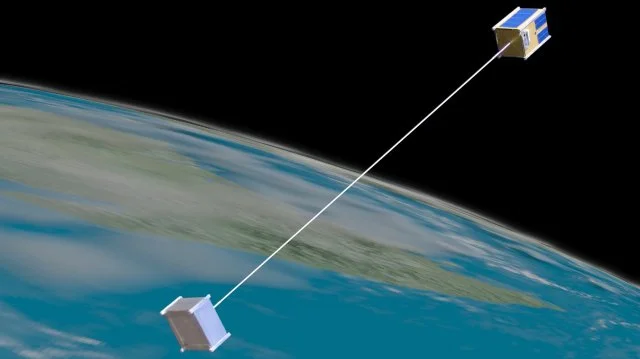
The cheapest, lowest-cost version of this, instead of constructing a large structure like a cylinder or wheel, would be as follows:
- Simply construct two equal-mass capsules,
- separate them by a particular distance,
- connect them by a tether that cannot be stretched or broken,
- and then start them in relative motion — uniform circular motion — about their mutual center of mass,
and they’ll continue revolving around that fixed point, with an inward, center-seeking acceleration providing a normal force always pointing toward the opposite capsule. Throughout the 20th and 21st centuries, this has provided fertile ground for artists, futurists, and space enthusiasts of all varieties.
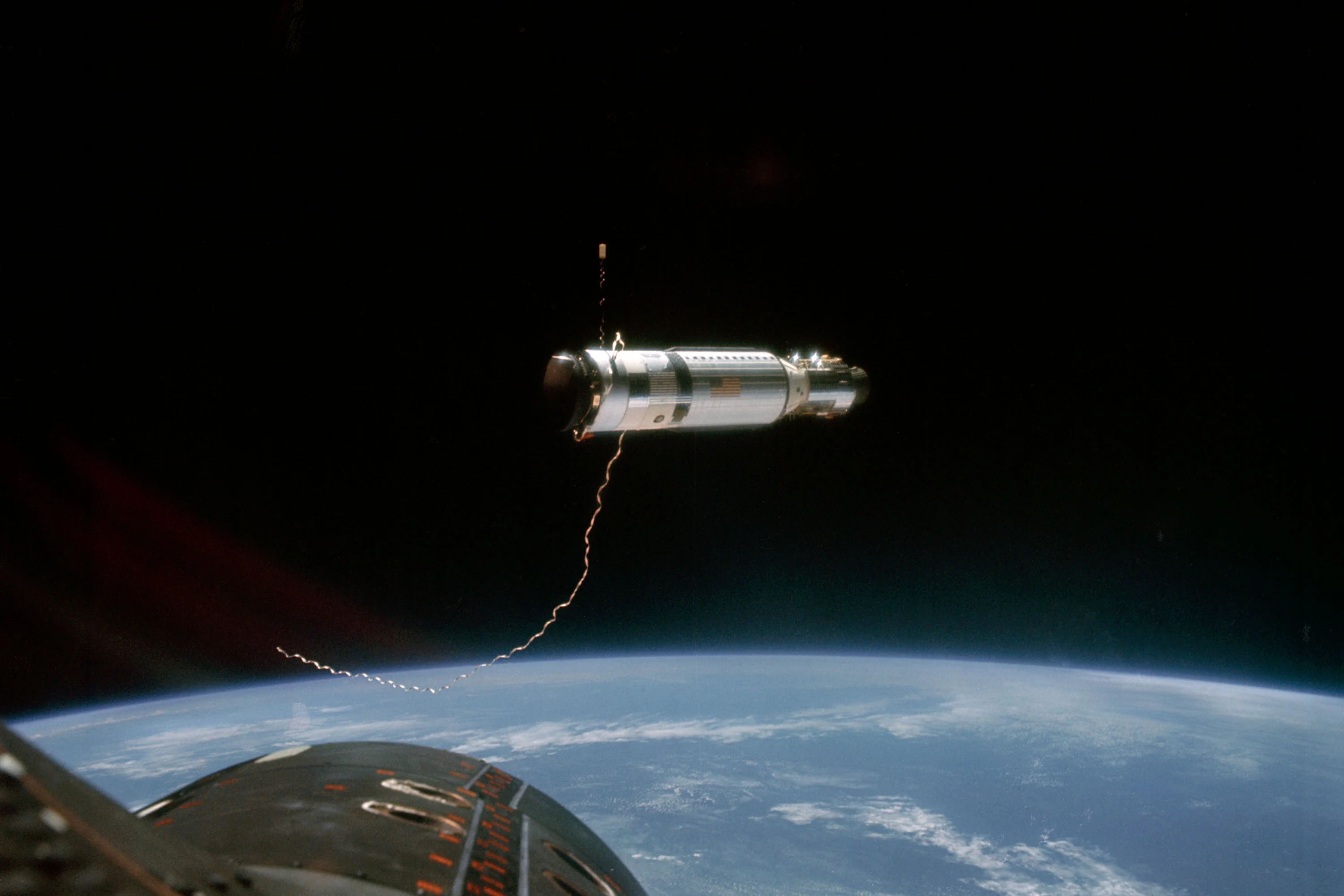

But is this actually a feasible solution to the long-term problem of having a sustained human presence in space?
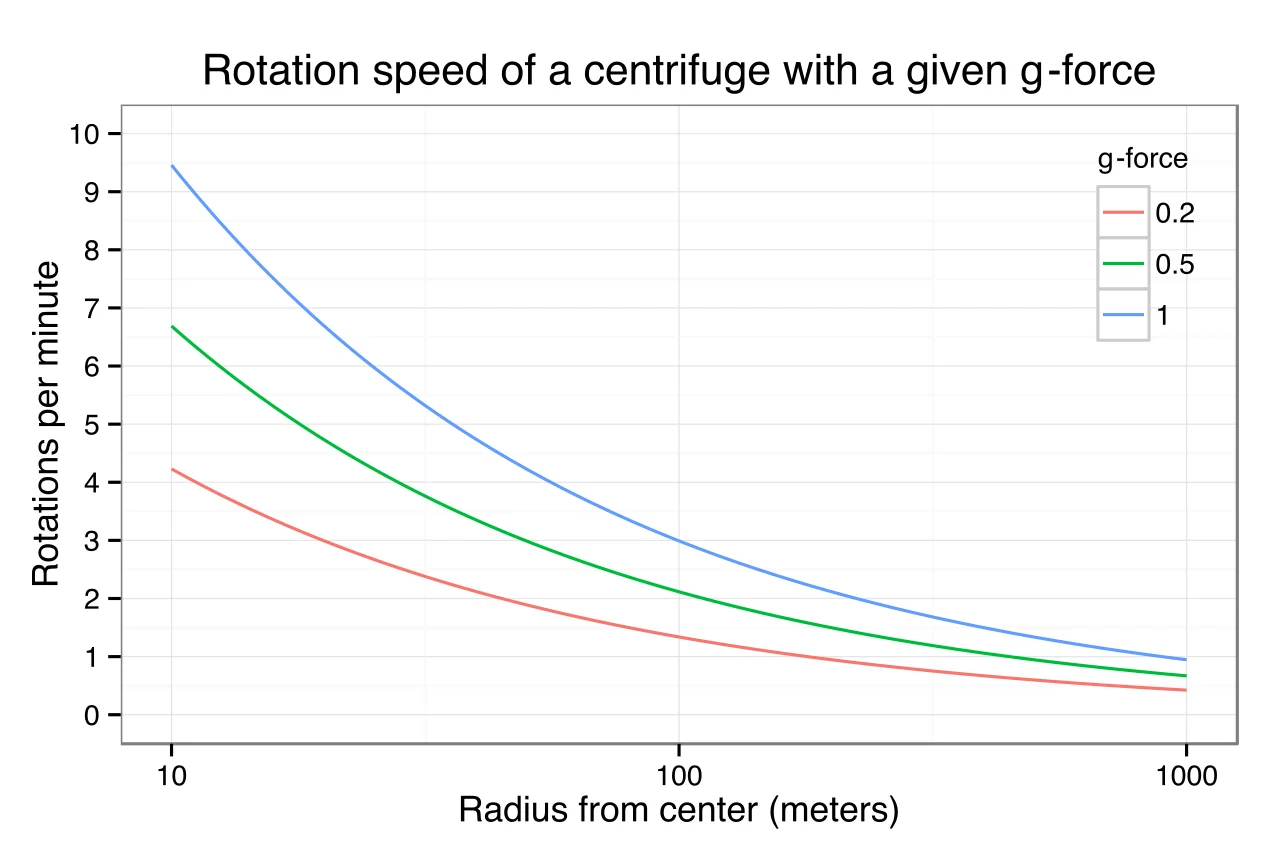
If you want to create a significant amount of artificial gravity, something close to Earth’s g, for example, you have to have your spacecraft rotate at a particular rate, where the centripetal acceleration is defined by the formula a = v²/r. Since angular velocity is v/r by itself, that means that if you want to reproduce Earth’s gravitational acceleration, a set of capsules separated by a tether that’s:
- 20 meters long requires spinning at just under 10 revolutions-per-minute,
- 200 meters long requires spinning at right around 3 revolutions-per-minute,
- and 2000 meters long requires spinning at just under 1 revolution-per-minute,
which illustrates the main drawback of the approach.
The problem is that the spacecraft needs to rotate quite quickly in all cases, and has to build up a lot of angular momentum while maintaining that balance around the center-of-mass. The faster the speed you have to go at and the larger a radius you’re at from the center-of-mass (or the center-of-rotation), the greater your angular momentum is, and these three examples all have a lot of it. The 20 meter tether requires a speed of about 9.9 m/s, the 200 meter tether requires a speed of about 31.3 m/s, and the 2000 meter tether requires a speed of an impressive 99 m/s. As you can see, greater distances require the buildup of greater amounts of angular momentum, and that’s an enormous challenge to keep delicately balanced.

This also runs into a big problem for humans who, for example, stand on the floor. Assuming the average human astronaut is about 1.7 meters (170 cm, or 5’7″), head-to-toe, that means there’s an enormous experiential difference between the acceleration you feel at your feet and the acceleration you feel at your head. Here on Earth, because the radius of the Earth is so enormous — over 6000 kilometers — and the rotational rate of Earth is so relatively low, at just one revolution per day, the difference between the accelerations on your head and on your feet is tiny: about 500 parts-per-billion.
However, if your acceleration is produced artificially, by these rotations, then the acceleration difference can become very, very large.
- For a 2000 meter tether, the difference is about 0.02 m/s², which is roughly where human perception begins. You might not get disoriented, but you can tell that something is happening.
- For a 200 meter tether, the difference is greater: about ten times as great, or 0.17 m/s², which means if you move or even tilt your head at a normal speed, you’ll feel a swimming sensation, as though you had been spinning in circles for a few seconds and suddenly stopped.
- And for a 20 meter tether, the difference is enormous: ten times greater still, or about 1.7 m/s², or over 15% of your total acceleration. This won’t just induce severe vertigo, nausea, and illusions anytime you move your head, but anytime you move any of your limbs. Unless you remained perfectly still, you’d feel a violent (but false) sensation of tumbling, known as the Coriolis illusion.
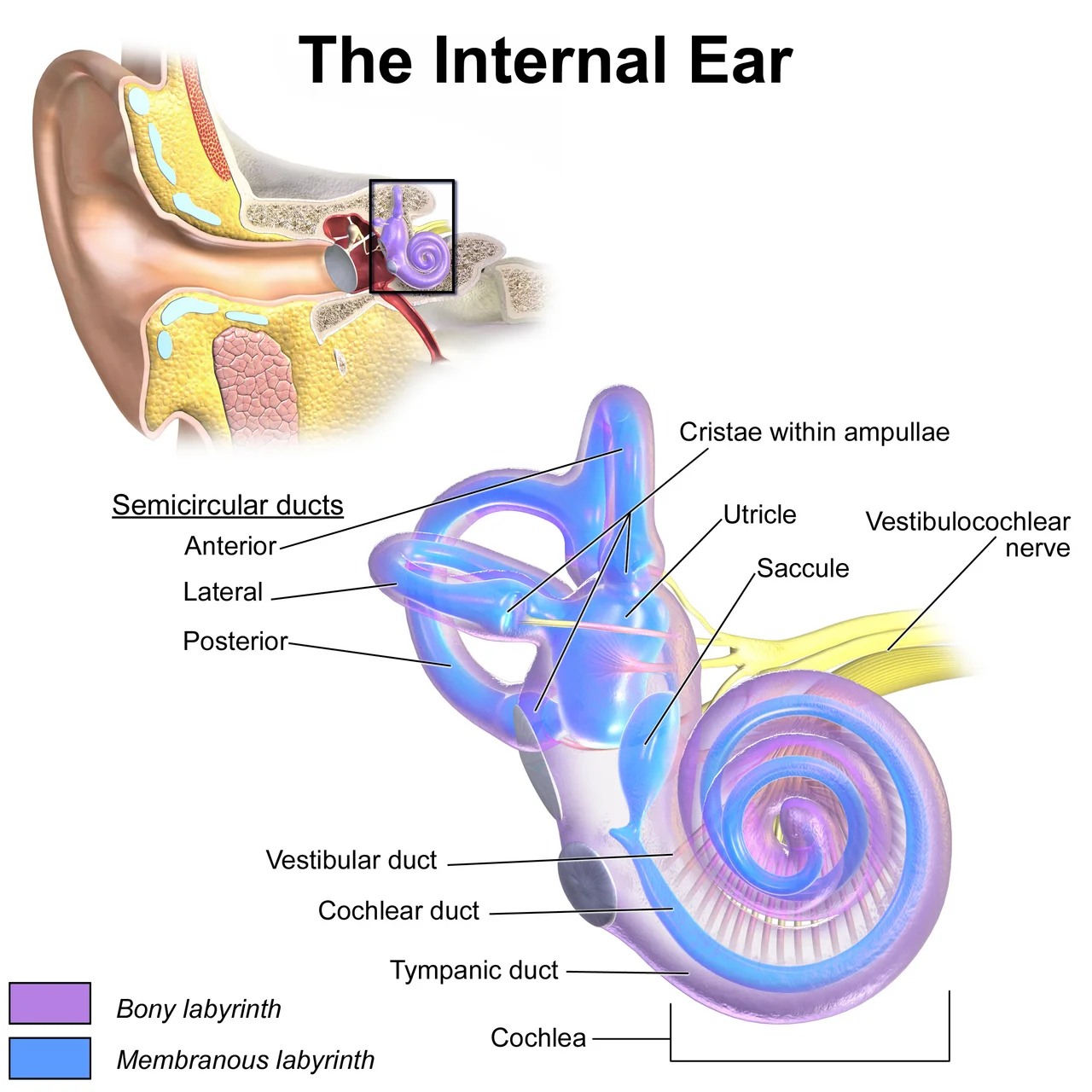

The reason behind this has nothing to do with someone’s toughness, nor is it something that anyone can reasonably adapt to. The issue is physiological in nature, and nearly every human has to reckon with it. As a human being, you have a complex set of organs in your inner ear, including a network of ducts and sacs made of soft tissue with a mythical sounding name: the membranous labyrinth. This labyrinth isn’t hollow, but rather is filled with a fluid known as endolymph, and the motion of this fluid when your body accelerates, rotates, or even when you tilt or turn your head is how you experience that sensation of being oriented, independent of the visual cues you receive from your eyes.
If you’re in an environment that’s rapidly rotating, and the rate of rotation is large — not just in terms of absolute speed, but rather in terms of the number of revolutions-per-minute that you’re experiencing — the flow of the endolymph fluid in your inner ear will be affected, resulting in a mismatch between what your eyes tell you you’re seeing and how the fluid in your ear is behaving. This leads to those sensations of severe discomfort that we described above. The only way to have an artificially rotating space station not lead to those symptoms is to build an extremely large one that’s over a mile (1.6 km) long, and even that is pushing it. You’d really want one that was even longer, perhaps around 5 kilometers (3 miles) in diameter, in order to avoid what would be near-constant and persistent symptoms of disorientation, nausea, and discomfort.
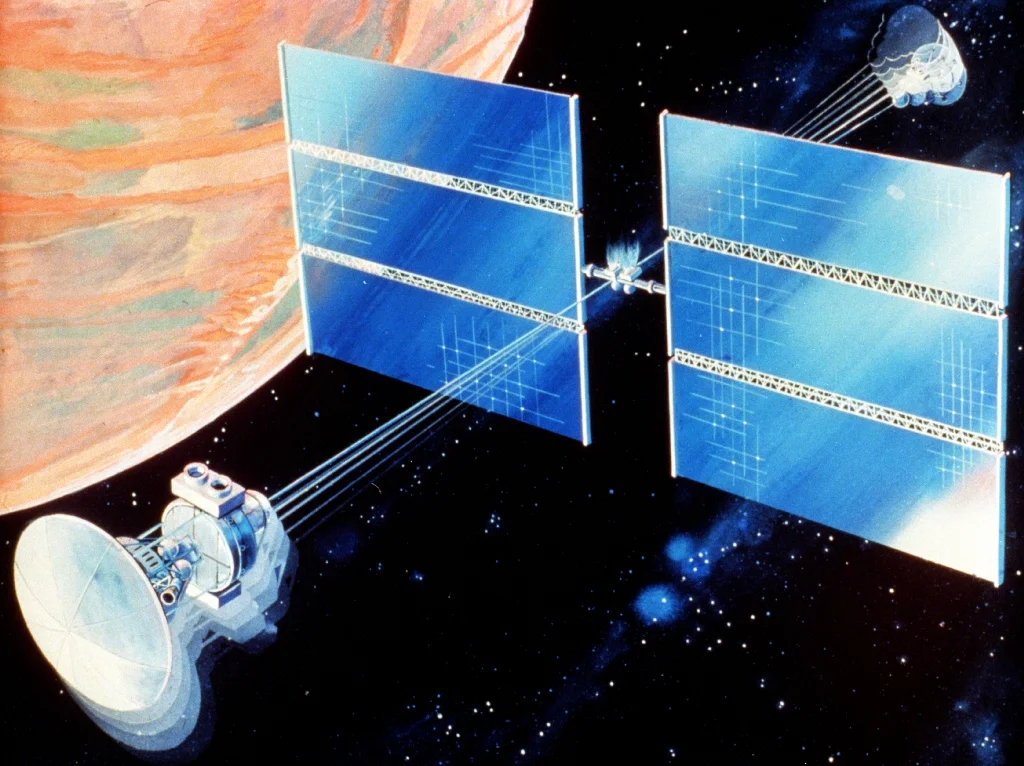

From a scientific perspective, of course, this is possible. You can, in theory, build, launch, and deploy two equal-mass capsules. You can place them as far apart as you want, with a connecting cable — either a soft one, like kevlar, or even a rigid one, like a steel alloy — if you like. You can attach thrusters to each capsule and slowly but steadily begin to spin your structure up. And, depending on size, when you reach the proper rotation rate, you’ll have constructed an artificial habitat with artificial gravity inside: up to and including the acceleration here on the surface of Earth: g.
The problem, though, is keeping your angular momentum balanced so precisely. The larger your distance is from the center-of-rotation, the more you can perturb your system with even small motions. An act like jumping, doing a single pull-up, or rearranging the items inside the capsule would require a complete recalibration of your spacecraft, which poses an enormous obstacle for habitation. The reason a wheel, cylinder, or torus-like design is preferred to a simple two-mass tether is because the mass distribution is more even, and so is less sensitive to small perturbations or deviations.
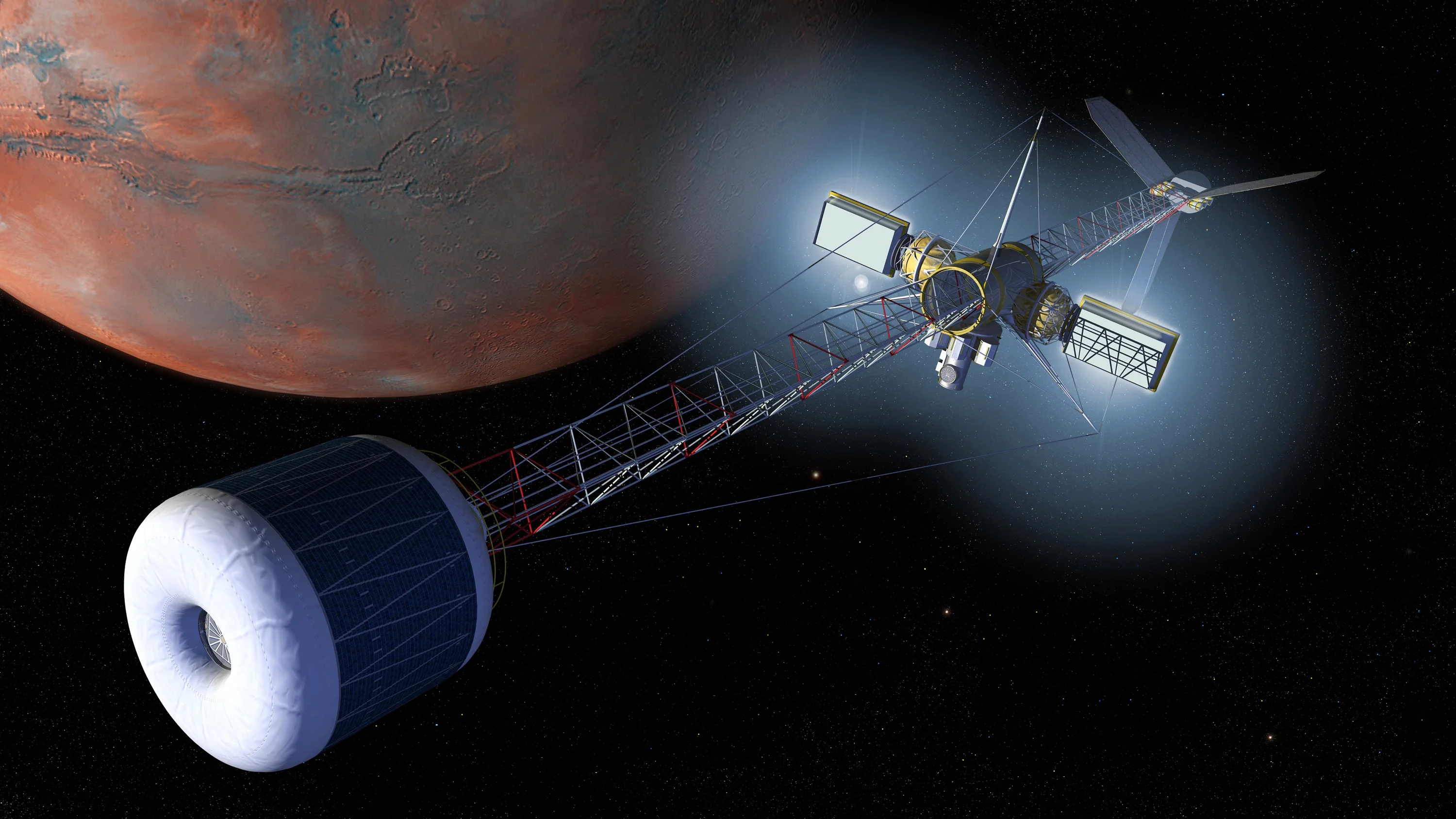

The danger of rearranging your mass (changing your moment of inertia) in a large, rotating system is that you’ll start to get differential rotation, which starts exerting torques on the tether or cable. Just as an unbalanced tire can lead to catastrophe if untreated, what will initially begin as vibrations, tremors, or wobbles in the orbit of your capsule can lead to the complete destabilization of your spacecraft. You’d have to make constant corrections to the rotating spacecraft’s motion anytime the masses inside of it were moved or rearranged, and the larger the distance your two tethered masses are separated by, the more complex those corrections are going to be.
This isn’t necessarily a dealbreaker, but this engineering difficulty is very much the reason why no one has even attempted to build such a spacecraft, practically, even though it’s the cheapest and lowest-technology path forward to artificial gravity in space. The tradeoff is, in order to use rotation for artificial gravity, that you need to make your spacecraft large enough so that the Coriolis illusion doesn’t make life miserable (or intolerable) for the astronauts on board, while simultaneously not making the puzzle of having to balance your torques and angular momentum too difficult to keep the spacecraft rotating in a stable configuration. On the first count, a mile is just barely long enough to be tolerable, but on the second count, a mile is profoundly long, and presents engineering challenges that go well beyond the current capabilities of today. Artificial gravity in space, as a result, is still quite a ways off.
Send in your Ask Ethan questions to startswithabang at gmail dot com!
This article Ask Ethan: Can a Kevlar tether create artificial gravity in space? is featured on Big Think.