A traffic stop changes in seconds
A speeding stop near Warrnambool became an urgent roadside delivery when officers realised the driver was racing to hospital with his partner in labour. Sergeant Liam Cook and Constable Angus Hill helped bring baby Ashlee into the world less than four kilometres from the hospital. An ordinary night shift had turned into a family’s most urgent journey, and a career highlight for the officers.
Just after 2am on Monday, October 19, Cook and Hill were patrolling the Princes Highway near Dennington when they pulled over a blue SUV travelling slightly above the speed limit. Both doors opened as the officers approached, a moment Cook said initially raised concern. A routine stop can change character quickly when what looks like a traffic matter turns out to involve an immediate medical need.
Instead, driver Joel explained that his wife, Jamie-Lee, was in labour and asked whether he could deal with any fines later. Then came the question that reset the encounter: “Are you any good at catching babies?” Cook recalled answering with a few expletives. The exchange was abrupt, but it made the priority clear: the couple needed help with the birth before anyone could worry about the original reason for the stop.
Cook called for an ambulance, but the birth couldn’t wait. Hill stayed beside Jamie-Lee and held her hand while Cook assisted Joel. Ashlee was born within two minutes. No time for a hospital room or a planned handover; the officers had to respond to the situation in front of them.
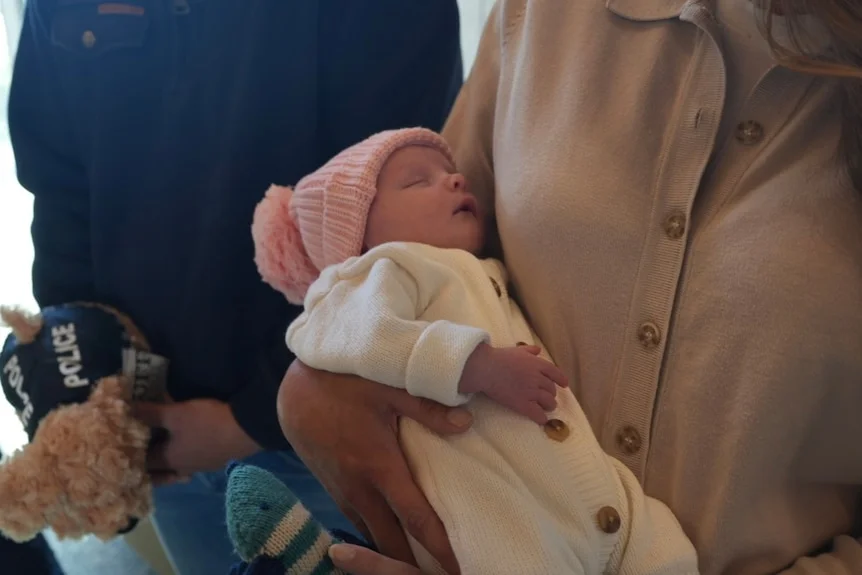
Baby Ashlee has been a calm and "cruisy" baby since her birth a week ago. (ABC News: Tamsyn Buckle)
“We’ve got the little girl all wrapped up, nice and warm,” Cook radioed. He then told Jamie-Lee they had a daughter, a moment he described as special for the officers as well as the family. The radio call captures the shift in the encounter: it began with a speeding vehicle and ended with a newborn safely wrapped while help was on its way.
Once paramedics arrived, they took Ashlee and her parents to hospital to be checked. The family lives about 50 kilometres outside Warrnambool and had reached a point around four kilometres from Warrnambool Base Hospital when the birth happened. They’d covered most of the trip, but those final kilometres weren’t enough to get Jamie-Lee to a hospital bed in time.
A moment the officers won’t forget
Joel said he’d been focused on reaching the hospital and didn’t fully take in what was happening until he heard the sirens. “Until they said the ambulance was coming, that was the first time I thought, ‘Well, it’s happening.’” His account gives the stop a different perspective: in the middle of the emergency, he was still trying to get his family to professional care, and the full reality of the birth only registered as events unfolded.
Jamie-Lee and Joel later reunited with Cook and Hill in Warrnambool. Jamie-Lee said they were fortunate to share the experience with the officers. Their 18-month-old daughter, she added, had taken “a lot longer” to arrive. The couple brought chocolates to the reunion, a small gesture that marked a meeting neither family could have planned.
The officers received an enthusiastic welcome back at the station. Cook’s wife, a midwife, was surprised by the story and told him the pair had handled the delivery “almost textbook.” Childbirth isn’t part of police training, and the account doesn’t suggest the officers were acting as medical professionals. They responded to an immediate situation while waiting for paramedics to arrive.
Hill said the experience showed how varied the job can be. “Nine times out of 10, we’re dealing with people on their worst day, so it was lovely to deal with someone on their best day.” That contrast is part of what made this call stand out: a roadside stop usually begins with enforcement, but here the officers’ role quickly became practical and personal.
When the unexpected becomes the job
This is more significant than it looks. The story isn’t simply that a baby arrived before the family reached hospital; it’s that the officers had to read a changing situation, set aside the routine purpose of the stop and help until paramedics could take over. For readers, the detail matters because it shows how a public service role can shift in a matter of minutes, without any special preparation for the exact event.
That said, a successful outcome doesn’t turn an emergency roadside birth into a plan anyone would choose. The account ends with Ashlee and her parents taken to hospital for checks, and with the officers’ work remembered warmly by the family. It offers no wider claims about how often police attend births or what another roadside emergency might require.
If you’re working in this space, the useful detail is the handoff: Cook called an ambulance, Hill stayed with Jamie-Lee, and paramedics took the family to hospital when they arrived. It’s a brief sequence, but it shows how several people contributed under pressure. And this is the part most people overlook: the stop’s original purpose faded quickly, while the need to stay calm and act on the immediate facts remained.
Cook called it a career highlight he and Hill are unlikely to top. For the couple, the experience has also become a story with a clear lesson about the final stretch of the drive: Joel and Jamie-Lee aren’t planning another child soon; if they do, Joel said, “we’ll be staying in town.”
A night shift, a roadside delivery, and a reunion over chocolates. Not the call either side expected.


