Aaron Rodgers’ final days with the Pittsburgh Steelers ended in a public rupture: after learning he would be benched, the veteran quarterback accused coach Mike McCarthy of repeated lapses, and the team released him hours later. The fallout leaves Pittsburgh preparing for Friday’s game against Denver with Mason Rudolph set to start, while Rodgers must look for another team in what was meant to be his final NFL season. The sequence has turned a personnel decision into a dispute over trust, authority and how a team handles a late-season change at quarterback.
A benching, then a public attack
The Steelers announced late Tuesday, local time, that Rodgers would be inactive against the Broncos. The decision came hours after McCarthy had said Rodgers would remain the starter following Pittsburgh’s loss to Philadelphia. That change in public position gave the benching added weight: Rodgers wasn’t simply learning that the team had chosen another quarterback, but hearing it after the coach had recently described him as the starter.
Rodgers said he learned of the change while speaking by phone with teammates, including tight end Pat Freiermuth. The account places the news in the middle of a conversation with other players, rather than in a private meeting with the coach. That detail helps explain why Rodgers presented the decision as a breakdown in communication as well as a football choice. For a veteran quarterback, the manner and timing of a benching can shape how the move is understood inside the locker room.
On ESPN’s The Pat McAfee Show, Rodgers accused McCarthy of arriving late and falling asleep during team meetings. He also recalled the coach saying “one, two, three, Packers” instead of “Steelers” after a huddle. These are Rodgers’ allegations, delivered publicly, and the account doesn’t include McCarthy’s response to them. The reference to Green Bay carries particular history: McCarthy and Rodgers won a Super Bowl together there in 2011.
That shared history makes the dispute more pointed. The coach and quarterback had worked together at the highest level, so Rodgers’ criticism isn’t framed as a complaint about an unfamiliar manager; it’s an accusation against someone he once succeeded with. It also puts their past partnership beside a very different present, in which Rodgers says he questioned McCarthy’s attention to the job and wanted a change in how the offense was run.
Rodgers said he had raised concerns about McCarthy’s attentiveness directly with him and had discussed changing play-calling duties. In the interview, he framed his position as an effort to help the team, not as a demand for a personal accommodation. He said he had told McCarthy: “If you try and bench me or don’t change the play-calling then you should just release me.”
That ultimatum sets out the conflict in unusually direct terms. Rodgers linked his willingness to remain with Pittsburgh to two conditions: keeping his role on the field and changing who called the plays. The account doesn’t establish how the team assessed those requests or what discussions took place beyond Rodgers’ description. But the public airing makes clear that the disagreement had moved beyond a routine debate over tactics.
Rodgers said McCarthy replied that he would do what was right for the organisation. “Which in his mind was getting rid of me,” Rodgers added, saying the coach had the owner and general manager on his side. That claim casts the decision as one backed by the team’s leadership, while leaving readers with Rodgers’ interpretation of McCarthy’s intent. The gap between those two things matters: the reported decision is clear, but the reasoning and internal process aren’t fully visible in the account.
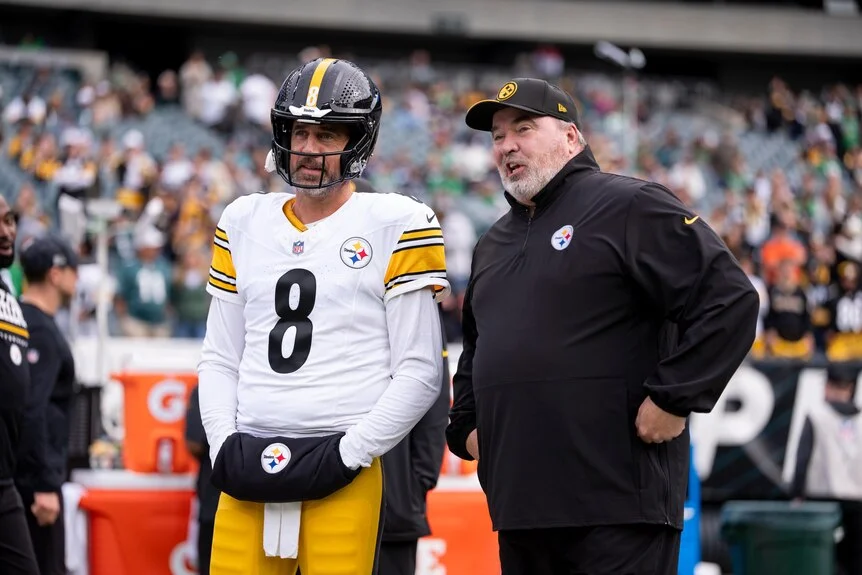
Fallout inside Pittsburgh
The Steelers excused Rodgers from Wednesday’s practice. After the session, McCarthy walked through reporters gathered at team headquarters, many following Rodgers’ interview on their phones. The scene gave the team’s silence a visible backdrop: Rodgers had made his case in public, while the coach passed through a group already tracking the allegations. The account doesn’t report McCarthy addressing them at that point.
The team’s remaining players and coaches largely avoided addressing the accusations directly. That restraint may reflect the difficulty of commenting on a dispute involving a departing teammate and the coach who remains in charge, especially with a game approaching. It also leaves the public record uneven. Rodgers spoke at length; the responses cited from inside Pittsburgh were brief and guarded.
Freiermuth was asked whether he trusted McCarthy to lead the team and replied, “I’m confident,” without elaborating. The answer expresses support, but its brevity doesn’t show how players view the underlying complaints or the benching. Marquez Valdes-Scantling, who played with Rodgers and under McCarthy as a rookie in Green Bay in 2018, acknowledged broader frustration with the Steelers’ recent results. “I didn’t think it was this,” he said.
Valdes-Scantling’s comment points to a distinction between dissatisfaction with results and the specific confrontation Rodgers described. It doesn’t tell us what the wider locker room thinks, and one response can’t stand in for a team’s mood. Still, it suggests the public dispute caught at least one player off guard in its form. Here’s the thing: a quarterback change can be explained as a football decision, but a release following a public accusation inevitably gives the episode a wider meaning.
What the split means for both sides
Rodgers joined Pittsburgh in what was expected to be his final NFL season. His release turns that plan into an open search for a new team, while the Steelers move ahead with Rudolph at quarterback against Denver. The immediate consequences are clear; what happens beyond the next game is not. Rodgers’ future depends on whether another team wants to bring in a veteran quarterback this late in his intended final season, and the account offers no indication of where he might land.
For Pittsburgh, the change leaves Rudolph with the start and the team with a dispute still fresh in public view. A quarterback transition can put pressure on preparation and on the people responsible for keeping a locker room focused. The available details don’t show how the Steelers’ players will respond on the field, or whether the change in play-calling Rodgers sought will be considered. Friday’s game will provide the next visible test of the team’s adjustment, but it won’t settle the questions about how the split unfolded.
This is more significant than it looks. The clash is not only about who starts against Denver; it’s also about whether a coach and a veteran quarterback can resolve a disagreement over leadership and offensive control before it becomes a public rupture. (And this is the part most people overlook: the team’s brief responses leave plenty of room between what Rodgers alleges and what Pittsburgh has confirmed.) That uncertainty limits what outsiders can conclude, even as the consequences for both sides are already unfolding.
If you’re working in this space, the episode is a reminder that a late-season roster decision can quickly become a test of communication and authority. The Steelers have to prepare with Rudolph, and Rodgers has to find out whether another team is interested. For now, the clearest account of the disagreement comes from Rodgers himself. A fractured partnership, with the next steps still unresolved.