Kane’s award ends a long wait
Harry Kane’s Ballon d’Or win ends a 25-year wait for an Englishman to claim the men’s award. The Bayern Munich striker scored 73 goals for club and country last season, setting scoring records in Germany and helping England finish third at the World Cup. Those achievements put individual output and team results in the same frame: Kane’s case rests on a remarkable scoring tally, but also on what his teams accomplished around him. That combination is central to how a season-long award is understood, even when no single measure can settle the debate.
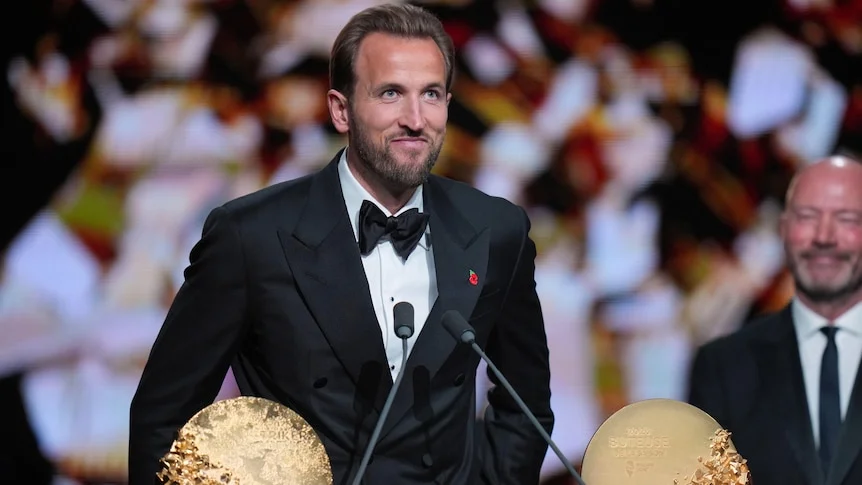
Kane received the award Monday at a ceremony in London. He topped a field that included Lamine Yamal, Kylian Mbappé and Lionel Messi. Michael Owen was the last English winner, in 2001. The gap gives this result a national dimension, though the award’s reach is broader than that: it places Kane’s season alongside the work of players whose roles, teams and achievements can be difficult to compare directly.
Seventy-three goals is the headline figure, and understandably so. A total spanning club and country captures production across different settings, where teammates, tactics and the quality of opposition can all change. It doesn’t, by itself, show how those goals were scored or how much each match depended on them. But paired with records in Germany and England’s World Cup finish, it gives voters a clear account of a season with both individual scale and team consequences.
This is more significant than it looks. An award can recognize a standout year while also changing the way a player’s career is discussed: Kane’s name now sits beside the small group of English winners, with Owen’s 2001 victory as the previous marker. That doesn’t make the two seasons equivalent. It does make the long interval part of the story, and it gives the result weight beyond the ceremony itself.
What the men’s award is weighing
Individual honors in football carry an awkward task. They ask voters to compare players who may have entirely different jobs, and whose teams may offer very different levels of support. A striker’s goals are easy to count; the work that creates space, keeps possession or prevents an opponent from advancing is less easily compressed into one headline. That tension doesn’t make the award meaningless. It does mean that the figures and the broader season have to be read together.
Kane’s profile makes the central argument unusually legible: goals, records in Germany and a strong finish with England. The source doesn’t specify how voters ranked those factors, or how the other nominees’ cases were assessed. There’s no need to pretend a single formula explains the outcome. The useful question is what the result says about the season being recognized, and here the answer is a forward whose scoring carried across club and national-team football.
That comparison with Yamal, Mbappé and Messi also puts the decision in context. Their inclusion shows the breadth of the field, but the list alone doesn’t tell us what separated the winner from the other candidates. Awards coverage can turn a shortlist into a contest between reputations; the more grounded reading is that Kane’s reported output and team achievements formed a persuasive case. Not a complete account of every vote. A clear one.
Putellas returns to the top
Alexia Putellas won her third women’s Ballon d’Or after a trophy-filled season with former club Barcelona, including a Women’s Champions League title. She also helped Spain win the Women’s Nations League in December before joining London City Lionesses in the off-season. The award connects achievement at club and national level, while the move to a new club gives the result an added career context: Putellas is being recognized for work completed with Barcelona and Spain, as she begins a different chapter.
Three wins place Putellas among the award’s repeat winners, but the route back to the top matters too. She previously claimed the prize in 2021 and 2022, then missed time after tearing her ACL as Bonmatí rose to prominence. A serious injury can interrupt a player’s season and public momentum at once; returning to the award’s summit after that interruption says something about the strength of the season described here. And yet, an award can’t capture the full experience of recovery or the work behind a return.
The 32-year-old midfielder ended teammate Aitana Bonmatí’s three-year run as winner. Putellas had previously claimed the prize in 2021 and 2022, then missed time after tearing her ACL as Bonmatí rose to prominence. Bonmatí, who completed a three-year streak in 2025, wasn’t shortlisted this year after breaking her leg in December. Those details make this year’s result more than a handover between teammates: the previous winner’s absence followed an injury, while Putellas’s return follows her own period out of action.
Here’s the thing: repeated wins can make an award feel like a measure of status, while a changed result brings the season back into focus. Putellas’s third win reflects a campaign that included major club and national-team success, according to the source. It also marks a break in Bonmatí’s run, though her absence from the shortlist means there wasn’t a direct contest between the two this time. (And this is the part most people overlook.) The circumstances around a shortlist shape the story as much as the name at the top.
What the results say about the season
Together, the men’s and women’s awards point to the different ways a football season can be judged. Kane’s case is led by a striking goal total and records; Putellas’s includes major titles with Barcelona and Spain, alongside a return after injury. Neither profile reduces neatly to a single statistic. Titles show what teams achieved, while individual numbers and performances help explain who stood out within those teams.
If you’re working in this space, the practical lesson is to treat award results as a summary, not a full statistical verdict. The source gives us useful anchors: Kane’s 73 goals, England’s third-place finish at the World Cup, Putellas’s Champions League and Nations League success, and the injury history surrounding both players’ award campaigns. It doesn’t provide voting details or a full comparison of their seasons, so stronger claims about why one candidate beat another would go beyond the available account.
For readers, the results offer two distinct career stories. Kane ends a long wait for an English men’s winner, with a season built around scoring records and output across club and country. Putellas returns to the award’s top position after an interrupted run, while Barcelona teammate Bonmatí’s injury kept her off this year’s shortlist. The awards establish who won. The surrounding seasons explain why those wins will be remembered.


