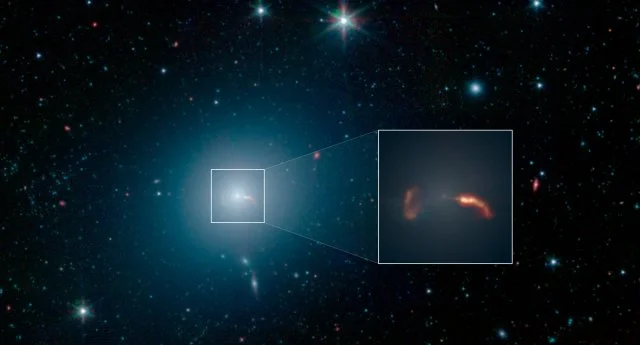
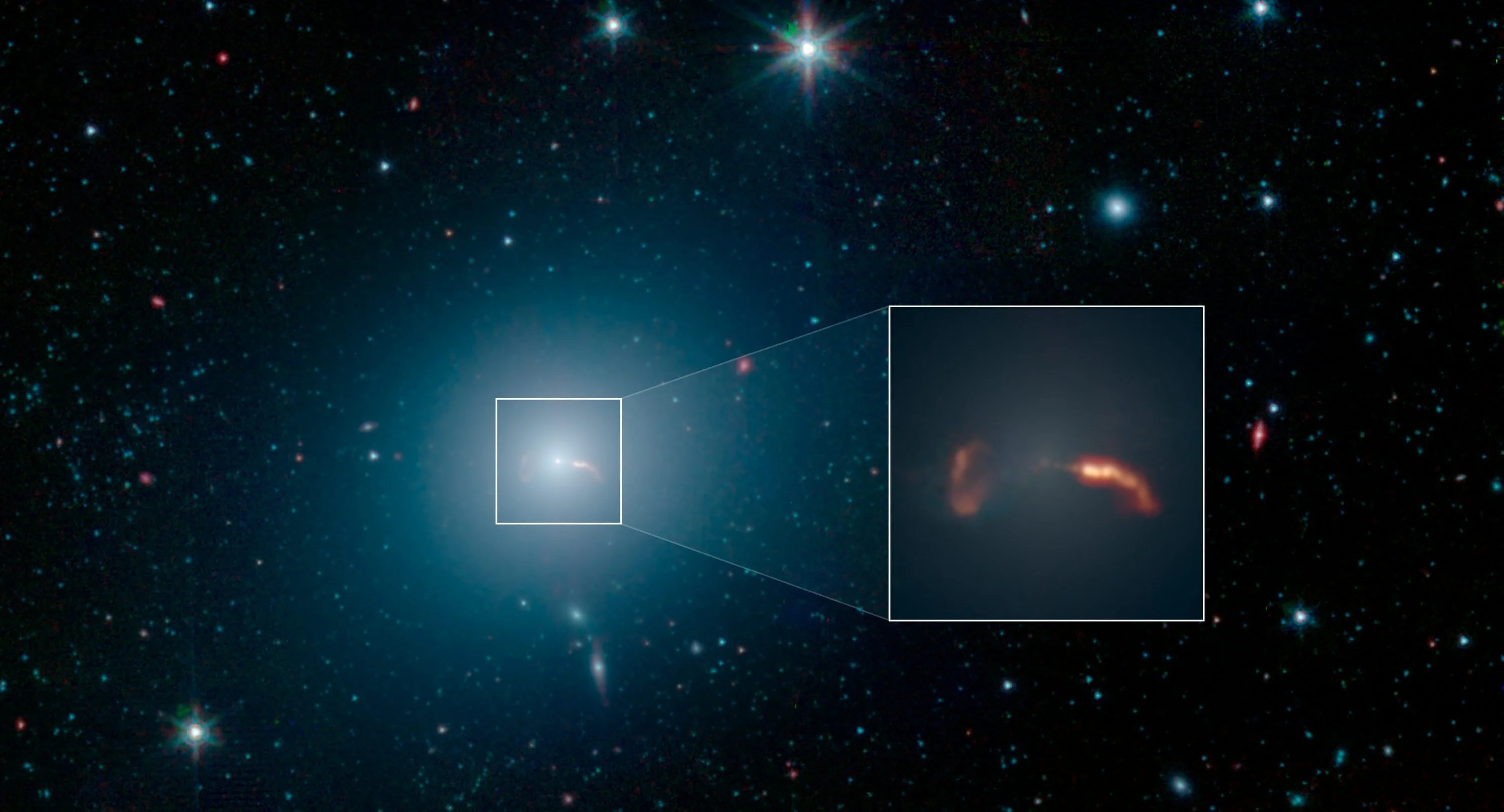
TON 618 matters because it forces two puzzles into the same frame: how a black hole could reach extraordinary mass so early in the Universe, and why we don’t find more objects like it nearby. The familiar picture—small black holes growing gradually—has trouble accounting for the most extreme examples. Eric Trant’s question gets at the tension: TON 618 was measured at roughly 66 billion solar masses, and we see it as it was 10.8 billion years ago, when the Universe was only about 3 billion years old. How did it get so large so quickly? And where are its local counterparts?
TON 618 launched a wider debate about how supermassive black holes form and grow. The headline mass is striking, though it comes with a qualification: later analysis revised the original estimate downward. Even at the lower figure, TON 618 remains an extraordinary object for its era. To see why it unsettled astronomers, it helps to trace how black holes went from theoretical possibility to measured cosmic extremes.
From theory to evidence
The basic idea of a black hole is much older than modern astronomy. John Michell proposed an early version in the 18th century using Newtonian reasoning; the concept later gained a firm footing in general relativity when Karl Schwarzschild found an exact solution to Einstein’s equations in 1916. Starting with matter at rest and allowing gravity to pull it inward, Schwarzschild’s solution describes a non-rotating black hole with an event horizon at a characteristic distance, R, now called the Schwarzschild radius. The older history is outlined in this account of John Michell’s predictions.
Anything crossing the horizon adds to the black hole’s mass. Early calculations also put a ceiling on how quickly a black hole could grow by feeding on surrounding matter. The expected starting point was a “seed” left by a massive star’s core collapse in a supernova. Seeds could gain mass through accretion and mergers, then settle into the centers of galaxies as supermassive black holes. That framework predicts both stellar-mass black holes and much larger black holes at galactic centers.
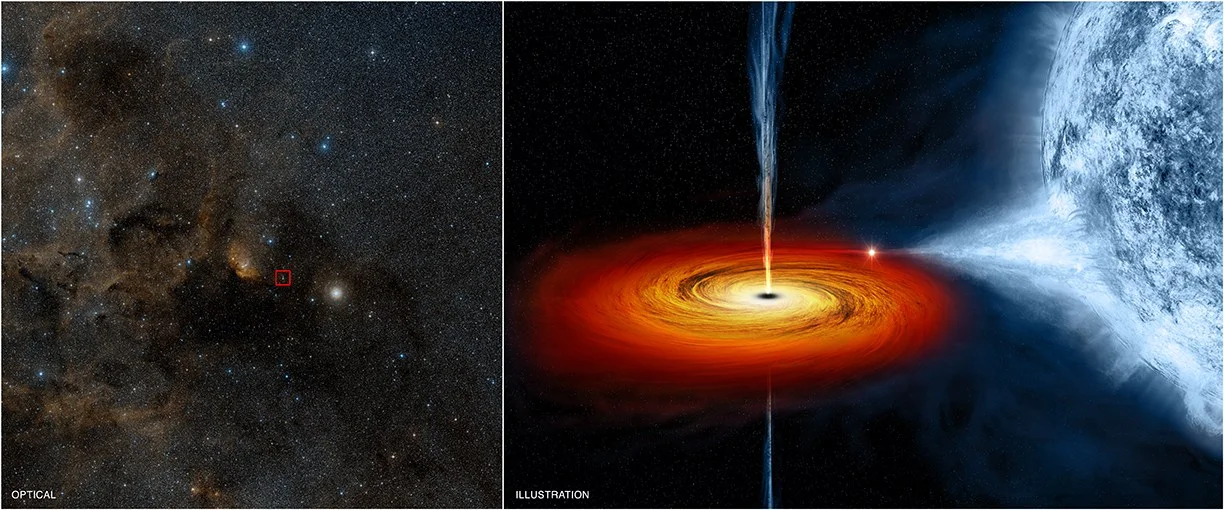
Evidence arrived decades after the theory. By the 1950s and 1960s, astronomers were finding candidates through X-rays and radio waves, wavelengths far removed from ordinary visible light. Cygnus X-1, discovered during a 1964 rocket flight, became a leading example. When a black hole orbits a companion star—especially a massive one—it can pull in the star’s material. The gas heats up and accelerates around the black hole, producing the X-rays that mark an X-ray binary. Until gravitational-wave astronomy developed, this was the main way to detect stellar-mass black holes. Cygnus X-1 remains one of the best-known cases.
At the opposite end of the scale, radio observations revealed quasars: objects whose name began as an abbreviation for “quasi-stellar radio sources.” Their host galaxies were often too faint to see when quasars were first identified. We now understand them as active galactic nuclei, with supermassive black holes at their centers. The black holes feed from accretion disks and can launch jets that stretch for millions, sometimes tens of millions, of light-years. Quasars’ place in galaxies is discussed in this overview of galaxies and quasars.
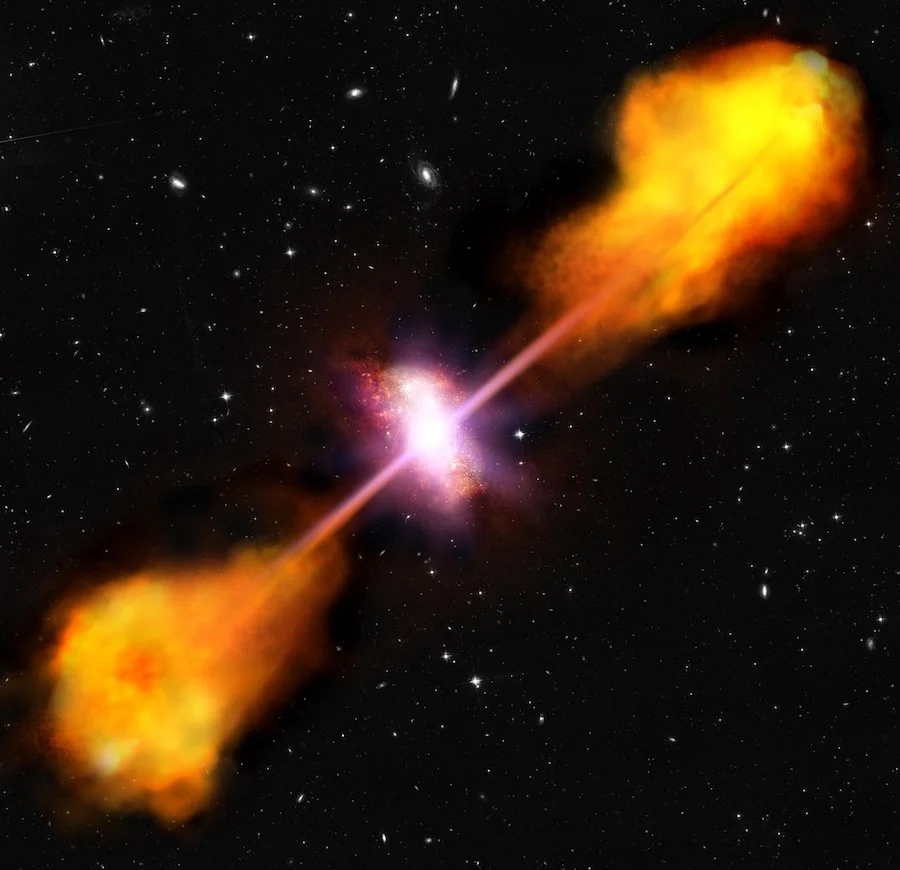
By the turn of the century, the broad outline seemed settled. Astronomers had a theoretical upper limit on black-hole growth, a model in which stellar-mass black holes came from core-collapse supernovae, and evidence for supermassive black holes in galaxies—including distant, bright active galactic nuclei and quasars.
That framework also offered a reasonable explanation for why many visible quasars are far away. The early Universe was denser, galaxies merged more often, and stars formed more rapidly. Those conditions could make powerful quasars more common in the past. Nearby galaxies, by comparison, are mostly quiet. Their black holes are harder to spot because they emit less radiation when they aren’t being strongly fed, though active galaxies can still be identified through X-rays, radio signals, or jets.
Even before astronomers tracked individual stars near the Milky Way’s center or imaged the event horizons of the black holes in M87 and our own galaxy, they had strong grounds to conclude that supermassive black holes sit at the centers of practically all galaxies. Their masses range from millions to billions of Suns. The question was how far that growth could go—and how early it could happen.
Why TON 618 was a problem
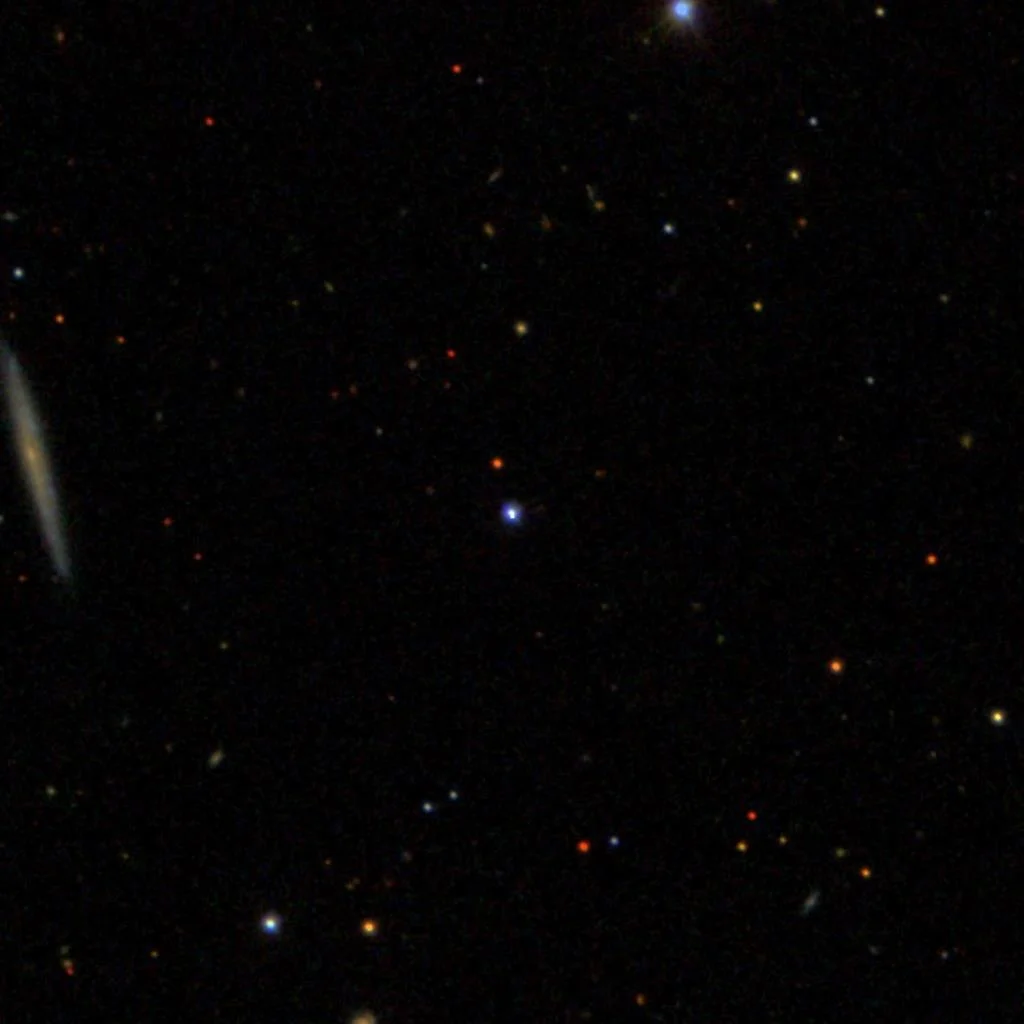
In 2004, astronomers used relationships between quasar emission lines to estimate the mass of the black hole powering TON 618. A study of more than 30 systems used spectroscopy and examined two lines: one from triply ionized carbon and another, cyan-colored line from neutral hydrogen. The researchers also challenged earlier claims that metallicity determined luminosity or black-hole mass. Applying their analysis to TON 618 produced a startling estimate: 66 billion solar masses.
Two details made that result hard to fit into the standard account. First, calculations suggested that a luminous, accreting black hole could grow to around 50 billion solar masses at most—less than the original TON 618 estimate. Second, TON 618 is not nearby. Its redshift is z = 2.219, meaning its light is stretched to more than three times its original wavelength. We see it as it was roughly 10.8 billion years ago, when the Universe was about 3 billion years old. The Universe itself is about 13.8 billion years old.
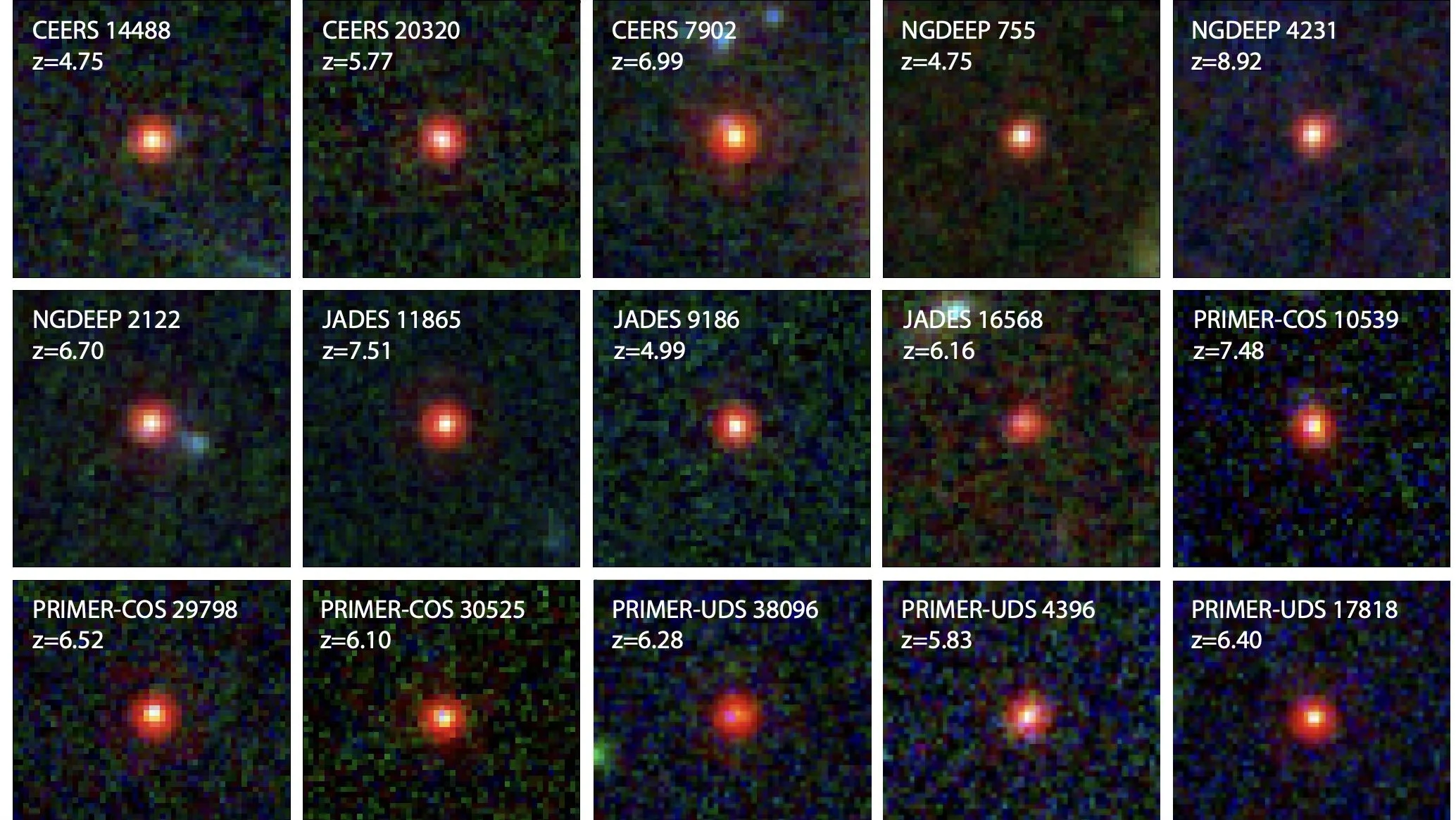
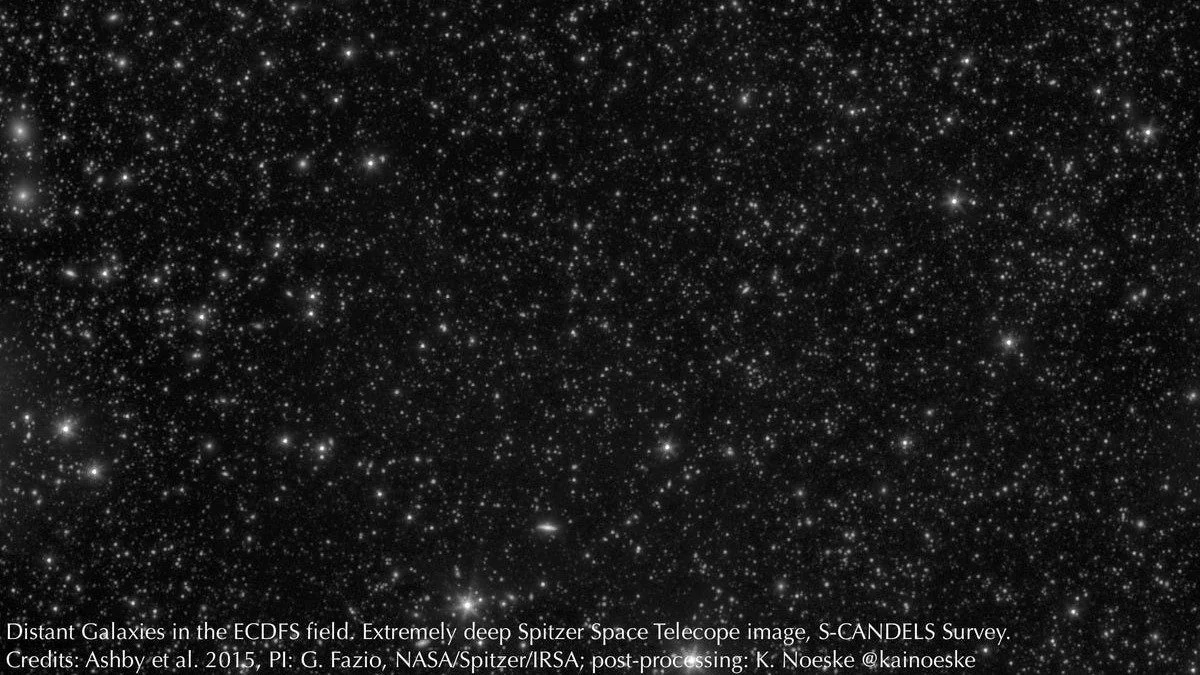
JWST has made the early-growth problem harder to ignore. It has found hundreds of compact, luminous, distant objects known as Little Red Dots. Some appear to be massive supermassive black holes, weighing hundreds of millions or even billions of solar masses, and they existed earlier in cosmic history than TON 618. Their nature is still being worked out, but they raise the same basic question: how did black holes become so massive so soon?
The more disruptive evidence comes from comparing black holes with the stars in their host galaxies. In the late Universe, including in TON 618’s era, the most massive known black holes typically reach about 0.1%—one part in a thousand—of their galaxy’s stellar mass. Yet astronomers have found black holes amounting to 1%, 10%, or even 100% of the mass in stars in their host galaxies. These overmassive black holes point to a gap in the usual story. If every supermassive black hole began as the remnant of a massive star, it’s difficult to explain how some could rival or exceed the combined mass of their host galaxy’s stars. The evidence is discussed in this analysis of black holes that stars can’t explain.
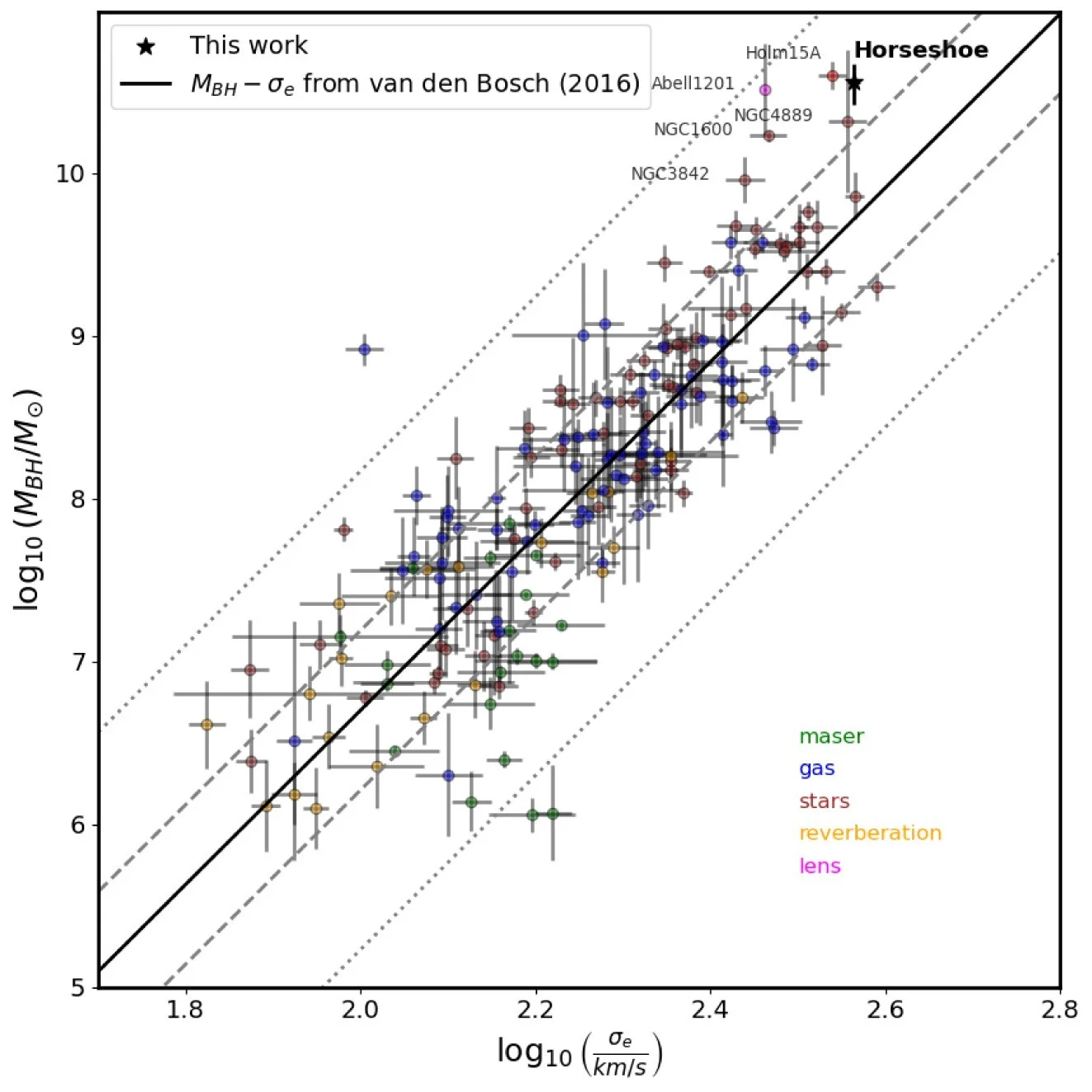
Massive stars die first, and their remnants can merge, accrete matter, and sink toward galactic centers. That process can build black holes over time. But it doesn’t readily account for a black hole that matches or outweighs all the stars in its galaxy. If the measurements hold up, the seeds must sometimes have started much heavier than the tens or hundreds of solar masses left by individual stars.
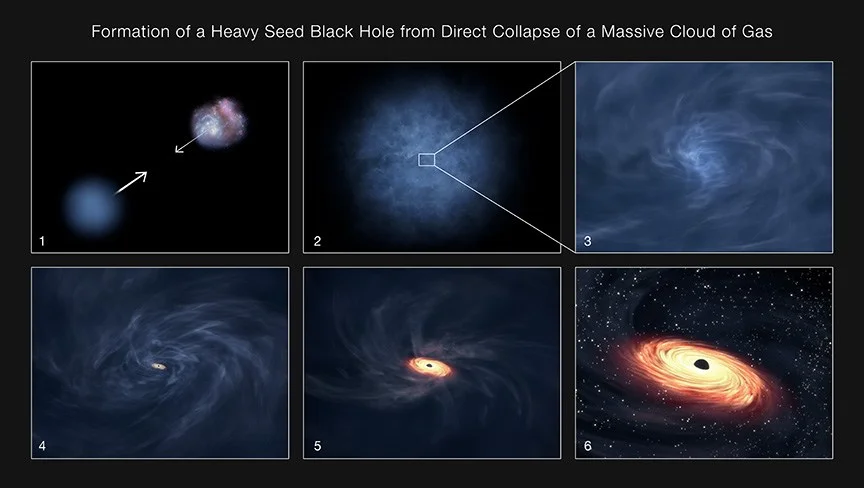
Seeds weighing tens of thousands of solar masses or more would have a head start. They could grow into massive black holes early, and help explain the largest supermassive black holes seen at later times. The origin of these heavy seeds remains unsettled. Leading candidates include:
TON 618 is enormous, but the mass record is still uncertain
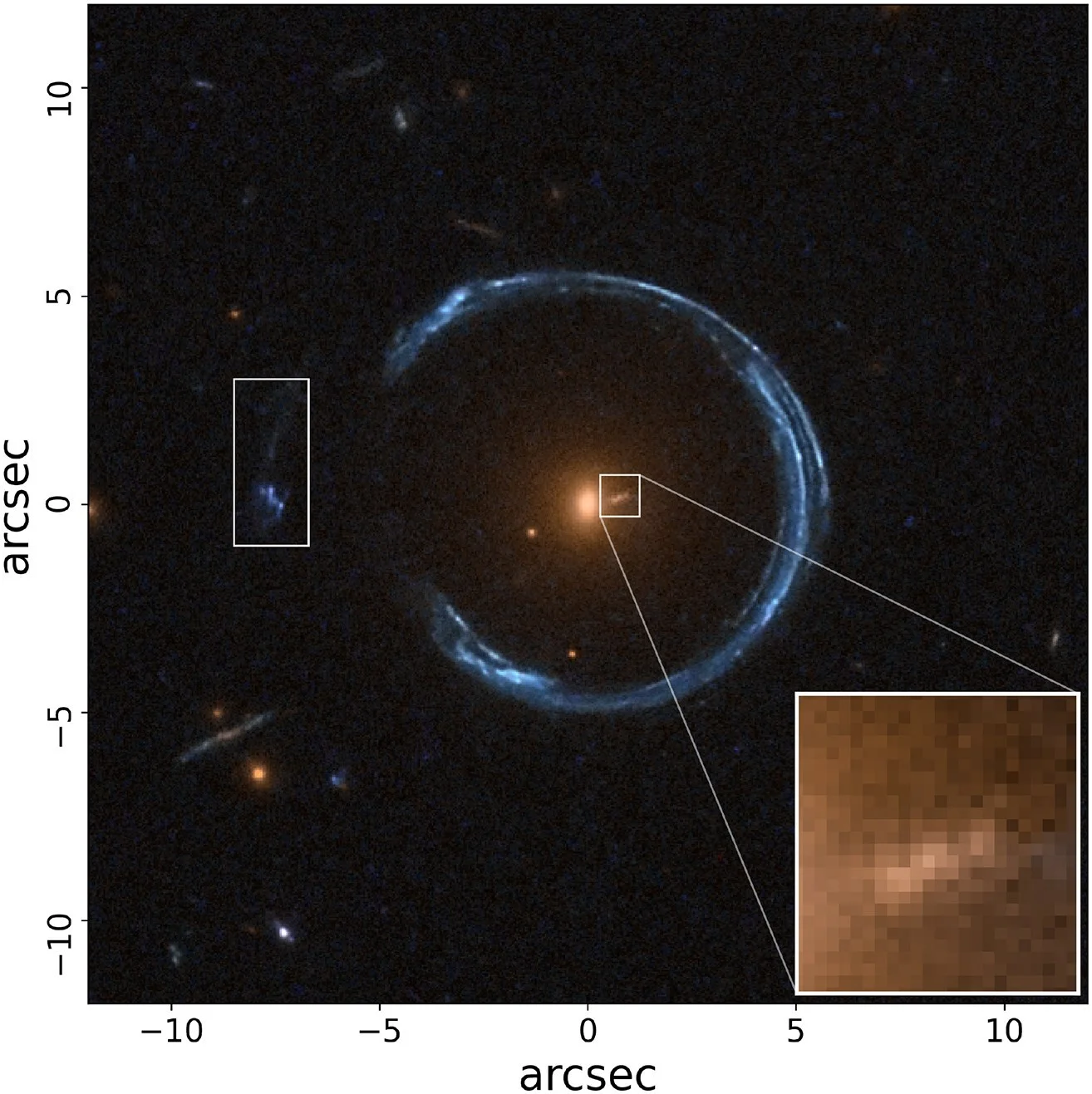
The big takeaway is that TON 618 remains a giant, but the old headline figure of 66 billion solar masses probably overshot. A bias in the triply ionized carbon line used for its 2004 estimate brings the revised figure down to roughly 40–41 billion solar masses. That’s still extraordinary. It’s also about 25 billion solar masses below the original estimate.
TON 618 isn’t alone in this weight class. Ten other black hole systems are estimated to exceed 30 billion solar masses, though their measurements carry substantial uncertainty. Three candidates are reported as more massive: Phoenix A, IC 1101, and 4C+74.13. They’re closer than TON 618 and were measured using comparatively crude methods, so the rankings aren’t settled. A 36-billion-solar-mass black hole about five billion light-years away was confirmed in 2025, a sign that TON 618 may be a remarkable example rather than a one-off. Finding more could be hard: the quasar activity that makes these objects easy to spot was more common in the young Universe.
The theoretical ceiling is higher than the old estimate
The familiar 50-billion-solar-mass ceiling rests on two assumptions that don’t describe real black holes very well. One is that they’re spherical and nonrotating. Evidence instead points to rapid rotation, at more than half the speed of light and sometimes as much as 95 percent. Rotation changes the shape of the event horizon and, by itself, raises the proposed ceiling from 50 billion to 270 billion solar masses—far beyond any black hole observed so far. The revised limit is laid out here.
The other assumption is that a black hole grows through steady feeding at the Eddington rate, the maximum sustainable rate in the traditional calculation. But super-Eddington feeding has been known for decades and is common; bursts can reach ten times that rate. They don’t last indefinitely, yet they can speed up growth enough to produce heavier black holes earlier than steady accretion would allow. Put rapid spin and brief feeding surges together, and the old ceiling tells us less than it once seemed to.
How the first giants got their start
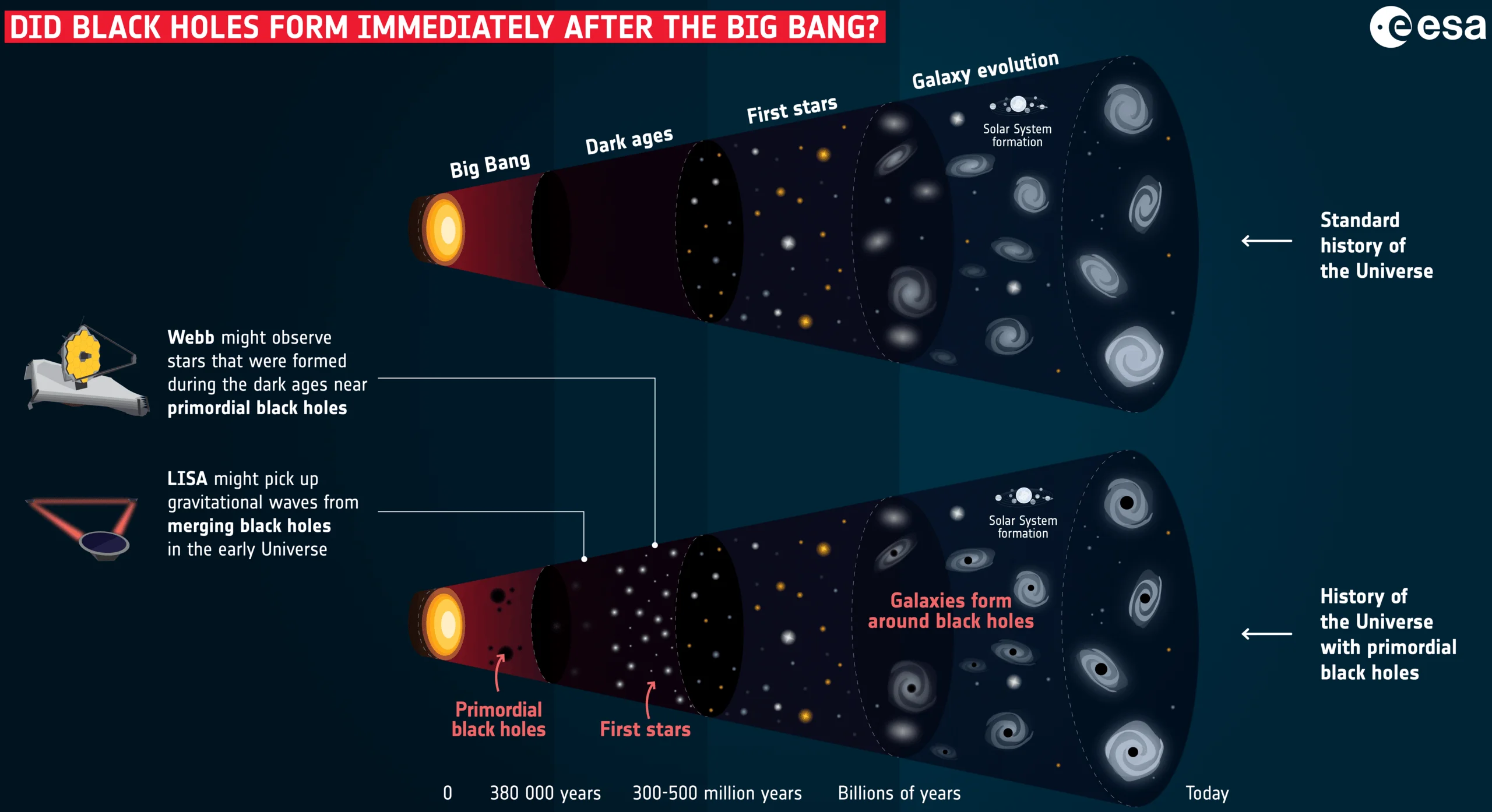
The standard picture, in which supermassive black holes grow from ordinary stellar-mass seeds, doesn’t explain the earliest giants. The alternatives start with much larger seeds: gas streams may collapse directly into black holes of roughly 30,000 to 100,000 solar masses; enormous early stars could reach up to a million solar masses before particle–antiparticle pair production triggers their collapse; or primordial black holes may have formed through more exotic processes, potentially before the first stars existed.
So the apparent puzzle doesn’t mean cosmology is broken. It means the story is more complicated than a single mass estimate or a single growth model can capture. We have candidates, revised measurements, and plausible ways to build massive seeds early; we don’t yet have a settled account of how those ingredients combine. Nearby galaxies are generally less active than distant ones, and black holes are often found through the light from matter they’re consuming. A quiet giant can be hard to see, much like a tiger that isn’t roaring.
If you’re following this field, the next useful evidence will come from observations that track black hole growth across time and test how early seeds formed. New data and observatories may finally connect the first seeds to the giants we see today. For now, TON 618 is a striking clue, not a complete explanation.
Send in your Ask Ethan questions to startswithabang at gmail dot com!
This article Ask Ethan: Can we solve the mysteries of the largest black holes? is featured on Big Think.



