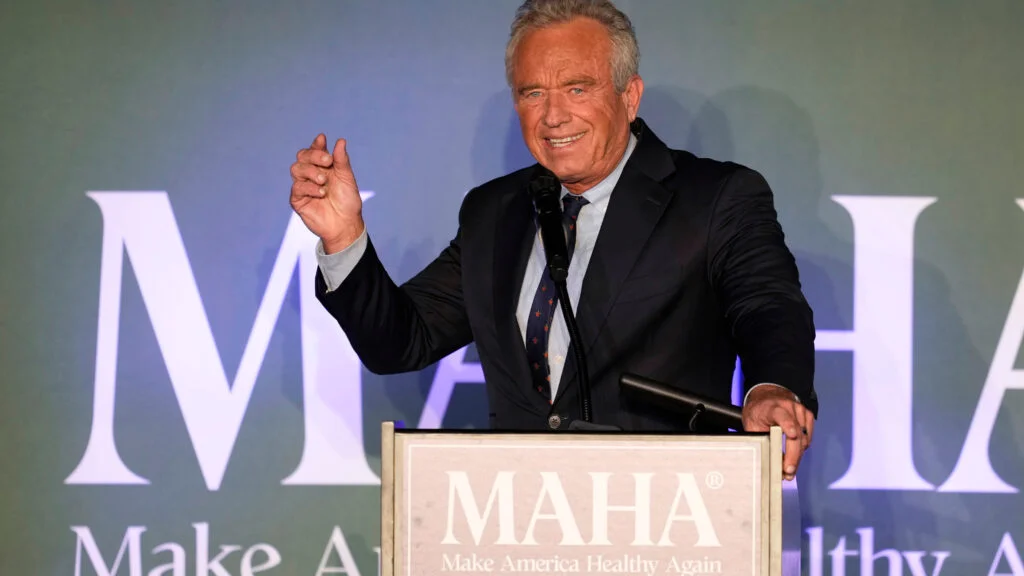
A campaign rally becomes a health debate
Robert F. Kennedy Jr. used a rally in Clive, Iowa, to frame Republican gubernatorial candidate Zach Lahn’s campaign against Big Agriculture as a fight over health and the food supply. The Wednesday night event also put Make America Healthy Again activists’ calls on vaccines and corporate liability in front of a political audience. That combination matters: concerns about how food is produced can draw a broad audience, while arguments about vaccines and liability bring sharper political divisions into the same room.
The rally was organized for Lahn, a farmer-turned-Republican candidate whose platform centers largely on confronting Big Agriculture. Kennedy has been a vocal supporter, though the speakers’ remarks also set the stage for the health secretary’s appearance. The event therefore served two purposes at once: it promoted a state-level candidate and gave national MAHA themes a campaign setting. Whether those themes can win support beyond an already receptive crowd is a different question.
Health claims share the stage with food concerns
Before Kennedy spoke, Florida Surgeon General Joseph Ladapo made inaccurate claims about the hepatitis B vaccine. Zen Honeycutt, who founded Moms Across America, called for ending liability shields for pesticide and pharmaceutical companies. Michael Boes, Steak ’n Shake’s chief MAHA officer, described the movement as a “catalyst for a monumental shift.”
Those remarks put distinct policy questions under one political banner. Food production, pesticide exposure, vaccine safety and corporate liability are related in MAHA’s rhetoric, but they aren’t interchangeable issues. Each involves different evidence and different choices about what government, companies and individuals should do. Bringing them together can make a campaign message feel coherent; it can also blur important distinctions for listeners.
The vaccine claims deserve particular care because inaccurate statements can shape public understanding of health decisions. The article identifies Ladapo’s remarks as inaccurate and links to a source on vaccine safety. It doesn’t provide the full exchange or detail each claim, so the useful point here is the contrast: a rally built around food and health also gave a prominent place to vaccine criticism. That’s a significant choice of emphasis.
Honeycutt’s call to end liability shields raises another question: how responsibility should be assigned when people believe products or business practices have harmed health. The rally account doesn’t spell out the legal mechanisms or evidence behind that proposal. Still, the appeal is politically legible. It casts corporate accountability as part of a broader effort to protect families, even as the details of any policy change would require more than a slogan.
Kennedy’s appeal is moral as well as political
A video montage of Kennedy speaking, greeting President Trump and doing pull-ups played to “Free Bird” before he took the stage. He called Lahn’s agenda a “spiritual battle.” The presentation made the appearance feel like more than a routine endorsement: it tied Kennedy’s public identity and personal performance to a candidate’s campaign message.
“We have to figure out a way to grow food without poisoning our kids, without giving ourselves cancer, without destroying the soils that enrich us and enrich our microbiome that connect our brain and all of our organs. And make us healthy, robust and vibrant people,” Kennedy said.
His language turns a set of agricultural and health concerns into a moral claim about what society owes children and the communities that produce food. That can be persuasive because it starts with outcomes most people care about: health, safe food and healthy soil. But the breadth of the statement also leaves open the hard questions. Which practices are responsible for which harms? What changes would address them? The rally account doesn’t answer those questions, and Kennedy’s speech, as quoted, doesn’t specify a policy program.
This is more significant than it looks. Campaigns can shift which subjects their party’s voters expect candidates to address, even before they produce a detailed platform. If you’re working in this space, the signal is that food production and chronic disease are being presented alongside familiar political arguments about vaccines and corporate power. The bundle may help activists reach voters who wouldn’t come to a rally for any one of those topics alone.
What the 2026 audience may hear
The rally’s mix of food concerns, chronic disease and vaccine criticism shows how MAHA themes are entering Republican campaign events ahead of the 2026 midterms. Continue to STAT+ to read the full story…
That political shift is visible in the event’s lineup and framing, but the rally alone can’t show how far the message will travel. A campaign appearance tells readers what organizers want to emphasize; it doesn’t establish how voters will respond or whether the themes will become concrete proposals. And yet, putting these issues on the same stage gives them a shared political vocabulary, with “health” doing much of the work.
Here’s the thing: broad language can unite people around a concern before they agree on causes or solutions. That may be useful for a candidate seeking support across different constituencies, but it leaves room for tension when policy details come into view. Calls to change farming practices, vaccine messaging and corporate liability won’t necessarily attract the same supporters or invite the same debate.
(And this is the part most people overlook.) The rally’s most durable effect may be the way it connects these subjects in public, not any single line from the stage. A campaign can make food and health feel like central political questions by repeating that connection. Whether Lahn’s campaign can turn it into a persuasive case for voters remains to be seen. A message, before the policy.


