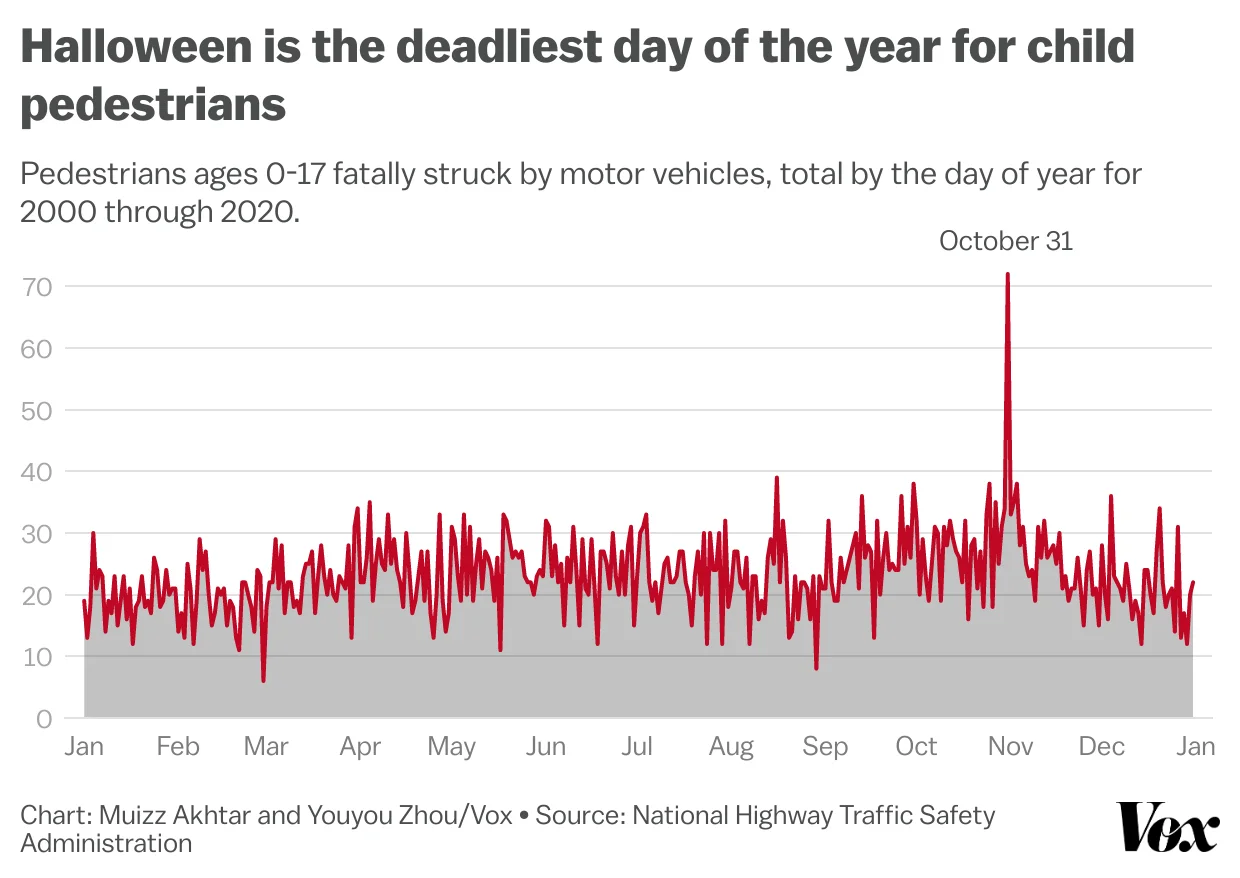
Halloween’s most immediate danger for children isn’t a suspicious piece of candy. It’s traffic. Federal crash records cited in a 2026 analysis show that 45 children were killed while walking on Halloween between 2010 and 2024, more than on any other day. Children under 18 are three times more likely to be struck and killed by a car that evening than on a typical day; for children ages 4 to 8, one study puts the risk at ten times higher.
That makes Halloween a revealing test of how well streets serve the people who use them. Millions of children head outside to trick-or-treat, as the US Census Bureau has noted, following a tradition with a long history. Public fears often focus on poisoned sweets and other stories of Halloween danger. Tales of razor blades in apples and warnings about rainbow fentanyl in candy have circulated for years. Yet the risk of children receiving drug-laced treats is unfounded, while the danger posed by cars is measurable.
Why Halloween concentrates the risk
Halloween brings more children onto neighborhood streets, often at dusk, when drivers have less time to spot them. Costumes can make children harder to see, and masks may limit their peripheral vision. Kids crossing between houses may pay less attention to traffic, while some adults are driving after drinking. A 2019 study in JAMA Pediatrics identified these conditions as factors that can raise pedestrian risk during Halloween celebrations.
“You’re going to have increased numbers of children, including younger children who are out on the streets,” said Lois Lee, a professor of pediatrics and emergency medicine at Harvard Medical School. She also pointed to adults driving home from work, noting that dark clothing and costumes can make children more difficult to detect. The calendar can add to the exposure: Halloween falling on a Monday, she said, means people will be commuting while children are out.
The danger extends beyond children. The JAMA Pediatrics analysis found that the risk of death for all pedestrians was 43 percent higher on Halloween than on an ordinary evening. The spike is striking, but it sits within a wider pattern: motor vehicle injuries are the second leading cause of death among US children, after gun injuries. Pedestrian deaths among adults and children have also reached a 40-year high.
That context complicates the familiar response that more children outside naturally means more accidents. Doug Gordon, a writer and podcast host who advocates for safer streets, argues that this explanation accepts an everyday level of danger as inevitable. “Sometimes when you talk about this issue, you get pushback from people and people say, ‘Well, of course, you have more children on the streets, of course, more children are going to die,’” said Gordon, whose work is described by Brooklyn Spoke. “But that accepts a baseline level of danger that I think we as a society have in fact accepted on the other 364 days of the year.”
Street design shapes what drivers and children can do
Some risks come from the vehicles themselves. Drivers may be distracted by phones or by the increasingly elaborate infotainment systems built into newer cars. At the same time, larger vehicles have become more common: SUVs account for about half of US car sales, and research suggests that SUVs pose a greater risk to pedestrians than smaller cars. Consumer Reports has also examined the dangers of large trucks.
Gordon summarizes the physics simply: “Mass times [acceleration] is force.” When a heavier vehicle hits a child, the consequences can be more severe. A car-centered approach to city design compounds the problem. Charles Marohn, founder and president of Strong Towns and an urban planning and civil engineering expert, has argued that street engineers often prioritize moving cars quickly from one place to another. The organization has challenged those priorities in its discussion of how traffic engineers shape streets.
The results can be counterintuitive. In one Utah example, a traffic safety committee reportedly couldn’t identify a way to make a five-lane crossing near a school safer for students except to remove the crosswalk. That kind of response illustrates the limits of treating pedestrian safety as a matter of individual caution. Children can be careful, but street layouts determine how much room they have to see, cross, and avoid traffic.
Safer Halloween routes can point to lasting changes
Some communities have tried a direct fix: temporarily keeping cars off streets where children gather. Programs that create open streets expanded in some places during the Covid-19 pandemic, making public space available without car traffic. New York City announced a “Trick or Streets” plan with 100 car-free zones scheduled for Halloween from 4 to 8 p.m., according to Curbed. Other approaches have appeared in cities with different patterns of density and car use: St. Petersburg, Florida, planned to close its city center, while Seattle let residents apply for permits to close neighborhood streets, as Slate reported.
These measures offer immediate ways to create safer routes. The broader goal is a neighborhood where children can walk comfortably throughout the year. Gordon uses the “popsicle test” to describe that standard: a child should be able to walk to a store, buy a popsicle, and get home before it melts. That simple trip asks a serious question about whether a place is designed for children to move around independently.
“If you start thinking along those lines, then I think you start thinking along the lines of what infrastructure is needed to make that possible, where I would feel comfortable letting my kid do that,” Gordon said. Halloween, he added, is “like a giant version of the popsicle test” because whole neighborhoods of children are out at once.
For Lee, safer streets bring everyday health benefits as well as fewer injuries. “Having sidewalks and good lighting is a good preventive measure, not just for injury prevention, but also just general health,” she said, pointing to the exercise and outdoor activity that walking encourages. Gordon makes a related point about children’s freedom: when streets feel safe, kids can explore independently, and parents have less reason to worry about a passing car.
Halloween can make the stakes visible, but the design choices that determine a child’s safety apply on every ordinary evening, too. Sidewalks, lighting, crossings, and car-free routes can make trick-or-treating safer while helping children move around their neighborhoods throughout the year. The practical measure of a safer city is whether a child can walk home with a bag of candy and a little more independence.
Correction, October 31, 4 pm ET: A previous version of this story had an inaccurate definition of the equation for force.
Update, October 30, 2026, 10 am ET: This story has been updated to include new federal crash data.


