


Get your daily dose of health and medicine every weekday with STAT’s free newsletter Morning Rounds. Sign up here.
Mitochondrial replacement therapy is being sold to some people facing infertility as a route to a genetically related child. The reporting behind STAT’s new investigation points to a more sobering picture: patients are crossing borders to pursue a treatment with little evidence that it improves pregnancy odds for older women, while the commercial machinery around it remains difficult to scrutinize.
The investigation, by Megan Molteni, follows women drawn to reproductive tourism companies that connect patients with clinics offering MRT. One patient, Heidy Willis, had endured several unsuccessful IVF rounds before traveling to Albania for the procedure. Her genetic material was placed into another woman’s egg cells, with the donor’s mitochondria intended to supply energy to the developing embryo.
MRT is unavailable legally in the United States, but agencies charge thousands of dollars to direct patients to clinics elsewhere. The companies often market it to women over 40, a group for whom the available evidence offers scant support that MRT can reverse age-related infertility. A bioethicist at Johns Hopkins University put the concern bluntly to Molteni: “You’re paying for the privilege of being a guinea pig.”
Following patients through a fragmented system
Molteni’s investigation grew from years of reporting on MRT. In 2019, she covered results from a small pilot study of the technique for infertility. She continued to track the field, including later reports on births following mitochondrial replacement in the United Kingdom.
The immediate lead came in February, when a couple in the U.K. contacted her about IFG, a reproductive tourism company promoting MRT as a potential answer to age-related infertility. The woman, a doctor in her 40s, had been attracted by the prospect of having a genetically related child. She ultimately chose not to proceed after a series of troubling experiences, but she knew other women considering or undergoing treatment and helped Molteni reach them.
That patient network offered a way into a business that is purposefully hard to map. Reproductive tourism can divide a course of care into separate services, then route those services through companies and clinics in different countries. The result is a chain of decisions and procedures spread across jurisdictions, making it difficult for patients and outsiders to see who is responsible for each part.
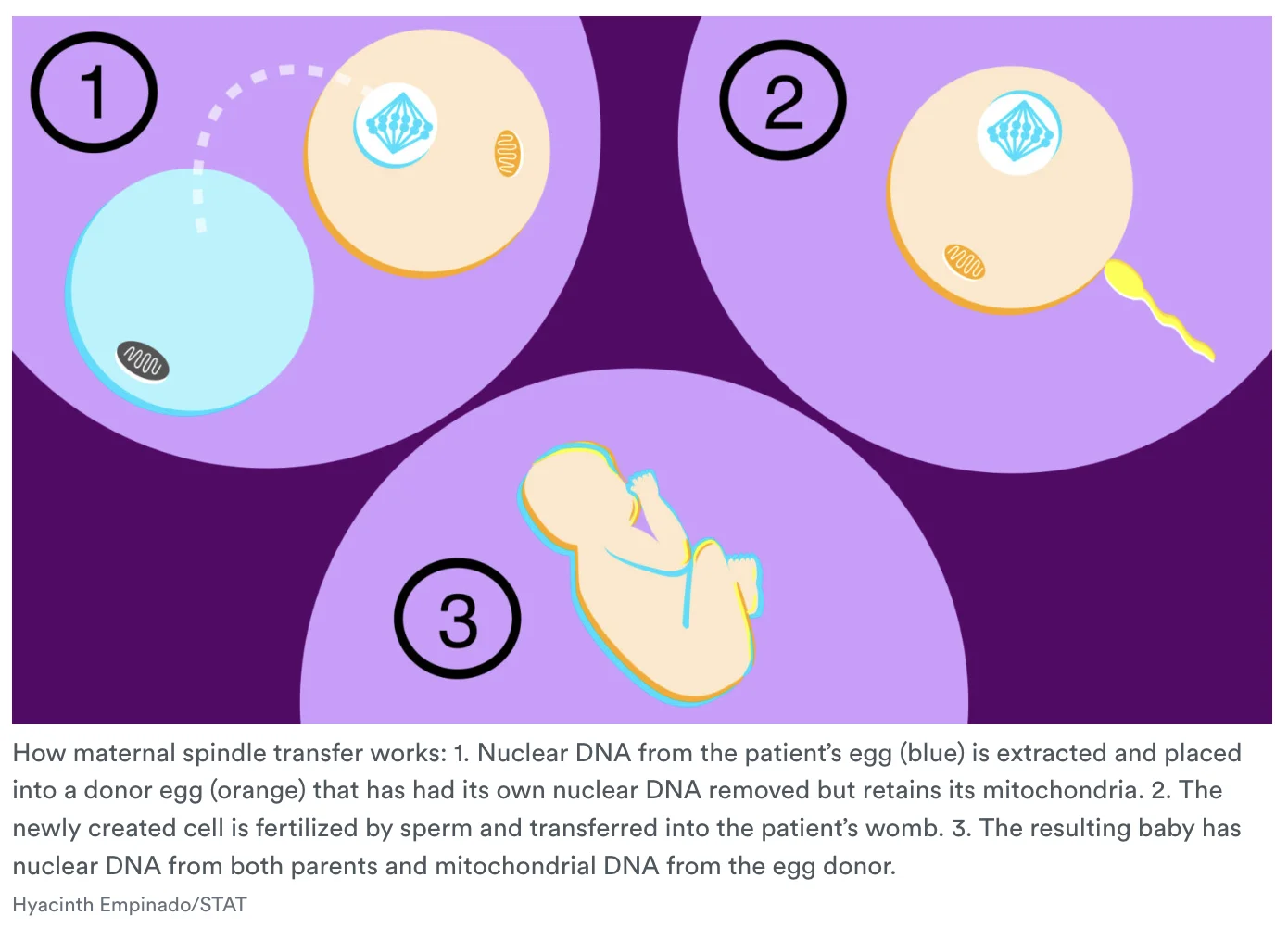
MRT adds another layer: the science itself is complex, and clinics must operate within differing national rules. To understand how the treatment was being delivered, Molteni traveled to places patients were going, including an Albanian clinic in a country whose laws are more permissive toward procedures such as MRT.
Long-awaited clinic data offers a reality check
A major reporting breakthrough came from Ukraine. Before Russia’s full-scale invasion in 2022, a clinic there had been among the most prolific providers of MRT. Researchers had waited for the clinic’s results, but publication had stalled and communication had grown quiet after the war began.
Molteni contacted the clinic’s former embryologist, Pavlo Mazur, to ask about commercial providers offering MRT for age-related infertility. She did not expect a response. Instead, the conversation opened into months of interviews and access to data Mazur wanted to make public but had not been able to publish.
The reasons for that delay were mixed, according to Molteni: some were understandable, while others reflected skepticism toward research from countries without a long-established record of evidence-based medicine and tightly regulated biomedical research. The clinic’s results, she said, provide the strongest evidence against treating MRT as a reliable fix for age-related infertility.
That finding matters because marketing can make a technically advanced procedure sound like a proven answer. Patients may be navigating a stressful, expensive process while relying on claims that outrun the evidence. In this case, the gap between a compelling biological theory and demonstrated benefit is central to the story.
Why the reporting took eight months
Molteni spent eight months investigating the companies that connect patients to MRT, speaking with dozens of patients, employees and researchers. The work required following both the people seeking treatment and the organizations that arrange it, across a system where the service can be split among multiple actors.
Willis’s experience illustrates the personal stakes. After failed IVF attempts, she was willing to consider an option abroad that promised a chance at pregnancy. The investigation also includes a later development in her story that Molteni’s editor described as startling. That detail underscores why patient accounts are more than anecdotes: they can reveal what happens after a clinic’s procedure and a company’s sales pitch.
Molteni’s earlier reporting helped frame the questions. Her 2019 coverage examined a small pilot study, while subsequent work tracked developments in the U.K. The new investigation shifts attention from scientific possibility to the commercial networks bringing MRT to patients, and to the evidence those networks can point to when promoting treatment.
Other health stories in focus
STAT’s coverage also looks at the broader forces shaping health care. Daniel Payne spoke with more than two dozen policymakers, lobbyists and experts about how the 2026 midterm elections could affect health policy. The sources described deep dissatisfaction with the status quo, alongside uncertainty over what control of Congress might mean for policy changes. One consultant said they had warned insurance leaders to expect “significant” changes and to “be afraid.” Read the report, or watch the STATus Report. STAT’s midterms page gathers additional coverage.
Election stress has also drawn researchers’ attention. Studies have found higher rates of arrhythmias in the weeks around elections and more heart attack hospitalizations just after voting day. A surge of news and related stress can increase adrenaline and activate the sympathetic nervous system, potentially affecting the heart’s electrical activity in people already susceptible to abnormal rhythms. STAT’s report examines findings around the 2016 and 2020 elections.
A First Opinion essay considers cancer care during pregnancy through the experiences of two women with ovarian cancer. Maternal fetal medicine physician Elyce Cardonick knew both patients: they became friends and compared experiences after giving birth. One is now thriving with her 28-year-old twins; the other died before her child turned three. The essay asks what shaped those different outcomes and what clinicians need to understand when treating cancer during pregnancy. Read the essay.
Further reading
- Serbia just elected the world’s brainiest parliament, Science
- Doctors say a rare kind of measles is on the rise, The Atlantic
- Christa Pike’s execution doctor speaks, New York
- How much do you know about sugar? New York Times
- CDC scientists sought urgent alert on measles in pregnancy. It wasn’t approved, The Washington Post
For fertility specialists and patients alike, the emerging takeaway is clear: MRT’s promise deserves scrutiny against published outcomes, especially when companies market it to people facing age-related infertility. Molteni’s reporting suggests that the most useful next step is not another promise, but clearer evidence about who benefits and what patients actually experience.


