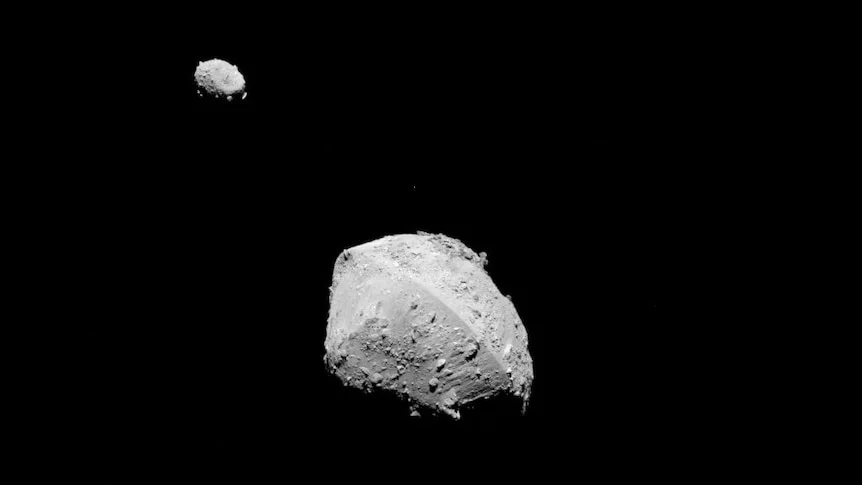
A crater across Dimorphos
The first close-up look at DART’s impact site on Dimorphos suggests the 2022 collision reshaped much of the small asteroid’s visible surface. Images from the European Space Agency’s Hera spacecraft show a crater covering nearly the entire side struck by NASA’s spacecraft, while Dimorphos continues to tumble in a chaotic rotation. The pictures offer a striking view of the aftermath, but they’re also a reminder that a collision’s effects can extend beyond the simple question of whether an asteroid’s orbit changed.
“The side impacted is now completely covered by a crater, with the visual impression that a piece of the asteroid was cut off by the impact,” said Michael Küppers, Hera mission scientist at ESA. The opposite side shows no clear evidence of major changes, he said, a combination that Küppers called surprising. That contrast matters: it suggests the damage visible from one side doesn’t tell the whole story of how the collision affected the body, and researchers need close observations from different angles to interpret it.
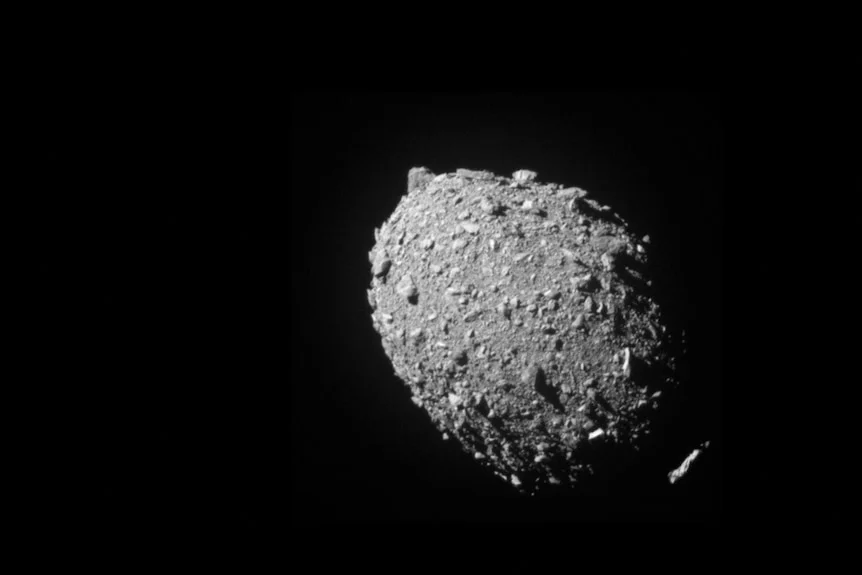
Asteroid moonlet Dimorphos as seen by the DART spacecraft seconds before impact, in 2022. (Reuters: NASA/Johns Hopkins APL/Handout)
What the impact changed
DART, short for Double Asteroid Redirection Test, hit Dimorphos on September 26, 2022, at about 22,530 kilometres per hour. The mission demonstrated that a spacecraft could alter an asteroid’s path. Earlier measurements confirmed that Dimorphos’s orbit changed; Hera is examining what the collision did to the asteroid itself. Those are related but distinct questions: tracking an orbit can show that a push had an effect, while inspecting the target can help explain how that effect was produced.
Dimorphos is an oblong rocky body about 151 metres wide, orbiting the 730-metre asteroid Didymos. The pair is currently about 193.5 million kilometres from Earth. Both are classed as near-Earth asteroids, though neither threatens the planet. Their paired arrangement gives researchers a way to study the consequences of an impact on a small body in orbit around a larger one, rather than treating the collision as an isolated change in motion.
The impact also left hundreds of boulders floating around the system, Küppers said. Dimorphos’s altered rotation and the sharply uneven damage offer clues to how a kinetic impact affects an asteroid’s structure—knowledge needed to assess the technique for a future object on a collision course with Earth. The crater’s broad coverage is visually dramatic, but appearance alone can’t establish how much material was displaced or how the asteroid’s interior responded. That’s why the surface images need to be read alongside measurements of the body’s motion and structure.
Hera’s closer inspection
Hera, roughly the size of a small car, is observing the asteroid pair from about 25 to 30 kilometres away. Next month, it is scheduled to approach within 13 kilometres, giving its instruments a closer view of the crater and surrounding terrain. The change in distance should help the spacecraft examine details that are harder to resolve from farther out, while continuing to place the impact site in the context of the whole asteroid.
In January, the spacecraft is due to release two shoebox-sized CubeSats. The miniature satellites will move closer to the asteroids and study them further, including their internal structure. That work should help connect the dramatic surface damage in Hera’s images with the way the impact changed Dimorphos as a whole. A crater is the visible record of the collision; understanding what lies beneath it is part of determining how the force traveled through the asteroid.
Why the uneven damage matters
This is more significant than it looks. A deflection method is useful only if researchers can understand how a target responds when struck, and small asteroids aren’t necessarily solid, uniform rocks. Similar systems can behave in ways that depend on their internal makeup and on how material moves during an impact. Hera’s observations can help test those assumptions in this specific case, though the images by themselves won’t settle every question about other asteroids.
The difference between the battered impact side and the apparently less changed opposite side is a useful starting point. It raises questions about how the collision’s energy and ejecta were distributed, and why Dimorphos now tumbles chaotically. The report doesn’t establish a complete explanation, and it shouldn’t be read as one. A close visual survey is evidence, not a full account of the asteroid’s internal structure.
If you’re working in this space, the practical value is in combining observations: orbit measurements show the change in motion, surface images map visible damage, and the CubeSats are intended to investigate the interior. (And this is the part most people overlook.) A successful demonstration of a push doesn’t automatically tell mission planners exactly how a different asteroid would react. The physical details matter.
Hera’s next observations will add to that record as it moves closer and deploys its smaller companions. The findings could sharpen the picture of how a kinetic impact changes both an asteroid’s path and its physical condition. For now, the crater and the chaotic rotation point to a collision with effects that were not confined to a neat dent in the surface. A messy result, and a more useful one for understanding what happened.


