For Heidi Biggin, smart glasses have changed what an ordinary trip to the shops can look like. The Ballarat resident, who is legally blind, says Meta’s AI glasses give her enough information to navigate stores independently—and have made her reconsider getting another guide dog.
Biggin has been legally blind since she was 22. For 16 years, a guide dog has helped her with everyday tasks such as crossing roads and buying groceries. She has worn her current dog for about four years and has used the glasses for roughly six months.
Store information, delivered by voice
Biggin can ask the glasses where she is and hear a spoken description through the frames. In a Kmart, for example, she might say, “Hey Meta, look and tell what section of Kmart I'm in.” The glasses can identify the women’s section and describe nearby features, including a register and the entrance.
That kind of help has given her a greater sense of privacy and independence while out with her three children. Biggin says she used to attract attention and questions when she went shopping with her guide dog. With the glasses, she feels less conspicuous.
She expects to use them to shop for a blue athletics top for her twin nine-year-old boys, a task she says she’ll be able to manage by herself. “I’d go as far as to say I wouldn’t get another guide dog because of these AI glasses,” she said.
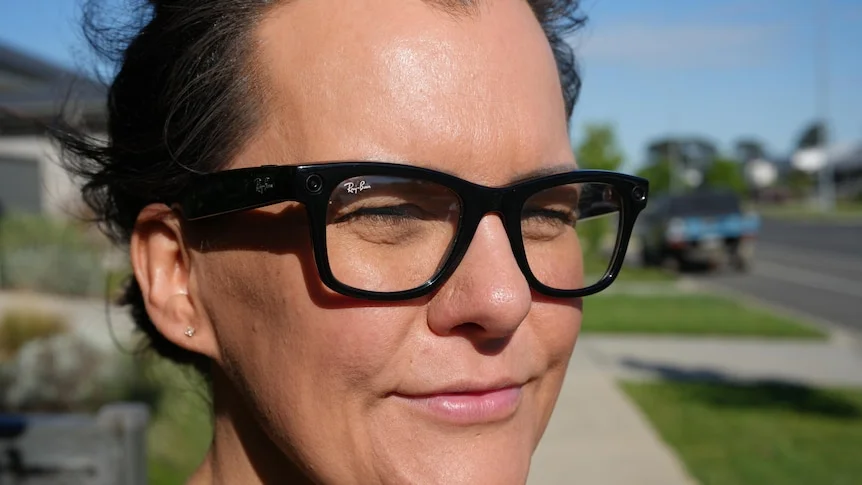
Heidi Biggin says AI glasses have opened up her world. (ABC News: Charlotte Wilkes )
Privacy concerns follow her in public
The glasses bring a different kind of unwanted attention. Biggin says people stop her at least three times a week, sometimes grabbing her arm to accuse her of recording them. A light on the frames when they’re in use, she says, prompts people to assume she’s filming.
Having to explain the device repeatedly has become exhausting. Biggin wants people to understand that smart glasses can serve as assistive technology, not just as cameras. She says she doesn’t look blind and doesn’t want to wear a visible badge asking strangers to treat her differently.
Her experience highlights a challenge for wearable assistive devices: they can make a user less conspicuous while also drawing suspicion because people don’t know why the technology is being worn.
School restrictions raise questions about access
Biggin also works as an inclusion coach in schools and is concerned about a Victorian ban on smart glasses in schools due to start in term one next year. She says it’s unclear how someone could qualify for an exemption, or what documentation would be required.
Without that guidance, Biggin says she won’t be able to wear the glasses at work when the restriction takes effect. She argues that the rules need to account for people using the devices for legitimate accessibility needs.
Guide dogs and glasses serve different roles
Guide Dogs Victoria’s Erin Goedhart, a vision-impaired user of both guide dogs and smart glasses, says the technology shouldn’t be treated as a substitute for a primary mobility aid. She is currently between guide dogs and uses a cane, alongside smart glasses.
“There is absolutely no way I could get from A to B, with the glasses and not a mobility aid as well,” Goedhart said. She expects guide dogs and white canes to remain essential for the foreseeable future, even as wearable technology improves.
In Victoria, breeding, raising and training a guide dog takes nearly two years and costs more than $50,000, with government schemes covering the cost for clients. Wait times range from three months to almost two years.
Biggin’s experience shows how voice-based AI can help with specific everyday decisions, from identifying a shop section to locating an entrance. Goedhart’s view points to the practical boundary: smart glasses can add useful information, while safe, reliable mobility still depends on aids designed to guide movement.


