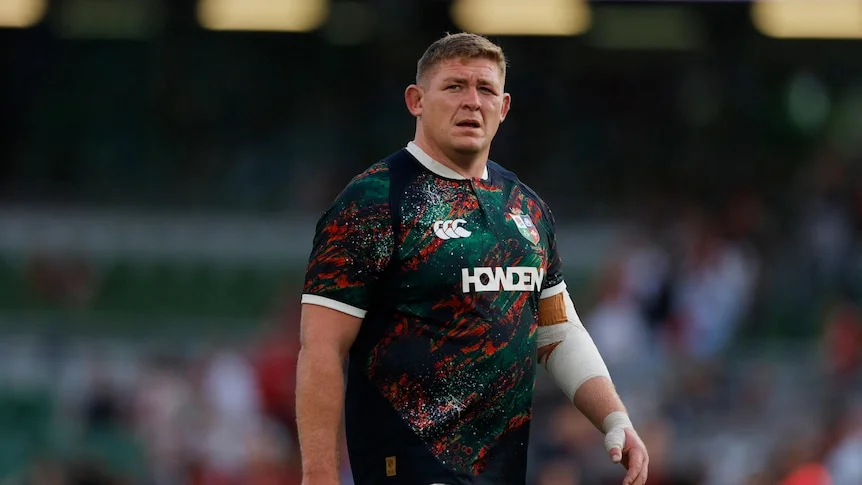
Tadhg Furlong’s citation puts a serious allegation against a senior Ireland player before the United Rugby Championship’s disciplinary process. The Leinster prop is accused of grabbing Munster No. 8 Gavin Coombes during their match at Dublin’s Aviva Stadium on Saturday, 24 October. The allegation concerns conduct that rugby’s laws explicitly prohibit, but a citation is an accusation to be examined, not a verdict.
Coombes raised the claim during the game. Referee Andrew Brace ordered an immediate television review, but it was inconclusive and produced no evidence of the incident. That leaves the match-day review without a clear answer; it doesn’t, by itself, settle what happened. The referee’s report nevertheless recorded the complaint, allowing citing commissioner Peter Ferguson to review the matter after the match.
What the citation says
The URC said on Monday that Furlong had been cited over an incident in the 37th minute of the Round 4 fixture. The complaint falls under Law 9.27, which bars conduct contrary to good sportsmanship, including grabbing, twisting or squeezing an opponent’s genitals. The union said arrangements for the disciplinary process were under way. The rule identifies the type of conduct at issue; the hearing will have to assess the allegation and the available evidence.
That distinction matters because the television review and the later citing process serve different roles. The review during play did not produce evidence of the incident, while the referee’s report preserved the complaint for further examination. The source gives no detail about what evidence Ferguson considered or what material will be presented at the hearing. For now, the public record described here establishes that a complaint was made, a review took place, and a formal citation followed.
Munster coach Clayton McMillan said he supported Coombes, adding that the player “wouldn't do it lightly” and that it was “not the sort of person Gavin is.” Leinster head coach Leo Cullen declined to weigh in on the case, saying his comments would not help the citing commissioner. He added that, from what he had seen, “I can't see anything.” Their comments reflect the positions of people close to the teams, but neither resolves the factual question before the disciplinary process.
What a citation can establish
A citation is a procedural step that brings an alleged act of foul play into a formal disciplinary review. It doesn’t mean the player has been found responsible, and the inconclusive television review shouldn’t be treated as proof either way. The hearing is the point at which the allegation can be assessed through the league’s process. Until then, certainty would outrun the information available.
That may sound like a narrow distinction, but it has practical weight in a case involving a prominent international player. Public discussion can quickly turn an allegation into an assumed fact, particularly when the conduct described is serious. The measured account is simpler: Coombes raised the claim, the referee recorded it, and the citing commissioner’s review led to a citation. The outcome remains unknown.
Why the outcome matters
Furlong, 33, is a British & Irish Lion and a key member of Ireland’s squad, approaching 100 Test caps. He is named for the team’s November Nations Championship fixtures. A finding against him could bring a lengthy suspension and disrupt those plans, while also putting his reputation under scrutiny. This is more significant than it looks: the case links a disciplinary decision to Ireland’s preparations and to the standing of one of its established players.
If you're working in this space, the immediate question is how the hearing weighs the complaint against the inconclusive review. That’s the part most likely to shape any decision and its consequences for the November fixtures. And this is the part most people overlook: the case also tests how the competition handles an allegation that was raised during play but couldn’t be resolved by the television review at the time. The source doesn’t say what evidence will be available at the hearing, so the answer can’t be assumed in advance.
There is a recent URC precedent: Bulls hooker Jan-Hendrik Wessels received a nine-week suspension last season after grabbing Connacht’s Josh Murphy’s testicles. That case shows that the league has imposed a substantial suspension for similar conduct. It offers a point of comparison, not a forecast: the cases will be assessed through their own disciplinary process, and the source provides no basis for assuming the same outcome here.
What happens next
Furlong’s citation is not a finding of guilt. The next consequential step is the disciplinary hearing, whose arrangements the URC says will be announced in due course. Until that process concludes, the allegation, the match-day review and the eventual decision need to remain distinct. No ruling has been reported here.
For Ireland, the timing makes the process worth watching as the November fixtures approach. For the URC, the case will turn on what the hearing can establish from the material available. A straightforward question. A serious allegation. An unresolved answer.
Privacy information: ABC Privacy Collection Statement.


