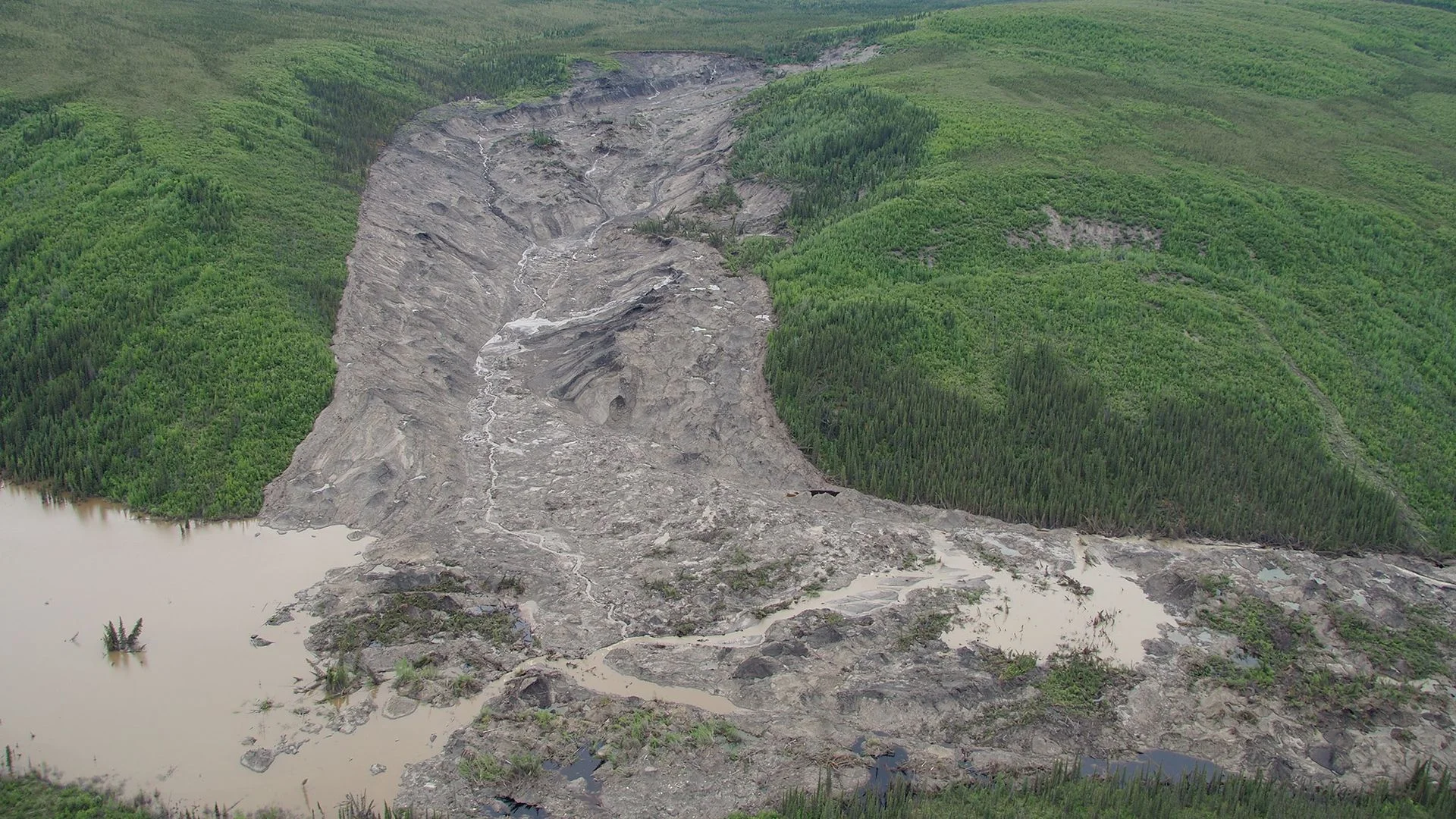
Large blocks of frozen ground are breaking loose from slopes in Canada’s Northwest Territories, pointing to a landslide process that could emerge in other fire-prone regions with shallow permafrost. Researchers have identified more than 150 such slides in the area, including two that moved millions of cubic meters of soil and rock. The scale matters because these failures don’t follow the more familiar pattern of thawed soil gradually turning into a muddy flow. They suggest that frozen ground can remain apparently intact, then move in large pieces after conditions beneath it change.
Frozen ground moves in blocks
The slides, known as permafrost detachment slides, differ from the familiar pattern of thawed ground turning into a muddy flow. Fieldwork and satellite imagery showed researchers that these slopes were releasing substantial blocks of still-frozen material. Some reached 10 meters high, roughly the height of a two-story house. That distinction helps explain why the failures can reshape a slope quickly: material can detach as a thick mass, carrying soil and rock downslope before the ground has thawed all the way through.
Study leader Joseph Young, who completed the work during his doctoral studies at the University of Alberta, said the affected valleys had long appeared stable. “It has been stable, and then it just flipped a switch, essentially,” he told Live Science. The findings were published Sept. 23 in Geophysical Research Letters. Young said slides of this kind had not previously been observed in the region and may be unprecedented there for at least 10,000 years. A long record of apparent stability can be misleading in this setting: changes underground may build gradually before the surface gives way.
Two examples show the scale. A 2017 slide in the Johnson River Valley carried more than 18 million cubic meters of soil and rock downslope. In 2018, a slide in the Redstone River Valley moved nearly 4.5 million cubic meters of debris. The larger scar stretched almost 3.2 kilometers; the smaller ran about 1.2 kilometers. Those figures describe not just landslides, but substantial transfers of material from slopes into river valleys, where it can alter drainage and move downstream.
A delayed response to fire and warming
The researchers used field measurements, including electrical surveys to estimate permafrost depth, to model how the slopes failed. Their explanation combines rising ground temperatures with the effects of a severe wildfire in 1995. Permafrost in the area has warmed about 0.3 degrees Celsius per decade since monitoring began in 1980. The measurements and model point to interacting pressures rather than a single trigger: warming changes the frozen ground over time, while fire affects the surface and can open a path for thaw to reach deeper layers.
Rather than thawing downward from the surface into a slurry, the process appears to start with fire-related thaw and warming that open cracks near the slope top. Those cracks let thaw reach deeper layers, eventually melting the base of the permafrost. The downward progression can take about 20 years to reach 20 meters, matching the timing researchers observed in both river valleys. That slow progression helps account for the gap between the wildfire and the later slope failures. The surface may look settled while the frozen material below it is losing support.
“We had a fire in ’95 and then 20 years later, we start to get a lot of these widespread disturbances,” Young said. The lag matters: the visible failure may come long after the fire that helped weaken the frozen ground. It also complicates monitoring, since a slope’s risk may not be obvious from the condition of its surface immediately after a fire.
Effects reach rivers, with wider exposure possible
The Northwest Territories are remote, and no infrastructure has been damaged by the slides so far. But the two studied events blocked rivers, forming new lakes and quickly sending sediment downstream, Young said. A river blockage can change where water collects and how it moves; sediment can also affect conditions beyond the slope where a slide began. The study doesn’t establish what those effects mean for every river, but it shows that the consequences can extend past the scar itself.
Young said many parts of Canada and Alaska have permafrost roughly 20 to 40 meters deep, putting them within the range that may be vulnerable to similar failures. Greater wildfire intensity at northern latitudes could add to that exposure. “This is almost a potential glimpse into the future of what we might be able to expect in these areas with changing forest fire dynamics,” he said. The comparison points to a possible mechanism, not a claim that every shallow-permafrost slope will fail in the same way.
What the findings mean for watching northern slopes
For researchers tracking northern slopes, the key signal may be the combination of fire history, warming ground and cracks that allow thaw to penetrate below the surface. In some places, today’s wildfire could shape slope stability for decades. Here’s the thing: the delay makes the sequence harder to read. If you're working in this space, a quiet slope years after a fire may still warrant attention to what’s happening below ground. The signal may be in the ground before it’s visible in the landscape.
This is more significant than it looks. The findings suggest that monitoring only the immediate aftermath of a fire could miss a later period of slope instability, while the river impacts show why the issue isn’t confined to remote hillsides. And yet, the study describes a specific process in two valleys; it doesn’t show how widespread these failures will become or when other slopes might respond. A warning sign, not a forecast.
For now, the practical value lies in recognizing the ingredients researchers identified: fire, warming permafrost, cracks near the slope top and thaw advancing toward the frozen ground’s base. Their work gives scientists a way to ask more targeted questions about where similar conditions occur and how long a slope may take to respond. The timing is slow. The failure can be sudden.


