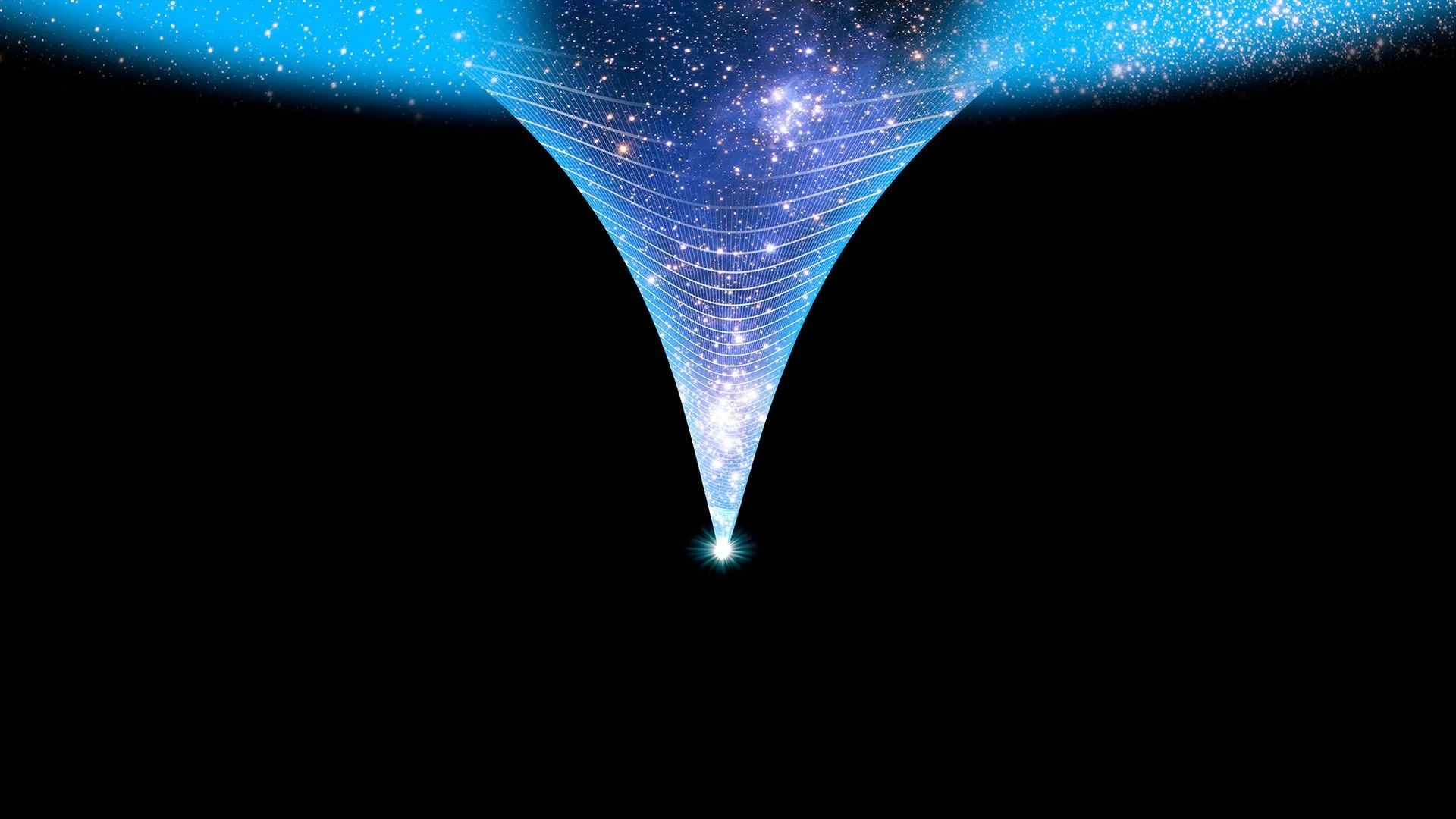
A particle that has never been detected may have briefly dominated the energy of the young universe. The proposal, developed by theoretical physicists Rishav Roshan and Sudipta Show, links that period of dominance to a possible explanation for why matter survived the Big Bang’s expected matter–antimatter balance.
The particle is a hypothetical right-handed neutrino. In the researchers’ calculations, one example weighed about 100 trillion times as much as a proton. Its influence on the early universe’s expansion could have delayed interactions involved in producing the matter surplus. The study was published Sept. 8 in Physical Review Letters.
Why neutrino mass points to a hidden partner
Neutrinos rarely interact with other matter. A solar neutrino could travel through a light-year of lead—about 5.9 trillion miles, or 9.5 trillion kilometers—before hitting an atom. Three known neutrino types, called flavors, change into one another as they travel. That behavior requires neutrinos to have mass, even though the Standard Model of particle physics predicts they should be massless.
One proposed explanation adds right-handed neutrinos to the picture. Physicists describe a particle as left- or right-handed according to how its spin lines up with its direction of motion. All detected neutrinos so far are left-handed; right-handed neutrinos remain hypothetical.
“Right-handed neutrinos are hypothetical particles that do not feel the weak nuclear force,” unlike their left-handed counterparts, said Roshan, a theoretical physicist at the University of Southampton in the U.K. He told Live Science by email that they carry no electric charge and are much heavier. If they mix with ordinary neutrinos, he said, they could help explain both the latter’s mass and their ability to change flavors.
A seesaw with consequences for cosmic history
The seesaw mechanism offers a way to connect heavy right-handed neutrinos with the small masses of ordinary ones. In this framework, each known neutrino contains a faint contribution from a heavier partner. A more massive partner leaves a smaller contribution, and therefore a lighter ordinary neutrino—like opposite ends of a seesaw.
The idea reaches beyond neutrino mass. Right-handed neutrinos have been proposed as part of explanations for dark matter and the universe’s matter–antimatter imbalance, among other open questions. The Big Bang should have produced matter and antimatter in equal amounts. Since the two annihilate on contact, an exact balance would have left no matter to form stars, planets or people.
In one proposed account, heavy neutrinos decayed in the early universe and created a small excess of leptons, the family of particles that includes electrons. Later processes could have turned that excess into the matter surplus we observe. Seesaw models commonly contain three right-handed neutrinos, though researchers often set aside the third, assuming it is either extremely heavy or interacts too weakly to matter.
How a rare particle could take over
Roshan and Show examined what that often-neglected third particle might have done after the Big Bang. Their calculations describe a shift in its role as the universe expanded and cooled. At first, the heavy neutrino would have moved close to light speed, and its energy would have thinned out as space expanded. As it slowed, more of its energy would have remained bound up in its mass. Because that energy was diluted less quickly, the particle’s share of the universe’s total energy could grow until it dominated.
The particle would have remained influential until it decayed into other particles. Roshan said the team’s results point to a period of early matter domination that changed the expansion rate and affected interactions among particles in the Standard Model.
Those interactions depend on whether they can proceed faster than the universe expands. A heavy-neutrino-dominated era would have accelerated expansion, forcing some interactions to wait until the universe had cooled further. That timing matters because the interactions could distinguish between lepton flavors, which in turn affects how a matter excess develops.
The team found that this delay could make room for a lighter right-handed neutrino, about 100 billion times the mass of a proton, to produce the observed matter surplus before the flavors became distinguishable. The decay of the heavier particle would dilute some of that surplus, but the researchers’ calculations suggest the lighter one could still generate enough.
Looking for an imprint in gravitational waves
No accelerator could produce a particle as massive as the one in the study, so any test would have to look for effects it left behind. One possibility is a signature in the background of primordial gravitational waves.
The researchers’ proposed era of heavy-neutrino dominance could leave a kink in that background. Gravitational waves from hypothetical cosmic strings—thread-like defects in space—are among the possible signals. Roshan pointed to future observations from the Laser Interferometer Space Antenna (LISA) and the Square Kilometer Array Observatory (SKAO) as ways to test the idea.
LISA, a European Space Agency mission, is scheduled to launch around 2035. SKAO, a radio telescope project under construction in Australia and South Africa, could search for relevant waves by carefully timing distant pulsars. Roshan said tests may become possible as the facilities begin collecting data. A background hum from the hot plasma of the early universe could also carry evidence of the proposed era, though its frequencies lie beyond the reach of current detectors.
The proposal ties a hidden particle to two linked questions: why neutrinos have mass and why the universe contains matter at all. Its case will depend on whether future instruments can detect the expansion history’s faint gravitational-wave imprint.


