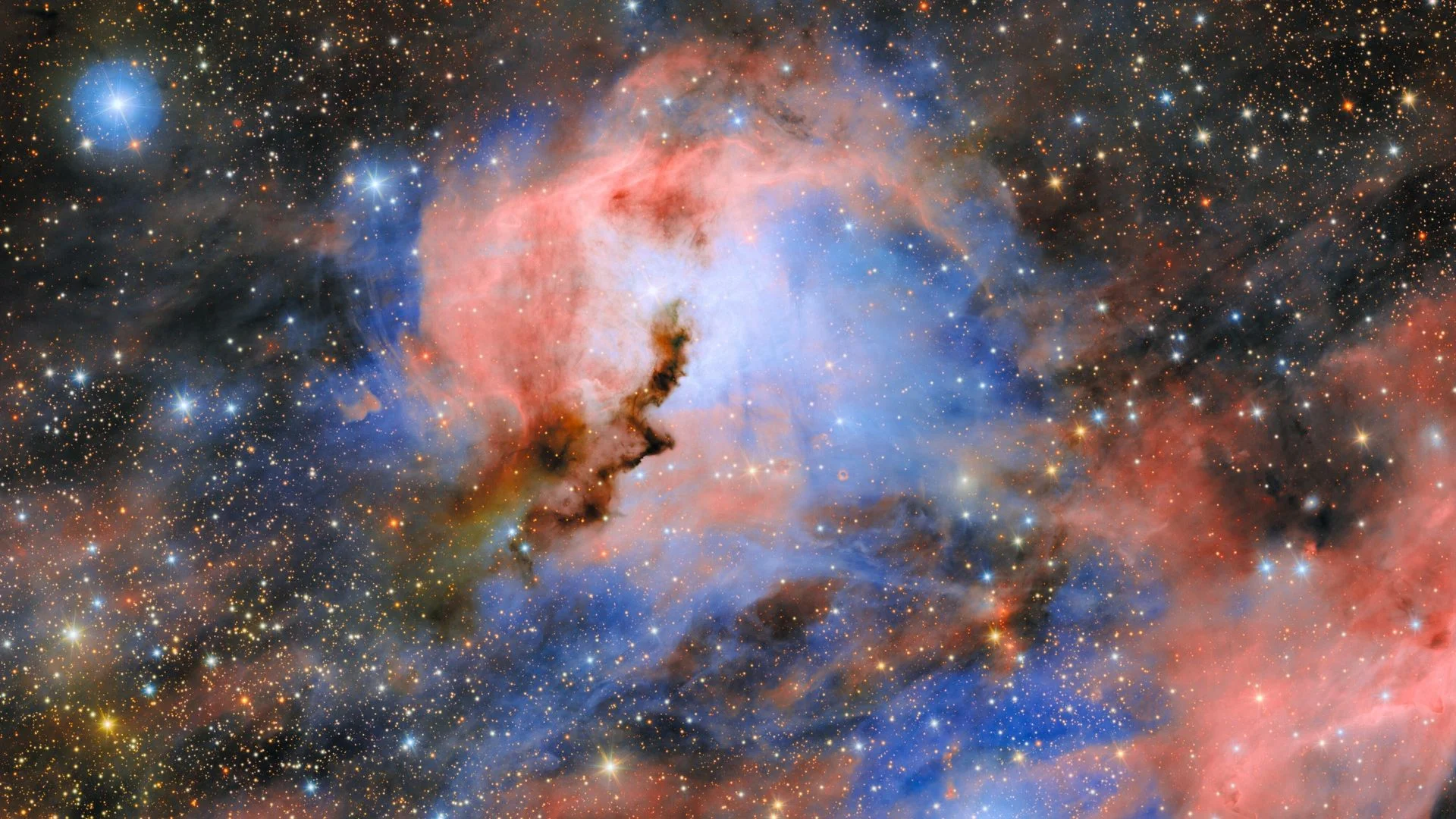
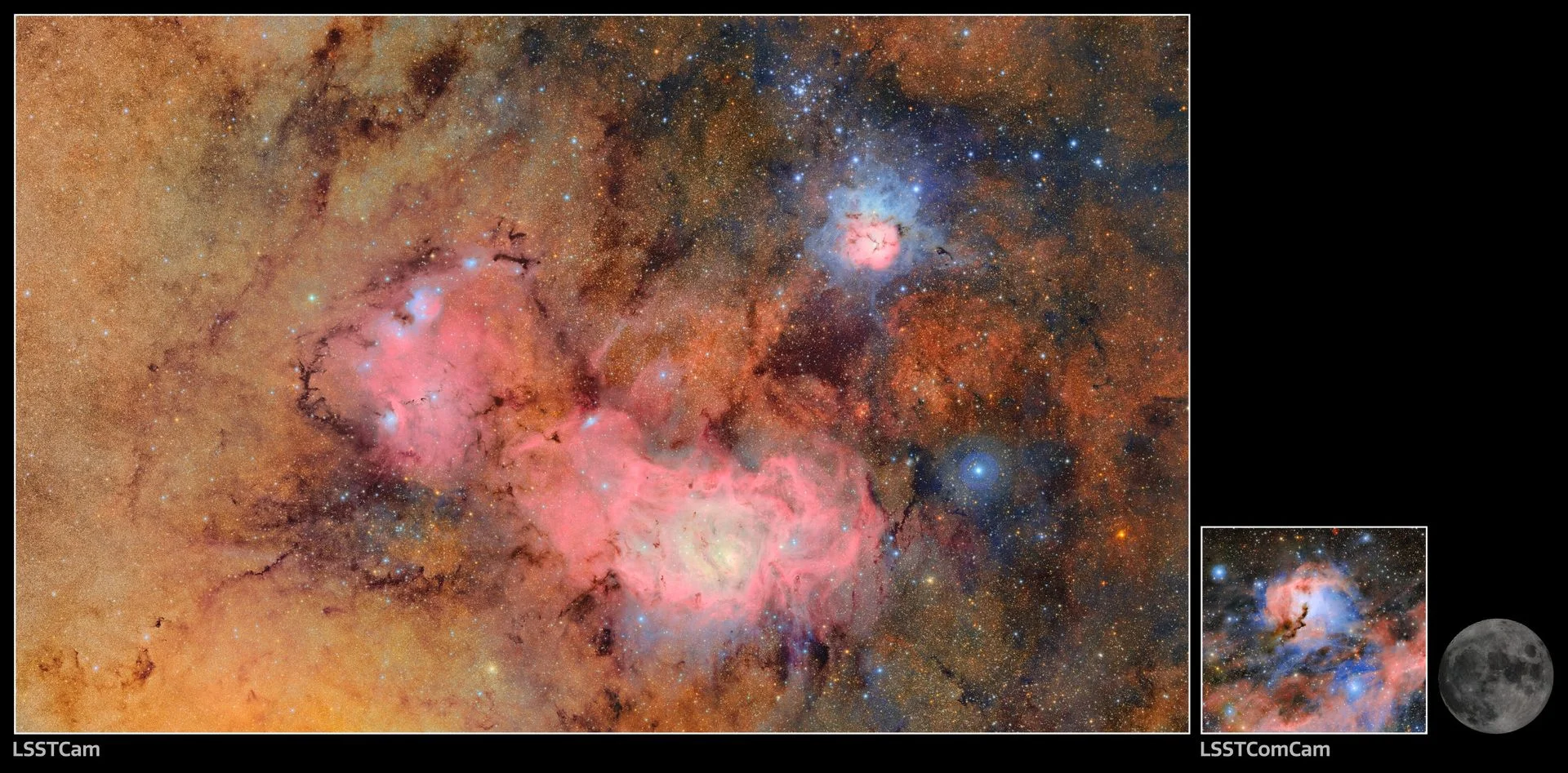
The Seagull Nebula offered an early glimpse of what the Vera C. Rubin Observatory could do. Its test portrait, taken with a 144-megapixel commissioning camera, captured the nebula’s vivid structure across a broad field of view. Rubin’s current camera covers roughly 20 times more sky in each exposure, a difference that points to the observatory’s larger purpose: repeatedly recording wide areas of the sky so astronomers can track both distant structure and changes over time.
A nebula shaped by young stars
About 3,700 light-years from Earth, the Seagull Nebula (IC 2177) lies between Monoceros and Canis Major. Its head, Sharpless 2-292, is a cloud of hydrogen that glows pink as radiation from young stars energizes the gas. Elsewhere in the region, dust reflects blue starlight, giving the nebula its feathered appearance. The mix of glowing gas and reflected light makes the object a useful example of how different materials can produce distinct colors and shapes within one star-forming region.
The apparent eye belongs to HD 53367, a triple-star system. Its young, energetic stars are actively shaping the surrounding cloud, and their flickering light can make the nebula seem to blink. That visual effect is a reminder that these images aren't simply portraits of static objects: the stars and gas are part of a changing environment, even when the changes are too gradual or subtle to follow in a single exposure.
Two years before the image was shared on Oct. 22, 2026, Rubin’s team pointed its experimental camera at the nebula. The image was part of about 16,000 exposures collected from Oct. 24 to Dec. 11, 2024. Those observations put the observatory’s hardware, software and image-processing systems through an early test. A commissioning image has a dual purpose: it can reveal an astronomical target while also showing whether the instruments and processing pipeline can turn raw observations into images scientists can use.
From test exposures to a decade-long survey
The observatory has since moved beyond the commissioning camera. Its Legacy Survey of Space and Time Camera, mounted on the Simonyi Survey Telescope, produces 3,200-megapixel images every 30 seconds. Rubin chief scientist Tony Tyson previously told Live Science that the system can scan the entire southern sky every few nights. The field-of-view comparison helps put that capability in context: a larger view per exposure means the telescope can cover more sky as it carries out repeated observations.
With the Legacy Survey of Space and Time underway, Rubin is set to photograph the sky repeatedly over the next 10 years. The resulting time-lapse record is expected to capture changing objects, including supernovas, comets and exoplanets. Repeated observations can help researchers distinguish transient events from objects that remain steady, and build a record of how the sky changes between visits. Here's the thing: the camera's reach matters because the survey depends on returning to large areas of sky often enough to catch change.
The Seagull image shows the scale of the observatory’s starting point; the survey will reveal what changes when that view is repeated night after night. This is more significant than it looks: a striking nebula portrait is a demonstration of image quality, while the survey's larger scientific promise rests on consistency across many observations. If you're working in this space, that distinction matters: one beautiful image can show what an instrument sees, but a long-running sequence can show what the universe is doing. And yet, turning repeated exposures into useful discoveries will depend on the full observing and processing system working together. Not just the camera.
What the wider view makes possible
Rubin’s move from a commissioning camera to the Legacy Survey camera marks a shift from testing the observatory to using it for sustained observation. The larger field of view can make wide-area monitoring more practical, while frequent revisits give researchers a way to compare the same regions over time. That combination is central to finding events that may be brief or hard to predict.
The Seagull Nebula doesn't by itself demonstrate every capability the survey will need. It does, however, give a concrete early example of the observatory's imaging approach and a clear visual comparison with the camera now in use. The test image is a beginning; the value of Rubin's survey will come from what its repeated views add to that first look.
Like what you see? Take a look at the hidden details in the Vera C. Rubin Observatory's debut images here.


