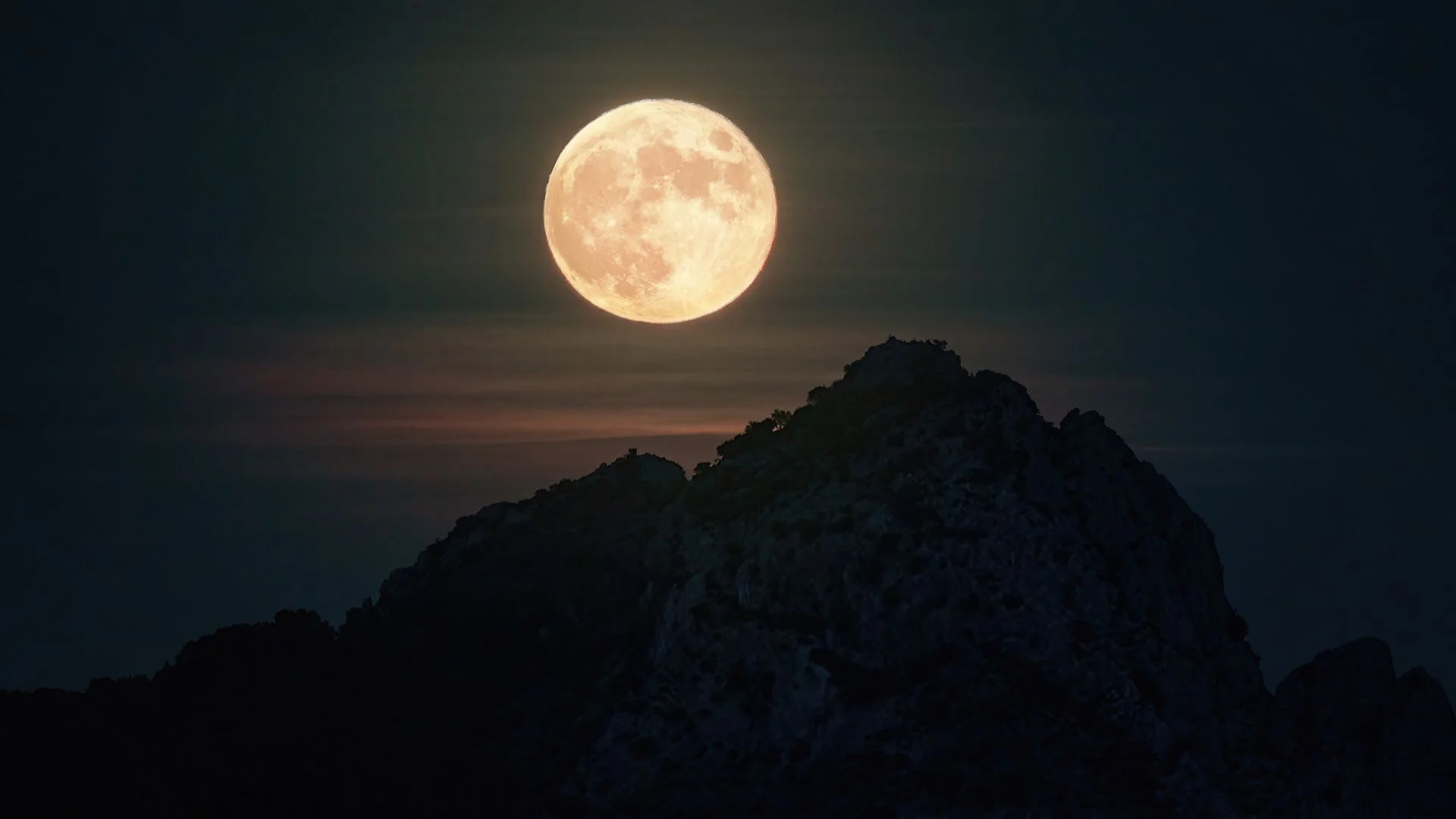
The Hunter’s Moon offers skywatchers two near-full moonrises in a row, with Saturn and the Pleiades providing different points of interest on Sunday and Monday. The moon officially reaches full phase at 12:11 a.m. EDT Monday, Oct. 26, but it’ll look almost completely illuminated on both evenings. That gives observers a useful choice: catch the moon rising with Saturn nearby, or wait a day for the Pleiades to share the view. The difference won’t be dramatic to the unaided eye, but the changing arrangement makes the two evenings distinct.
Two chances to watch the moonrise
On Sunday, Oct. 25, look toward the eastern horizon shortly before sunset. The moon will rise in Aries, with Saturn positioned above and to its right. Seeing the two together gives the evening a clear focal point: the bright moon and a planet close by in the same broad patch of sky. As the moon climbs, its position relative to the horizon will change, so the first minutes after it appears may offer the most distinctive composition.
Monday’s moonrise comes just after sunset, when the moon will appear above the Pleiades open cluster, also known as M45. The darker sky may make Monday’s scene more striking, though the nearly full moon’s brightness can make faint stars harder to pick out. That’s a useful reminder that a full moon can be both the main attraction and a source of glare. If you’re hoping to see the cluster clearly, give your eyes time to adjust and look for the grouping near the moon rather than expecting every star to stand out.
Choose a spot with an unobstructed view of the eastern horizon, and check local moonrise times so you’re ready before the moon clears the horizon. An open field, coastline or elevated viewpoint can help avoid trees, buildings and hills blocking the view. Arriving early also gives you time to settle on a position and watch the moon emerge, instead of trying to find it after it’s already high enough to clear nearby obstacles. The first appearance can be brief if the horizon is uneven.
Why October’s full moon has its name
The name Hunter’s Moon comes from an Anglo-Saxon tradition: October’s full moon marked a time to hunt and preserve meat ahead of winter, according to Time and Date. The name reflects a seasonal association, not a special astronomical event that changes how the moon behaves. Other names used by Native American communities include the Drying Rice Moon, Falling Leaves Moon and Freezing Moon. These names point to different seasonal activities and conditions, and they shouldn’t be treated as interchangeable labels with a single origin.
The moon should be easy to enjoy without equipment, though binoculars or a backyard telescope can bring lunar features into closer view. With binoculars, the contrast of bright and dark areas can become easier to notice; a telescope can show more surface detail, depending on its capabilities and the view from your location. Near the horizon, the moon may also seem larger than usual. That apparent size comes from the “moon illusion”: familiar objects such as trees and buildings influence how our brains judge distance and size. The moon hasn’t grown as it rises. Here’s the thing: that familiar foreground can make a simple observation feel more dramatic, even though the effect comes from perception.
A supermoon run starts next month
This Hunter’s Moon isn’t a supermoon. It precedes a run of four consecutive supermoons, beginning with the Beaver Moon on Nov. 24 and continuing with full moons in December, January and February. A supermoon occurs when a full moon coincides with the moon’s relatively close approach to Earth in its slightly elliptical orbit, making it appear somewhat larger and brighter than average. The change is a matter of degree, so the label doesn’t mean the moon will suddenly look radically different to everyone watching.
This is more significant than it looks as a viewing schedule: the coming sequence gives observers several chances to compare full moons under different conditions. The apparent size and brightness can be hard to judge from memory alone, and the horizon, nearby objects and sky clarity all affect what you notice. (And this is the part most people overlook.) A good view depends as much on where you stand and when you arrive as on the name attached to the moon. That said, a clear eastern horizon is a practical advantage for this weekend’s rising moon.
What to look for this weekend
For this weekend, the practical choice is simple: Sunday offers a view of Saturn beside the rising moon; Monday pairs the moon with the Pleiades under a darker sky. The moon will be close to full on both nights, so you don’t need to choose based on a major difference in its appearance. Pick the evening that suits your location and the kind of view you want. If you’re working in this space, the broader lesson is familiar: an observing guide is most useful when it tells people what they can actually see, and where to look.
How much do you know about the moon? Test your lunar smarts with our moon quiz!


