From evidence of dark matter to its properties
Dark matter research has largely moved past asking whether it exists. Astrophysicists point to several independent kinds of indirect evidence; the harder question is what dark matter is like and how its properties shape galaxies. That shift matters: evidence for an unseen source of gravity doesn't, by itself, tell researchers what the source consists of or how smoothly it is distributed.
The basic problem is observational. Dark matter doesn't emit the light astronomers use to map stars and gas, so researchers infer its presence from gravitational effects on visible matter. They can then compare those effects with predictions from simulations. But a simulation is a way to test a proposed picture, not proof that nature follows it. Observations have to determine which models remain plausible.
Why stellar streams can help
Stars and gas respond to gravity, so their visible patterns can reveal the shape and clumpiness of an otherwise unseen dark matter halo. Stellar streams offer one way to read those patterns. They form when the gravity of a larger galaxy pulls stars from a smaller system, stretching them into a long, narrow structure. If the surrounding gravitational field is uneven, the stream's shape and density can carry traces of that disturbance.
That makes streams useful, but not self-explanatory. Astronomers have to distinguish features caused by gravity from those that reflect how the stars were distributed in the first place, as well as account for the stream's host environment. Simulations help frame the possibilities; observations decide which models still fit. The evidence is indirect, and the interpretation depends on seeing enough of the structure to compare it with those predictions.
Streams in familiar galactic settings provide a starting point, but unusual environments can offer a different test. A system with relatively little ordinary matter and a large dark matter contribution may make gravity's role easier to isolate. That isn't a guarantee of a clean answer. It does, however, give researchers a setting in which the balance between visible and unseen matter is striking.
A stream beyond the Milky Way
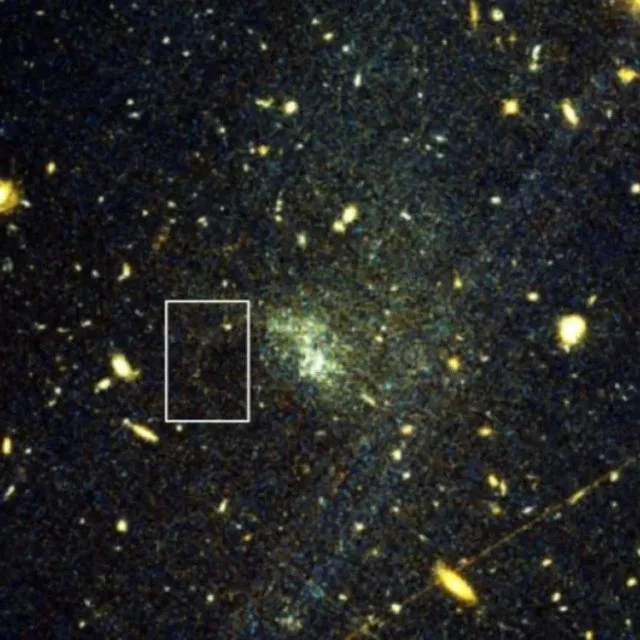
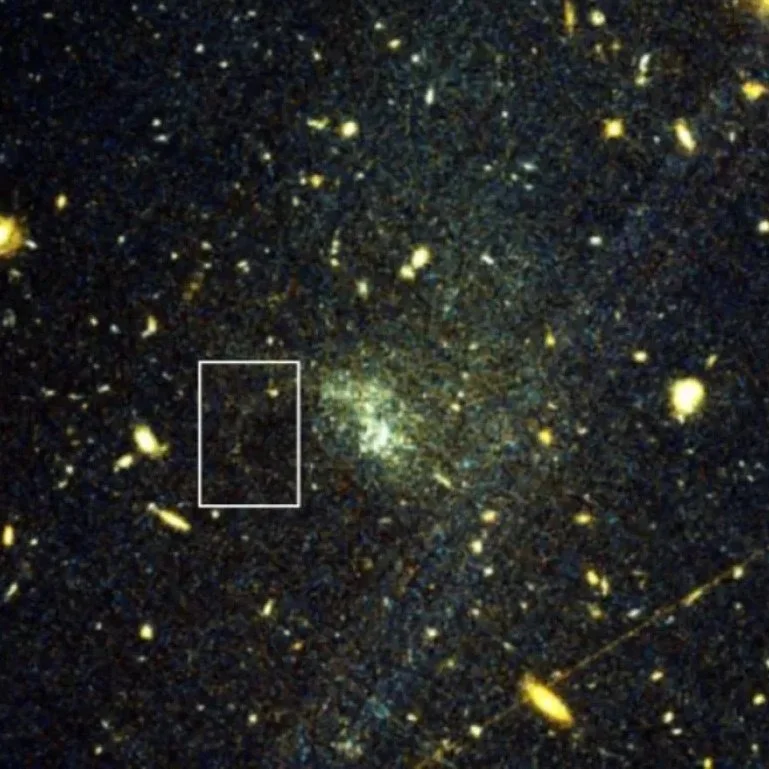
A newly discovered stellar stream from a globular cluster marks the first such finding beyond the Milky Way. It sits in an ultra-diffuse galaxy unusually rich in dark matter and sparse in ordinary matter, making the system a useful place to investigate how dark matter's gravity shapes its surroundings. The discovery extends the study of these structures to a different host galaxy, where the conditions may reveal features that are harder to assess in more familiar settings.
This is more significant than it looks: finding a stream outside our own galaxy gives researchers another environment in which to examine the relationship between visible structure and the dark matter halo. Still, one discovery can't establish a general rule about how streams behave or how dark matter is arranged. Its value lies in opening a new observational case that can be compared with models and with other systems.
What the finding can tell researchers
The podcast episode features the stream's discoverer, Julie Kiel Holm, a PhD candidate at the Niels Bohr Institute, University of Copenhagen. Her findings put a rare kind of stellar structure in a setting where its gravitational clues may be especially clear. The conversation offers a route into the research question: how can astronomers use the motion and arrangement of ordinary stars to investigate matter they can't see directly?
Here's the thing: the stream is a tracer, not a direct image of dark matter. Researchers must connect its observed properties to the gravitational field that shaped it, then assess whether competing explanations fit the same evidence. (And this is the part most people overlook: an unusual host can sharpen a test while also making comparisons with other galaxies less straightforward.)
If you're working in this space, the useful question is what further observations of the stream and its host can establish about their structure. The discovery gives researchers a new target and a distinctive environment. A test case, at last.
This article Listen: Stellar streams and the dark Universe is featured on Big Think.


