Traveling Across the Universe at 1g: From Mars to the Observable Edge
2026-10-26 06:00
345 views
Continuous 1g acceleration could take a traveler from Mars to the farthest reachable regions of the universe in about 25 years of onboard time.
The surprising part of a hypothetical 1g voyage isn’t how quickly a spacecraft would cross the Solar System. It’s that, with continuous acceleration, a traveler could reach the farthest destinations in the observable universe within roughly 25 years of their own time. Relativity makes that possible: the ship’s speed approaches the speed of light, while time aboard passes more slowly than time on Earth.
That journey remains a thought experiment. Current rockets can sustain acceleration for only about 8 to 10 minutes before running out of fuel. But the figures show how sharply the experience of distance changes when a ship keeps accelerating and the traveler measures the trip from inside it.
Why 1g would feel familiar
Earth’s surface gravity gives us an acceleration of about 9.8 meters per second squared, commonly called 1g. A spacecraft accelerating at that rate would press its occupants toward the floor, producing a sensation much like standing on Earth. The key is acceleration: astronauts in orbit feel weightless because they and their spacecraft are in free fall together, even though Earth’s gravity is still acting on them.
This image shows a person in free-fall close to Earth’s surface. They still accelerate toward the center of the Earth at 1g, but have no normal force acting on them. As a result, for the brief moments from when this photo is taken until they hit the water, they effectively experience weightlessness.
Astronauts experience weightlessness when their spacecraft and everything inside it are falling together in orbit. During powered acceleration, the sensation changes: the force pushing them against the cabin floor would mimic gravity. This connection between acceleration and gravity is captured by Einstein’s equivalence principle. Experiments have tested the equivalence of inertial and gravitational mass to better than about one part in a trillion for ordinary matter; the ALPHA-g experiment has also confirmed the expected behavior for antimatter.
Shown here, two astronauts experiencing weightlessness aboard the International Space Station demonstrate, together, the conservation of angular momentum. A consequence of the symmetry of rotational invariance, the astronaut spins faster only because a torque is applied to him from another astronaut’s body. The amount of angular momentum transferred to the spinning astronaut is canceled out by the equal-and-opposite amount of angular momentum transferred back into the other astronaut-ISS system.
Credit: NASA/International Space Station
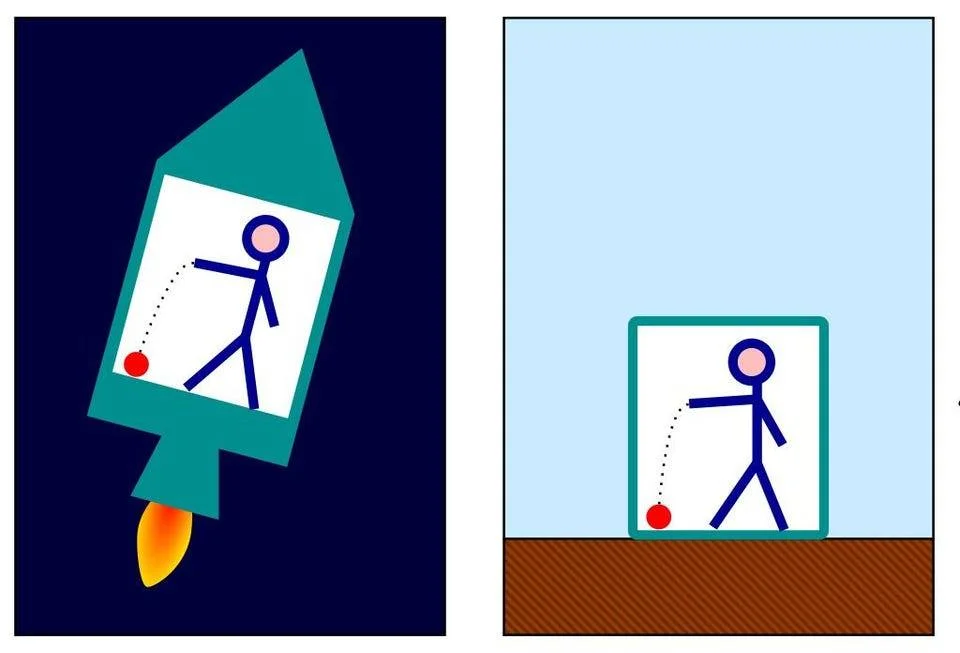
The identical behavior of a ball falling to the floor in an accelerated rocket (left) and on Earth (right) is a demonstration of Einstein’s equivalence principle. If inertial mass and gravitational mass are identical, there will be no difference between these two scenarios. This has been verified to better than ~1 part in one trillion for matter through torsion balance experiments, and was the thought (Einstein called it “his happiest thought”) that led Einstein to develop his general theory of relativity. Recently, the ALPHA-g experiment confirmed that this is true for antimatter as well.
Credit: Markus Poessel/Wikimedia commons; retouched by Pbroks13
The fuel problem, and the relativistic payoff
For a real spacecraft, sustaining 1g is a fuel challenge long before it becomes a navigation problem. Conventional rockets burn through their propellant quickly, and a continuous-acceleration mission would need a much more capable energy source. Nuclear fission, fusion, or antimatter are often discussed as possibilities for extending powered flight, but none currently makes this imagined trip practical.
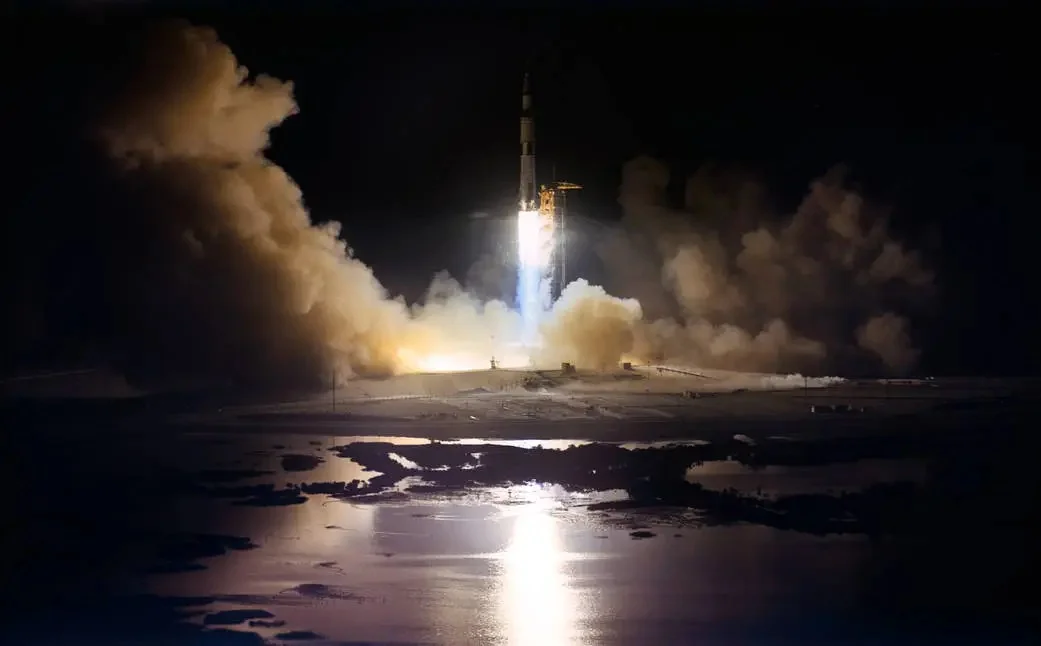
The launch of Apollo 17, the ninth and final crewed mission to the Moon as part of the Apollo program, was also the first nighttime liftoff of a Saturn V rocket, occurring on December 7, 1972. The Saturn V remains the heaviest launch vehicle in history, capable of carrying the greatest masses to low-Earth orbit of any rocket ever.
Keep accelerating, though, and the journey changes dramatically. A ship can get close to light speed after only a few years of acceleration, but it can’t reach or exceed light speed. As its velocity rises, relativistic time dilation grows: less time passes for the traveler than for observers back on Earth. The faster the ship moves, the more distant destinations can fit into a comparatively short onboard schedule.
Whereas normal matter and antimatter particles can only move at (if they’re massless) or below (if they’re massive) the speed of light, another possibility is that there’s a negative-energy state or imaginary mass state that’s possible: a tachyonic state. If that mathematical possibility is physically borne out in our Universe, then faster-than-light travel is a necessity.
If you were to get in a spaceship and accelerate at 1g (Earth’s acceleration) for the entirety of the trip, you could travel at nearly the speed of light after only a few years of acceleration. As you increased your speed ever closer to the speed of light, the effects of time dilation would get progressively more severe. In theory, distances of many light-years could be traversed in experienced times of much less than a year, but one must reckon with the weight of realistic fuel sources as well.
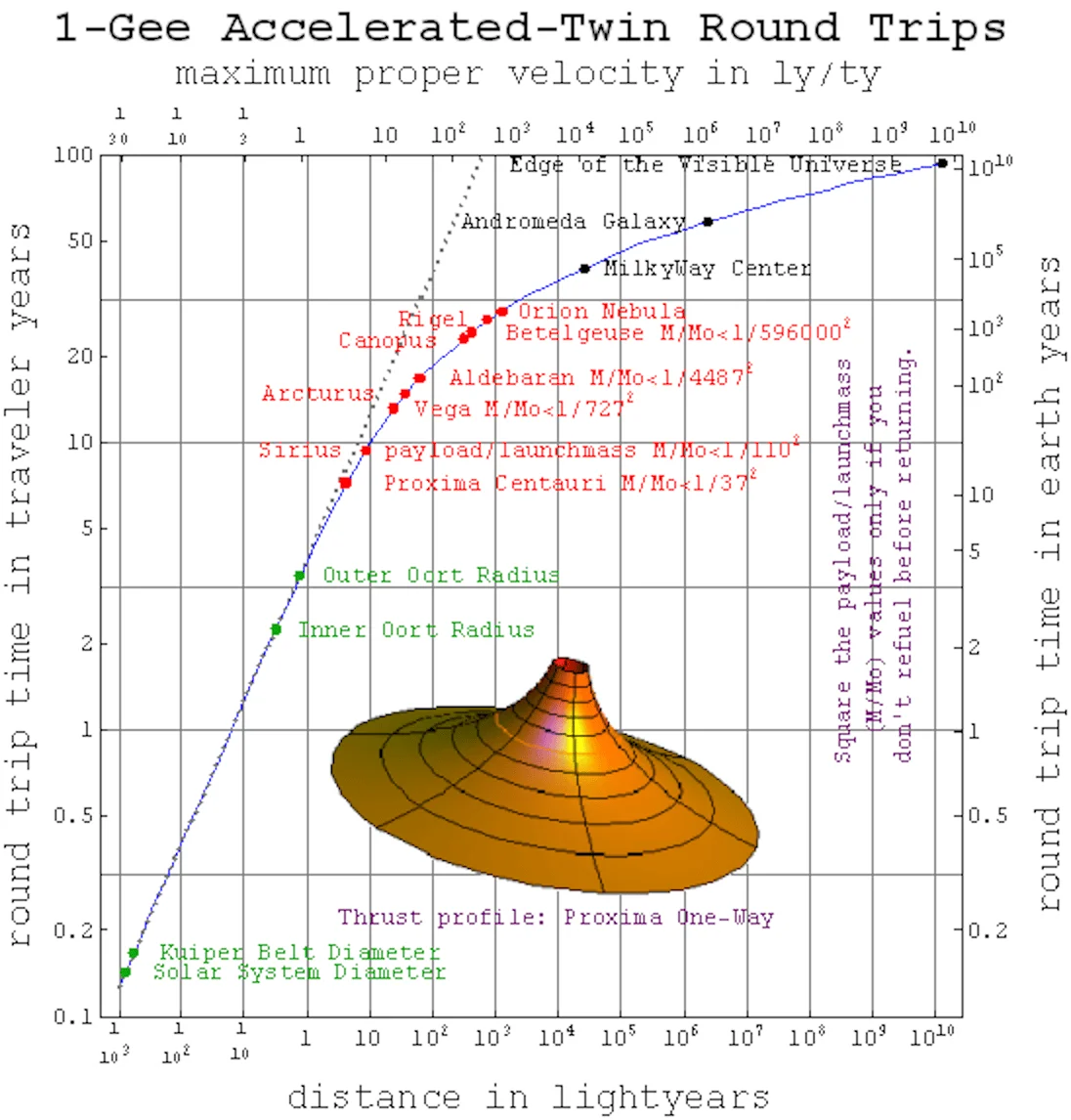
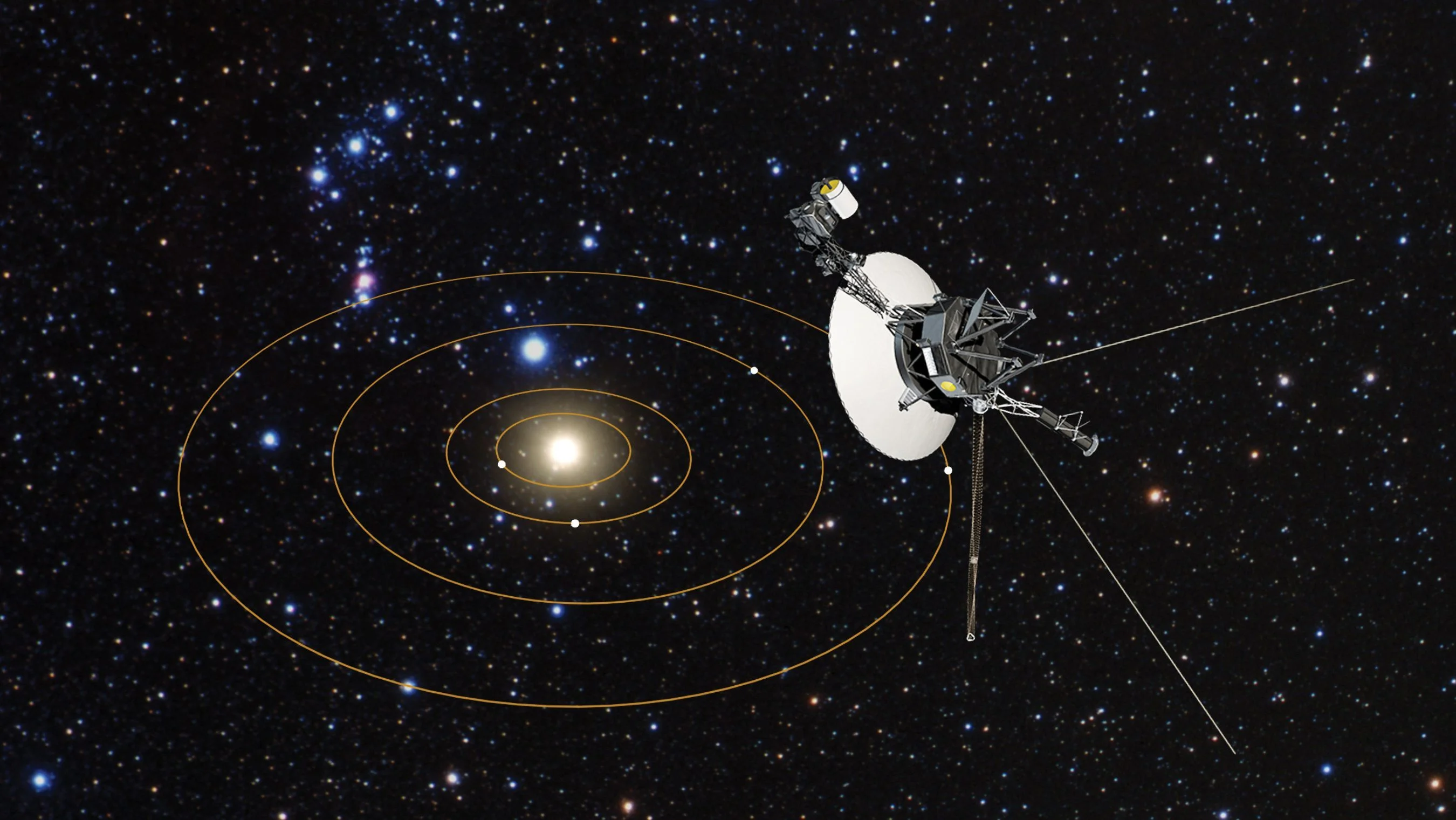
The nearest milestones would arrive quickly on the traveler’s clock. At its closest approach, Mars would be about 1 day, 5 hours, and 42 minutes away. The Kuiper cliff, where the population of Kuiper Belt objects drops off around 50 to 55 astronomical units from the Sun, would come after a little more than two weeks. In about four weeks, the ship would pass Voyager 1, the most distant human-made spacecraft.
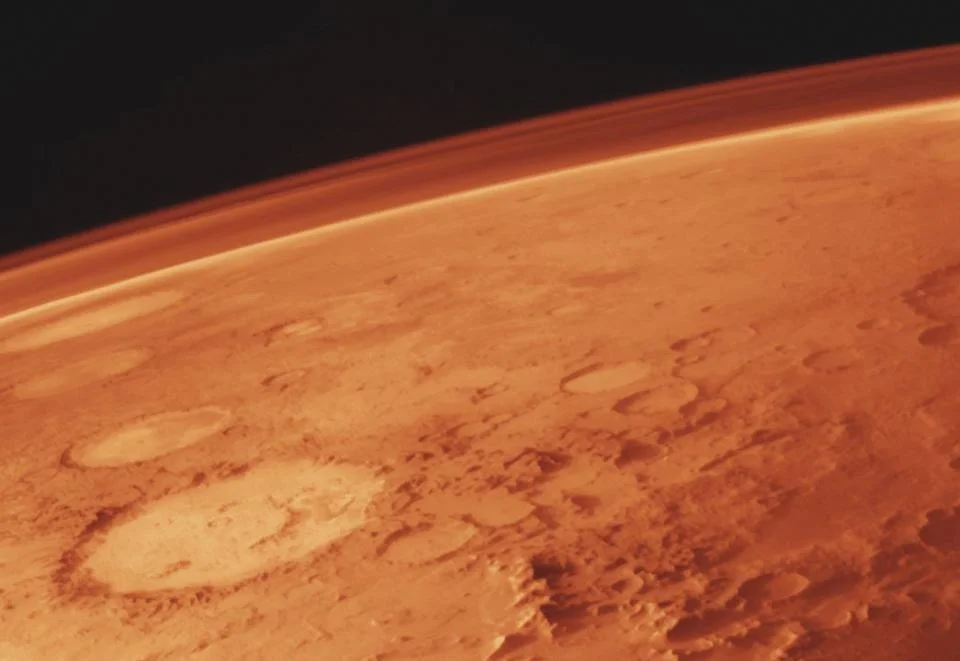
Mars, like most rocky worlds in the Solar System, is full of craters and has an impact-rich history. Despite how easily visible the Martian atmosphere is from orbit, it’s very thin, just 1/140th the thickness of Earth’s atmosphere and less than 1/200th of the mass of Earth’s atmosphere. With current technology, gravity does most of the driving on a journey to Mars, but the journey takes several months.
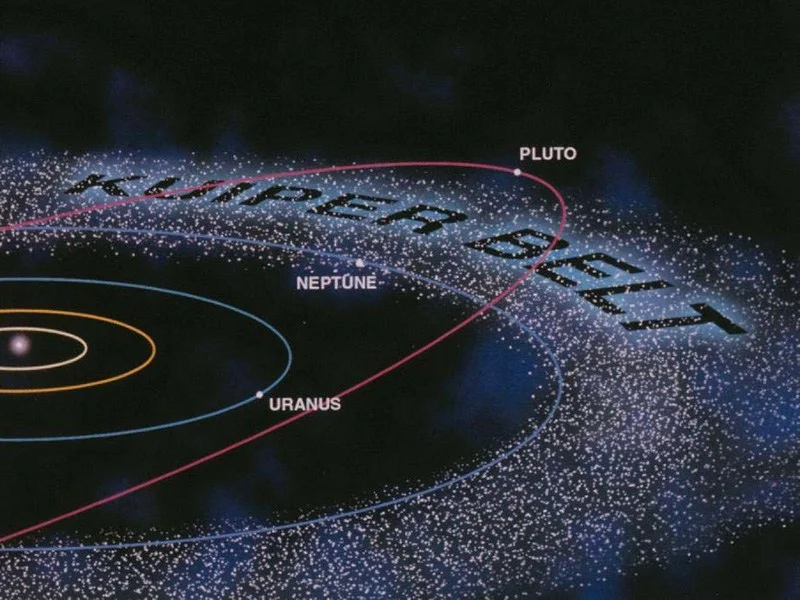
The Kuiper belt begins at the edge of Neptune’s orbit (30 AU), and continues on, populated by millions of ice-dominated objects left over from our Solar System’s formation, until a distance of about 50-55 AU, where the population of objects abruptly ends: what astronomers call the Kuiper cliff.
In 1977, NASA’s Voyager 1 and 2 spacecraft began their pioneering journey across the Solar System to visit the giant outer planets. Now, the Voyagers are hurtling through unexplored territory on their road trip beyond our Solar System. Along the way, they are measuring the interstellar medium, the mysterious environment between stars that is filled with the debris from long-dead stars. Voyager 1 became the most distant spacecraft from Earth in 1998, and no other spacecraft launched, to date, has a chance of catching it.
After about three months, the ship would reach the inner Oort cloud while traveling at roughly 25% of light speed. It would leave the outer Oort cloud after 1 year and 7 months, moving at 92% of light speed. Proxima Centauri, the nearest star beyond the Sun, would be reached after 2 years and 4 months.
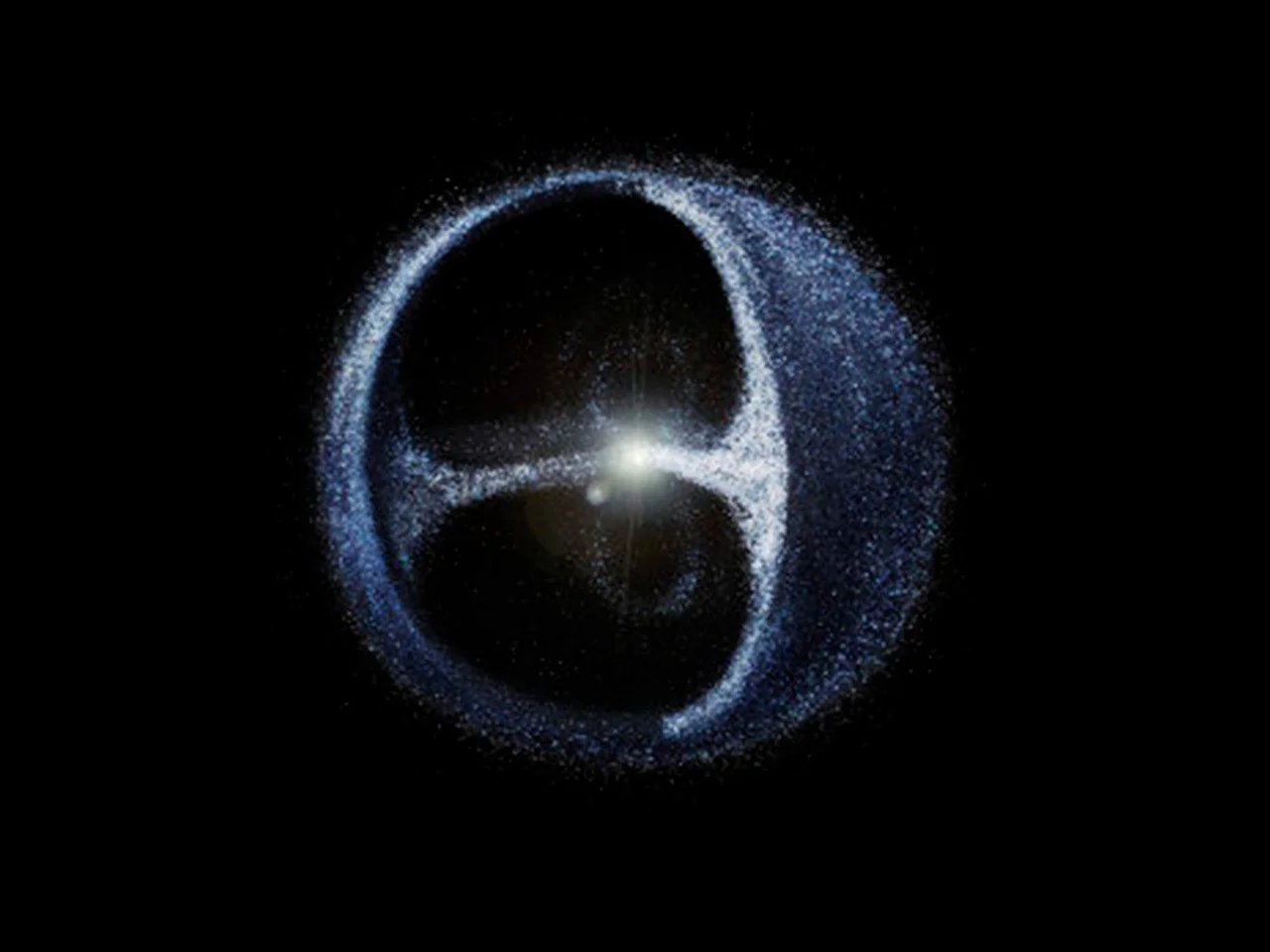
An illustration of the inner and outer Oort cloud surrounding our Sun. While the inner Oort cloud is torus-shaped, the outer Oort cloud is spherical. The true extent of the outer Oort cloud may be under 1 light-year, or greater than 3 light-years; there is a tremendous uncertainty here. Any massive object that passes through the Oort cloud has a significant chance of perturbing the objects within its vicinity.
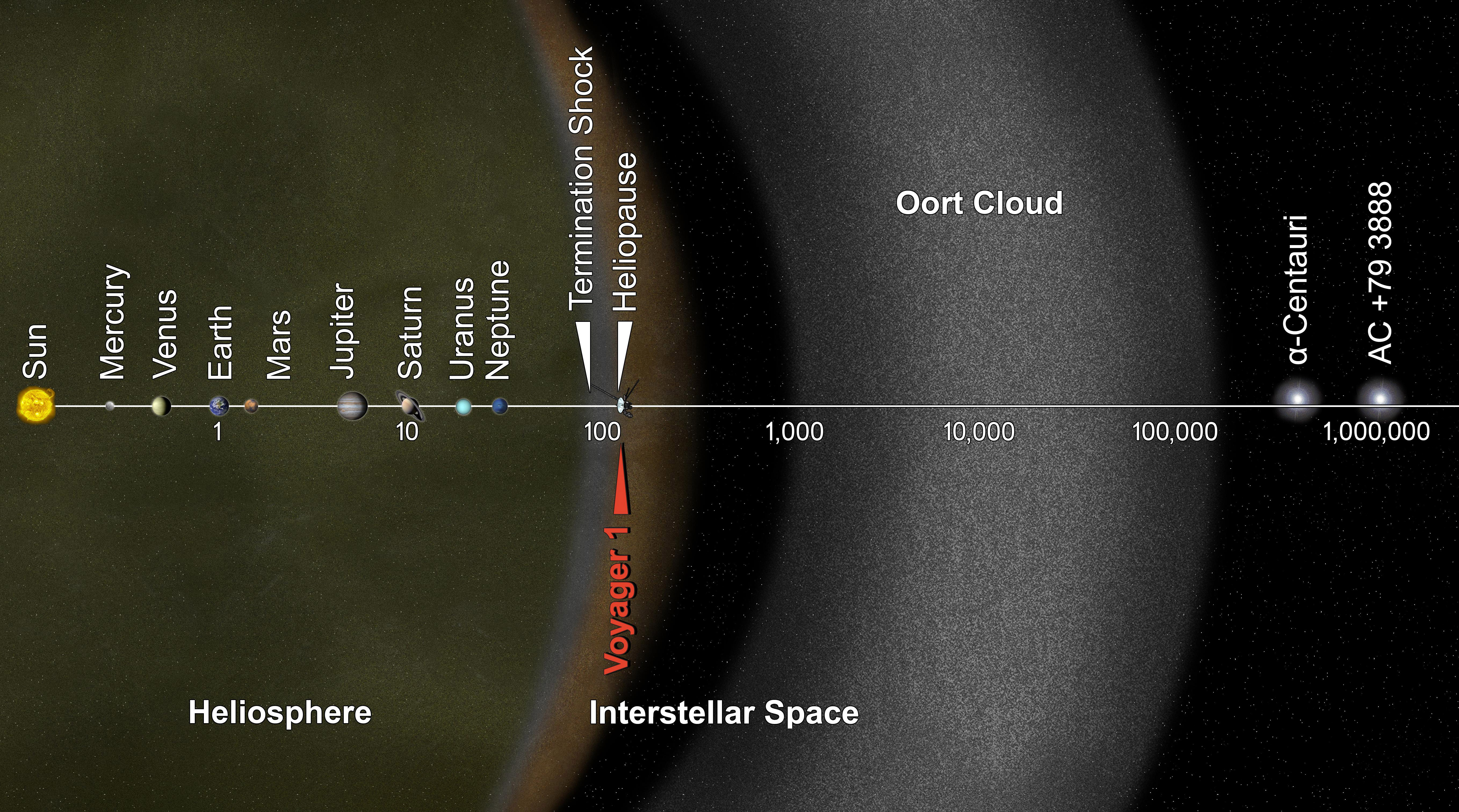
A logarithmic chart of distances, showing the planets, the Voyager spacecraft, the Oort Cloud, and our nearest star: Proxima Centauri. If we had a spacecraft that was capable of accelerating continuously and of withstanding the relativistic collisions that would ensue with interplanetary and interstellar material, upon leaving the Solar System, Voyager 1, the Oort Cloud, and Proxima Centauri would be the first three key “distance milestones” we’d encounter.
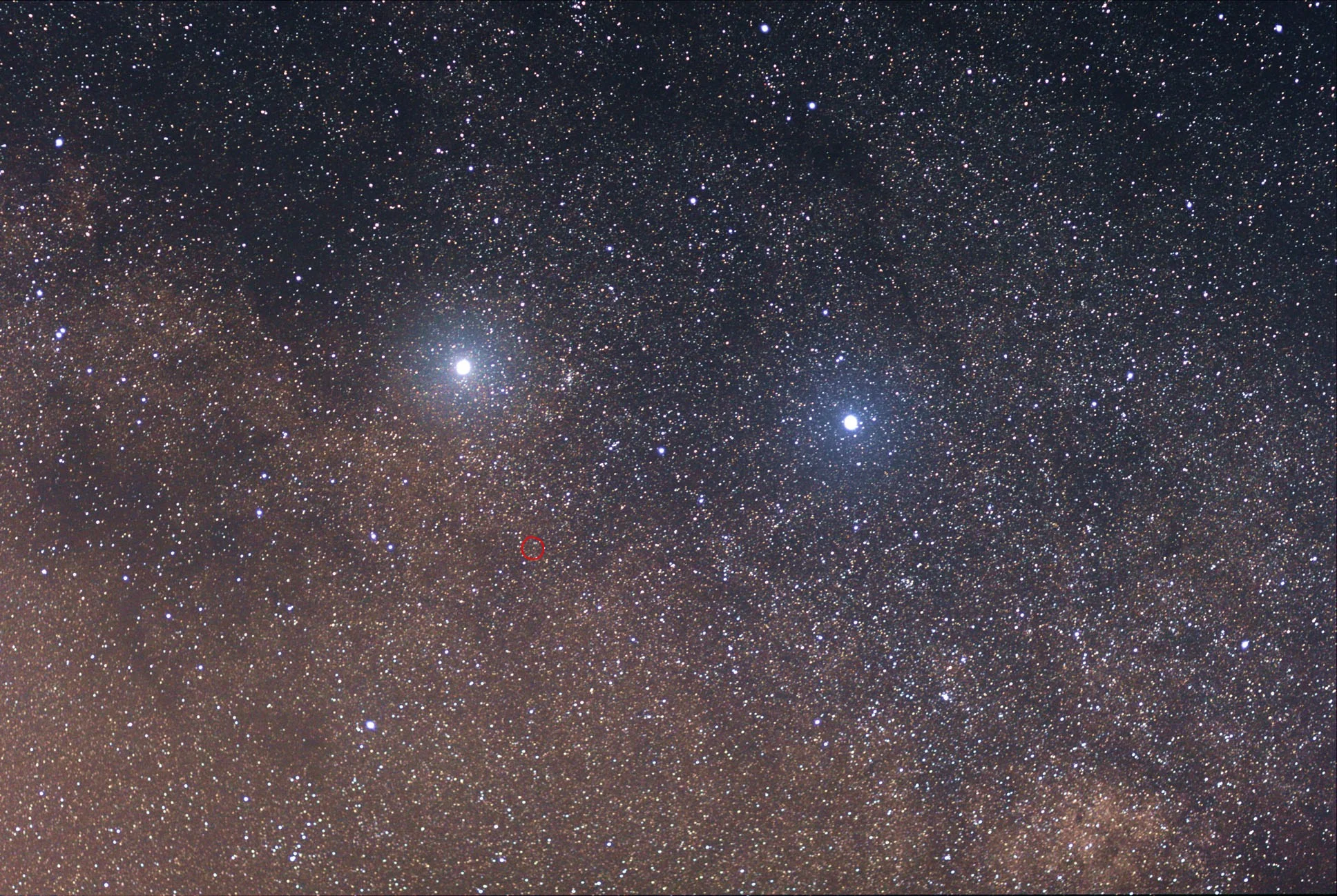
The stars Alpha Centauri (upper left) including A and B, are part of the same trinary star system as Proxima Centauri (circled). These are the three nearest stars to Earth, and they’re located between 4.2 and 4.4 light-years away. Alpha Centauri (at left) and its slightly fainter but far more distant neighbor, the almost 400 light-year distant Beta Centauri (at right), are easily visible in the southern skies. Proxima Centauri, the closest, is far too intrinsically faint to be seen with the unaided eye.
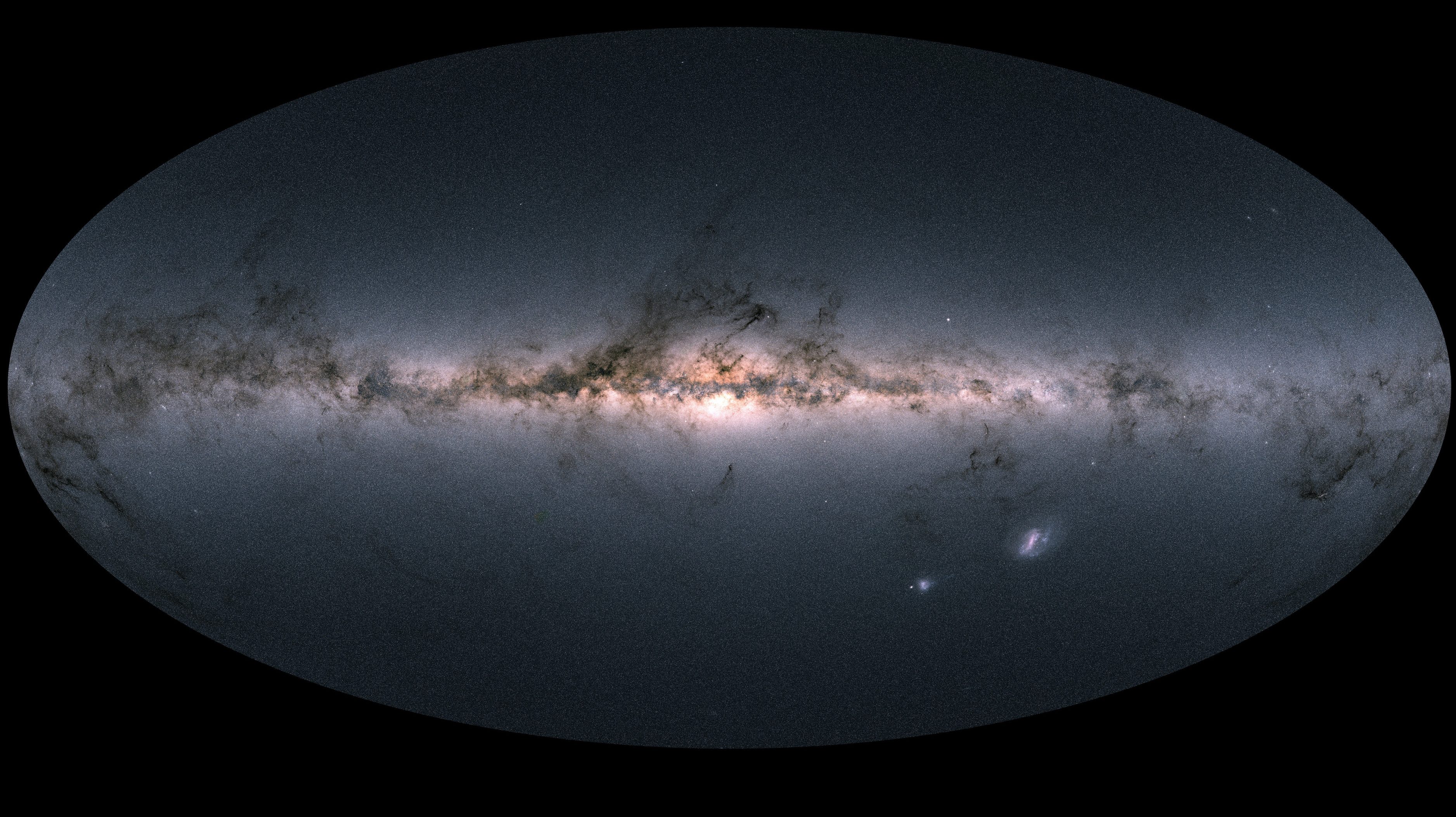
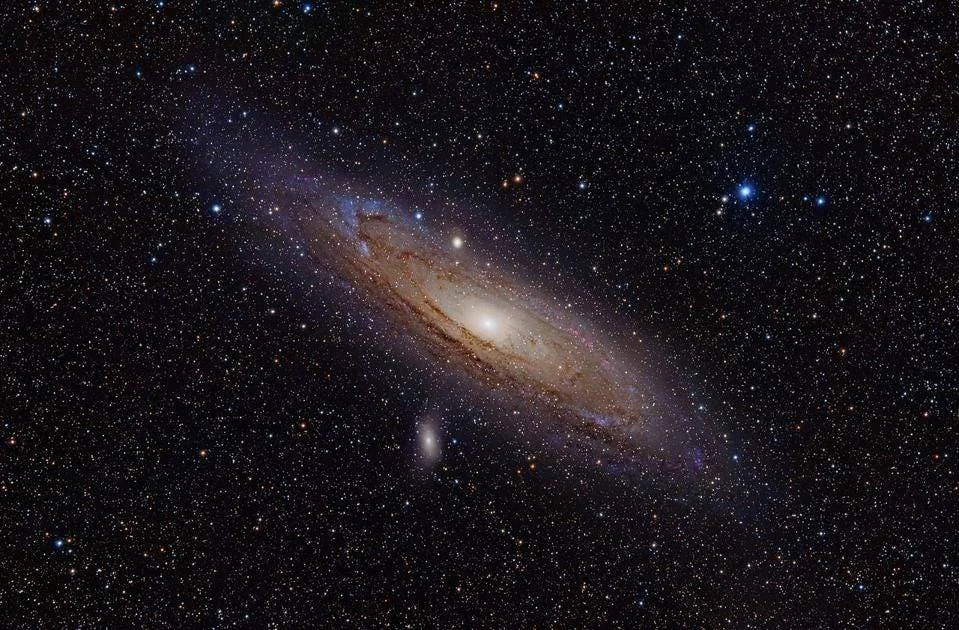
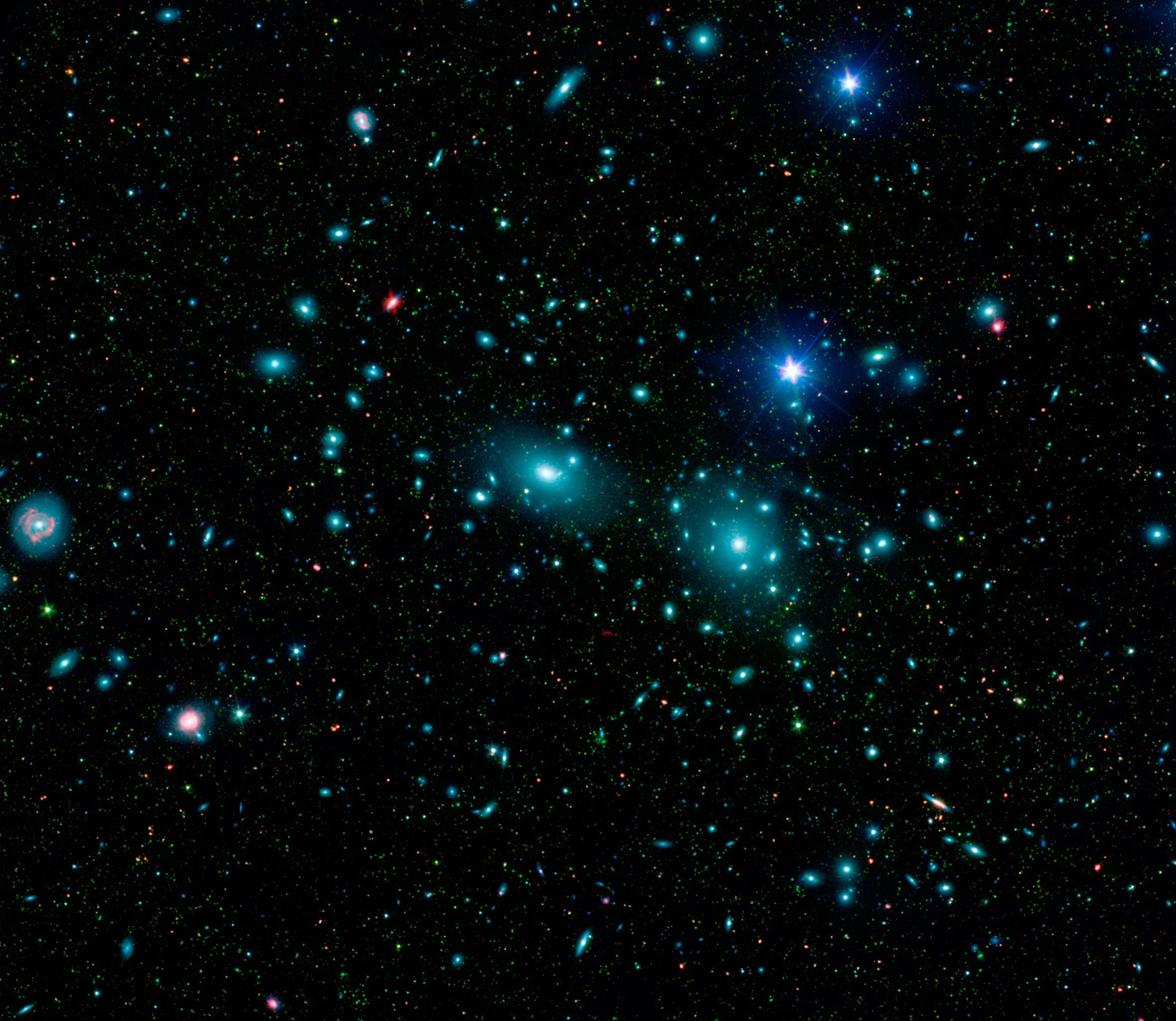
The distances become immense, but onboard time continues to rise comparatively slowly. A voyage to the Milky Way’s center, about 26,000 light-years away, would take just under 11 years. Andromeda, roughly 2.5 million light-years from Earth, would take about 15 years of cumulative travel time. The Coma Cluster, at a distance of 321 million light-years, would be reachable after around 20 years.
The European Space Agency’s space-based Gaia mission has mapped out the three-dimensional positions and locations of more than one billion stars in our Milky Way galaxy: the most of all-time, as well as many stars in sufficiently nearby galaxies. Looking toward the center of the Milky Way, Gaia reveals both light-blocking and luminous features that are scientifically and visually fascinating, but cannot see our central black hole, 26,000 light-years away, due to the intervening material.
This full-scale view of the Andromeda Galaxy, M31, showcases its star-forming regions lining its spiral arms, its dust lanes, and its central, gas-poor region. Unlike the Milky Way, Andromeda lacks a prominent central bar. This image is a fairly close approximation of what human eyes would see if they could make out these details in Andromeda, which is the largest galaxy in the Local Group and the only one more massive than the Milky Way.
The Coma Cluster of galaxies, as seen with a composite of modern space and ground-based telescopes. The infrared data comes from the Spitzer Space Telescope, while ground-based data comes from the Sloan Digital Sky Survey. The Coma Cluster is dominated by two giant elliptical galaxies, with over 1000 other spirals and ellipticals inside. Gas-free, red-and-dead elliptical galaxies are very common, especially toward the cluster center, in large galaxy clusters such as this one. The speed of galaxies within the cluster can be used to help determine the cluster’s total mass, revealing our first evidence for dark matter in the 1930s.
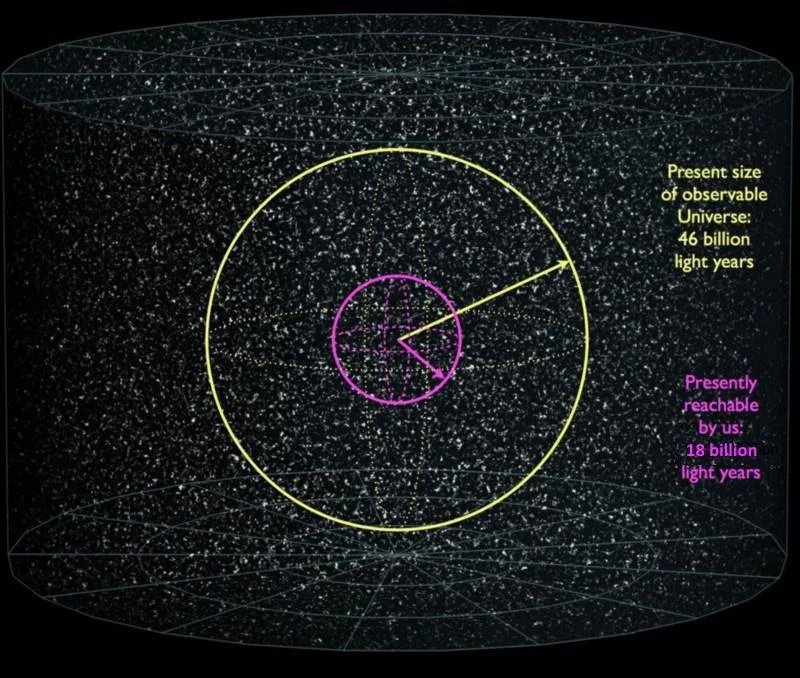
The farthest destinations in the reachable universe could be reached in roughly 25 years, according to this idealized 1g scenario. That estimate assumes a ship can accelerate continuously, carry enough fuel, and survive collisions with matter encountered along the way. Those conditions are far beyond current spacecraft capability, and cosmic expansion also means some regions visible from Earth are already beyond any possible journey. Still, the thought experiment makes the central point clear: for a traveler who can keep accelerating, onboard time—not the distance measured from Earth—sets the strikingly short scale of an intergalactic trip.
The size of our visible Universe (yellow), along with the amount we can reach (magenta) if we left, today, on a journey at the speed of light. The limit of the visible Universe is 46.1 billion light-years, as that’s the limit of how far away an object that emitted light that would just be reaching us today would be after expanding away from us for 13.8 billion years. Anything that occurs, right now, within a radius of 15-18 billion light-years of us, will eventually reach and affect us; anything beyond that point will not. Each year, another ~20 million stars cross the threshold from being reachable to being unreachable.
Credit: Andrew Z. Colvin and Frederic Michel, Wikimedia Commons; Annotations: E. Siegel