
Young voters who helped Donald Trump return to the White House are now among the groups most visibly turning away from him. With midterm elections a week away, polling points to a shift that could matter at the ballot box: approval has fallen among younger Trump voters, and young adults have swung back toward the Democratic Party.
The shift is less a simple ideological conversion than a test of whether politicians can deliver material improvements. Young people are focused on jobs, prices, health care and the prospects of building a financially secure life. Many remain skeptical of both parties; their changing support appears tied to whether they believe the political system is producing results.
That helps explain why the 2024 movement toward Trump has proved fragile. His gains among young voters prompted debate about whether Gen Z was rejecting progressive politics, responding to online influences such as “manosphere” podcasts and TikTok algorithms, or reacting to Biden-era gerontocracy. Others asked whether young voters had turned against “woke” progressives.
Those explanations captured some of the moment, but current polling suggests that economic expectations and disappointment with political performance are at least as important. The coming youth vote may reflect not a durable partisan realignment, but a volatile electorate looking for evidence that its circumstances can improve.
Support has slipped, and the party balance has swung back
A Pew Research Center poll released earlier this month found that just 49 percent of Trump voters aged 19 to 34 approve of his performance as president. Among his 2024 voters aged 50 and older, approval stands at about 75 percent. The difference suggests that the youngest members of his coalition have been quicker to reconsider their vote.
Party identification among young adults has shifted just as sharply. According to Pew’s party affiliation data, Democrats held a 17-point edge among adults aged 18 to 29 in 2022 and 2023: 55 percent identified with or leaned toward the Democrats, against 38 percent for Republicans. In 2024, the parties were nearly even, with Republicans at 47 percent and Democrats at 46 percent. By 2026, Democrats had regained a 16-point advantage, 54 percent to 38 percent.
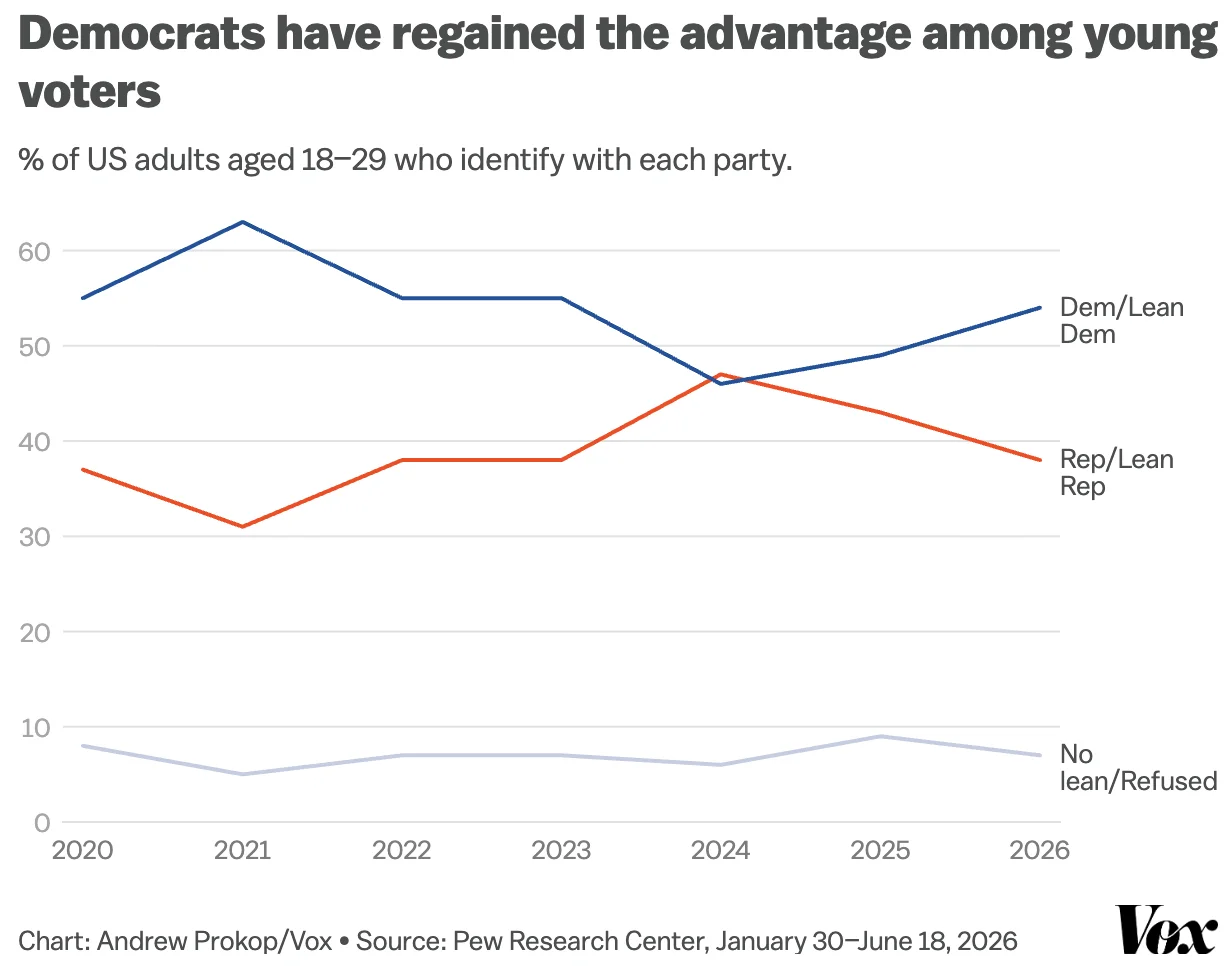
These figures measure party preference, not who will cast a ballot. On that question, the Harvard Youth Poll released last week found a notable gap: 50 percent of Democrats aged 18 to 29 said they would definitely vote, compared with 34 percent of young Republicans. The 16-point difference is the largest partisan turnout gap the poll has recorded in recent midterm cycles.
A Democratic advantage among young adults could therefore be amplified by turnout. But the Republican decline has more than one form: some former supporters may choose a different party, while others may simply stay home. Those are distinct political outcomes, and the second could leave young voters less attached to either side.
Three kinds of young Trump voters
Rachel Janfaza, founder of the Gen Z-focused strategy firm The Up and Up, divides young people who voted for Trump in 2024 into three groups. The first is made up of committed MAGA supporters who continue to back the president, much like older members of the movement.
A second group remains drawn to “America First” politics but dislikes what it sees as Trump’s move into the establishment. Janfaza pointed to the proposed White House ballroom, the Epstein files and the start of new wars as sources of resentment. These voters may be alienated from Trump without becoming more receptive to Democrats. Some may instead disengage from the election.
The third group, Janfaza said, includes many young men who were never firmly aligned with MAGA. They supported Trump because they were frustrated with the wider political conversation, their economic situation and what they viewed as excessive political correctness or “wokeness.” Now, she said, many feel “politically homeless.”
That account is consistent with focus groups conducted by Tina Tang of the Democratic-aligned firm Navigator Research. Tang said many young people who now regret voting for Trump hoped he would change the political system and follow through on promises about jobs and the economy. “Young voters are especially worried about jobs right now,” she said. She described frustration with a job market that has not met expectations, alongside promises that the economy would improve, costs would fall and more jobs would appear.
The groups’ differing reactions matter for both parties. A voter who still favors America First ideas but feels let down may not shift to a Democrat; a young person who wants tangible economic gains may consider a candidate from either party. Trump’s weakening support, then, does not automatically translate into a stable Democratic coalition.
Material results matter more than political labels
Young adults don’t fit the assumption that they are uniformly liberal. In the Harvard Youth Poll released this week, 25 percent of respondents aged 18 to 29 described themselves as liberal and 23 percent as conservative. About 46 percent chose a position between those labels.
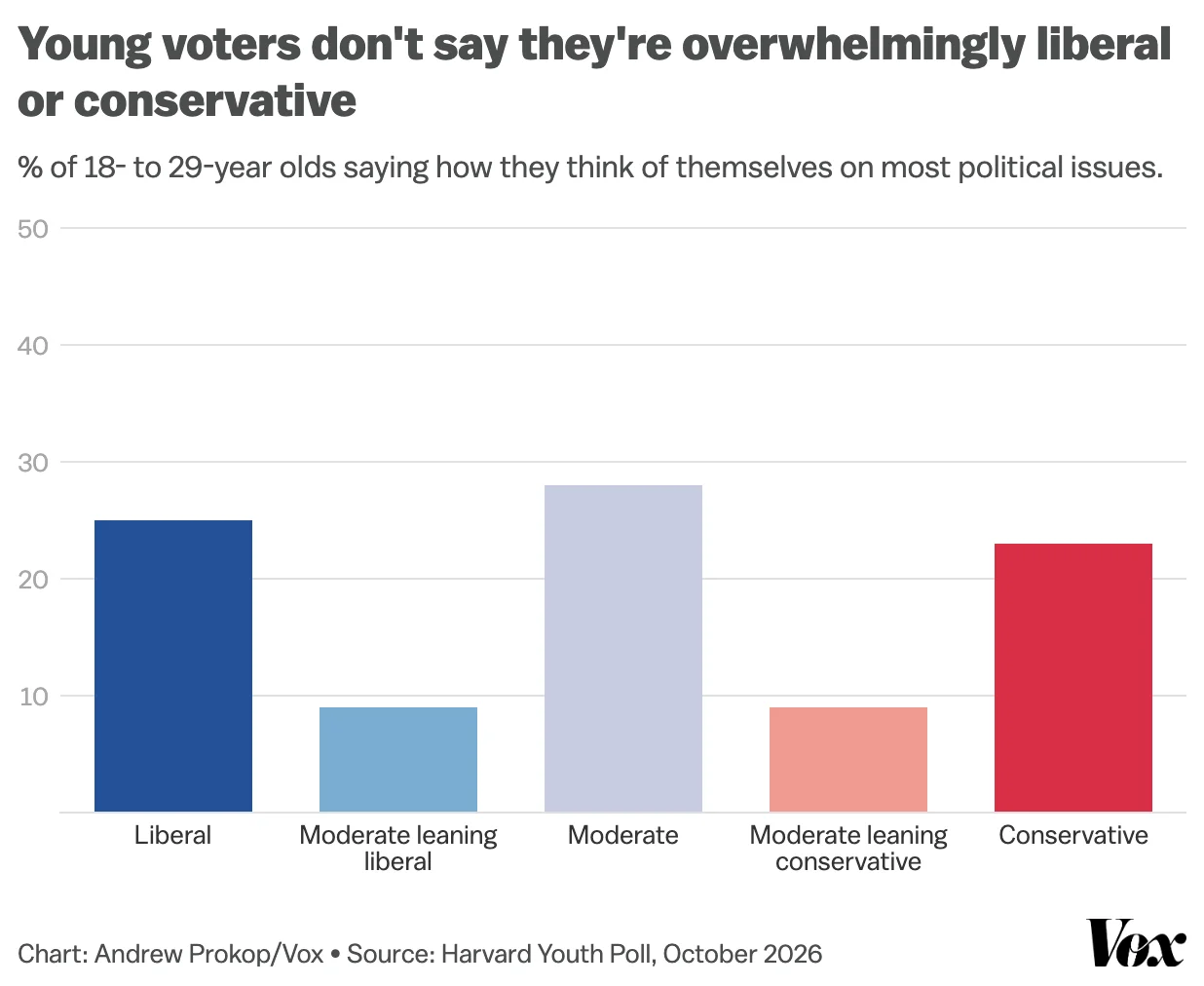
Santiago Mayer, founder of the progressive youth group Voters of Tomorrow, said many young people hold views that others would call progressive without treating those views as ideological commitments. “I think for a lot of things many of us would consider progressive, for them, they are common sense, and they’re not necessarily analyzing these issues through a political lens.”
For Mayer, the common thread among appealing politicians is practical promise. Young voters want to hear how a candidate will improve daily life and produce “material, tangible change.” Tang likewise said young people are skeptical of both parties and want to see results.
The priorities behind that demand are largely economic. Young voters are concerned about the cost of living, corruption in government, overseas wars and health care, according to the Harvard Youth Poll. Janfaza said pundits have overstated the degree to which culture-war issues define young voters’ choices. Climate and abortion still matter, she said, but neither now ranks among the top issues young people say they care about; economic concerns weigh more heavily.
That focus also changes how to read young voters’ interest in left-wing economic proposals. Janfaza said what gets described as a “flirtation with socialism” often reflects support for affordable housing, health care and education, along with a desire to break from established politics. The label may attract attention, but the underlying request is concrete: make basic milestones more attainable.
For many young adults, that request sits alongside growing pessimism. In the latest Harvard Youth Poll, more respondents said they expected to be financially worse off than their parents at the same age than said they expected to do better. It was the first time the poll had recorded that result.
Mayer described the mood as a kind of nihilism. He sees young voters giving Democrats another chance, while worrying that the party may have little room to disappoint them again. If elected leaders fail to make life materially better, young people may lose faith not just in a party, but in the political system’s capacity to respond.
The electoral signal is clear but not permanent: young voters are rewarding perceived performance, and their support can move quickly when promises collide with experience. The party that earns their trust will have to show how its plans translate into jobs, lower costs and a more credible path to financial security.


