The G20 foreign ministers’ meeting opened without its customary group photo, a small but visible sign of how Russia’s war in Ukraine is complicating diplomacy. The United States removed the photo from Friday’s official agenda after a third of participants, including Australia and Canada, objected to appearing alongside Russian Foreign Minister Sergei Lavrov. The decision turned a routine ceremony into an early test of how the gathering would manage divisions that were already shaping its agenda.
A US official said Washington wanted to avoid turning the photograph into a spectacle or distraction. Australia’s Foreign Minister Penny Wong supported the host’s decision, her spokesperson said. The choice kept the meeting’s attention on its formal business, though the absence of the image also made the disagreement hard to miss.
"Australia has been clear and consistent: we will not normalise Russia's brutal and illegal invasion of Ukraine,"the statement said.
"Our focus at the G20 remains on the important work before us and addressing the challenges facing the global economy."
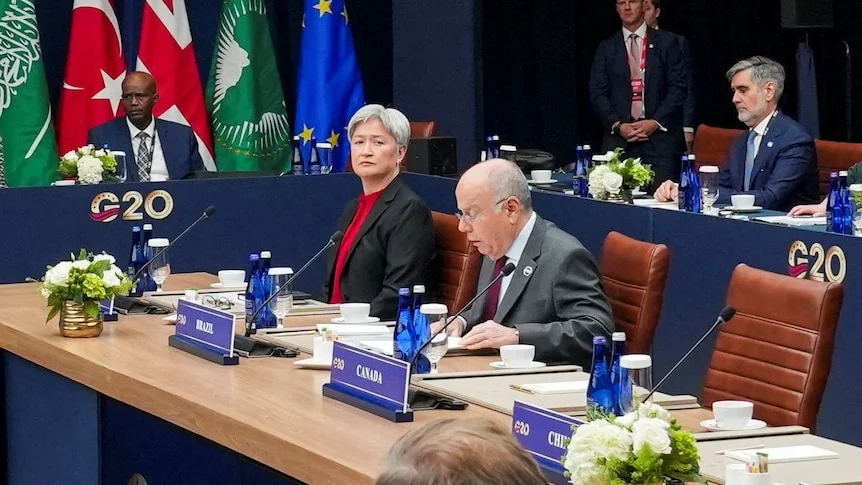
Australia was one of the countries that opposed the idea of being photographed alongside the Russian foreign minister. (Reuters: Megan Varner/Pool)
Ukraine divides the gathering
European members also back Ukraine, which has criticised recent decisions by US President Donald Trump concerning Russia, including a diesel purchase deal and a waiver of some sanctions. Those disagreements add strain to a meeting where members are expected to discuss shared economic concerns even as they differ sharply over the war and how governments should respond to Moscow.
British Foreign Secretary Ed Milliband directly addressed Lavrov, arguing that the G20 should work harder for “just and lasting peace in Ukraine”. He described Russia’s actions as an assault on Ukraine and on shared principles, including international law, sovereignty and self-determination. The remarks framed the dispute as more than a bilateral conflict: they put the credibility of those principles on the table for a group that includes countries with sharply different positions.
Polish Deputy Prime Minister and Foreign Minister Radosław Sikorski told reporters in Atlanta: “I am not the only one who does not want to be photographed with Lavrov.” His comment made clear that the objection was shared, though the decision to remove the photo avoided forcing ministers to express that disagreement in a staged public moment. A missing image, with a message attached.
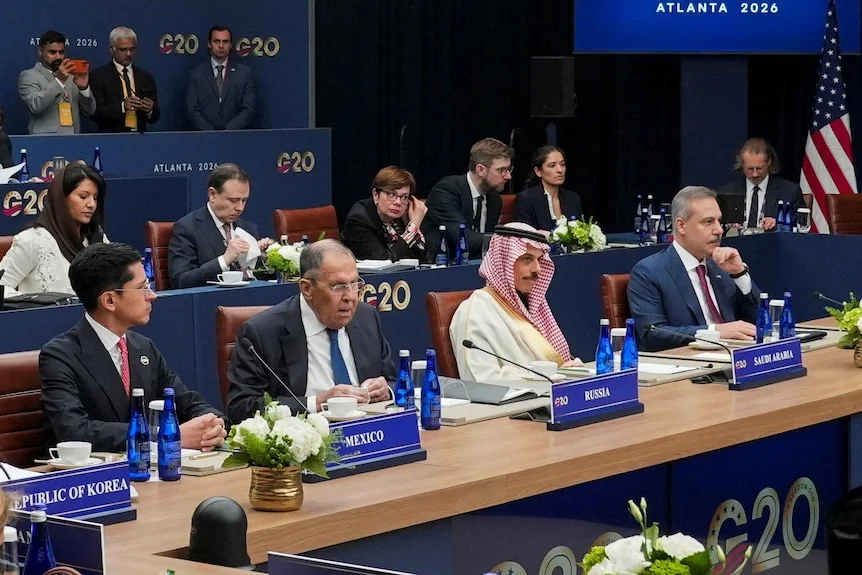
The 2026 G20 Summit is taking place at the Trump National Doral Miami. (Reuters: Megan Varner/Pool)
Talks face a crowded agenda
US Secretary of State Marco Rubio opened the meeting by urging unity on threats to security and trade. “We are in a critical moment,” he told fellow ministers, pointing to connected economic and geopolitical crises. His appeal placed a broad set of pressures at the centre of the gathering, but calls for unity can only go so far when members disagree over the conflicts and policies driving those pressures.
"We are facing a series of interconnected economic and geopolitical crises."
Rubio cited disruptions to energy and food supplies, trade and freedom of navigation, saying they pose “severe threats to essential foundations of the global economic order”. These subjects connect security disputes directly to economic conditions: disruption to supply routes or trade can affect prices and confidence well beyond the countries at the centre of a conflict. The challenge for ministers is to discuss those shared effects without pretending that their disagreements have gone away.
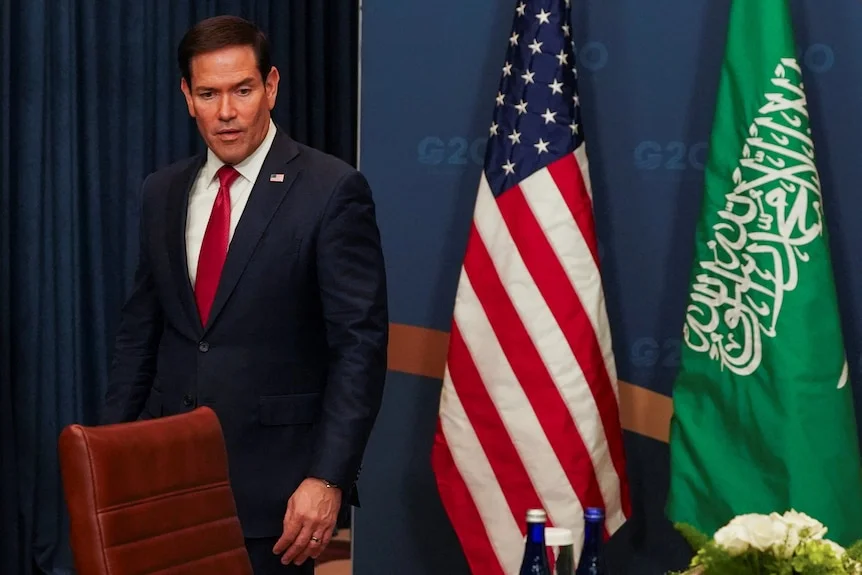
US Secretary of State Marco Rubio called for unity, saying the world is in "a critical moment". (Reuters: Megan Varner/Pool)
Yet the disputes extend well beyond Ukraine. Ministers face differences over the US-Israeli war against Iran, US tariffs and China’s actions in the South China Sea, issues linked to fuel price spikes and trade uncertainty. Each subject carries its own political sensitivities, while their overlap makes it harder to treat economic stability as separate from security. If you're following the talks for signs of agreement, the breadth of that agenda is a reason to be cautious.
Participants described the opening session as cordial, but said Russia remained firm on Ukraine and opposed Poland’s G20 membership. Disagreement over the Trump administration’s decision not to invite member South Africa, despite objections from other participants, adds another obstacle. A civil tone may help ministers keep talking, but it doesn’t by itself show that positions are converging.
What the divisions mean for the summit
Those divisions make a joint communiqué unlikely when the foreign ministers’ meeting ends Saturday, participants said. Several diplomats, speaking anonymously because they weren’t authorised to discuss closed-door talks, said members had nevertheless agreed to try to bridge differences and help ensure next month’s leaders’ summit in Florida succeeds.
That effort may matter even if the ministers can’t produce a shared statement. The G20’s value in moments like this lies partly in keeping channels open and identifying areas where members can still work together; its limits show up when a common position would require them to set aside fundamental disputes. Here’s the thing: the missing photograph captures that tension neatly. The group can convene, but agreement on how to present itself is already difficult.
This is more significant than it looks. The ministers’ meeting offers an early indication of the political conditions facing the leaders’ gathering, while the issues on its agenda carry consequences for trade, energy and food supplies. Whether the attempt to bridge differences produces practical cooperation remains uncertain. And yet, keeping that attempt alive is itself part of the work.
AP/Reuters


