Mathew Kent is heading for Ironman 70.3 Melbourne with a guide—and a practical sense of what the day will bring
For Mathew Kent, a splash during the swim can prompt an uncomfortable thought: is it another athlete, or a shark? That moment captures the extra calculations involved in racing with severely limited sight. It also helps explain why the 37-year-old from Albury relies on close communication with his guide, Brad Manczak.
Kent has retinitis pigmentosa, a genetic eye condition that causes vision loss, including night blindness and tunnel vision. His sight is now limited to a field of about zero to five degrees. “It's almost like putting a hole through a piece of paper and you look through that hole … you just see what's in front of you,” he says.
In the swim, a tether links the pair at the waist. They keep away from the main pack to reduce the chance of collisions, and Kent turns his breathing to the left so he can try to locate Manczak. If the tether tightens, he knows he’s veering off course and pushes back towards him. The system has its awkward moments: “Every now and then I swim over the top of him,” Kent says with a laugh.
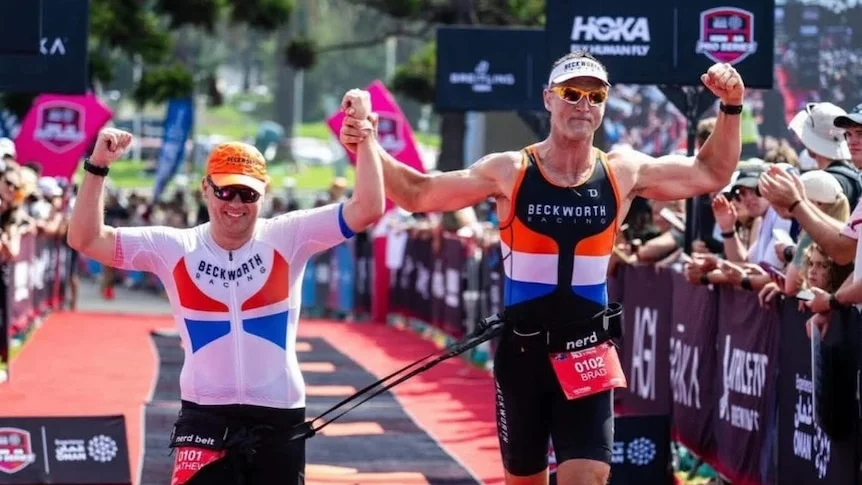
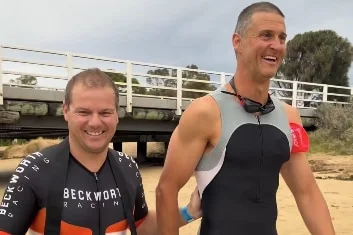
On November 8, Kent and Manczak will take on Ironman 70.3 Melbourne. The “70.3” refers to the race’s total distance in miles: a 1.8-kilometre swim, a 90-kilometre ride and a 21.1-kilometre run, adding up to 113 kilometres. They’ve already raced together at Ironman 70.3 Geelong in March, the Barwon Heads Triathlon and the Geelong Running Festival half marathon.
From water polo to long-distance racing
Kent was fully sighted until he was 15, when his vision began to deteriorate. He could keep his driver’s licence provided he didn’t drive at night, but by 20 he had lost most of his sight—and with it, the licence and much of his independence. “You have to sort of change everything you do,” he says. “You can't just go out and do what you want, when you want.”
He had loved sport as a teenager, including water polo, but his changing vision narrowed his options. About three years ago, his brother Jeremy “dragged” him into triathlon and became his first guide.
The brothers attempted a full Ironman in Busselton, Western Australia, last year. They completed the 3.8-kilometre swim and were about 20 kilometres from the end of the 180-kilometre bike leg when illness forced them to withdraw.
A race built around communication
Kent now does most of his training with a local support worker. Manczak, an experienced triathlete and Ironman who lives in Jan Juc, joins him for races. Guiding changes the job, Manczak says: he has to steer a tandem bike while tracking what’s happening around them and keeping Kent informed.
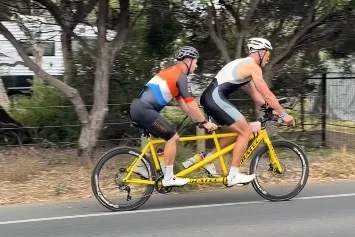
Manczak considers the swim the simplest leg for communication. Kent keeps track of where he is by feel, while Manczak checks that he’s OK. In transition, they move to a designated area and get onto Kent’s custom tandem, imported from the Czech Republic.
The bike makes them hard to miss. “They do notice a tandem bike,” Manczak says. Four legs can mean serious speed: when the pair flies past another competitor, “it does raise an eyebrow.” Kent enjoys the descents, where they can reach 70 kilometres an hour. Climbs are slower going. “We're like a truck going up a hill because we're double the weight on the bike.”
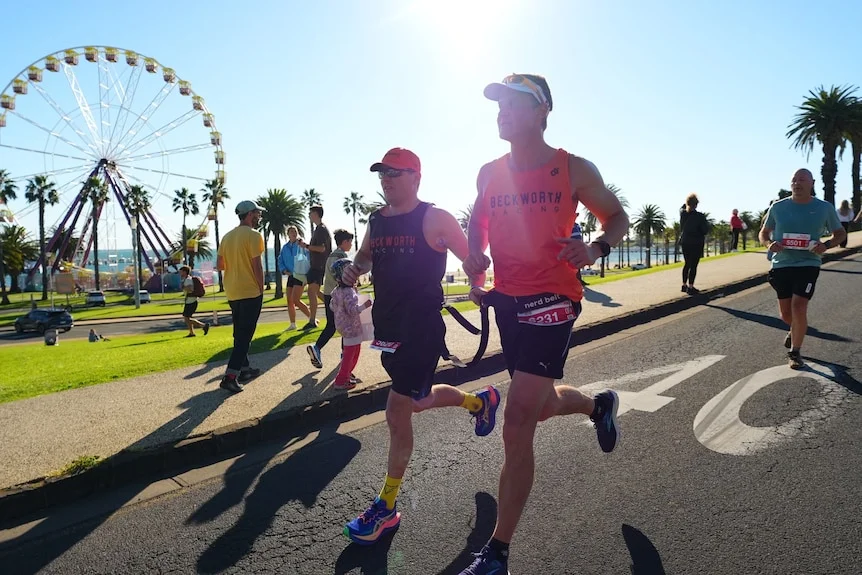
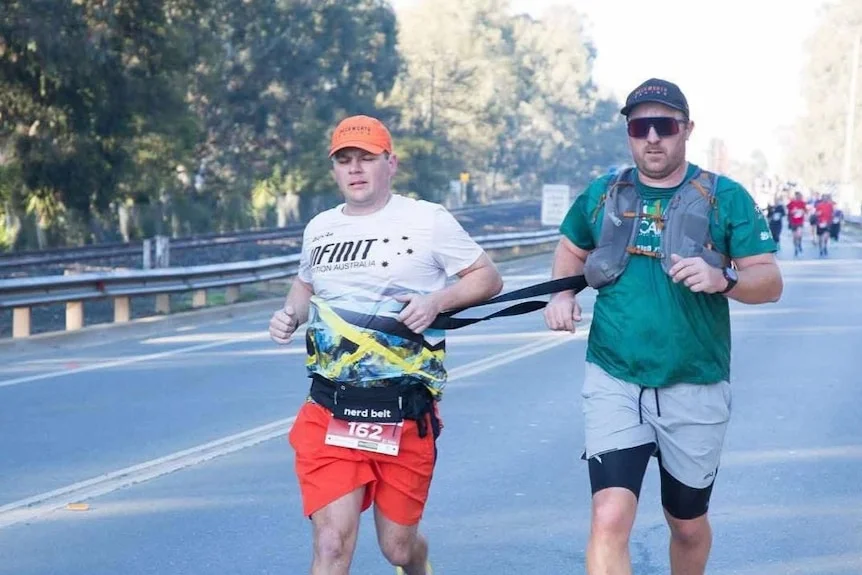
The run brings a different set of demands. The pair use the waist tether again, and on flat, predictable sections Kent can jog normally. He may rest a hand on Manczak’s arm for support. Changes in slope, surface or surroundings require more talking, Manczak says, because Kent needs to know what’s ahead.
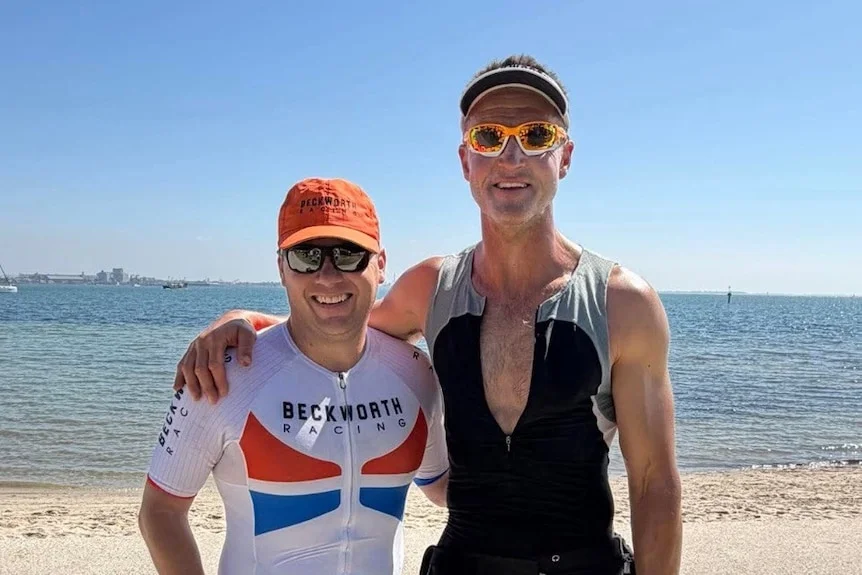
That partnership matters to Manczak beyond the mechanics of the race. Triathlon can be isolating, especially over long distances, he says. Helping Kent has been rewarding, and he enjoys seeing him finish races happy with what he’s achieved.
Kent hasn’t set a firm target for Melbourne, though he’d be pleased to finish in around six hours. He knows that’s a long stretch of hard exercise. His answer is characteristically uncomplicated: “Oh it is, but we're done by lunchtime, and we can have a beer at 1 o'clock.”
The pair may have a strong chance in their category because there are few visually impaired competitors, but results aren’t Kent’s main concern. “You can't take life too seriously, with what I've been through,” he says. “Now I'm just having a bit of fun and just enjoying the moment.”


