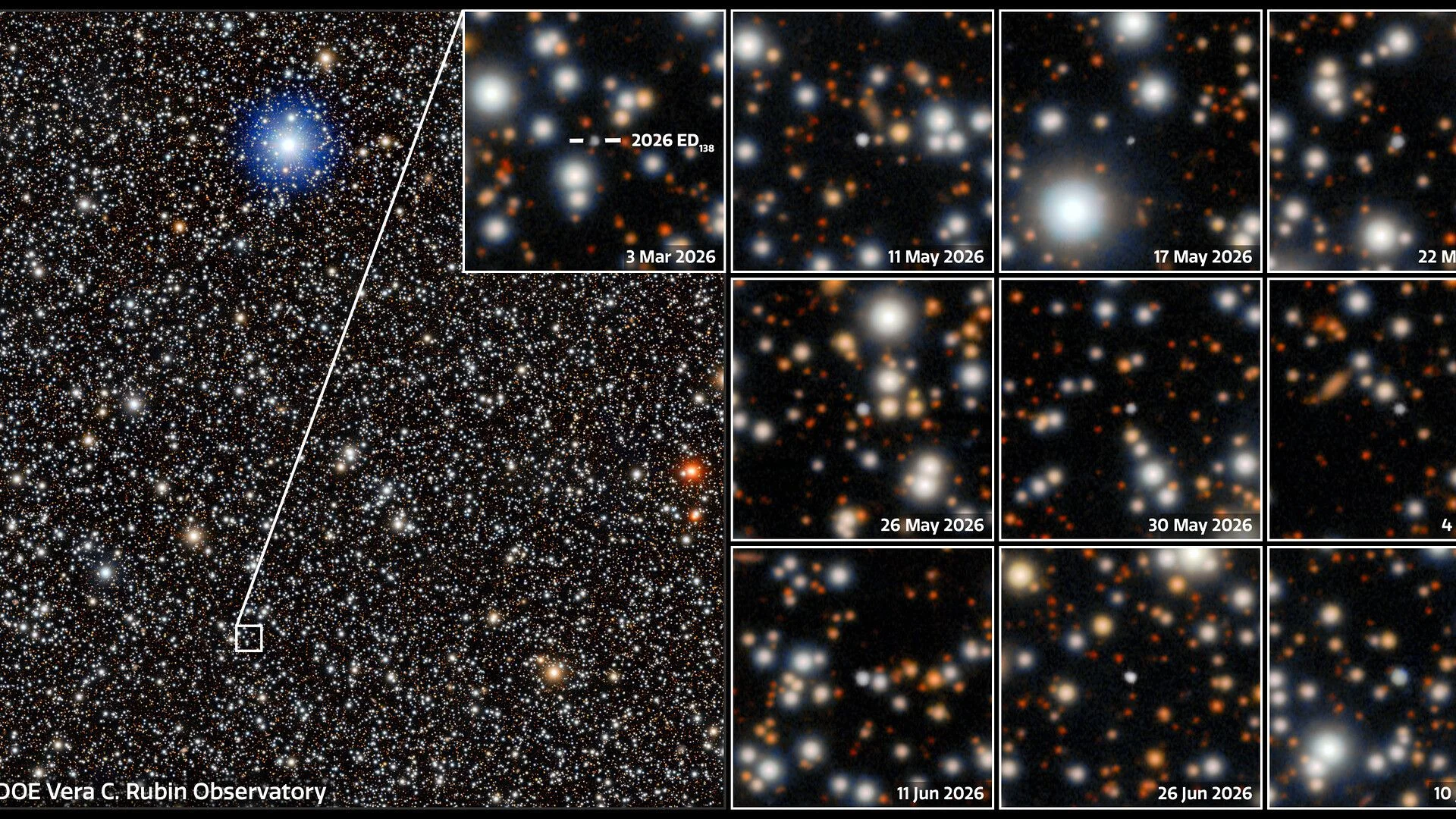
Rubin Observatory’s early survey has surfaced a promising dwarf planet candidate in a region of the sky where moving objects can disappear against the crowded Milky Way. Designated 2026 ED138, the object may be 600 to 1,500 kilometers across—large enough to rank among the biggest known bodies beyond Neptune, though its classification remains unconfirmed.
Its discovery also points to the kind of find Rubin’s repeated, wide-field imaging is built to make. The observatory scans the southern sky every few nights, tracking changes in brightness and position across vast volumes of data. That cadence can reveal distant objects whose slow motion makes them difficult to pick out in one-off observations.
A moving object in a crowded field
ED138 circles the Sun at about 46 times Earth’s distance from it. Its orbit is inclined roughly 25 degrees to the plane of the solar system, placing it against the bright inner Milky Way from our viewpoint. The dense field of stars makes this part of the sky a difficult place to spot faint bodies.
Smithsonian Astrophysical Observatory astrophysicist Matthew Holman, who developed the discovery software with colleague Kevin Napier, said his first reaction was “one of excited disbelief.” He began checking whether the code or his own work had produced an error, he said in a statement.
Their algorithms compare billions of observations to identify detections that belong to the same moving object. When the team ran Rubin data through the software, ED138 emerged as an unusually large candidate. Researchers then combined Rubin observations with archival images from the Dark Energy Camera on the Victor M. Blanco 4-meter Telescope at Cerro Tololo Inter-American Observatory in Chile. Together, those records allowed them to trace the object’s orbit across the past decade.
Rubin had only recently begun its planned 10-year sky survey when ED138 appeared in the data. The observatory’s large digital camera and frequent scans produce millions of nightly alerts for objects that change position or brightness, covering solar system bodies as well as transient events such as supernovas.
Size puts it in the dwarf planet conversation
ED138 lies in the Kuiper Belt, a broad zone beyond Neptune that stretches roughly 30 to 50 times the Earth–Sun distance. The region contains thousands of mostly icy bodies made of materials including frozen methane, ammonia, water and rock. These objects preserve clues to the solar system’s early history, and several of the largest are classified as dwarf planets.
The International Astronomical Union recognizes five dwarf planets: Pluto, Ceres, Eris, Haumea and Makemake. Astronomers who study the category often consider at least nine likely members, alongside candidates whose properties remain uncertain. The broader count is difficult to settle because distant Kuiper Belt objects appear faint and move slowly across the sky.
To qualify as a dwarf planet, an object must be massive enough for its gravity to pull it into a rounded shape, while lacking the mass to clear other bodies from its orbital path. Brightness can help researchers estimate a candidate’s size, but surface reflectivity—the fraction of sunlight it reflects—also affects that estimate. Strong candidates tend to have high reflectivity and diameters above roughly 600 to 800 kilometers.
Based on its brightness, estimated reflectivity and distance from the Sun, ED138 may measure between 600 and 1,500 kilometers in diameter. The range is wide: Pluto measures 2,377 kilometers across, while Ceres, the smallest dwarf planet recognized by the IAU, is 958 kilometers across. If ED138 falls near the upper end of its estimated range, it would exceed Ceres in size. More observations are needed to narrow the estimate and measure its density.
Those measurements will help determine whether ED138 is round enough to meet the dwarf planet criteria. If it qualifies, the officially recognized total would rise to six. Holman said Rubin’s repeated surveys over the next decade could also uncover objects missed by earlier searches, extending the inventory of large worlds in the outer solar system.


