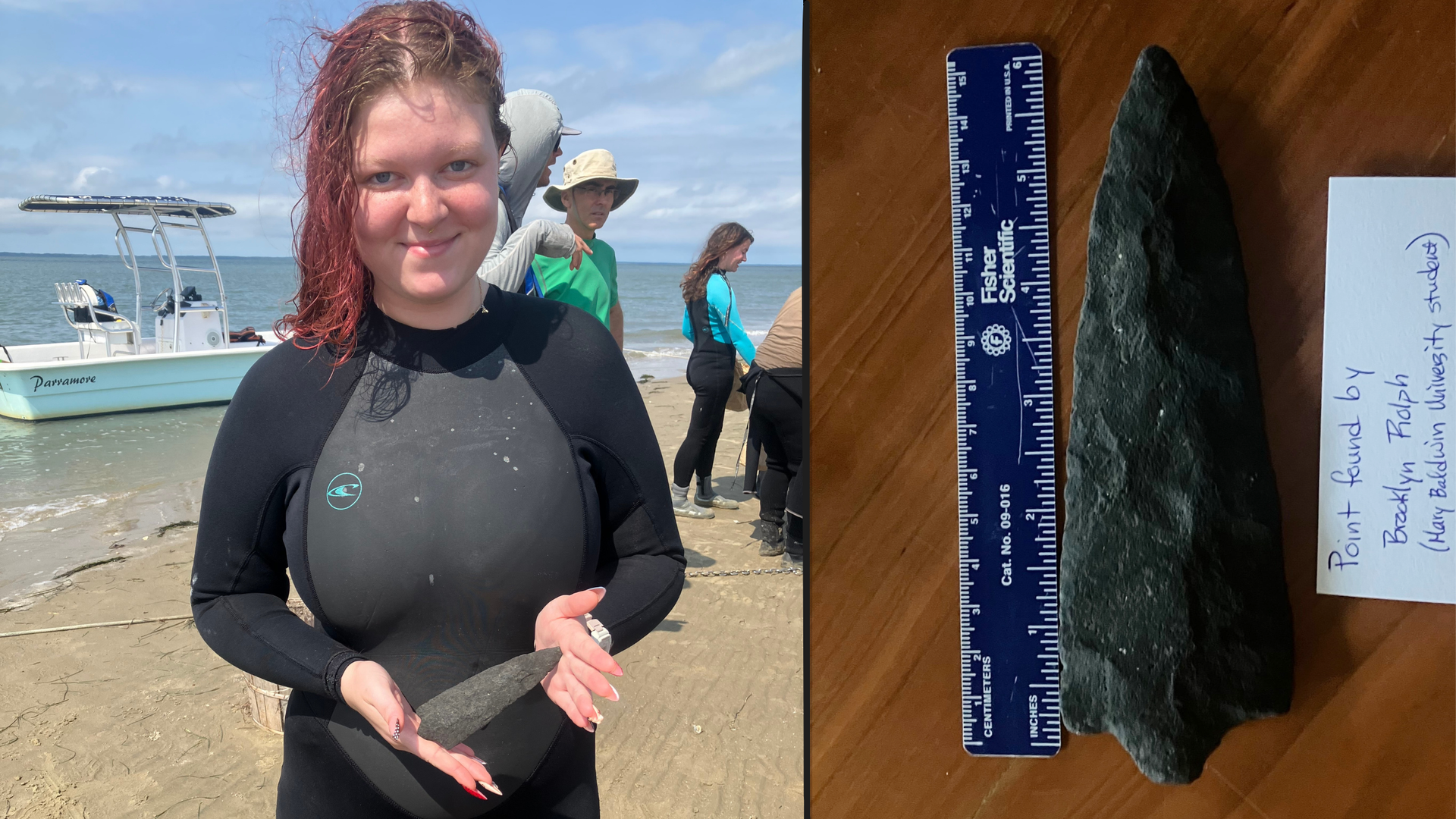
A routine ecology field trip nearly lost an archaeological find to the incoming tide. Mary Baldwin University student Brooklyn Rolph spotted a stone point on Virginia’s Eastern Shore, estimated to be 3,000 to 4,500 years old. The artifact offers a tangible link to Indigenous life during the Late Archaic period, though a single tool can tell only part of that history. Its discovery also shows how archaeological material can surface in places being studied for entirely different reasons.
A find made just in time
Rolph was looking for shark teeth during the final day of the course excursion on Sept. 21. After lunch, she explored a shell mound and noticed the point beside an inlet. The setting mattered: the rising tide was already threatening to cover the object, making the time between spotting it and reporting it unusually short. She showed it to the faculty leading the trip, who were stunned by the discovery.
“The set of circumstances that came together that made this possible is quite unbelievable,” said Paul Callo, a Mary Baldwin biology professor and trip co-leader. The tide was rising, he said, and the artifact “was soon to be buried.” That urgency is part of the story, but it also explains why the discovery depended on people paying attention to what was underfoot. A field trip focused on coastal ecology had put students in a position to notice an object that might otherwise have disappeared from view.
Rolph said she was already scanning for sharp objects underwater when she found it. “Wow, this is so crazy,” she recalled in a university statement. She alerted her professors, who were “ecstatic.” The quick handoff to faculty gave the find a chance to be documented and assessed before the tide could bury it again.
What the stone point reveals
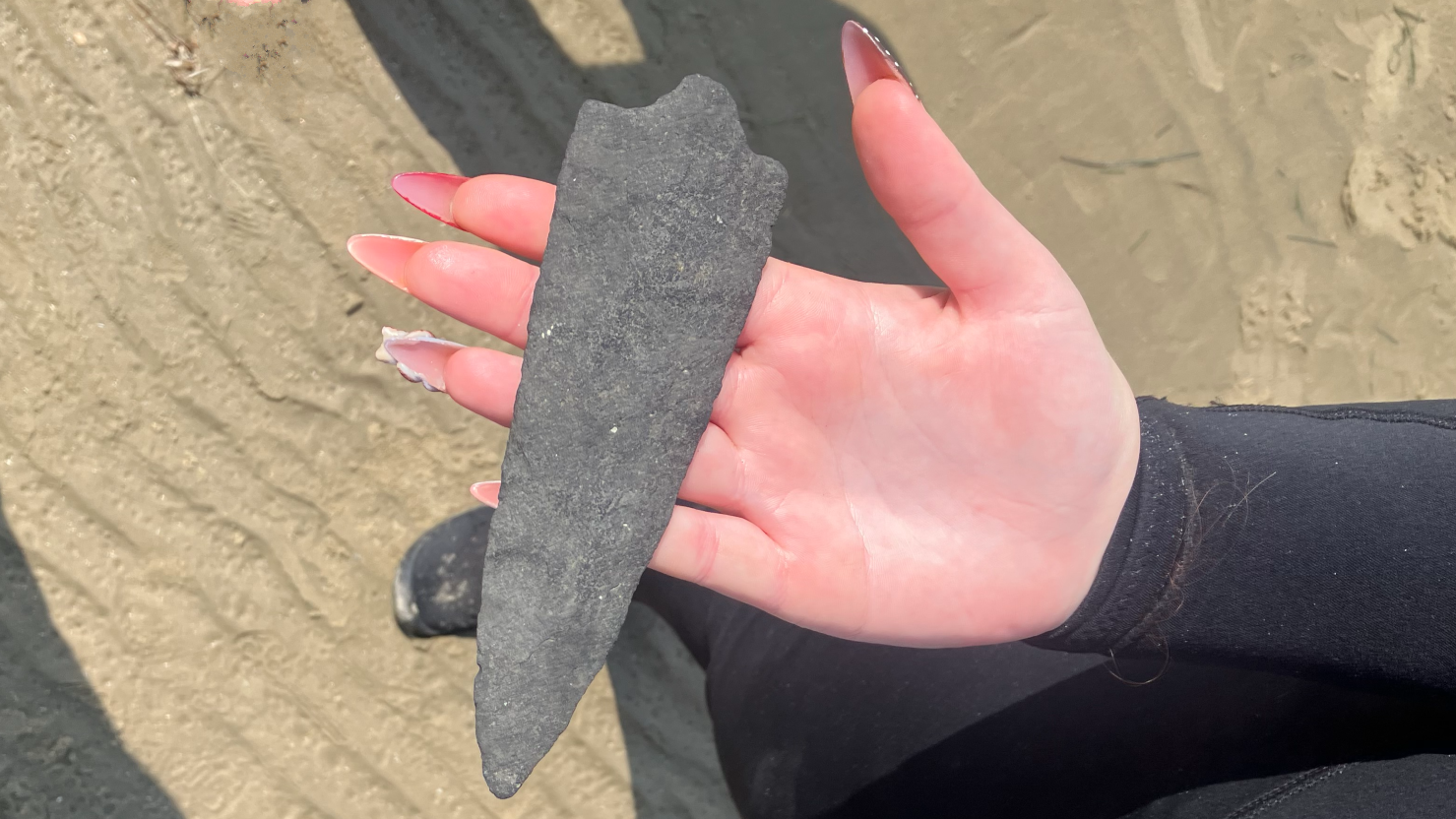
At about 6 inches (15 centimeters) long, the artifact is identified as a Lehigh/Koens-Crispin point, a type made by Indigenous people along the East Coast roughly 4,500 to 3,000 years ago. Sometimes called a “broadspear,” it may also have served as a knife. Tools of this kind are associated with the Late Archaic period, a broad span of the region’s past rather than a precise date for this particular object. The type offers a useful starting point for understanding the tool, but it can’t by itself identify who made it or what happened at the spot where it was found.
A stone point can carry evidence of practical knowledge: choosing workable stone, shaping an edge, and making an object suited to a task. The possibility that this one could be used as either a spear point or a knife also cautions against treating ancient tools as having only one function. Its age estimate places it thousands of years before the present, but the object is still modest in scale. The history it evokes is much larger than the artifact itself.
The trip was part of a Mary Baldwin ecology course focused on coastal plants and animals. Faculty had a state permit to explore barrier islands off Virginia’s Eastern Shore, at the southern end of the Delmarva Peninsula. That combination of ecological fieldwork and access to a coastal natural area put the group in a setting where natural processes and human history meet. Erosion and tides can expose material, then cover it again; similar coastal conditions often make careful observation and prompt reporting especially valuable.
Archaeologists take the artifact for study
The island belongs to a natural area managed by the Virginia Department of Conservation and Recreation, so the point is now property of the Commonwealth of Virginia. Archaeologists collected it from the university group and brought it to the Virginia Department of Historic Resources for further study. That transfer places the object with specialists who can assess it in a historical and archaeological context, rather than leaving its interpretation to a field identification alone.
Callo said he was “truly at a loss for words” when Rolph showed him the find. “It is certainly awe-inspiring to see and touch something that was made by human hands thousands of years ago.” Rolph was comfortable handing it over: “That’s how you get cursed!” Her joke aside, the artifact’s path from the shoreline to state archaeologists marks a practical shift: the find is no longer just a striking object, but material available for closer examination.
Why the discovery matters beyond the shoreline
This is more significant than it looks. The point won’t provide a complete account of Indigenous life in the region, and the available details don’t establish how it came to rest beside the inlet. Still, its identification and transfer for study give researchers a physical object to examine and place within the broader record of the Late Archaic period. That’s a useful reminder that archaeological discoveries often begin with a limited clue, not a finished explanation.
If you’re working in this space, the episode underlines the value of noticing and reporting objects found during fieldwork, even when the project has another focus. The course’s ecological purpose didn’t make the archaeological find less relevant; it created the circumstances in which Rolph encountered it. And yet, chance alone doesn’t explain what the artifact can tell us. Its long-term value will depend on the study that follows and on keeping the limits of the evidence clear.
A brief window before the tide returned. The point has now reached archaeologists, where its material and form can be considered more closely. For the public, the discovery offers a rare, direct encounter with an ancient object—and a reminder that the surviving traces of Indigenous history can be easy to overlook.
How much do you know about the first people to reach the Americas? Find out with our First Americans quiz!


