
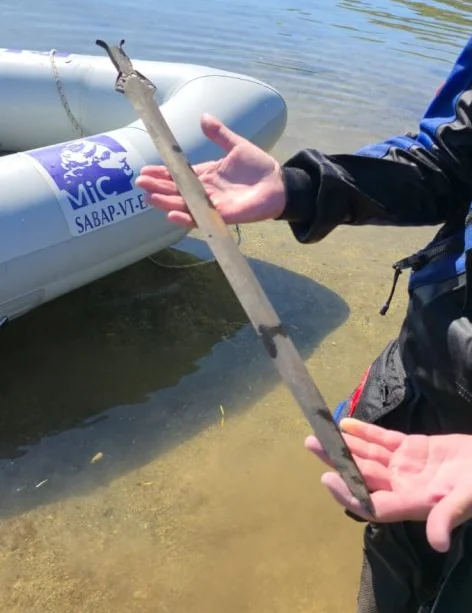
A Bronze Age sword recovered from Lake Mezzano still has a sharp edge after roughly 3,300 years underwater. Its discovery, alongside a bronze razor and other objects from a submerged settlement, gives archaeologists fresh evidence of life and ritual in central Italy before the Etruscans and Romans. The condition of the blade is striking, but the find’s value goes beyond its edge: its setting and its neighbors may help researchers understand how people used objects, and how they assigned them meaning.
The sword dates to the Late Bronze Age, around the 14th to 13th centuries B.C. It’s the third sword of its kind reported from the lake in the past 50 years. Lake Mezzano occupies the crater of an ancient volcano about 60 miles (100 kilometers) northwest of Rome, according to a translated statement from the Superintendence of Archaeology, Fine Arts and Landscape for the Province of Viterbo and Southern Etruria.
Finding another sword in the same lake makes this more than a one-off curiosity. Repeated discoveries can help researchers ask whether the objects reflect ordinary activity around the settlement, deliberate placement in the water, or a mix of both. The available evidence doesn’t settle that question. Still, the lake’s archaeological record offers a chance to examine individual objects in relation to a wider community and its material culture.
A settlement and its objects
Archaeologists investigating the lake also recovered remains of pile dwellings, or stilt houses, built by Bronze Age inhabitants. Finds from the submerged settlement include intact vases, axes, arrowheads, daggers, spearheads, pins and a bronze razor. Together, these objects point to a community whose daily life involved more than weapons: containers, tools and personal items all help flesh out what people made, kept and used.
That range matters because a settlement is harder to understand through a single spectacular artifact. A sword can attract attention, while the objects found around it may offer a more ordinary view of life and work. The vases, pins and other items provide different kinds of evidence, although their presence alone can’t tell researchers exactly who owned them or how they were used. Context is the key: where an object was found, what lay nearby and how the site was formed all shape what archaeologists can reasonably infer.
The razor was found near the sword. That proximity could point to an association with a high-status individual, perhaps an elite warrior. It’s a plausible interpretation, not a confirmed biography: nearby objects don’t automatically establish that they belonged to the same person. Researchers will need to weigh the find’s position and the broader site evidence before drawing firmer conclusions.
The weapons may also have had a ritual role. Bronze Age communities sometimes placed hoards of jewelry and deliberately bent or “killed” artifacts in bodies of water. Related practices persisted into Etruscan times, when wells were ritually “closed” with objects and human sacrifices. Those parallels make a ritual reading worth considering, but they don’t prove the Lake Mezzano sword was deposited for that reason. The distinction matters: a pattern known from other sites can suggest questions, but it can’t supply an answer for this one.
Weapons as signs of status
By the 13th century B.C., communities in central Italy were connected to trade networks spanning the Mediterranean. Bronze weapons carried meaning beyond their use in combat. “In this context, bronze weapons were not only instruments of combat, but also symbols of prestige, identity, and power,” the statement said.
That interpretation places the sword within a social system as well as a technological one. A weapon could be useful, but its material, craftsmanship and ownership could also signal standing or group identity. The statement’s reading is consistent with the idea that valuable objects had several roles at once; it doesn’t mean every weapon was ceremonial, or that this sword belonged to a warrior elite. The evidence leaves room for those possibilities without resolving them.
Here’s the thing: an artifact’s sharp edge is immediately legible, while its social meaning has to be argued from context. The blade’s condition draws the eye, but the nearby razor and the settlement remains may prove just as useful for understanding the people who lived beside the lake. And this is the part most people overlook: the strongest story may come from how these finds relate to one another, rather than from the sword alone.
What the lake can still reveal
The Lake Mezzano discoveries are helping researchers examine the people who lived in prehistoric Italy before Etruscan and Roman societies emerged. Further research at the site is planned in the coming years. That work could clarify how the settlement’s objects relate to one another and whether the lake preserved evidence of everyday life, deliberate offerings, or both.
This is more significant than it looks. The finds offer a window onto a period that came before the better-known Etruscan and Roman societies, and they make it possible to ask how communities organized status, trade and ritual before those later cultures took shape. If you’re working in this space, the challenge is to keep the interpretation proportionate: the objects raise meaningful questions, but the answers depend on careful study of their archaeological context.
For now, the sword is evidence of a long-lived object and a complex past, not a complete account of either. More research may sharpen the picture. Until then, the lake’s collection remains suggestive—and unfinished.
Can you identify these historical objects of war? Test your smarts with our weapons of the world quiz!


