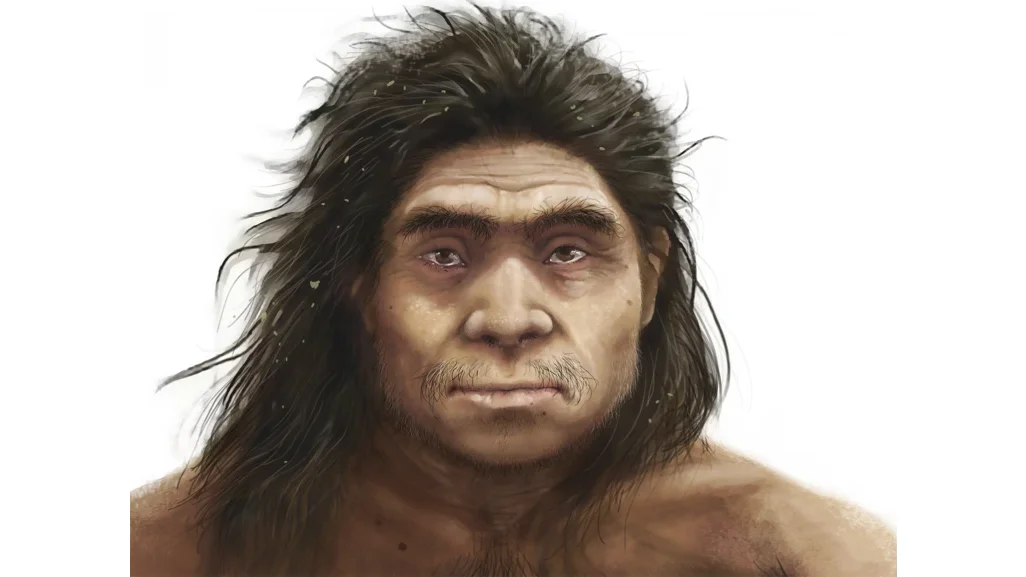
Denisovans may have had a recognizable skull shape that helps explain why many ancient human fossils from East Asia have been difficult to classify. A study of remains from Xujiayao, China, identifies a mix of traits shared with other human relatives and features that appear distinctive to Denisovans.
Published Oct. 21 in Nature, the research examines fossils dated to between 138,000 and 199,000 years ago. The team used ancient protein analysis to identify 20 Xujiayao bones and teeth as Denisovan, then compared their anatomy with fossils attributed to other human groups.
The result offers a clearer way to assess Denisovan remains. The group was first identified in 2010 through DNA recovered from a finger bone found in a Siberian cave. Denisovans lived across Asia and disappeared around 30,000 years ago, but their fossil record remains sparse. The Xujiayao bones had been excavated in the late 1970s, before Denisovans were known, and were initially considered possible Neanderthal or archaic Homo sapiens remains.
Proteins help identify the fossils
DNA breaks down over time, while some proteins in bones and teeth can persist longer. That makes paleoproteomics—the study of ancient proteins—a useful way to identify remains when DNA is unavailable. Researchers have used protein variants to distinguish Denisovans from other ancient human groups.
With the Xujiayao fossils assigned to Denisovans, the researchers found a combination of anatomical traits that crosses familiar boundaries. The skulls had a low, broad braincase and thick cranial bones, features also seen in Homo erectus. Their bicuspids, the teeth between the canines and molars, had similarities to those of Neanderthals and modern humans.
Other details may help distinguish Denisovans. The rear of the Xujiayao skulls was more vertical and less rounded than the corresponding area in Neanderthals or modern humans. The researchers argue that this combination separates Denisovans from H. erectus, modern humans and Neanderthal-lineage groups.
That finding bears on how researchers classify other East Asian fossils. Some have been assigned to proposed species such as Homo juluensis and Homo longi. Similarities with the Xujiayao fossils could mean that at least some of these remains belong to Denisovans, rather than to separate species.
In the study, the researchers write that the shared traits “supports the assignment of most members of East Asian late Middle Pleistocene archaic Homo as Denisovans.” Their interpretation points to one Denisovan lineage adapting to different ecological settings across Asia over hundreds of thousands of years.
One lineage, varied populations
The classification remains open to revision as more fossils emerge. Qiaomei Fu, a study co-author and director of the Ancient DNA Laboratory at the Institute of Vertebrate Paleontology and Paleoanthropology of the Chinese Academy of Sciences, told Live Science by email: “It is still possible that there are some other lineages that existed in East Asia during the time Denisovans are known to have existed.”
Chris Stringer, a paleoanthropologist at London’s Natural History Museum who was not involved in the research, also cautioned against expecting a single uniform appearance. “We know from DNA that Denisovans were a very varied group genetically, which split early into different populations,” he told Live Science. “These could have developed a lot of morphological variation, which may well surprise us as the sample of fossils grows.”
The study also informed a new reconstruction of a Denisovan man. Earlier DNA research suggested Denisovans likely had dark skin, brown hair and brown eyes. The new portrait depicts a man looking straight ahead, with dark hair swept back from a pronounced brow ridge. His broad, low braincase is largely hidden by his hair. He recalls both Neanderthals and modern humans, yet the skull evidence gives him a distinct profile.
As protein analysis and new discoveries add to the fossil record, researchers will be able to test whether Denisovan anatomy varied within one widespread group or also reflects other human lineages in ancient Asia.
- Enigmatic Denisovans lived by cave in what is now China for 100,000 years, rare fossils and handcrafted tools reveal
- Denisovan DNA influences the immune systems of modern Oceanians — but researchers aren't sure why
- 1 million-year-old skull from China holds clues to the origins of Neanderthals, Denisovans and humans
See how much you know about early humans with our human evolution quiz!


