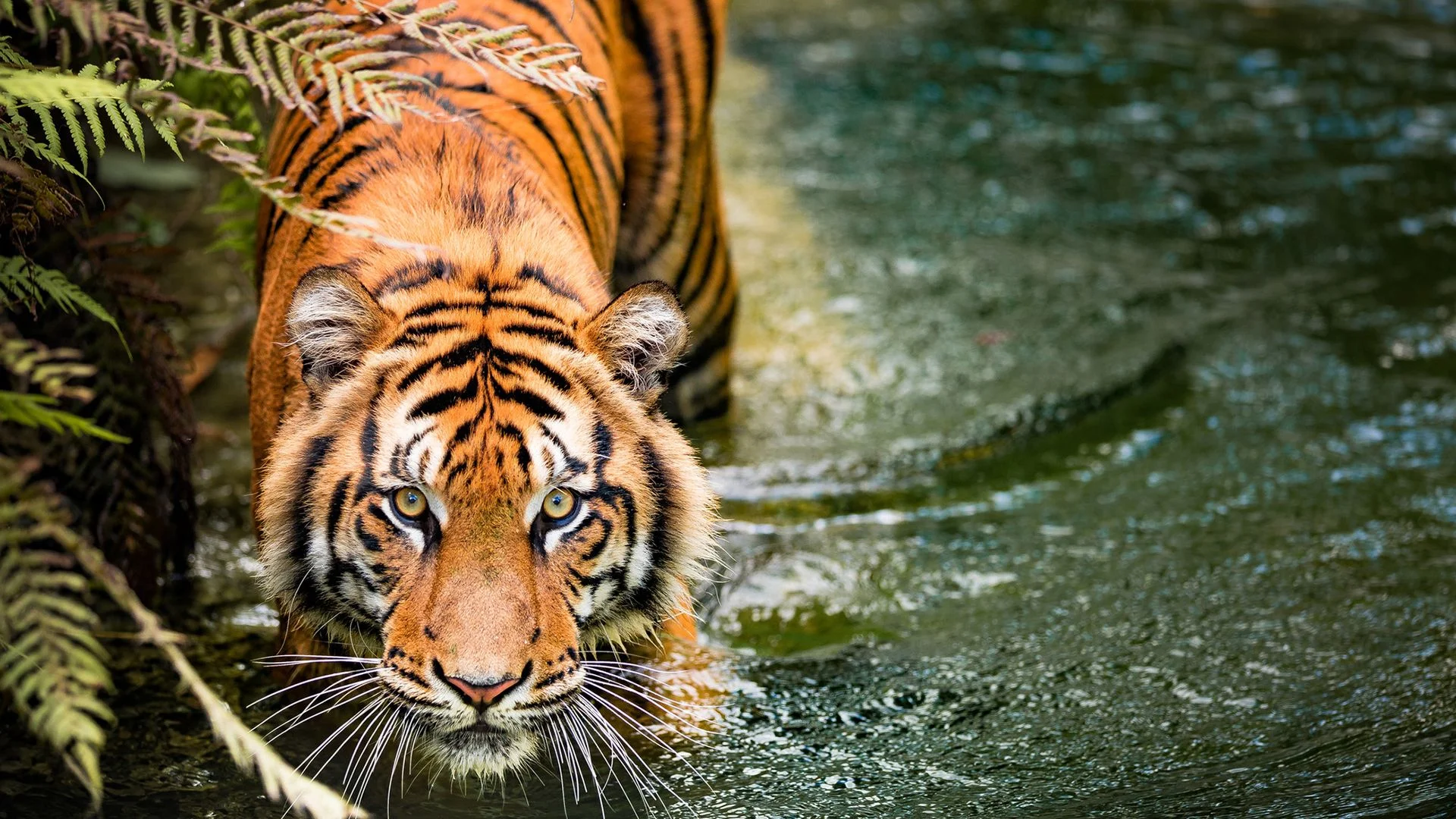
Rare footage from Nepal is challenging a familiar picture of tigers as strictly solitary. In the PBS Nature series Tiger Island, a male approaches his cubs and greets them with a bobbing motion while their mother rests nearby. The scene offers an unusual look at a tiger family spending time together, and it complicates the shorthand often used to describe the species. “Solitary” can describe how tigers generally live, but it doesn’t tell us everything about how they behave in particular encounters. One observed interaction can’t establish how common this kind of contact is. It can, however, make familiar assumptions harder to treat as settled fact.
What the footage reveals about tiger families
Wildlife biologist and filmmaker Dan O'Neill, who worked on the two-part documentary, says the footage may unsettle assumptions about how males behave around cubs. Tigers are generally understood to be solitary, and accounts commonly describe mothers raising their young for up to two years on their own, without help from males. Those descriptions are useful as broad summaries, but they can leave little room for behavior that doesn’t fit the usual pattern. The Nepal footage captures a moment of apparent contact; it doesn’t, on its own, show what the male’s role is over time or how often such interactions happen.
“It just shows that we really know nothing about them,” O'Neill told Live Science. “And they're so much more complex than people realize.” The statement is emphatic, but the underlying point is narrower and more persuasive: animals observed in the wild can behave in ways that challenge what researchers and viewers expect. A camera records what happened in front of it. Understanding why it happened, and whether it’s typical, takes more than a striking scene.
The series also records a female tiger caring for another tigress’s cubs. O'Neill says such observations expose the limits of tidy descriptions of animal behavior: “We have these very rigid ideas of how these animals live.” Seeing one female care for another’s young doesn’t establish a standard pattern of shared parenting. It does show why researchers need to keep individual observations in view, especially when a simple label can make animal relationships seem more uniform than they are.
That care could matter for cub survival. Male tigers sometimes kill young, particularly after a new male takes over a territory—a behavior known as infanticide. Another female helping to guard or raise cubs may give them a better chance of reaching adulthood, O'Neill suggested. The footage raises that possibility, though it doesn’t establish whether the female’s care changed the cubs’ chances in this case. Earlier observations have documented females co-parenting, though the behavior appears to be uncommon. The evidence points to a behavior worth watching, not a reason to assume that tigers routinely raise young in groups.
Capturing these moments required a different approach from placing camera traps along trails. The crew used drones fitted with powerful optical-zoom lenses to watch tigers in hard-to-reach areas. Their propellers, O'Neill said, were quieter than the local bees, allowing the team to observe the animals without disturbing them. That claim helps explain the filmmakers’ choice of equipment, though a quiet drone is still a tool for observing behavior from a distance, not a way to answer every question about it. Trail cameras can collect valuable images, but their fixed positions limit what they can record when animals move elsewhere. A mobile camera can follow action across a wider area and show interactions that might otherwise go unseen. The result is a view of behavior that trail cameras often miss. Briefly, but revealingly.
Tigers share space with people
Unusual family behavior is only part of the picture. Tigers (Panthera tigris) may be solitary, but they also live near human communities and share habitat with people. Encounters can lead to attacks on people or livestock. “It would be absolutely naive and wrong to suggest that they [attacks on people] don't happen,” O'Neill said. That acknowledgment matters: accounts of wildlife conservation can lose credibility when they present predators only as distant symbols or overlook the costs borne by people living nearby. The existence of attacks doesn’t tell us how often they occur or what causes each one, but it makes clear that coexistence has practical consequences.
Conservation depends on the people who live nearby
O'Neill, a researcher with wild-cat conservation organization Panthera, has also studied jaguars, pumas and snow leopards. The image of big cats in distant wilderness can hide how often their lives intersect with human ones. For people sharing space with predators, those intersections can mean the loss of livestock or the risk of an encounter. Conservation, in his view, has to account for those encounters and support the people who live with the costs of sharing space with predators. That’s a more grounded measure of conservation than treating the animals’ presence as an uncomplicated success.
“Helping those people is how you help tiger conservation,” he said. This is more significant than it looks: public interest in rare footage can draw attention to animal behavior, but lasting support for conservation also depends on whether local communities see its value. If you're working in this space, the implication is plain: understanding tigers means paying attention to their relationships with one another and to the people living alongside them. The footage makes a similar point about tiger behavior: direct observation can expose how much remains unknown, while showing that the animals’ lives are shaped by both family ties and proximity to people (and this is the part most people overlook).
What the footage can—and can’t—tell us
The documentary offers a view of behavior that’s difficult to capture, but a few scenes can’t settle broad questions about tiger family life. They can sharpen those questions. How frequently do males approach cubs? Under what conditions do females care for another tigress’s young? The article doesn’t provide answers, and the footage shouldn’t be asked to supply them. Its value is that it gives viewers a reason to question overly rigid accounts while keeping the limits of a single observation in mind.
In the U.S., the second part of Tiger Island airs Wednesday, Oct. 28, at 12:30 a.m. on the PBS channel. For viewers, the unusual encounters are a reminder that wildlife stories often contain more uncertainty than a familiar label allows—and that seeing an animal clearly is only the beginning of understanding it.
Think you know about lions and tigers? Test your smarts with our big cat quiz!


