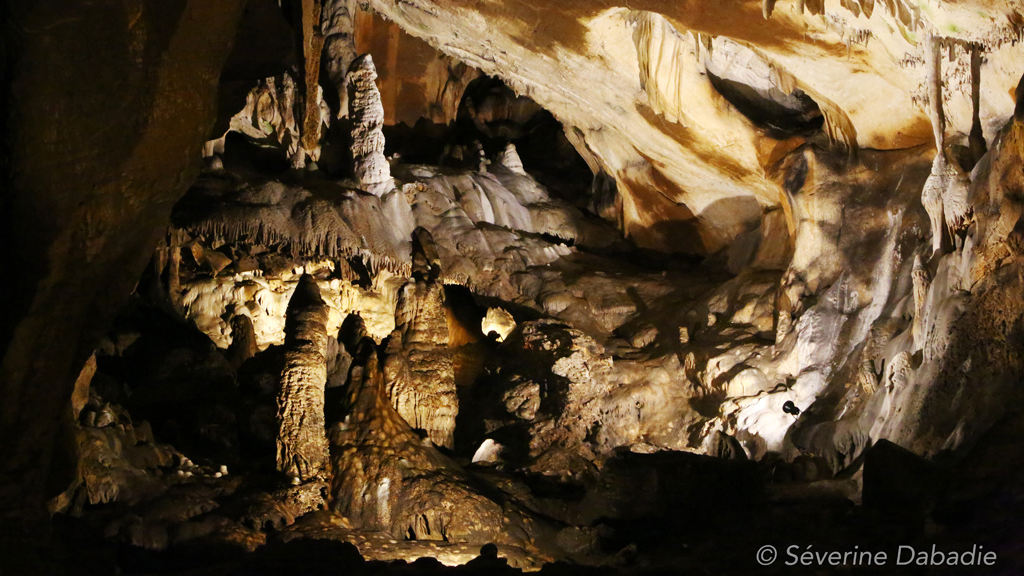
A woman buried in southwestern France around 30,000 years ago carried ancestry linked to people farther east, challenging the view that Ice Age populations in Europe lived in largely separate genetic groups. Her DNA also adds weight to the idea that Isturitz Cave sat at an important crossroads between continental Europe and the Iberian Peninsula.
The finding comes from a study published Oct. 23 in Science Advances. Researchers sequenced the genomes of three people from Spain, France and Italy who lived during the Gravettian period, which lasted roughly 34,000 to 25,000 years ago. Earlier genetic research drew on only about two dozen Gravettian skeletons, leaving major gaps in what scientists knew about the population’s ancestry.
That small sample matters because ancient DNA studies can reveal connections that bones and artifacts alone can’t establish. Researchers compare inherited genetic patterns across individuals and regions, then use those similarities to assess how populations may have been related. The results don’t map every journey or identify a specific migration route, but they can test whether groups previously treated as separate shared ancestry.
That limited evidence had suggested Western and Eastern European groups were mostly distinct. The newly analyzed woman, whose remains were found in Isturitz Cave, had ancestry most similar to previously studied Western Europeans, but also showed a connection to groups in Central and Eastern Europe. The result complicates a simple east-versus-west picture: the strongest genetic resemblance was regional, yet it wasn’t the whole story.
Study first author Pere Gelabert, an evolutionary anthropologist at the University of Vienna, said in a statement that the results show eastern and western populations “were not as genetically isolated as previously assumed.” The team estimates that the gene flow linked to the woman’s ancestry occurred around 31,500 to 32,500 years ago. Movement of people from Eastern Europe during the Gravettian period could explain the connection, the researchers wrote. That estimate describes when the ancestry connection may have formed; it doesn’t tell us exactly where the people met or how many traveled west.
A cave at a crossroads
Isturitz Cave’s history stretches well beyond the woman’s lifetime. The site, first used by Neanderthals, saw intermittent occupation from about 80,000 to 10,000 years ago. Archaeologists have also found evidence of its long use and cups made from human skulls dating to roughly 15,000 to 12,000 years ago.
That long record gives the cave significance as an archaeological site, but it shouldn’t be read as proof of uninterrupted occupation or a single community persisting across millennia. The Gravettian woman belongs to one moment within a much longer sequence of visits. Her DNA offers a separate kind of evidence from artifacts: it can speak to ancestry, while the cave’s objects and layers help researchers understand how people used the place at different times.
The cave’s position between Iberia and the rest of continental Europe could have made it a meeting point for people and ideas. Archaeological finds from the Gravettian, including portable art such as Venus figurines, show that the culture extended across Europe. The DNA results now offer evidence that people, too, moved across those broad distances. This is more significant than it looks: a shared cultural style can spread through contact, exchange or movement, but genetic links provide evidence that populations themselves were connected.
Still, one woman’s ancestry can’t establish how common such connections were. The cave’s location makes movement between regions plausible, while the genetic result supports a connection in this case. Those clues reinforce each other, but they don’t reveal a complete map of Gravettian travel. (And this is the part most people overlook.) A crossroads is a useful interpretation of the evidence, not a claim that every group passing through the region left a genetic trace.
What the genomes can—and can’t—show
All three newly sequenced individuals had close biological ties to Western European groups. Their genomes also pointed to dark skin, dark hair and dark eyes. Each person’s parents were not closely related, a pattern consistent with communities avoiding close-kin pairings.
These details come from different kinds of genetic analysis and answer different questions. Ancestry comparisons place the individuals in relation to other sampled populations, while inherited variants can inform estimates of physical traits. The findings offer a glimpse of three people, not a portrait of every Gravettian community. Their parents’ lack of close biological relation also doesn’t, on its own, explain how partners met or how communities organized family life.
The small number of available genomes still limits what researchers can say about Gravettian populations as a whole. But these three individuals show that ancestry and movement in western Europe were more varied than earlier samples suggested. The numbers here are underwhelming for drawing a population-wide picture; their value lies in adding evidence where the record has been thin.
Why the next samples matter
As more ancient genomes become available, sites such as Isturitz may help clarify how people crossed and connected across Ice Age Europe. New samples could show whether the eastern ancestry seen in this woman was widespread, limited to particular places or present only in certain periods. They could also help researchers compare genetic evidence with archaeological patterns across regions.
If you’re working in this space, the study’s clearest message is methodological: broad claims about prehistoric populations depend on who has been sampled. A small set of remains can reveal an unexpected connection, but it can’t establish its frequency or explain every route behind it. The picture is still incomplete.
That said, the finding gives researchers a more complicated account of Gravettian Europe than a division into isolated western and eastern groups. It points to contact across distance while leaving open how often it happened and what form it took. Isturitz’s value may be that it brings location, archaeological history and genetic evidence into the same discussion, where each can help refine the others.
Test your knowledge of early humans with our human evolution quiz!


