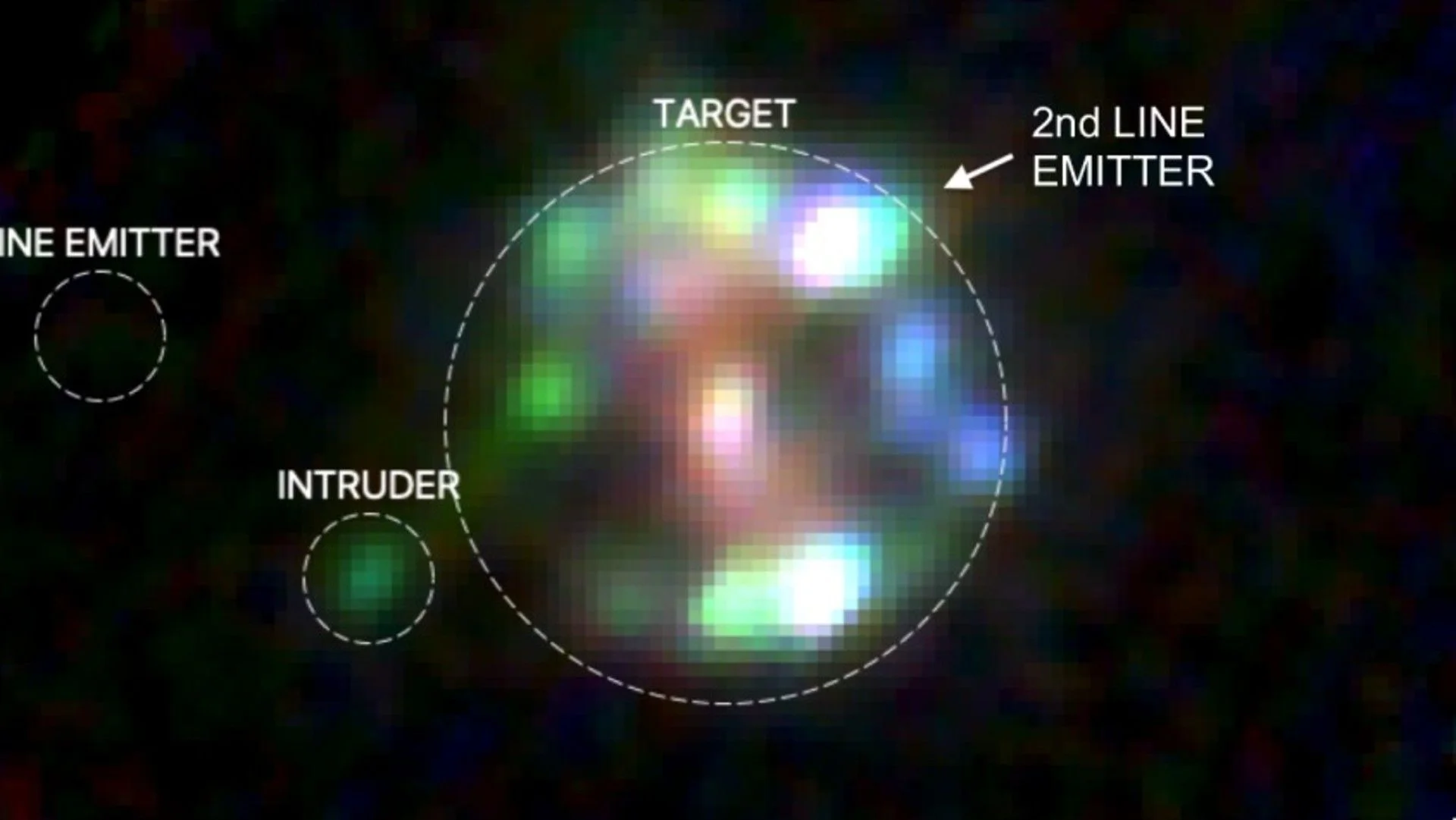
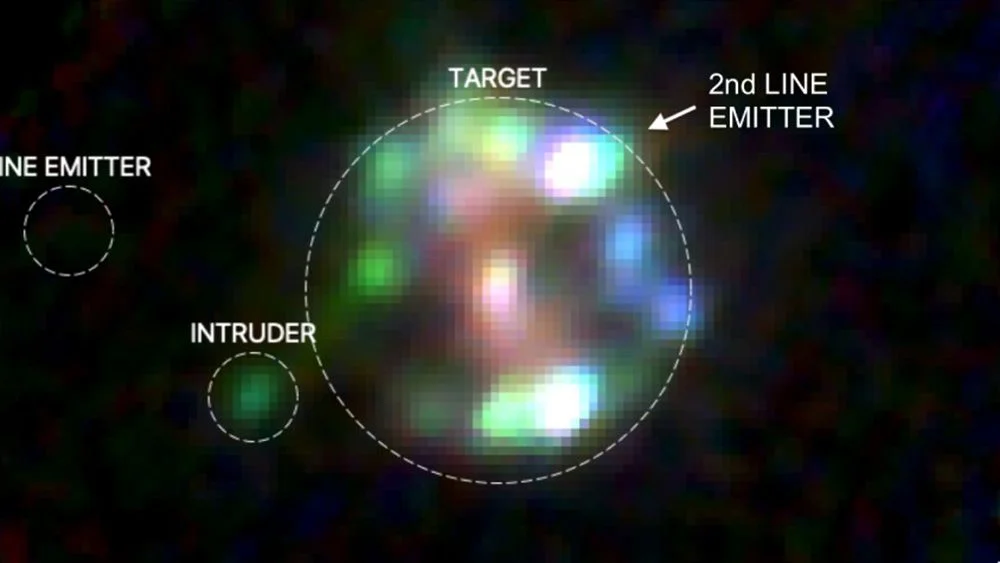
GS18660 gives astronomers a rare chance to examine a ring-shaped galaxy in the young universe—and perhaps catch the aftermath of the impact that made it. Observed as it appeared 2.1 billion years after the Big Bang, the galaxy is the most distant ring galaxy identified so far. Data from the James Webb Space Telescope (JWST) show a ring of young stars, a nearby companion and a bridge of gas that together support a collision scenario.
The evidence is suggestive, not conclusive. The study, published Sept. 8 in Astronomy & Astrophysics, presents a possible example of a small galaxy passing through a larger one and triggering a wave of star formation. If that interpretation holds, GS18660 could also prompt a reassessment of how often such systems formed in the distant universe.
A ring found in follow-up observations
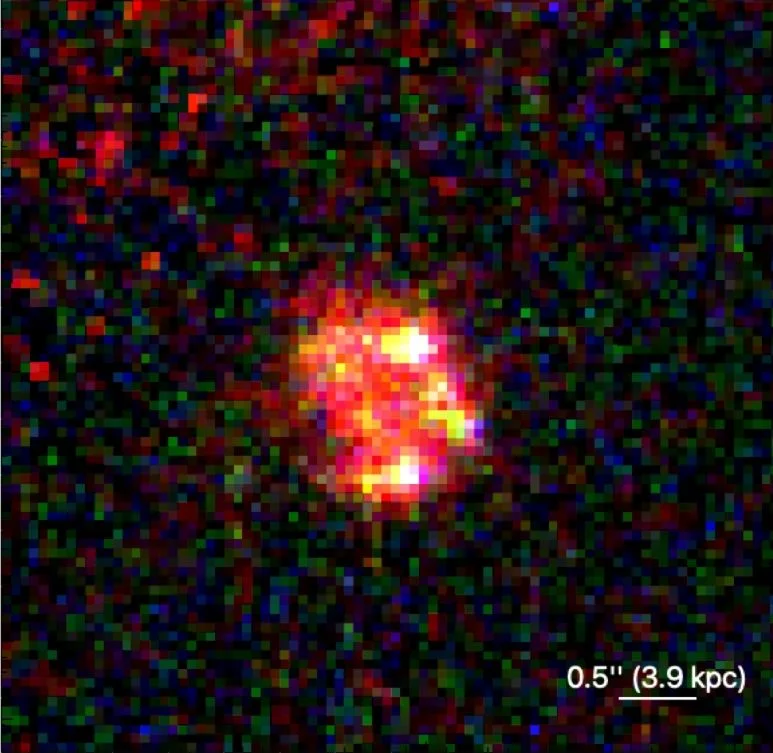
GS18660 wasn’t originally selected as a ring-galaxy candidate. Earlier images from the Hubble Space Telescope showed an elongated object, which led researchers to study it further. JWST’s Near-Infrared Spectrograph delivered a sharper view, revealing the ring and letting the team investigate the galaxy’s structure in three dimensions.
“We therefore did not target GS18660 specifically as a ring galaxy,” Michele Perna, a postdoctoral researcher at the Spanish Astrobiology Center and the study’s lead author, told Live Science. “When we observed it with JWST [Near-Infrared Spectrograph instrument], the much more detailed data revealed the prominent ring structure and allowed us to investigate the galaxy in three dimensions.”
The team examined the galaxy’s shape, measured the motion of its hot gas, analyzed the gas’s chemical properties and reconstructed its history of star formation. Those lines of evidence help explain how the ring might have formed—and give researchers a way to compare the impact hypothesis with other possibilities.
Clues point to a passing galaxy
In the collision model, a smaller galaxy plunges through the disk of a larger one. The passage sends a wave of dense gas outward. As gas collects along that wave, it can collapse into stars and form a ring. Ring galaxies are uncommon nearby, and possible examples from the distant universe have been difficult to confirm.
GS18660 has several features expected after such an encounter. JWST observations revealed a small companion moving away from the main galaxy at roughly 264 miles per second, or 425 kilometers per second. The galaxies are connected by a bridge of gas, and the gas’s velocity changes along that structure. Perna said the shift is consistent with an interaction between the two galaxies.
The companion’s location adds to the case. It sits roughly along GS18660’s minor axis—the direction where researchers would expect to find an intruder after a near head-on passage through the galaxy’s disk. No single feature establishes that a collision occurred, but the companion’s position, its motion and the gas bridge fit together as parts of the same account.
Using the companion’s speed and distance, the team estimated that the encounter took place about 17 million to 42 million years before the galaxy’s observed state. Christopher Conselice, a professor of extragalactic astronomy at the University of Manchester who wasn’t involved in the research, said that time span is plausible. Dating an interaction directly is difficult, he explained; researchers instead look for agreement between the timing of a star-forming episode and the average ages of the galaxy’s star clusters.
A burst of young stars supports the timeline
Measurements from different instruments indicate that 10% to 20% of the stars’ total mass in the ring formed during the past few tens of millions of years. That recent burst falls within the estimated window for the encounter. Perna said the timing suggests that the collision and the production of new stars may have stemmed from the same event.
That connection strengthens the collision explanation, though the star formation data can’t prove it on their own. “It is not, by itself, definitive proof of a collision, but together with the bridge and the ring morphology, it strengthens the case for a recent impact,” Perna said.
Conselice also sees the combined observations as persuasive. “It looks to me like the merger hypothesis is more likely, given the nearby galaxy intruder and the stability of the intruder galaxy and the main galaxy itself,” he said. “Overall, it is convincing evidence that a past interaction and/or merger has occurred for this galaxy system based on the light distribution.”
The rarity of ring galaxies makes the interpretation relevant beyond this one system. Earlier estimates put the frequency of collisional rings in the early universe at roughly one in every 10,000 galaxies, about the same as in the present-day universe. If GS18660 is confirmed as a collisional ring, Perna said, those estimates may need revision. The system could be evidence that the head-on encounters that produce rings were more common in the young universe than researchers had thought.
A bar could offer another explanation
The team’s preferred account still has a competitor: an internal structure known as a stellar bar. GS18660 appears to have a bar-like feature running north to south. In some galaxies, a bar can direct gas and stars into a ring at a particular distance from the center, without a small galaxy passing through the disk.
For now, researchers can’t determine whether the feature in GS18660 is a genuine bar or a product of the suspected interaction. A bar-driven ring would itself be a notable early-universe finding. JWST has revealed barred galaxies from that era, including CEERS-2112, but researchers haven’t yet identified a clear example of a ring formed by a bar so early in cosmic history.
For Conselice, the chance to observe a candidate collision is unusual because these events unfold over long timescales, and ring systems are thought to be uncommon. He told Live Science that the system may offer important information about early galaxy formation. Perna likewise sees value in either outcome: “Whether the ring was triggered by another galaxy or by the internal dynamics of GS18660,” she said, “the result would tell us something important about how galaxies were already becoming structurally organised when the universe was only a few billion years old.”
The next step is to establish which mechanism best explains the ring, the bar-like feature and the companion. For now, GS18660 is a well-supported collision candidate, and a reminder that JWST’s detailed views can turn an oddly stretched galaxy into a test of how early galaxies built their structure.


