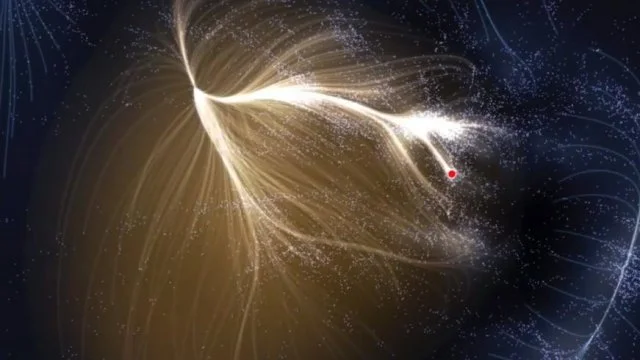
The universe has two boundaries that are easy to confuse: the farthest places we can see, and the farthest places we could ever reach. They aren’t the same. Some galaxies are visible to us now even though no message we send today could ever catch them. And some regions are still out of sight, though light already traveling toward Earth may eventually reveal them.
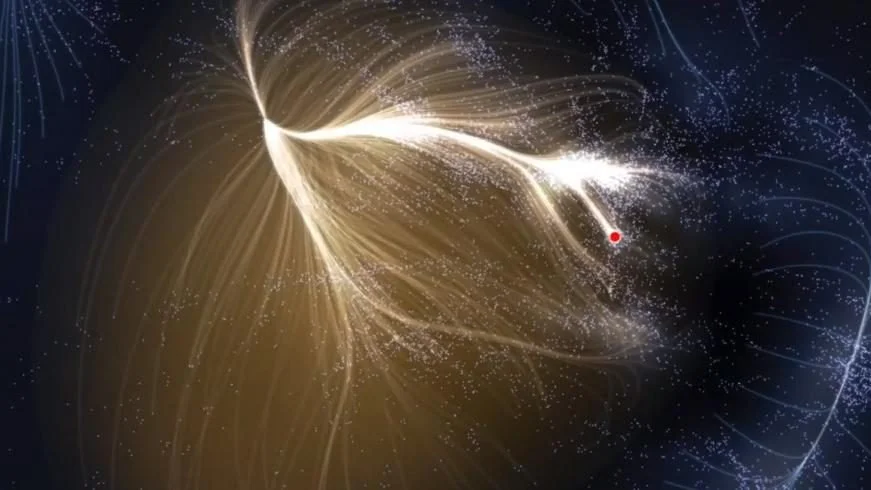
That distinction is more than a matter of cosmic bookkeeping. It changes what “far away” means in an expanding universe. The edge of the observable universe is about 46.1 billion light-years from us in every direction. The reachability limit is much closer: roughly 15–18 billion light-years, with the exact figure depending on cosmic parameters that remain uncertain. Farther out still lies a region whose light has not reached us yet, but may one day do so. Beyond the future visibility limit is the unobservable universe, whose full extent we don’t know.
These boundaries follow from the universe’s expansion, the finite speed of signals, and the time since the hot Big Bang. They also show why seeing an object doesn’t mean we can travel to it—or even send it a message that will arrive.
Credit: Mark Garlick/Science Photo Library
Expansion changes distance as light travels
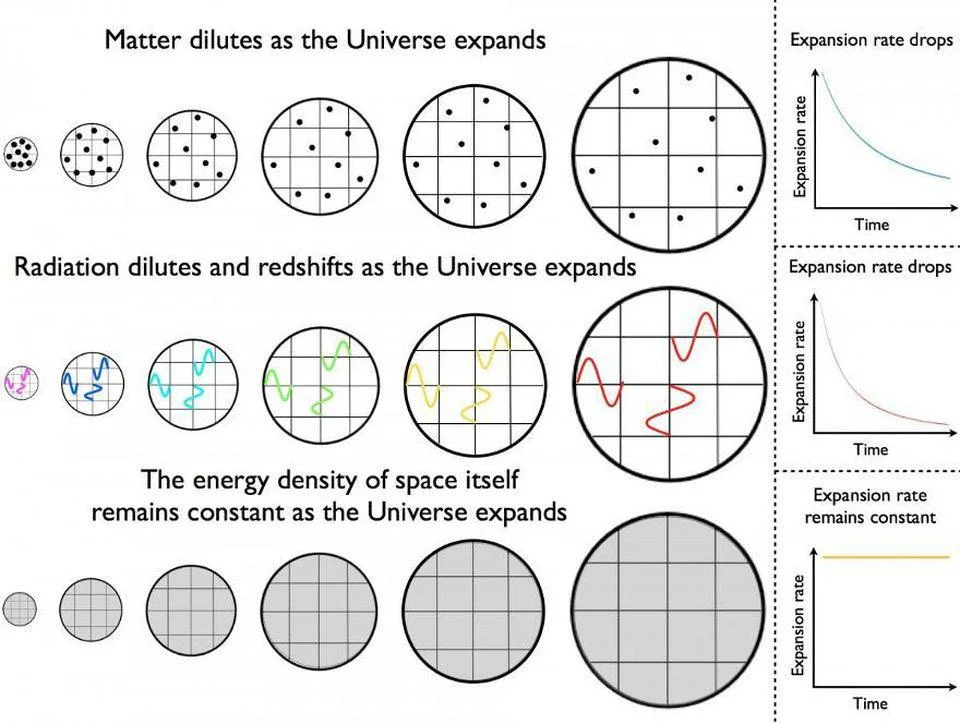
Start with a common misconception: the universe isn’t space stretching like the surface of an inflating balloon, thinning as it grows. Space itself doesn’t become thinner or otherwise change; there’s simply more space. Matter and radiation within it do become less dense as the volume increases.
The expansion rate changes too. It depends on the square root of the universe’s total energy density. Matter and radiation lose density as space expands, while dark energy—the energy associated with space itself—appears to remain constant. So the expansion rate fell for much of cosmic history. It’s now dominated by dark energy, though the remaining matter means the rate is still expected to decline, eventually settling around 55–60 km/s/Mpc.
The hot Big Bang is often pictured as all matter and energy emerging from a single point at the birth of space and time. That picture is misleading. For more than 45 years, the leading account has included an earlier phase called cosmic inflation. The Big Bang describes the hot, dense early universe as we know it; inflation came before it, with no matter or radiation, but with an enormous amount of energy intrinsic to space. The standard picture of the Big Bang gets several things wrong, and inflation is one reason the story is more complicated than a simple explosion from a point. Inflation set the conditions for the hot Big Bang that followed.
After inflation, the universe expanded rapidly. As it grew, density fell, and the kinetic energy of matter particles and the energy of radiation particles declined. Radiation dominated first; matter took over a few thousand years after the Big Bang. Neutral atoms formed, gravity helped build black holes, stars, galaxies, and the cosmic web, and dark energy became the leading influence on expansion about six billion years ago.
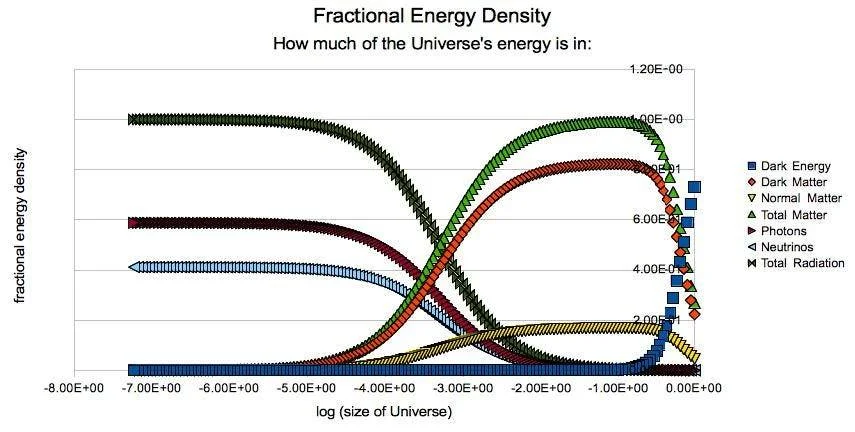
Dark matter has been largely important for extremely long cosmic times, and we can see its signatures in even the Universe’s earliest signals. Meanwhile, radiation was dominant for the first ~10,000 years of the Universe after the Big Bang. Note that in the future, when dark energy reaches a number near 100%, the energy density of the Universe (and, therefore, the expansion rate) will remain constant arbitrarily far ahead in time.
Those changing conditions determine how far light can travel across the expanding universe. A signal moves at a fixed speed through space, but the distance between distant points grows while it is in transit. That’s why light emitted 13.8 billion years ago can now arrive from a place that is 46.1 billion light-years away.
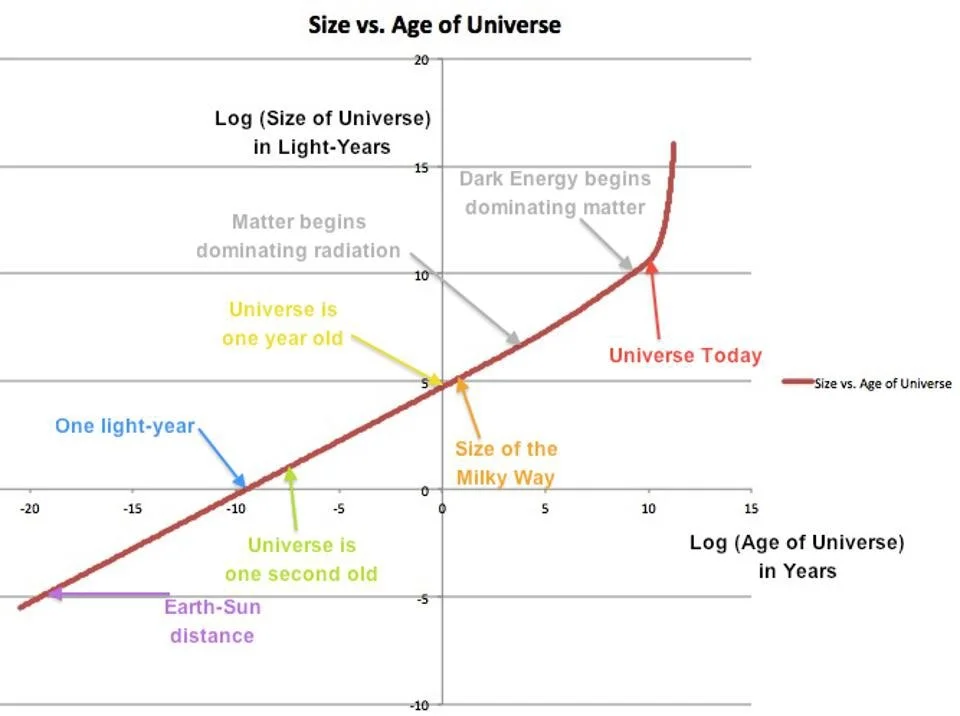
The scale changes sharply over cosmic time. After one picosecond, the distance light could cover was about the Earth–Sun distance. At one millisecond, it was about one light-year; after one second, roughly 20–40 light-years, comparable to the radius of a large globular cluster. After a year, it was a little less than the Milky Way’s radius. At 10,000 years, the matter-dominated universe had a radius of about 10 million light-years. Today, 13.8 billion years after the Big Bang, the observable radius is 46.1 billion light-years.
Here’s the subtle part: the places whose ancient light reaches us today are not necessarily places we could reach today. The speed of light in a vacuum is 299,792,458 m/s. Cosmic expansion, by contrast, is measured as a speed per unit distance. Using a present expansion rate of 67 km/s/Mpc—where one megaparsec is about 3.26 million light-years—two points separated by about 4.474 megaparsecs, or 14.6 billion light-years, recede from each other at the speed of light.
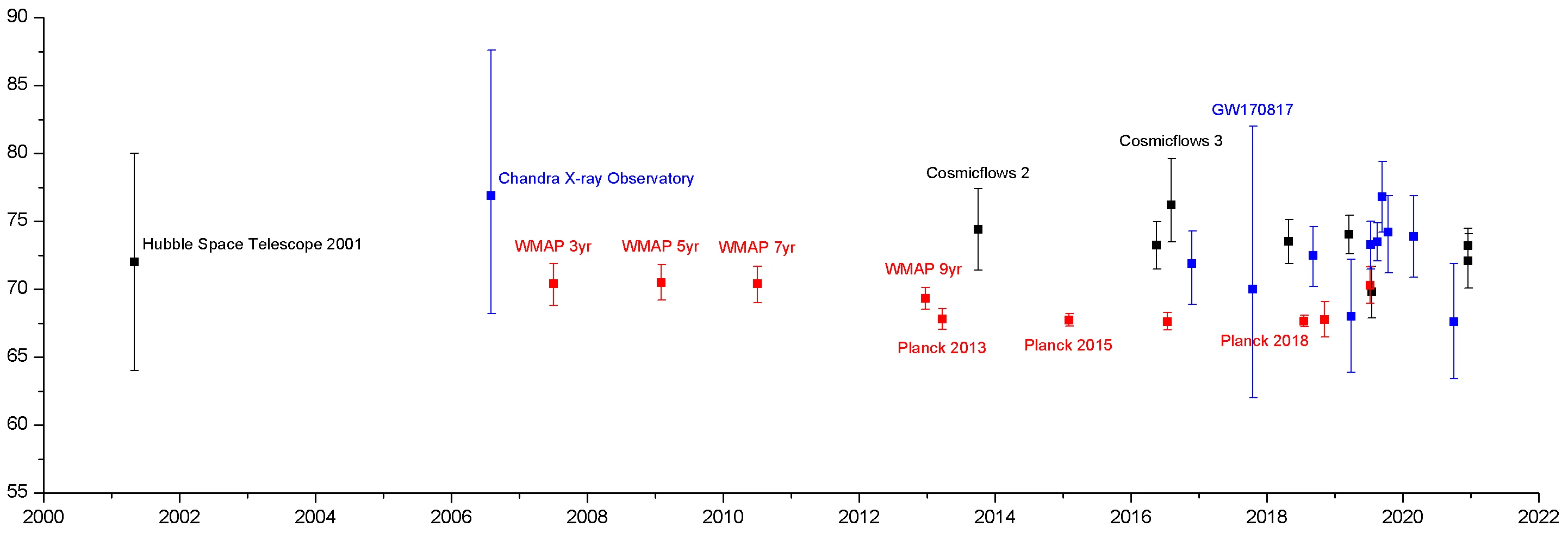
Because the expansion rate is expected to fall, the practical reach extends somewhat beyond that 14.6-billion-light-year estimate: to somewhere around 15–18 billion light-years. A signal sent today could reach an intelligent observer in that range, as could a spacecraft that accelerated continuously at 1g, approaching but never attaining the speed of light. A radio message could announce our presence; a spacecraft accelerating at 1g could, in principle, travel there. The numbers still depend on cosmic parameters we haven’t pinned down precisely.
That is the reachability limit, also called the one-way communicable limit. A two-way exchange has a tighter boundary, around 10 billion light-years: beyond that, a reply sent as soon as our message arrived might never make it back to Earth. For destinations between roughly 10 and 18 billion light-years away, a spacecraft could offer a better chance of contact than a message alone.
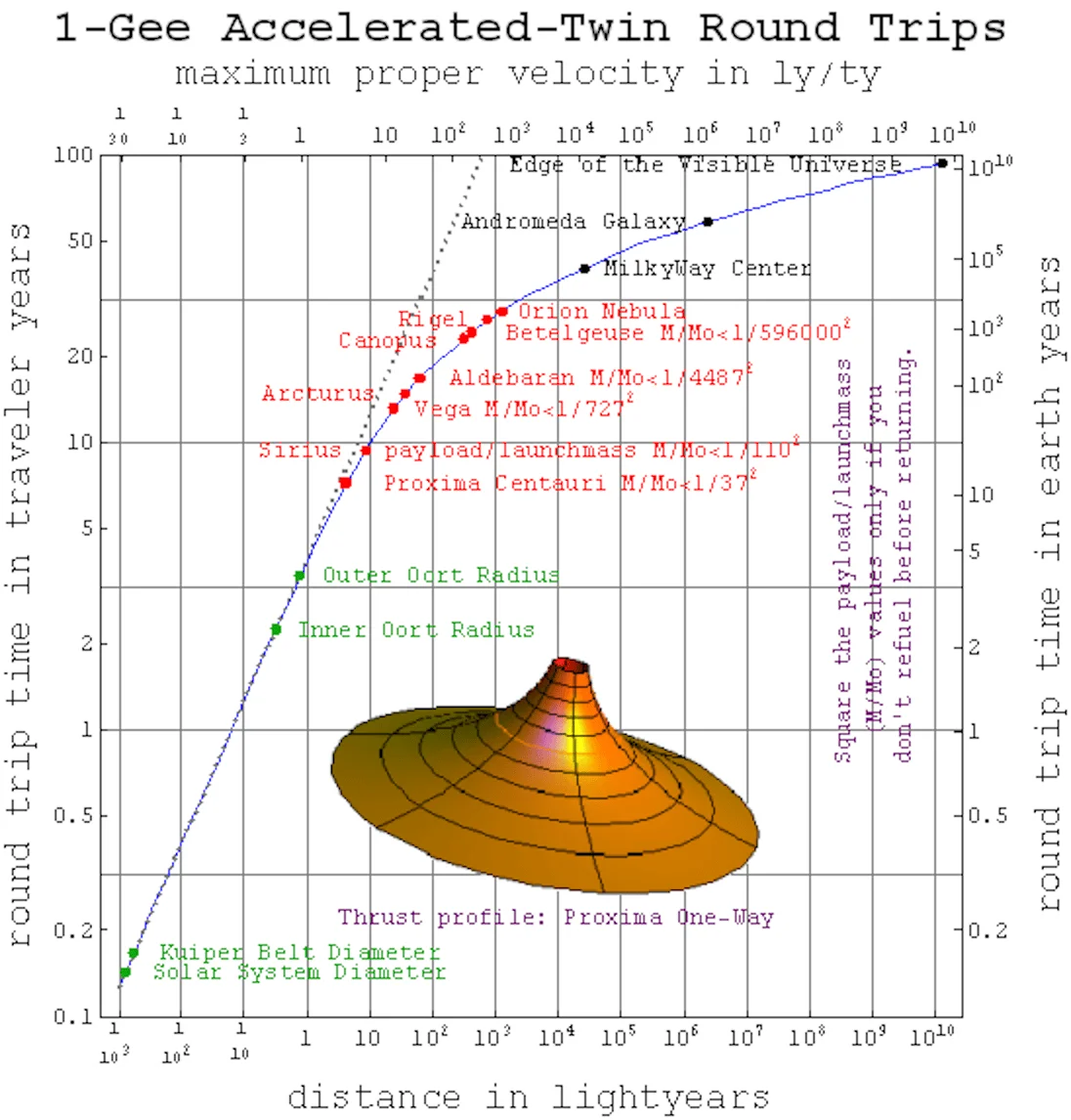
Credit: P. Fraundorf/Wikimedia Commons
Beyond that reach, we can still see distant objects as they were in the past, and they could have seen Earth as it was in the past. But signals sent from here today won’t arrive. Light itself can cross a much larger gap: the observable universe reaches 46.1 billion light-years in radius, putting us and any observers within that radius inside one another’s observable universes.
Credit: Rob Knop
And there’s one more boundary. Some light from beyond today’s observable universe is already on its way here. As it travels, it may enter the region from which signals can eventually reach us. That means parts of the universe beyond our current view could become visible in the future: the future visibility limit.
The future visibility boundary
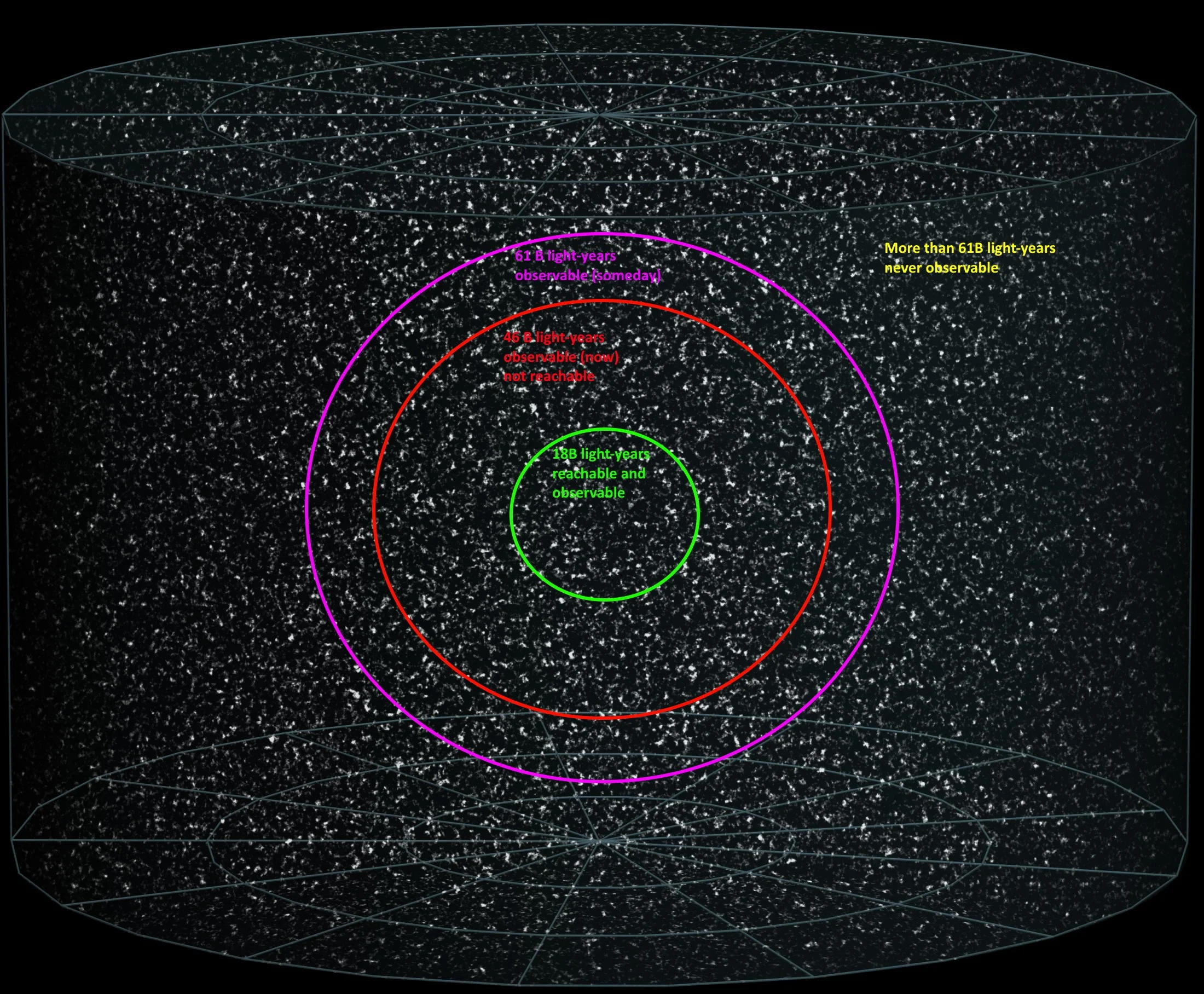
Some parts of the cosmos that are invisible to us now may become visible as their light reaches Earth. Add the estimated 15–18 billion light-year future visibility range to the observable Universe’s current radius of 46.1 billion light-years, and the boundary falls roughly 61–64 billion light-years away. An observer there could eventually detect the place where our Milky Way formed, just as we may collect light from their region. That won’t let either side travel to or contact the other. Seeing is all that changes. Beyond that boundary lies the forever-unobservable Universe: regions outside today’s horizon whose light will never reach us, no matter how long we wait. That gives us five useful zones, though their boundaries are estimates:- Within about 10 billion light-years: regions with which two-way communication is possible.
- Beyond 10 billion and up to 15–18 billion light-years: regions we can reach or send a one-way message to, but not communicate with in both directions.
- Beyond 18 billion and out to 46.1 billion light-years: observable regions that we can neither reach nor contact.
- Beyond 46.1 billion and out to roughly 61–64 billion light-years: regions that are invisible today but may become visible in the future.
- Beyond roughly 61–64 billion light-years: regions that will remain unobservable forever.
Credit: Andrew Z. Colvin/Wikimedia Commons; annotations: E. Siegel
This article These 5 divisions define how far we can go in space is featured on Big Think.



