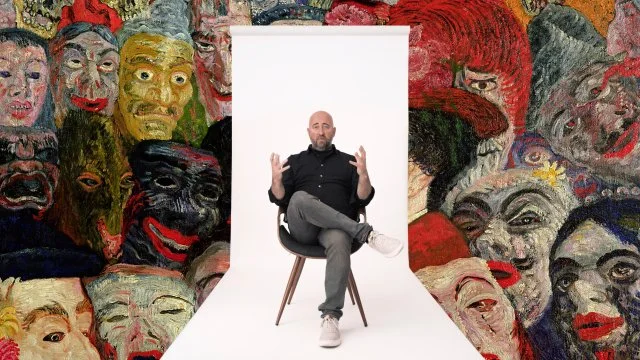
How a crowd shapes what we want
Holding your ground in a crowd may begin with understanding the pressures you carry from home. Luke Burgis, author of Wanting and The One in the 99, draws on psychiatrist Murray Bowen’s distinction between the solid self and the pseudo self to examine how anxiety and opinions can spread through groups. The distinction asks a difficult question: when we take a position, are we expressing a considered belief, or responding to the expectations and tension around us? That question matters because social pressure rarely arrives as a direct command. It can work through the ordinary wish to belong, avoid conflict, or be seen as reasonable by people whose approval matters to us.
The video’s title also points toward mimetic desire: the idea that other people can shape not only what we think, but what we want. A person’s attention may settle on an object, role, or ambition partly because others appear to value it. That doesn’t make every shared desire false. It does mean that popularity and personal conviction can be hard to separate, especially when the people around us seem confident. The pressure can feel like our own preference even when it’s been reinforced by the group.
The solid self and the pseudo self
Bowen’s terms offer one way to describe that tension. In Burgis’s account, the solid self refers to a person’s more grounded sense of what they believe, while the pseudo self reflects opinions and positions shaped by the surrounding social field. The point isn’t that people can live untouched by others. We learn, change, and make decisions in relationships; the question is whether we can stay connected to other people without letting their anxiety decide for us.
That distinction is harder to apply than it sounds. A person may sincerely believe a view and still have absorbed it through family or community. Another may resist a group’s position mainly to prove independence, which can be another form of reaction to the group. Self knowledge, then, isn’t simply choosing the opposite of what everyone else thinks. It involves noticing the forces at work and asking whether a position remains meaningful when the immediate pressure eases.
Here’s the thing: calm independence can be less dramatic than defiance. Sometimes it means keeping a disagreement open without turning it into a performance. Sometimes it means admitting uncertainty while a group is demanding certainty. If you’re working in this space, the distinction offers a practical prompt: look at how people respond to tension, not just at the opinions they state.
A historical image of resistance
Burgis uses a scene from Hamburg in 1936 to make the problem visible: a shipyard worker keeps his arms folded while hundreds of people nearby raise theirs for Hitler. The image captures a stark contrast between one person and a crowd, but its value here is not proof that resisting pressure is simple. A gesture can stand out in a photograph; the private calculation behind it, and the risks the person perceived, are harder to know from the image alone.
The scene instead gives the discussion a concrete question: what allows someone to maintain a separate judgment when the surrounding group is moving in unison? That’s a question about character, but also about conditions. People’s ability to disagree can depend on their relationships, their sense of safety, and the cost they expect to pay for standing apart. A crowd’s influence doesn’t erase individual choice, yet it can make that choice feel more consequential.
This is more significant than it looks. The example reminds viewers that group pressure isn’t limited to harmless trends or everyday disagreements. The same basic human susceptibility to belonging can operate across very different settings, with very different stakes. That said, the comparison shouldn’t flatten those differences: a modern online argument and the political setting evoked by Burgis’s example aren’t equivalent. The shared subject is the pressure to conform, not the scale or nature of the consequences.
Screens extend the social field
Burgis argues that screens have multiplied the crowds competing for our attention and influence. A person now encounters opinions and displays of consensus from many groups, often without being physically present with them. That can make social comparison feel continuous: what others praise, reject, or pursue is always close at hand. The screen doesn’t create the desire to belong, but it can make the signals of belonging more frequent and harder to ignore.
And yet, more exposure doesn’t automatically mean more understanding. Online attention can reward confident statements and visible agreement, while the slower work of changing one’s mind is less apparent. A feed can also make a group seem more unified than it is, because the loudest or most repeated views are easiest to notice. These are general pressures of mediated social life, not proof that every screen or community produces the same result.
(and this is the part most people overlook) The relevant crowd may not be the one with the largest audience. It may be a family, a workplace, a circle of friends, or a small online community whose approval carries unusual weight. A person can be surrounded by thousands of opinions and still be most affected by a few. The useful question is whose reaction feels costly to disappoint.
What resistance can look like
Resisting social contagion doesn’t require withdrawing from other people. That would be an unrealistic standard: relationships are part of how people form views, and isolation doesn’t guarantee clarity. A more grounded approach is to notice when urgency or anxiety is driving a judgment, make room to consider competing views, and distinguish a desire to belong from a reasoned commitment. None of that guarantees a correct answer. It can, however, make the decision more deliberate.
There’s also a limit to what one person can do. If a group’s tension is intense, staying thoughtful may take time and support; a single act of will may not be enough. Burgis’s framing puts responsibility on the individual to understand their own pressures, but it also points toward the wider group dynamics that shape what feels safe to say. The solid self isn’t a fixed possession. It’s something a person has to keep testing against the pull of other people.
The video, Mimetic desire, social contagion, and the fight for your true self, is featured on Big Think. Its central question reaches beyond the historical scene: when a crowd makes a belief feel obvious, can you tell whether you’ve chosen it for yourself? A useful question. Not an easy one.


