A collapse near the finish
Rachel Apa was running her first marathon for a cause close to her family when she collapsed in Central Park, about three kilometres from the finish of the New York City Marathon. The 24-year-old from Lewisberry, Pennsylvania, later died. The distance left in the race was short, but the circumstances were serious: she needed urgent medical care after falling during a major endurance event.

Medical response and investigation
The New York Police Department said Apa collapsed near the race’s finish line. A bystander began CPR, and New York Road Runners, the nonprofit that stages the event, said medical staff continued CPR and used a defibrillator. Paramedics took her to hospital, where she could not be saved. The response involved people already at the scene as well as race medical staff and emergency services, though the available account doesn’t establish how much time passed between each step.
Her father, Steve Apa, told The New York Times that she had rhabdomyolysis, a rare condition in which muscle tissue breaks down during exertion and releases substances that can poison the body. He described his daughter as being in “perfect health.” The city medical examiner’s office is investigating the cause of her death, so the account from her father and the formal determination remain distinct pieces of information. Rhabdomyolysis can be associated with strenuous exertion, but the details here don’t establish exactly how the condition developed in Apa’s case.
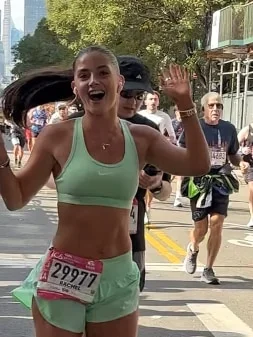
Michaela Nicholas, a hospital social worker who was watching the race, said she called out encouragement after reading Apa’s name on her bib. About 15 metres later, she saw Apa fall. Nicholas stayed with her as two other spectators administered CPR. Her account gives the emergency a human scale: a moment of encouragement became an effort to help a stranger in distress.
“I just held Rachel's hand and talked to her and told her that she wasn't alone and that she's loved, and I prayed for her,” Nicholas told the newspaper. Apa’s father called her death “unfathomable.” Those words reflect the shock reported by people close to her, while the medical examiner’s investigation may clarify the cause. Here’s the thing: a rapid response can be vital in a collapse, but it can’t guarantee a person will survive.
A run dedicated to her grandfather
Apa worked as an industrial-technology product manager at TE Connectivity and had played college field hockey. She ran to raise money for Parkinson’s disease in memory of her grandfather, who died in 2022. For her, the marathon connected a personal loss with a public effort to support a cause that had touched her family.
On her fundraising page, Apa wrote that her grandfather “taught me to stay active, push my limits, and embrace challenges, shaping my love for sports and movement”. The page’s $4,000 target was quickly exceeded after news of her death spread. The fundraiser was sponsored by the Parkinson’s Foundation. The increase shows how quickly attention can turn into contributions, though donations alone don’t measure the longer-term effect of a campaign.
Apa graduated from Bucknell University in 2024 with a degree in markets, innovation and design. She scored 17 goals for the university’s field hockey team. USA Field Hockey said her impact on the sport and the people around her “will not be forgotten.” Bucknell and TE Connectivity also expressed condolences. Her record as a student, employee and athlete helps explain why tributes came from several parts of her life, not just the running community.
Tributes after a record race
Apa died during the marathon’s 50th year in its five-borough format. A record 61,000 runners reached the finish line. New York Road Runners said it was deeply saddened by her death and offered condolences to her family, friends and the running community. That large field puts the race’s scale in view, but Apa’s death remains an individual tragedy rather than a footnote to a record turnout.
Her first marathon ended close to the finish, but the purpose behind her run has continued to draw support for Parkinson’s disease research and awareness. This is more significant than it looks: the fundraiser gives friends, supporters and strangers a practical way to carry forward the cause she chose. (And this is the part most people overlook.) A public memorial can sustain attention after the immediate news cycle, but its reach depends on what supporters do next.
What her story leaves behind
Apa’s death also underlines the limits of what can be concluded from a race-day account. Her father identified rhabdomyolysis, and officials are investigating the cause; the details provided don’t explain whether other factors contributed. That distinction matters when readers encounter a sudden death linked to strenuous exercise: a reported condition offers context, while the investigation is responsible for establishing the formal cause.
If you're working in this space, the story is a reminder that marathon safety involves both preparation and an effective response at the course, while individual outcomes can still be devastating. And yet. Apa’s own reason for running remains clear in her words: she wanted to honor her grandfather and support Parkinson’s disease work. The finish was near. Her purpose has carried on.


