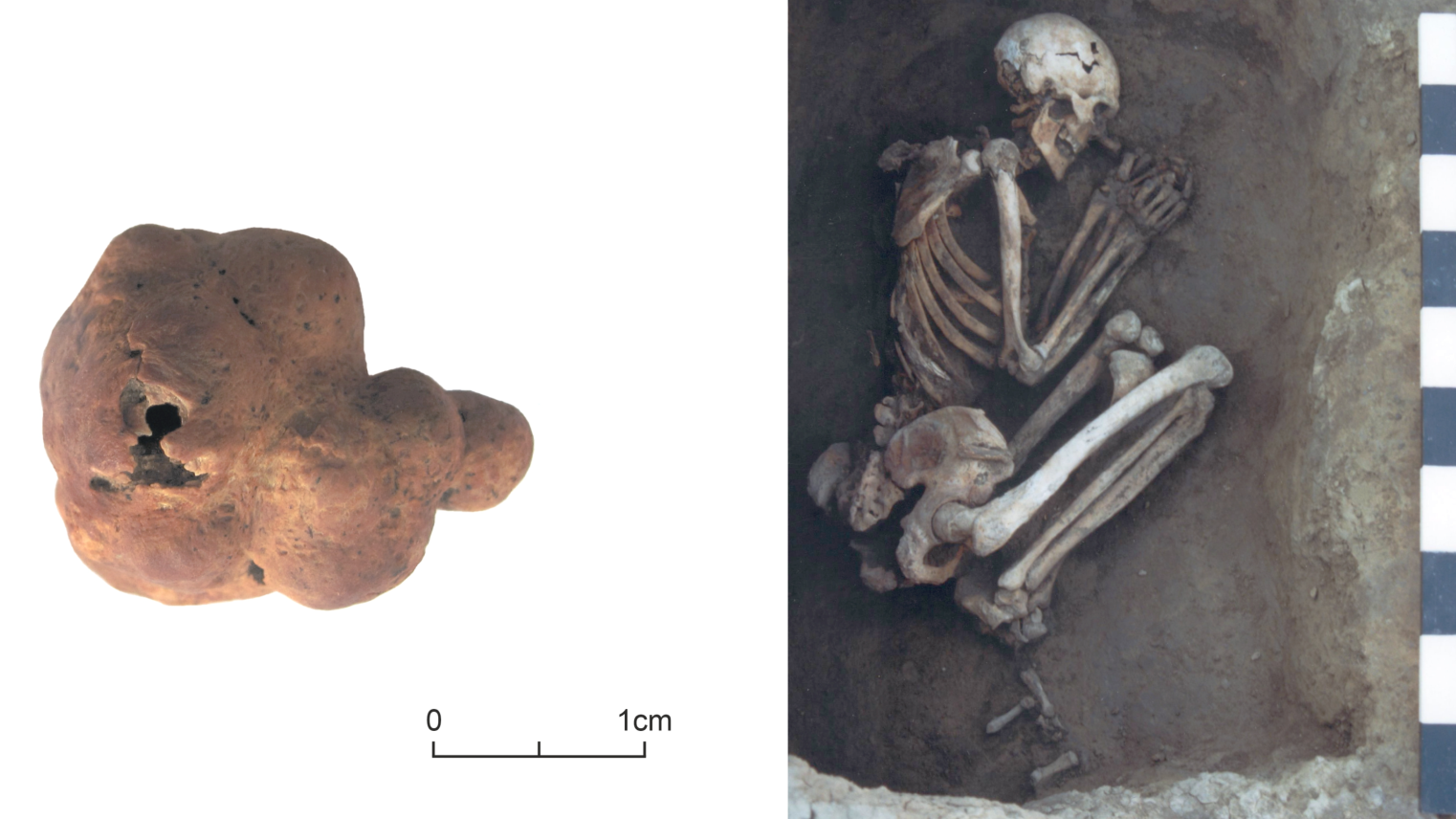
A stone found in the burial of a man who died about 5,300 years ago may preserve evidence of a long-running urinary infection. Its composition points to a kidney stone, though researchers can’t determine exactly where it formed or whether it contributed to his death.
The object was discovered during laboratory work on remains from an Early Bronze Age burial in the Stavropol Upland of southwestern Russia. Study lead author Natalia Berezina, an anthropologist at Lomonosov Moscow State University, told Live Science that the man “lived with a chronic urogenital infection.” His final years, she said, were probably marked by “considerable and more or less constant pain.”
A small find in a monumental grave
The man, who was in his 40s when he died, was buried in a catacomb beneath a large mound, or kurgan. The mound belonged to a cemetery built according to an ancient steppe burial tradition. Archaeologists found a flint arrowhead near his pelvis; the stone was spotted later among the collected bones of his hand.
Brownish and roughly round, the object had several protrusions and measured about 0.8 inches (2.1 centimeters) across—about the size of a grape. A crack revealed a crystalline interior. The research team reported its findings Sept. 30 in Archaeological and Anthropological Sciences.
Analyses found that calcium and phosphorus made up most of the object. X-ray powder diffraction then identified its crystal structures, including whitlockite, a rare calcium salt associated with kidney, bladder and prostate stones. These mineral masses, known collectively as calculi, differ in composition and in how they form. Kidney and bladder stones, however, can contain many of the same compounds.
Whitlockite’s strong association with bacterial infections led the researchers to propose that a chronic infection helped produce the stone. Their leading explanation is a kidney stone arising after a persistent infection in the upper urinary tract. Infections can change urine acidity, making it easier for minerals to accumulate.
Where the stone formed remains uncertain
The team can’t establish why the man developed urinary problems or whether they caused his death. Kidney stones can move into the bladder, so the object’s location in his body at death is unknown. If it blocked the ureter—the tube carrying urine from a kidney to the bladder—it could have led to kidney swelling, another infection or sepsis. Before antibiotics, such complications were often fatal.
Other possible explanations include an infection of the prostate or a sexually transmitted infection. The study identifies a likely connection between infection and the stone, but the available evidence doesn’t settle which condition came first or what ultimately happened to the man.
A physically demanding life
The stone was only one part of the man’s medical history. His remains show strong musculature alongside degenerative joint disease in his spine, shoulders, hips, hands and feet. He also had healed fractures in his right shoulder, ribs and forearm.
Those injuries fit the demands of steppe life, Berezina said: “These were people who worked with cattle and heavy wagons on the open steppe, and the injuries that follow from that are the injuries we find.” In an earlier study of a nearby cemetery, her team found a man who had survived being run over by a wagon several years before he died. “Against that background, four healed fractures in our man look unremarkable,” she said.
The healed injuries suggest he survived repeated physical strain. The suspected urinary infection offers a different kind of evidence: a condition that may have caused persistent pain while substantially diminishing his quality of life.
What do you know about the bones in your body? Test your knowledge with our human skeleton quiz.


