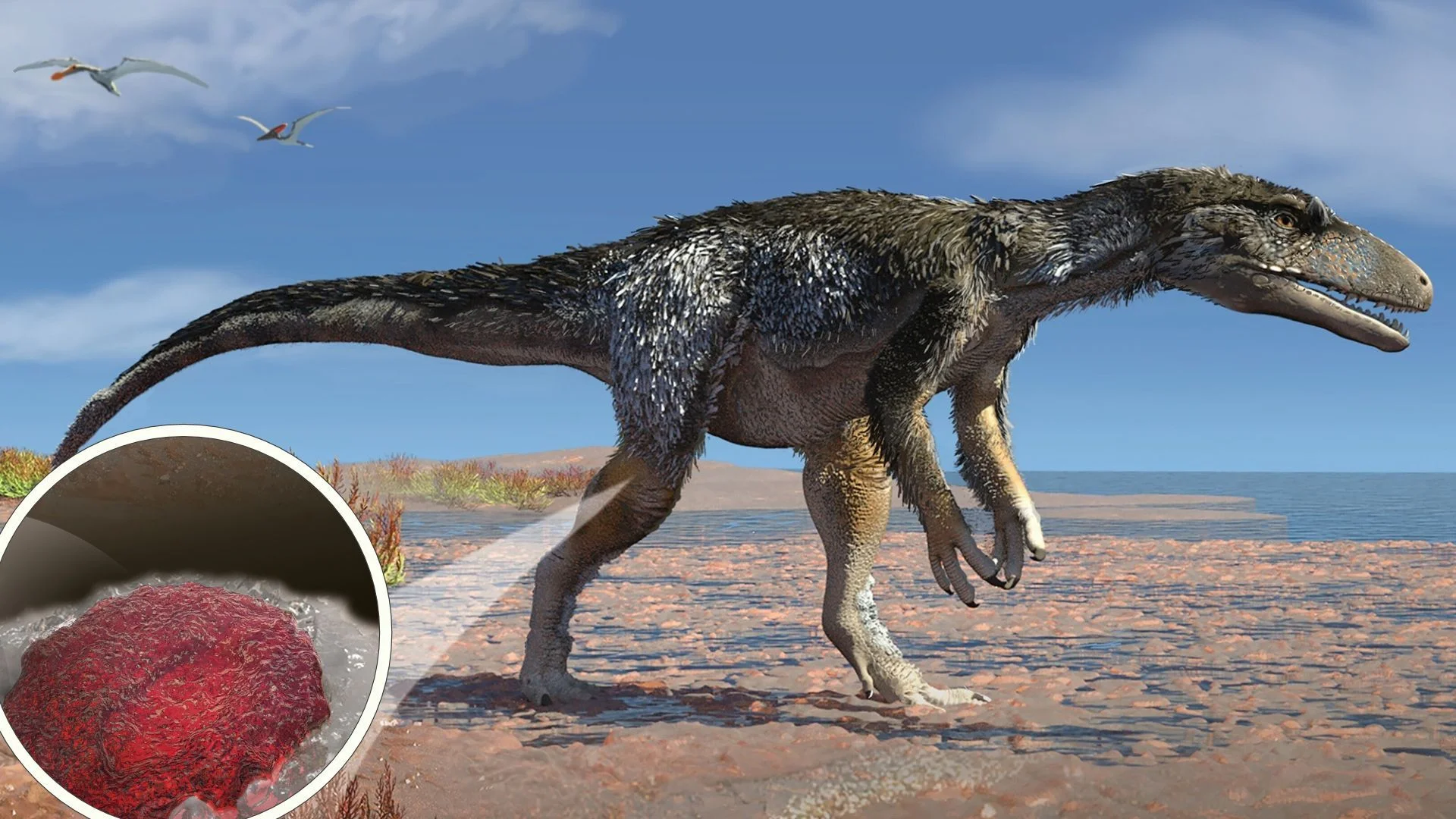
The most significant result in a new study of a Brazilian dinosaur fossil may be its chemical evidence, not the claim that it contains red blood cells. Researchers detected heme-related compounds alongside microscopic structures in the 115 million-year-old bones of Aratasaurus museunacionali. A molecular paleontologist who reviewed the findings says the structures don’t look like reptile or bird blood cells.
Published Nov. 2 in PNAS, the study reports what its authors describe as the oldest chemical evidence of blood-related material in a dinosaur fossil. Earlier research had reported blood in dinosaur fossils, but this team used chemical analysis to identify heme-based signatures in dinosaur bone.
The fossil belongs to a small theropod that measured about 10 feet (3 meters) long and lived in Brazil during the Early Cretaceous. Its limb bones offered the researchers a way to ask a broader question: how much of an organism’s original biology can remain detectable after fossilization?
Signals found in the bone itself
Microscopic examination revealed structures inside vascular canals, the channels that once carried blood vessels through the bone. The team said the structures’ size, shape and position were consistent with red blood cells. Chemical analysis found heme-related compounds associated with them. Heme is an iron-containing component of hemoglobin, the protein that carries oxygen in red blood cells.
Study co-author Kliti Grice, a professor at Curtin University in Australia, said the researchers combined microscopy, mineral analysis and molecular geochemistry. They examined the chemistry in situ, within the bone, so they could connect chemical signals to structures in their original physical context. That approach offers more support for a biological interpretation than analyzing extracted molecules alone, Grice told Live Science.
The work began without a search for dinosaur blood, Grice said. The team wanted to understand what biological evidence could survive fossilization. As she put it, exceptionally preserved fossils may hold microscopic and molecular traces that let researchers investigate ancient biology beyond what bones and other visible anatomy can reveal.
How the fossil may have preserved its traces
The researchers propose that the animal was buried quickly in sediment with little oxygen. Microbial mats—thin films of microorganisms—may also have been present. Together, those conditions could have changed the usual course of decomposition and helped preserve microscopic structures and related chemical signals.
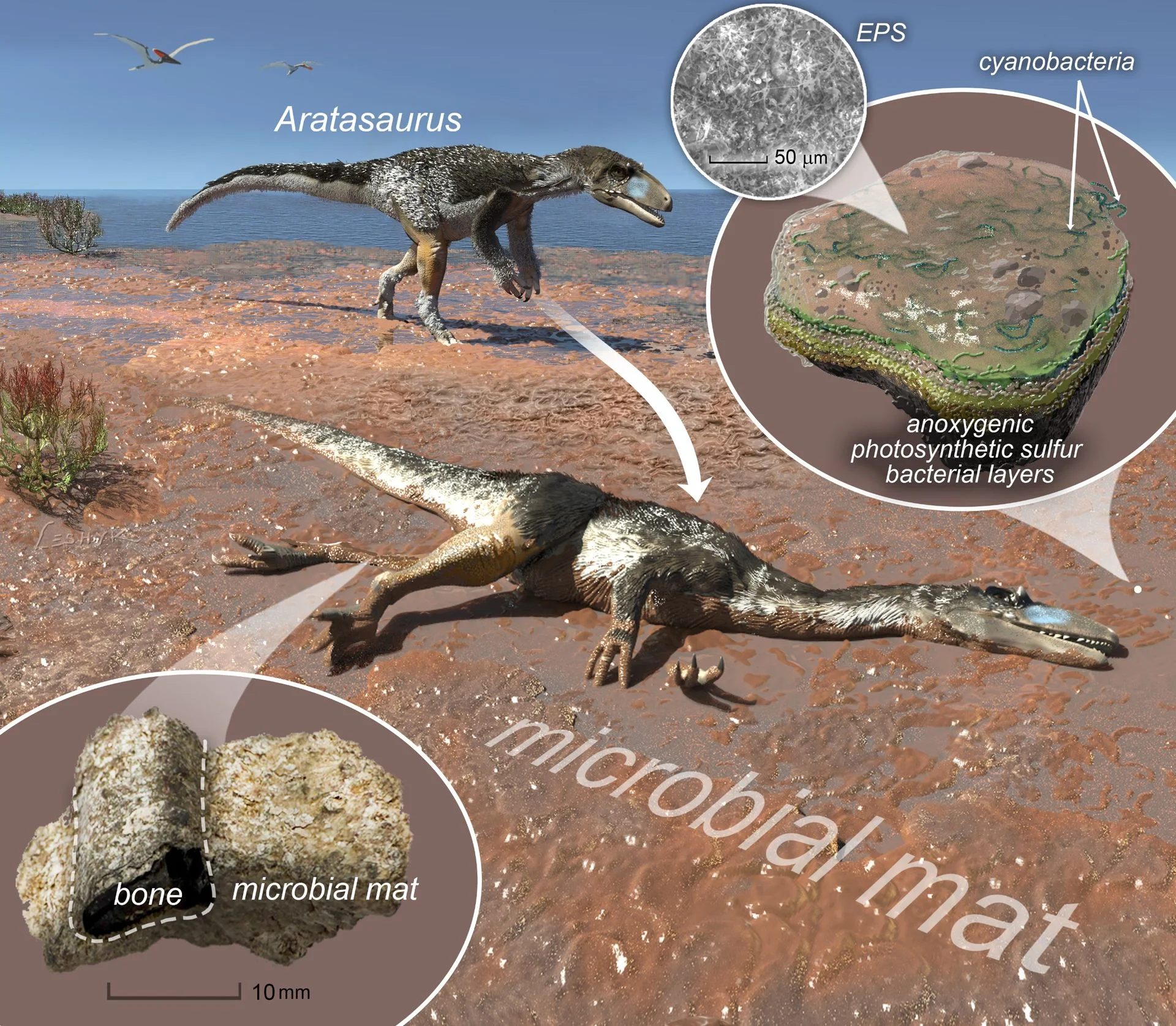
Grice said the cell-like structures were mineralized with hausmannite, a manganese oxide. The team thinks early mineralization may have stabilized or replicated biological structures before they broke down completely, while some of their chemistry persisted in altered form. The fossil also contained preserved amino acids associated with collagen, a structural protein in bone.
The red blood cell interpretation remains open
Mary Schweitzer, a molecular paleontologist at North Carolina State University who wasn’t involved in the research, agrees that molecules produced within organisms can persist in some form over geological time. She also welcomed the study’s molecular approach. But she isn’t persuaded that the pictured structures are remnants of red blood cells.
Her objection is morphological. Mammalian red blood cells lose their nuclei as they develop, while those of birds and reptiles retain them. That nucleus typically creates a visible bulge. Schweitzer said the structures in the study appear concave and lack that feature; she also described them as smaller than most red blood cells in non-mammalian animals.
That disagreement leaves two related but distinct claims on different footing: the researchers report chemical signals associated with heme, while the identification of the microscopic shapes as red blood cells remains contested. The study’s broader contribution may be its demonstration that molecular evidence can be examined alongside structures inside a fossil, giving future research more ways to test what ancient remains preserve.
- Rare armored dinosaur found in Japan may have ancestors that migrated across a land bridge 100 million years ago
- Fossil of 'unconquered female warrior' dinosaur with long claws found in UK museum drawer after 100 years
- Remarkably preserved feathered dinosaur discovered in China reveals new secrets of flying-predator evolution
Editor's Note: This article was updated at 5:44 p.m. E.D.T. to remove an outside comment that suggested the study did not include resonance Raman spectroscopy. The team did perform that analysis.


