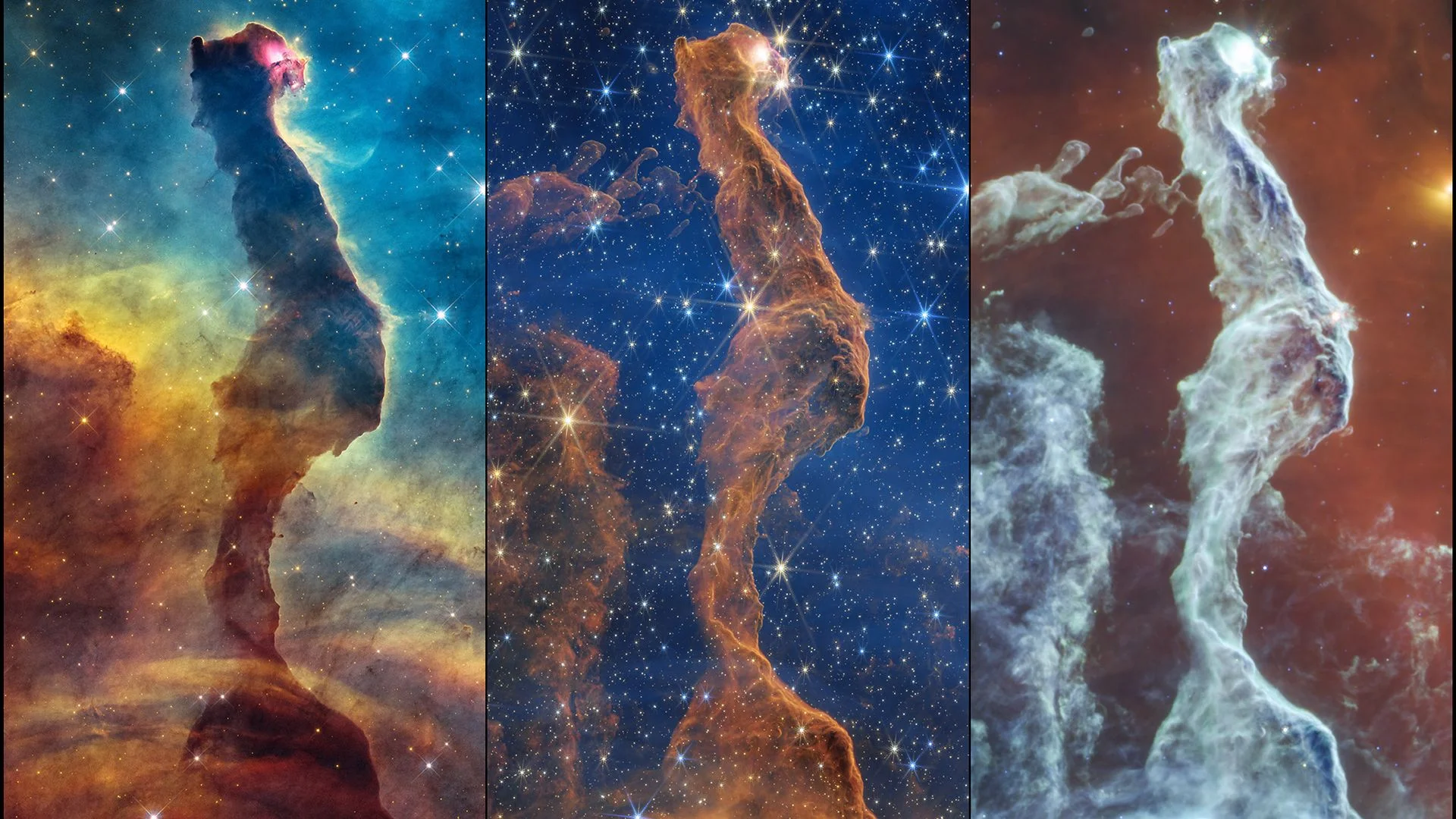
The Cat’s Head Nebula changes character with every wavelength, and the contrast among three new telescope views offers more than a Halloween-ready portrait. Together, images from Hubble and the James Webb Space Telescope show radiation from young stars sculpting nearby gas and dust, while also revealing a bright feature whose connection to the nebula remains unexplained. The images are a reminder that a single view of a cosmic object can leave much of its structure out of sight.
The nebula sits within the Carina Nebula, about 7,500 light-years from Earth. Its tall column of material resembles a cat facing away, with one red “eye”: a young star buried in dust that may be changing its surroundings. That resemblance makes for an immediate visual hook, but the more revealing story is how the column’s shape and appearance change across the different observations.
Radiation from young stars illuminates and erodes nearby material, helping shape structures like this one. The European Space Agency released views from Hubble’s optical instruments and two of Webb’s infrared instruments. Each records a different part of the interaction: visible colors trace light meeting gas, while infrared observations reveal material obscured by dust or glowing at wavelengths human eyes can’t see.
Hubble traces the eroding column
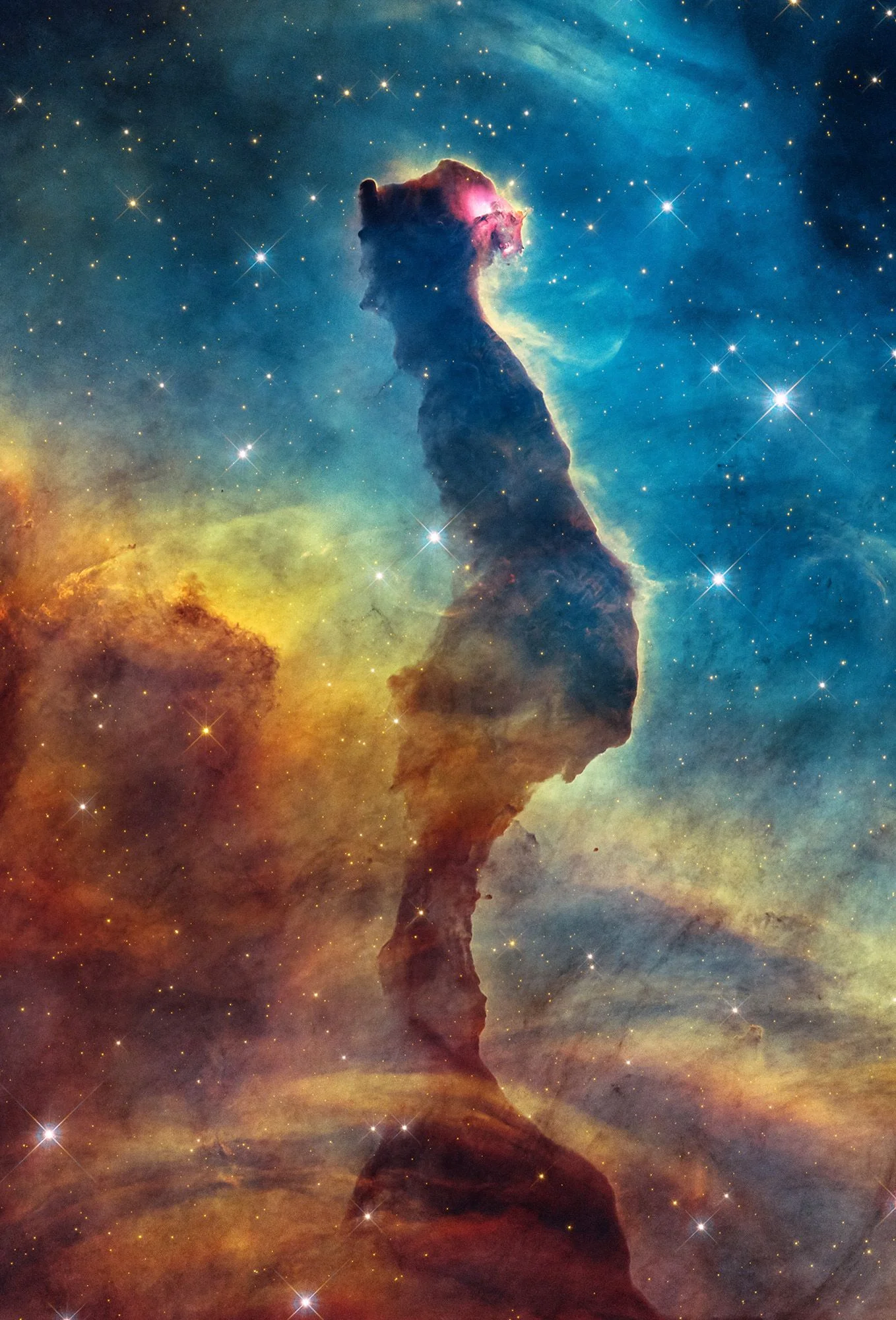
Hubble’s optical image shows a dark pillar that has endured ultraviolet radiation from nearby stars. Along its right edge, wisps mark gas being heated and dispersed by starlight, a visible boundary between denser material and its more exposed surroundings. The process is gradually stripping matter from the column, although the image captures a moment in that interaction rather than showing its full history.
Blue, yellow, orange and red regions trace starlight interacting with gases such as oxygen, hydrogen and sulfur, ESA says. Those colors aren’t the nebula’s appearance to the unaided eye; they help distinguish how different material responds to radiation. The effect has a loose parallel in Earth’s auroras, where gases in the atmosphere produce different colors as they respond to incoming energy. Here, color becomes a guide to the physical processes shaping the scene.
Webb’s near-infrared view exposes the interior
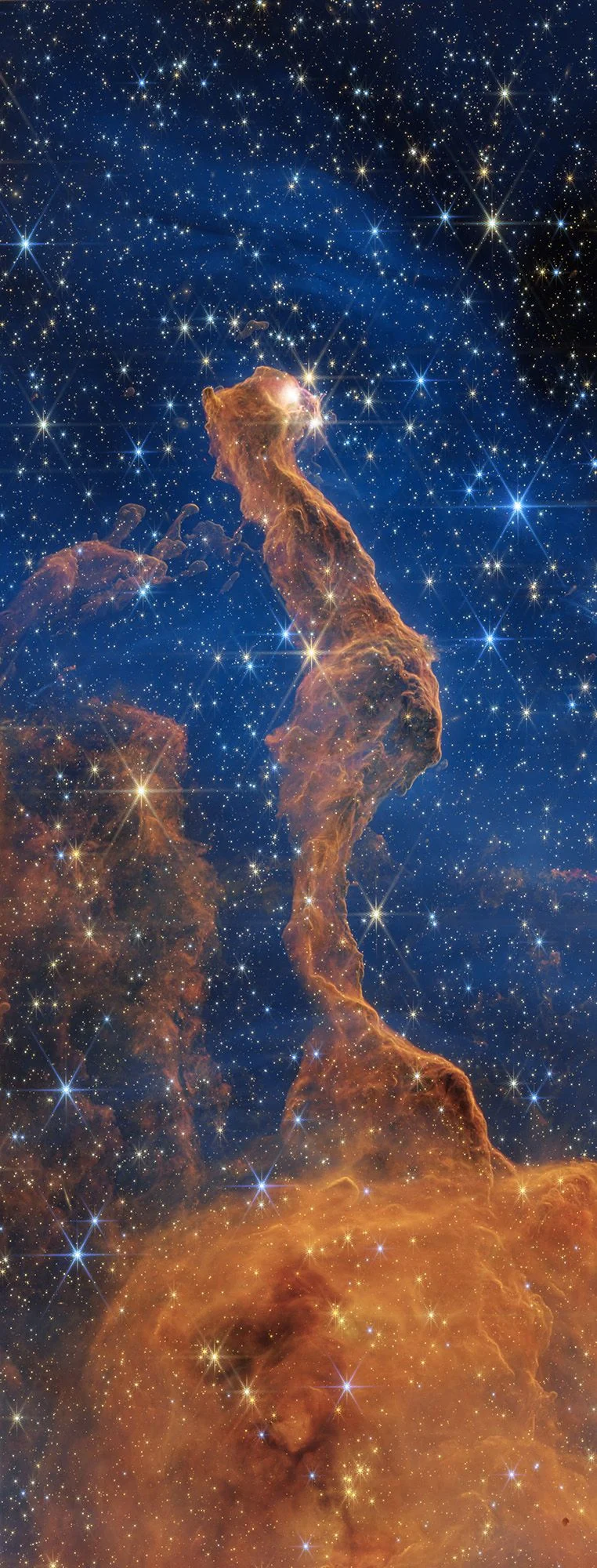
Webb’s Near-Infrared Camera sees through thinner outer dust and brings the column’s denser center into view. Its image also shows background stars and galaxies whose infrared light passes through the surrounding material. That added depth changes the reading of the scene: the pillar isn’t a solid silhouette against empty space, but part of a crowded view that dust partly screens.
The structure looks turbulent from within, with stellar radiation carving into the column as well as its outer edges. To the left, a hand-shaped feature seems to reach toward the nebula, an arresting form that stands out in this view. It’s a reminder that images can make familiar patterns appear in distant clouds; the scientific interest lies in the material and light behind the shape, not the resemblance alone.
Mid-infrared light reveals a mystery
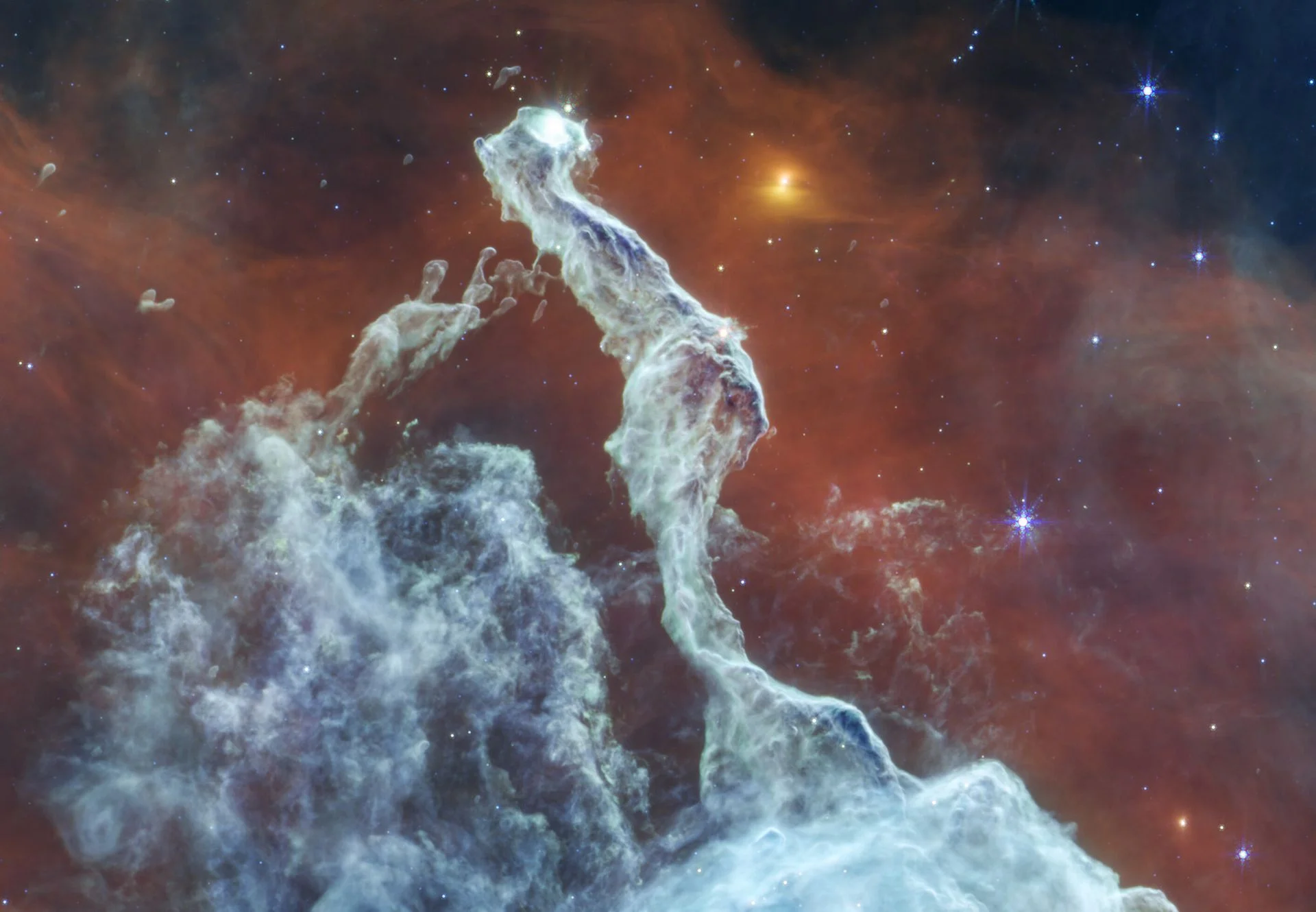
Webb’s Mid-Infrared Instrument pares the scene back to a faint, smoky glow. ESA attributes that emission to polycyclic aromatic hydrocarbons, molecules made of carbon and hydrogen that are commonly associated with combustion. The mid-infrared view therefore emphasizes a different component of the nebula than Hubble’s bright optical colors or Webb’s near-infrared view of the dusty interior.
Most stars fade from this image, but a bright orange point appears to the right of the cat’s head. ESA says its connection to the nebula remains unknown. That gap matters: an unusual feature in an image can invite a tidy explanation, but the available description doesn’t establish what the point is or whether it belongs to the nebula at all.
What the three views reveal
Put together, the images show why wavelength matters when astronomers study dusty regions. Optical light highlights visible interactions between radiation and gas; near-infrared light can expose structures behind thinner dust; mid-infrared light brings out a faint glow attributed to carbon-and-hydrogen molecules. No single image supplies the whole account. The comparison is more significant than it looks: each view both adds information and sets limits on what can be inferred from the scene.
If you're working in this space, the unresolved orange point is the detail to keep in mind. Similar observations often help researchers identify questions that need further study, even when they don’t settle them. Here's the thing: a striking image can show where the evidence runs out. And yet. That uncertainty is part of what makes the three views useful, offering a clearer picture of the nebula’s changing structure while leaving one bright feature open to explanation.


