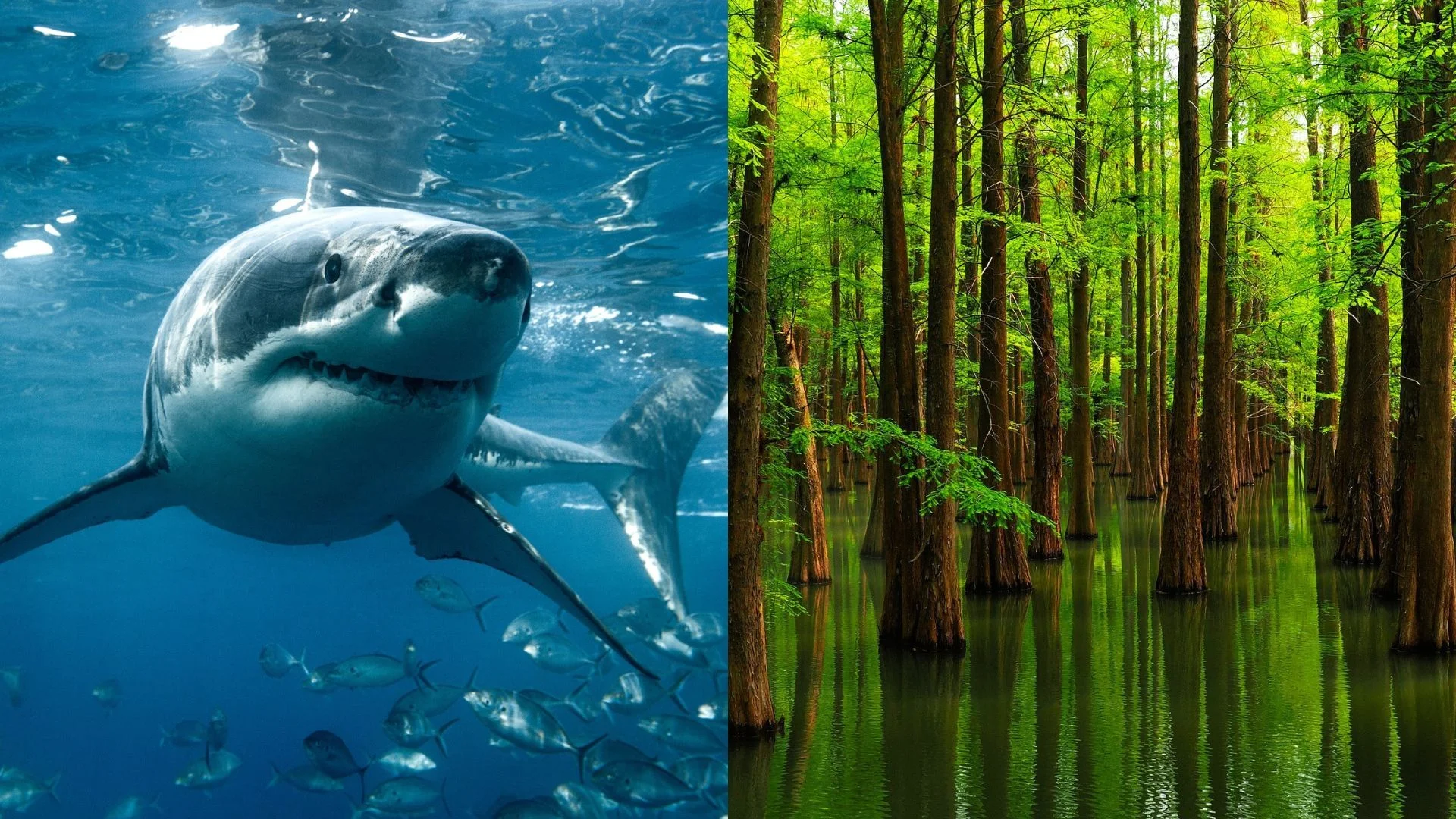
The claim that sharks predate trees depends on where scientists draw the line around “shark.” Living shark groups appeared roughly 195 million years ago, long after trees took root, so the familiar headline doesn’t hold if “shark” means the groups alive today. Fossils of more distant relatives, though, may push the lineage back to about 400 million years ago—before the oldest known trees. The answer changes with the definition.
“The takeaway is that the shark lineage within the fishes generally does go back further than trees,” said John Maisey, curator-in-charge emeritus of fossil fish at the American Museum of Natural History. “But it really depends on how you define what we mean by shark.” That distinction matters because evolution doesn’t proceed in neat categories: features associated with sharks can appear in ancient animals that aren’t clearly members of the group. Scientists have to decide which traits count and how much weight each one carries.
Modern sharks came later
The earliest fossils that can be linked to living shark groups date to around 195 million years ago, in the Jurassic period. They include members of Hexanchiformes, an order whose sharks have six or seven gill slits and a single dorsal fin. These fossils provide a relatively clear comparison with living animals, which helps researchers place them within the shark family tree. But they mark the appearance of recognizable modern groups, not necessarily the origin of every lineage that eventually led to sharks.
Trees appear in the fossil record much earlier. Paleobotanists generally place their emergence in the Middle Devonian, around 380 million to 390 million years ago. “I think it’s not very controversial, when we had the first trees,” said Cindy Looy, a paleobotanist at the University of California, Berkeley. The evidence gives scientists a useful point of comparison, though the first tree-like plants don’t need to match the shape or ecology of forests today.
One landmark is Archaeopteris, often considered the first true tree. It was found in a fossil forest near Cairo, New York, dated to about 385 million years ago. Its woody trunk, leaves and deep roots resemble features of trees today, making it a strong example of an early tree form. Other early tree forms include Eospermatopteris, from fossil forests near Gilboa, New York, dated to around 390 million years ago, and Calamophyton, found in southwest England in rocks about 393 million years old. Together, these finds show that several kinds of tree-like plants were present by the Late Devonian.
Ancient relatives blur the boundary
The comparison shifts when researchers include extinct relatives of modern sharks. Fossils of groups related to sharks extend through the Permian and into the Devonian, roughly 359 million to 420 million years ago. Among them are hybodonts, extinct spiny fish with a cartilage calcification pattern resembling that of modern sharks. Such similarities can point to a shared evolutionary history, but they don’t settle exactly where one group ends and another begins.
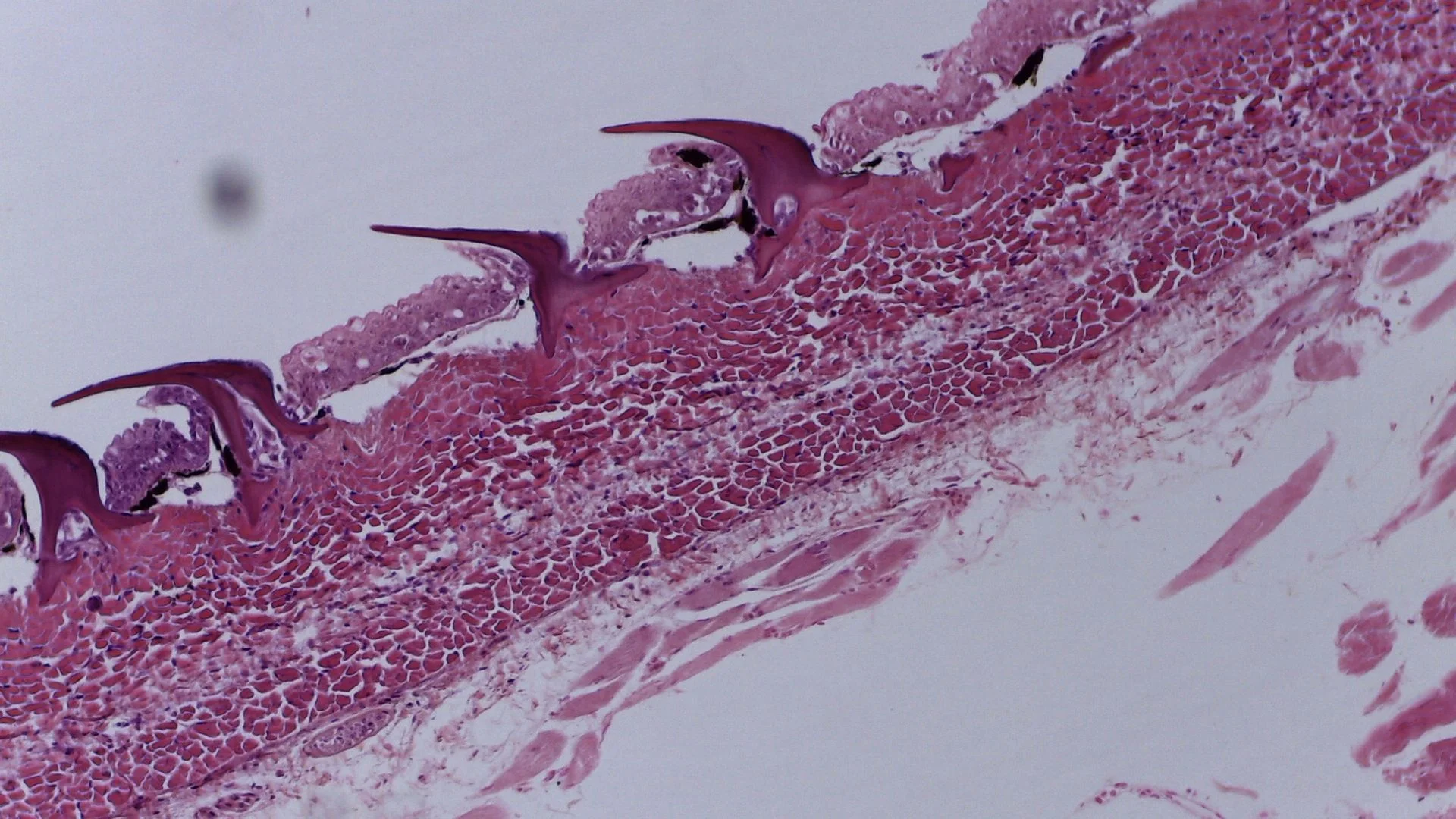
Maisey describes this tissue as “tessellated calcified cartilage,” a hallmark of many shark-like fish and their ancestors. He has studied Doliodus problematicus, a spiny fish fossil from the early Devonian. If fish with this feature count as sharks, their history reaches about 400 million years—older than trees. That’s a substantial shift in the timeline, but it rests on how researchers interpret a shared anatomical feature.
Another clue comes from shark skin. Dermal denticles, the tooth-like scales that give it a rough texture, appear in fossils around 450 million years old. Their presence is intriguing, but one shark-like feature doesn’t establish that an ancient fish was a shark; traits can be shared across related groups or appear before a modern group takes shape. Fossils from the transition toward sharks leave scientists with no living equivalent for comparison, making classification uncertain. The boundary is fuzzy.
Fragments leave an incomplete record
The fossil record often preserves only pieces of an animal, such as a tooth. Researchers are still assembling evidence about when and how sharks emerged, and each discovery can raise questions about other transitional forms that haven’t yet been found, Maisey said. A fragment can reveal a useful feature, but it may not show how that feature fit with the rest of the animal. Similar systems typically require several lines of evidence before scientists can place an incomplete fossil with confidence.
The tree record has its own gaps. Fossils on land are rare, especially those that clearly preserve parts of a tree. Finding a fossil forest takes luck, Looy said, though there’s little evidence that trees existed before the Middle Devonian. That means the oldest known tree fossils provide a strong reference point, while still reflecting what has been found and preserved. Comparisons between two lineages are therefore shaped by different kinds of evidence and different uncertainties.
What the comparison tells us
So the familiar comparison has two answers: trees predate modern sharks, while the broader shark lineage may be older. This is more significant than it looks, because a simple “which came first” question can hide a dispute about classification rather than a disagreement over the age of a fossil. The dates matter, but so does what scientists decide those dates represent.
If you’re working in this space, the distinction is a reminder to ask what a headline means by “shark”: a living group, a recognizable fossil relative, or a much broader lineage. New fossils could sharpen the timeline, but the dividing line will still depend on which ancient traits scientists accept as shark-like. And this is the part most people overlook: even a better fossil record may refine the boundary without making it perfectly clear.
How much of a shark fan are you? Find out with our shark quiz! It’s a quick way to test what you know about these animals and their history. The fossil record has plenty of open questions, after all.


