Earth looks round from space, but “round” is a matter of degree. A world’s shape reflects its rotation, internal structure and gravity, and Earth is an oblate spheroid: its equator bulges while its poles flatten. That difference puts Chimborazo’s peak in Ecuador 6,384.4 kilometers from Earth’s center, farther out than any other point on the surface, while the geographic North Pole is only 6,356.77 kilometers away. The planet is spherical to about 99.57% precision, with a 0.43% departure from a perfect sphere. (Earth’s gravity varies across its surface; planetary shape has physical limits; see also Chimborazo and the North Pole.)
This is more significant than it looks: the biggest challenge to a sphere isn’t simply size. Lower-mass bodies, including moons, asteroids and Kuiper belt objects, can have mountains and craters that loom large relative to their dimensions. Jupiter and Saturn, meanwhile, spin fast enough that their equatorial and polar radii differ by 7–10%. Across the universe, the contenders for greatest roundness are likely slow-spinning massive stars and neutron stars. Which one wins is still an open question.
The Solar System’s benchmark
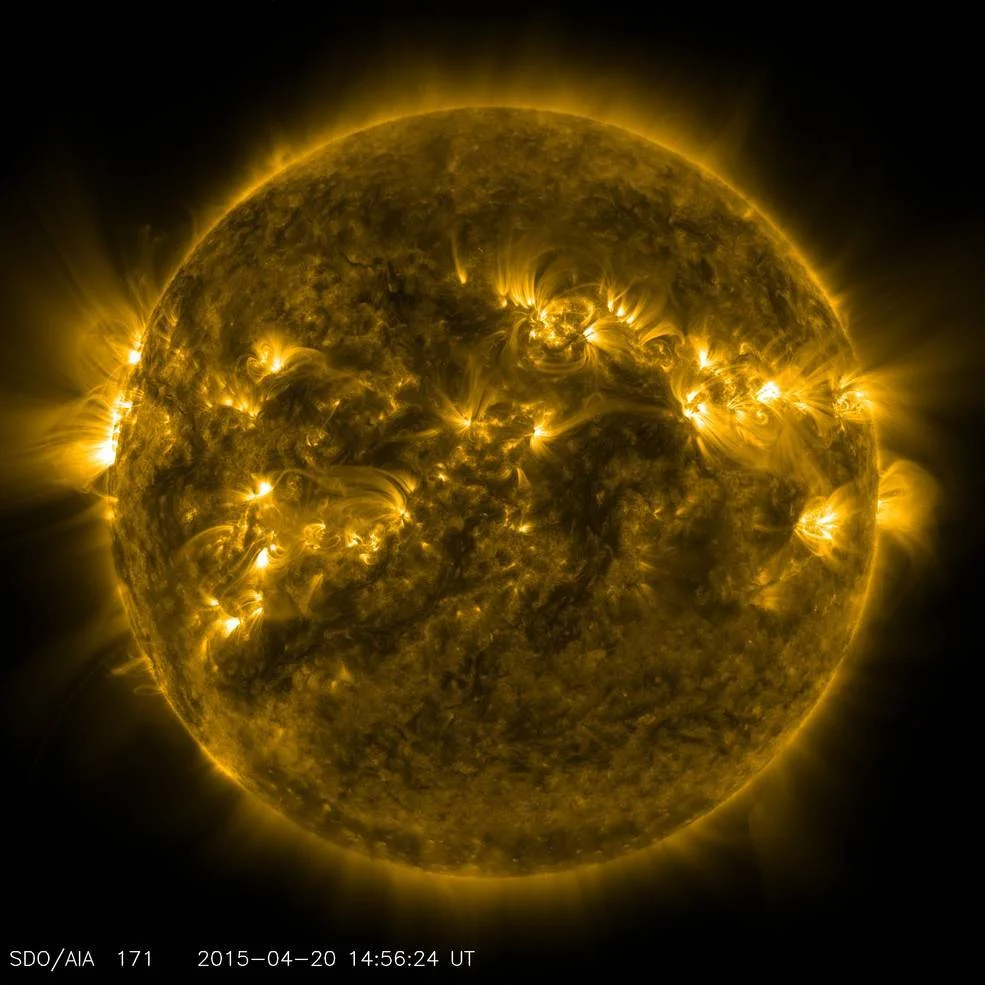
The Sun sets an impressive natural benchmark. It’s more than 1,000 times Jupiter’s mass, its surface plasma behaves much like a fluid, and it rotates slowly by stellar standards: once every 25 Earth days at the equator and once every 33 days near the poles. Its equatorial radius exceeds its polar radius by only about five kilometers. Against an average radius of roughly 696,000 kilometers, that makes the Sun spherical to 99.9993% precision, or 0.0007% off a perfect sphere.
Venus is the roundest planet, but its high mountain ranges still leave it 0.18% from perfect sphericity. Maxwell Montes is one example of the terrain that keeps a rocky planet from matching the Sun’s smoothness.
Humans have made a slightly better sphere. For Gravity Probe B, researchers built 1.5-inch (4-centimeter) quartz spheres coated with niobium and polished their surfaces to within 40 atoms—about 10 nanometers—of equal distance from the center. Their tolerance was 0.00005%, making them spherical to 99.99995% precision. (Gravity Probe B’s spheres were built to test Einstein’s general relativity.)
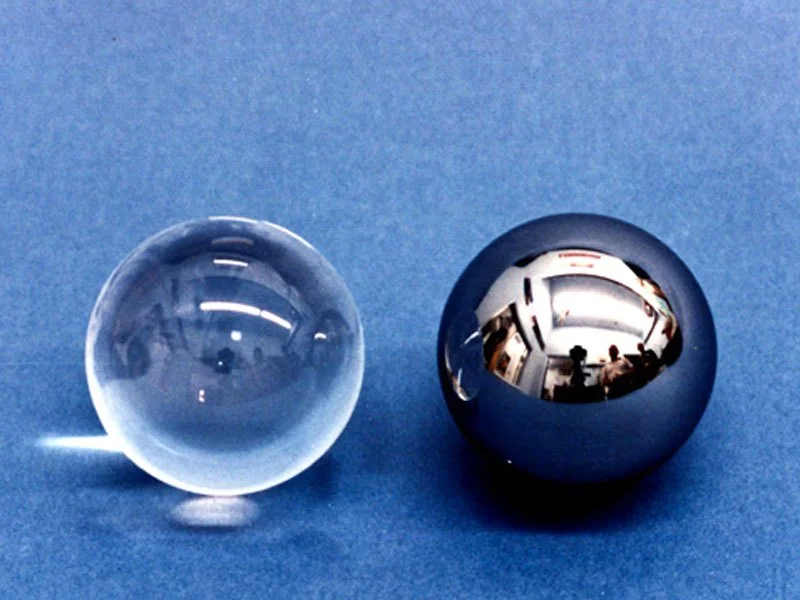
Scale one of those spheres up to Earth’s mean diameter of 6,371 kilometers, and its highest and lowest points would differ by only about 3.2 meters. Scale it to the Sun, and the gap between its polar and equatorial diameters would be roughly a third of a kilometer. Space offers no equivalent of precision polishing, so finding a more spherical natural object means finding one with the right combination of gravity, fluid behavior and slow rotation.
Gravity pulls inward; rotation pushes outward
Potential contenders include small, Sun-like and giant stars, white dwarfs, neutron stars and black holes. Two competing effects shape them. Stronger surface gravity suppresses bumps and bulges; rotation makes a body flatten at the poles and widen around the equator. Compact objects have an advantage from gravity, but concentrating mass near the rotation axis can make them spin faster if angular momentum is conserved.
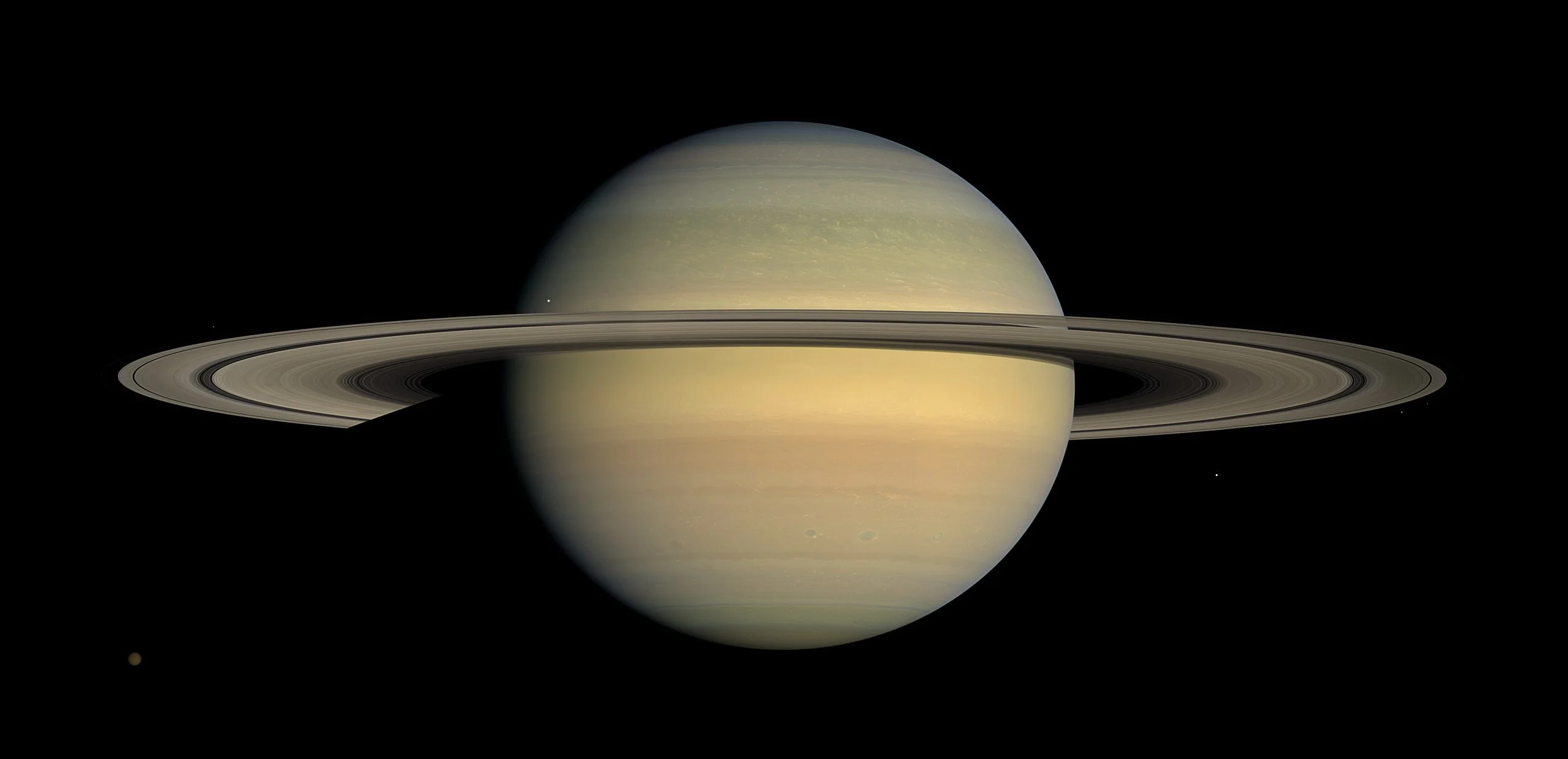
Imagine an isolated, nonrotating mass made of a perfect fluid. Gravity alone would pull its surface into a sphere, with every point equally distant from the center. Real bodies complicate that ideal: they rotate, contain uneven material and feel tidal forces. Solid terrain adds another obstacle. Venus, for instance, would be much rounder if its surface could flow freely instead of holding mountains, valleys, volcanoes and craters in place.
Surface gravity helps determine how large those irregularities can grow. A mountain or rotational bulge is harder to sustain where gravity is strong, so compact bodies tend to stay rounder—provided their rotation doesn’t undo that advantage. A red supergiant’s weak surface gravity, by contrast, allows large changes in shape and surface structure.
Credit: Bernd Freytag, Susanne Höfner & Sofie Liljegren
Approximate surface gravities illustrate the range. These values compare fluid-like bodies, leaving rocky terrain out of the equation:
- Jupiter-like planet: 25 m/s², or 2.5 Earth gs
- Brown dwarf (failed star): 1,000 m/s², or 100 Earth gs
- Red dwarf (low-mass star): 2,500 m/s², or 250 Earth gs
- Sun-like star (intermediate-mass star): 274 m/s², or 28 Earth gs
- Red giant (evolved Sun-like star): 5 m/s², or 0.5 Earth gs
- Blue supergiant (high-mass star): 3 m/s², or 0.3 Earth gs
- Red supergiant (among the largest stars): 0.004 m/s², or 0.0004 Earth gs
- White dwarf (stellar remnant): 1,000,000 m/s², or 100,000 Earth gs
- Neutron star (stellar remnant): 10¹² m/s², or 100 billion Earth gs
- Black hole (stellar remnant): surface gravity isn’t well defined, since a black hole has an event horizon rather than a surface
Among ordinary stars, small ones tend to have higher surface gravity than giants and high-mass stars. White dwarfs pack roughly the Sun’s mass into a volume about Earth-sized; neutron stars compress similar or slightly greater mass into a radius of roughly 10–20 kilometers. Their gravity is immense. Black holes are harder to compare: they have no conventional surface, so treating an event horizon as a rounded surface stretches the question.

Here’s the complication: compactness can make an object rounder through gravity, while also making it spin faster. A figure skater speeds up by pulling in her limbs; a star does something similar as its mass contracts toward its axis. If the Sun’s rotation were uniform and its angular momentum stayed constant while it shrank to Earth’s size, it would spin once every three minutes. Compress it to a neutron star radius—about 0.3% of Earth’s—and the rotation period would fall to roughly two milliseconds, comparable to that of millisecond pulsars.
Rotation matters sharply because the departure from a sphere scales with the square of angular velocity, while stronger surface gravity reduces that departure. Neutron stars have the strongest surface gravity of any known objects, but they can also rotate at 10% or more of the speed of light. The fastest known example, PSR J1748−2446ad, has an estimated surface speed of 24% of light speed.
Credit: T. Mikal-Evans (MPIA) / T. Müller (MPIA/HdA)
The slowest spin may decide the winner
The best candidates may be the slowest rotators among stars and stellar remnants. The Sun’s benchmark is 99.9993% spherical; Gravity Probe B’s manufactured spheres reach 99.99995%. Whether a natural object can match or beat the laboratory spheres depends on how slowly it spins as well as how strong its gravity is.
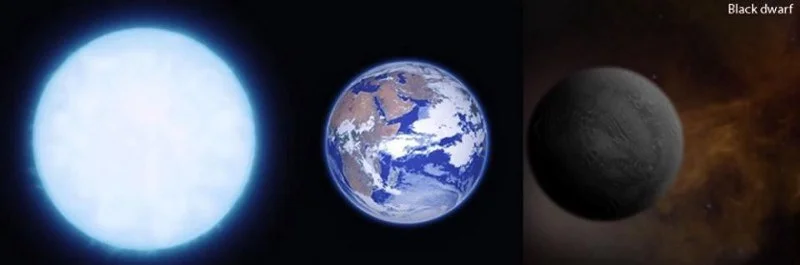
Credit: BBC / GCSE (L) / SunflowerCosmos (R)
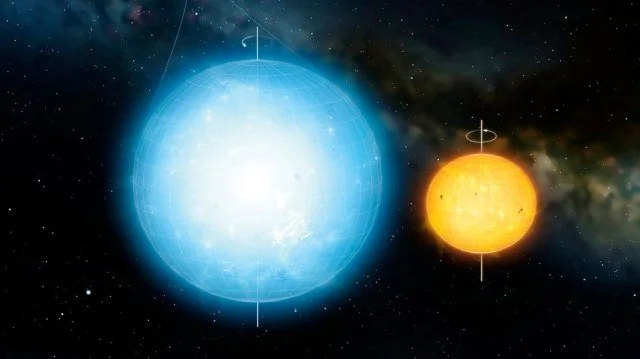
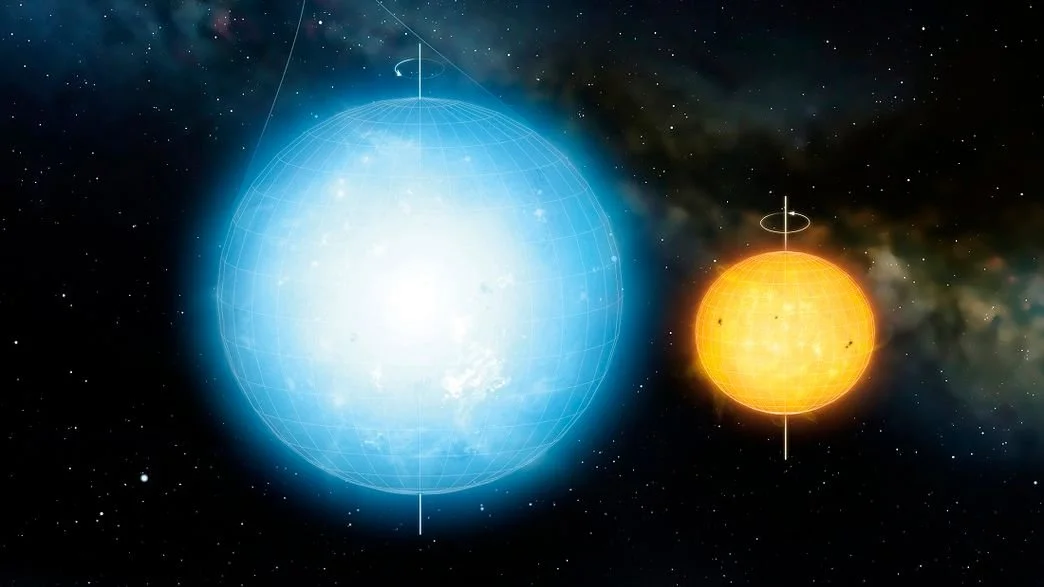
One strong candidate is KIC 11145123, a star about 1.57 times the Sun’s radius. Its measured rotation speed is just under 1 kilometer per second, giving it an estimated rotation period of about 100 days. On those figures, it’s roughly ten times more spherical than the Sun: 99.99993% spherical, with a 0.00007% departure. The measurement could still be an upper bound on its true rotation speed. If the star spins more slowly, it might rival Gravity Probe B’s spheres.
Neutron stars set a new standard for roundness
The best-known example of a remarkably round natural object may be a neutron star. That claim rests on how slowly it spins: rotation distorts a star, and a slower spin means less bulging at its equator. A white dwarf already makes an impressive comparison. WD 1532+129 was measured in 2026 with a rotation period of 289 days, longer than Venus’s and the longest known for a stellar remnant. Given its mass of 0.57 times the Sun’s, its estimated radius is 6,237 kilometers, or 0.896% of the Sun’s. At roughly 77,000 times Earth’s surface gravity, its calculated flattening is just 0.6 parts per trillion—about a million times smaller than that of the Gravity Probe B spheres.Credit: NASA’s Goddard Space Flight Center


