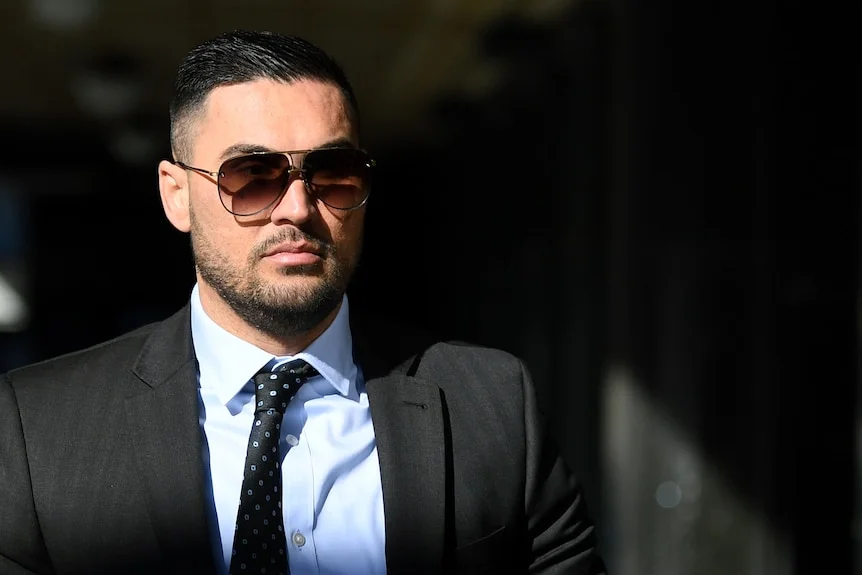
The latest charges against Salim Mehajer bring him back before the courts less than 16 months after his release on parole. Police allege the former Auburn deputy mayor committed domestic violence offences and stole jewellery valued at $41,000. The allegations put two familiar parts of his history back in focus: violence-related offending and a public profile built around conspicuous displays of wealth. They remain allegations, and the court process will determine what the evidence supports.
Arrest and charges
Mehajer, 40, was arrested around lunchtime on Wednesday at a café in Wentworth Point, in western Sydney. NSW Police’s Domestic Violence High Risk Offender team made the arrest after investigating an alleged domestic violence incident. The team’s involvement identifies the kind of police unit that handled the case; it doesn’t, by itself, establish what happened or prove the charges. Those questions will depend on the evidence presented in court.
At Auburn Police Station, he was charged with domestic violence-related common assault, stalking or intimidation, and intending to make a person fear physical harm. He also faces a larceny charge involving more than $15,000; the ABC understands the alleged theft involved $41,000 worth of jewellery. The combination of charges describes several distinct allegations, including conduct directed at a person and the alleged taking of property. Each will need to be considered on its own evidence.
Mehajer was refused bail and is due in court on Thursday. The charges are allegations. A bail decision concerns whether a person is released while a case proceeds; it isn’t a finding of guilt. That distinction matters in a case attracting public attention, where a prior record can make the newest claims seem settled before they’ve been tested.
Recent release, long record
Mehajer was released on parole in July 2025 after serving three years and nine months of a seven-year sentence for domestic violence and fraud offences. His convictions also include fraud and assault, while his offending history spans corruption and other crimes. That record provides relevant background to his return to court, but it doesn’t establish whether the current allegations are true. The new case has to be assessed on its own facts.
On leaving John Morony Correctional Centre near Windsor, he told reporters: “I respectfully decline to comment, sorry.” He was then driven away in a black Mercedes-Benz. A court had previously heard that he spent most of his time in prison in protective custody. The State Parole Authority recommended his release, assessing his risk of reoffending as “medium.” That assessment was made in the context of parole; it isn’t a verdict on the present charges.

Mehajer spent most of his time in jail in protective custody. (ABC News: Patrick Thomas)
Public profile
Mehajer first drew wide attention in 2015, when he was Auburn’s deputy mayor and held a lavish wedding in Lidcombe. The event included four helicopters and a convoy of luxury sports cars and motorbikes, while a nearby street was closed without permission. The spectacle made the wedding a public story well beyond the ceremony itself. It also tied his name to questions about the use of public space and the limits of private event planning.
Residents were angered by fake flyers distributed ahead of the wedding that warned their cars would be towed if they obstructed the event. The council later fined Mehajer $220 for the unauthorised street closure. The episode offered a clear example of how a local dispute can grow when an elected official’s private event affects residents and public streets. The fine was specific to that street closure; it shouldn’t be treated as a measure of the seriousness or outcome of his later criminal cases.
What the new case puts in focus
His court appearance will put the new allegations alongside a record that has already led to years in prison. The case now turns on the evidence behind the charges filed after Wednesday’s arrest. For readers, the important distinction is between the documented history of convictions and the claims police have only just brought forward. A familiar name and a long record can sharpen public interest, but neither substitutes for proof in the current case.
This is more significant than it looks: a return to court so soon after parole puts renewed attention on how a person’s previous convictions, release conditions and new allegations intersect in public discussion. They’re related parts of the story, but they aren’t interchangeable judgments. Similar cases often draw scrutiny because the public wants to know whether the justice system’s decisions have been followed by further allegations; the answer here will depend on what the court establishes. And this is the part most people overlook: the parole authority’s “medium” risk assessment describes an assessment made at a particular point, not a guarantee about future conduct.
If you’re following the case, the next useful developments will be the court’s handling of the charges and the evidence disclosed through the proceedings. That said, early reporting can only describe what police allege and what is already on the record. The difference between accusation and finding is not a technicality; it’s the boundary that keeps a report accurate. For now, the allegations remain unresolved.
A case still to be tested.


