A demonstration built around waiting
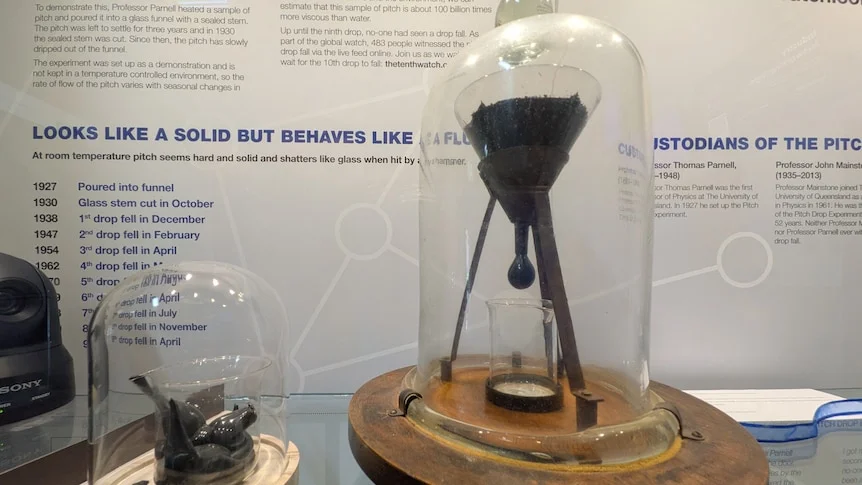
The University of Queensland’s pitch drop experiment has made patience part of the apparatus. Nearly a century after physicist Thomas Parnell prepared the material, the display outside a lecture theatre is still waiting for its tenth drop—and no one has ever seen one fall.
That absence is part of the experiment’s appeal. It asks visitors to think on a timescale that ordinary demonstrations rarely demand: the process is visible, but its defining event may happen between visits, or between one generation of observers and the next. There’s no dramatic apparatus to watch in motion. The lesson comes from understanding what the material is doing while it appears to do almost nothing.
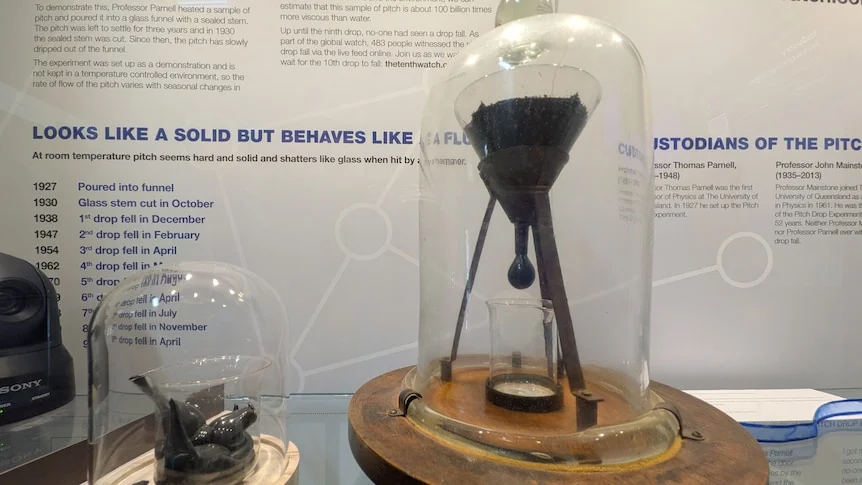
This humble experiment will turn 100 years old in 2027. (Supplied: University of Queensland)
When a solid material starts to flow
Parnell began the demonstration in 1927 to show how a familiar material could behave in an unexpected way. Pitch, made by heating coal or wood without oxygen, was once used to waterproof boats, decks, coffins and household containers. He heated a batch, sealed it in a glass funnel and let it cool. In 1930, he opened the funnel’s narrow end. The pitch began to move.
The setup is simple, but the timescale changes how that simplicity reads. The funnel and the material are easy to understand at a glance; the process itself is not. Pitch can hold its shape well enough to seem solid, while still yielding under sustained pressure. That distinction is the teaching point: a material’s appearance during a brief inspection doesn’t tell you how it will behave over a much longer period.
That slow motion is the point. Andrew White, the experiment’s third custodian, describes pitch as a material that seems solid but can flow under pressure. “Pitch is like that except billions of times more viscous than toothpaste,” he said. Its movement is roughly “about an atom a second,” White said—more than ten times slower than continental drift. “The ground beneath your feet moving in Australia is the red bull version of the pitch drop experiment,” he said.
The comparison gives visitors a scale they can picture, even if the pitch itself barely appears to change. A fast-moving geological process becomes a reference point for a flow too slow to follow by eye. This is more significant than it looks: the experiment turns an abstract property, viscosity, into a physical object people can return to and reconsider.
The setup has yielded just nine drops since 1930. The long intervals have repeatedly outlasted the people watching, and the experiment has turned missed moments into part of its history.
Nine drops, no witnesses
White’s predecessor, John Mainstone, once spent a weekend at the university hoping to catch a drop in motion. He waited through Friday night and Saturday, then left after Sunday morning. The drop fell while he was away: Mainstone returned on Monday to find it had happened after he went home to shower.
It’s an almost comically narrow miss, but it also shows the limits of human attention as a recording system. Watching continuously is an unreasonable demand when an event can take years to arrive. For a long-running experiment, keeping the object in place matters as much as having someone present at the right instant.
A later attempt to capture the event came during Brisbane’s 1988 Expo. The university put the experiment on display at its South Bank stall. According to White, the drop fell during the few minutes when people had stepped out for a drink.
And there’s the experiment’s recurring joke: even a public display can’t make an extremely slow process perform on cue. (And this is the part most people overlook.) The missed drops are not failures of the setup; they’re reminders that observation has practical limits when the thing being observed moves on a different clock.
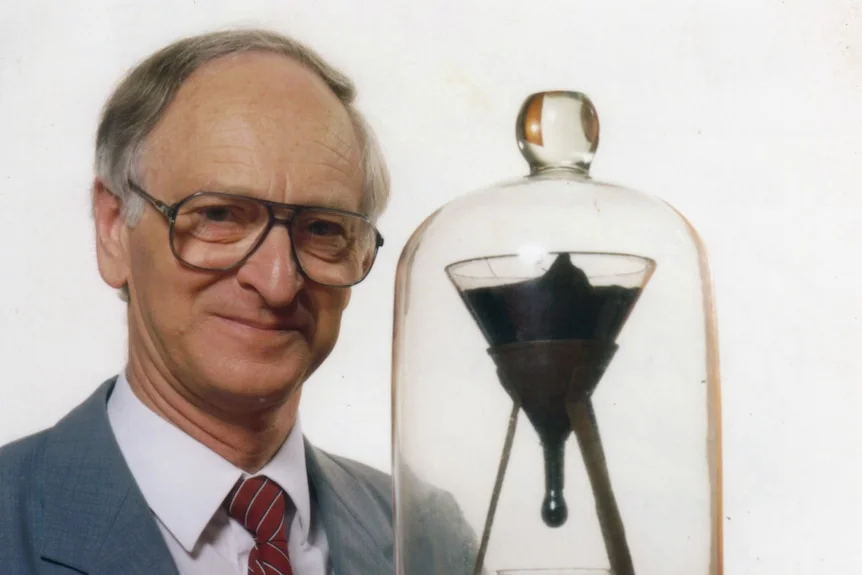
Professor John Mainstone was the second custodian of the long-running experiment. (Supplied: University of Queensland)
In 2000, with internet cameras offering a new chance to document the process, a power blackout intervened. Building changes had already slowed the experiment: air conditioning installed in the 1980s increased the time between drops.
The episodes show how a long-running demonstration depends on more than the material and funnel. The surrounding environment affects the rate, while power and recording equipment affect whether anyone can document the result. The camera offered a way to extend observation beyond the room, but it couldn’t remove the basic uncertainty of when the drop would fall.
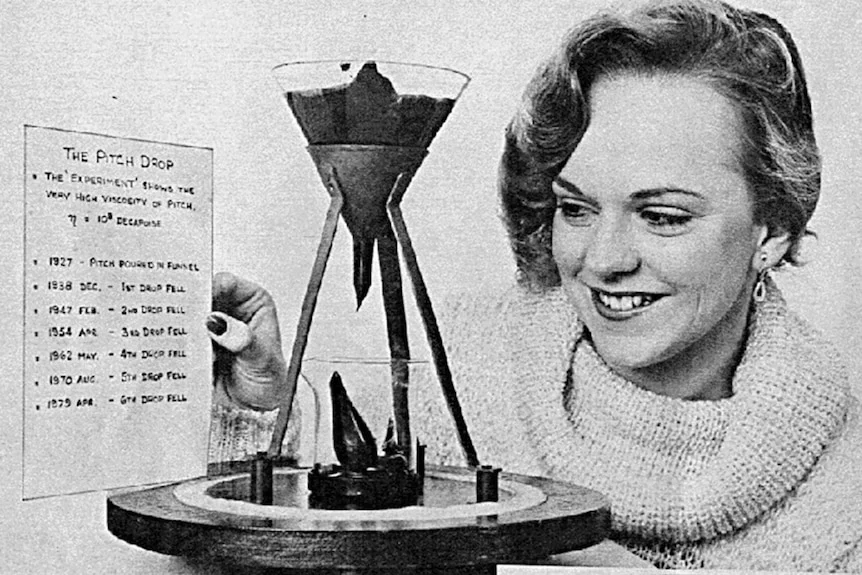
A photo of the pitch drop experiment taken after the sixth drop fell in 1979. (Supplied: University of Queensland)
The next drop and the value of watching
The most recent drop fell in 2014, but the receiving beaker was already crowded with earlier material. The new pitch touched the accumulated drops, then took about eight years to slowly fall over, White said. A clean beaker now sits beneath the funnel, ready to collect the tenth.
That change in the receiving beaker matters because it gives the next event a clearer path to be observed and recorded. It also makes the wait more legible: there’s a fresh vessel below the funnel, and another drop is expected, but no exact moment is promised. The apparatus can be ready without the event being predictable.
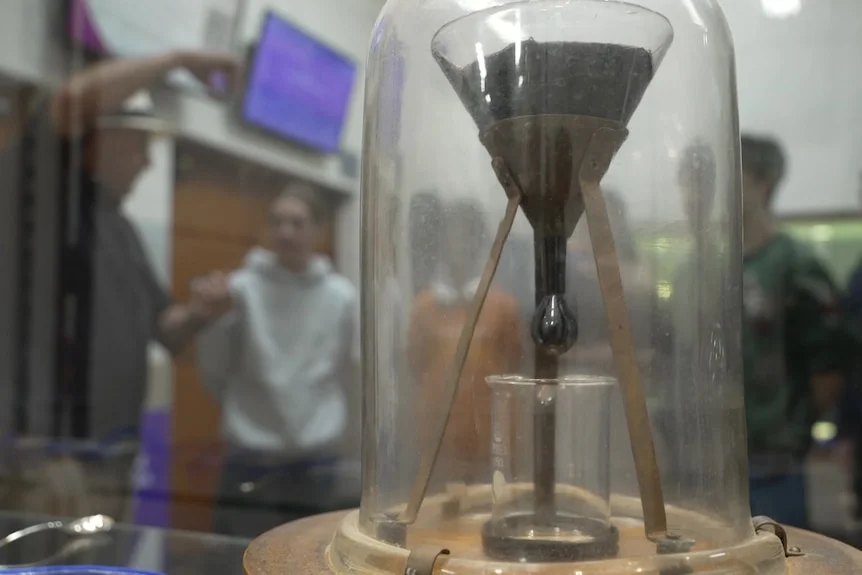
The pitch drop experiment makes for a good teaching moment for budding physics students. (ABC News)
White expects it to arrive within the next few years. For a demonstration built around waiting, a clear recording would count as a result: “I'd love to be able to witness it in person, but I would settle for just a really good recording.”
If you're working in this space, the experiment offers a modest lesson in how to communicate slow science: keep the process visible, explain what the eye can’t detect, and be candid about what the record can’t show. A recording would close one gap in the history, though it wouldn’t make the pitch move any faster. For now, the tenth drop remains a small event with an unusually long audience. A wait, still in progress.


