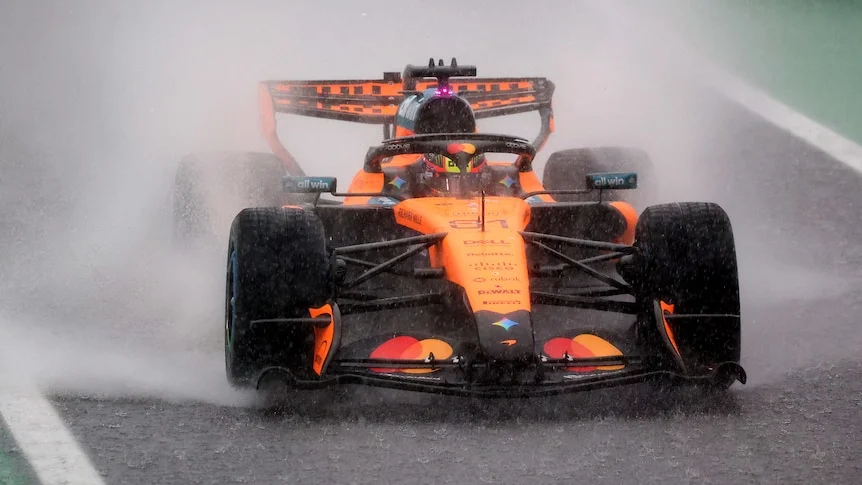
Grid penalties reshaped the front of the São Paulo Grand Prix, while rain cut Oscar Piastri’s qualifying short. The McLaren driver qualified 12th and is set to start 10th; teammate Lando Norris will lead the field from pole for a second year running. Those positions tell two different stories about the session: Norris found a way through a difficult, changing set of conditions, while Piastri’s chance to improve ended before he could contest the final qualifying segment.
That split matters because qualifying order is only part of the picture at Interlagos. Penalties have moved several drivers away from the positions they earned on the track, creating a starting order that rewards some and complicates the weekend for others. Piastri’s 10th-place start, for example, doesn’t reflect his qualifying result alone. In a race where rain may remain a factor, the grid is a starting point, not a reliable forecast of how the field will finish.
Norris leads a reshuffled grid
Norris said the conditions differed from last year’s session, but he was pleased to secure pole. “It was about getting two laps in, not making any mistakes,” he said. He added that this was his first time driving the car in the wet and that he felt he had worked it out.
His comments point to the narrow task facing drivers in a wet qualifying session. Speed matters, but so does keeping the car on track long enough to complete a lap when grip and visibility are changing. A driver can’t simply repeat the same approach from one lap to the next if the surface is moving between wet and intermediate-tyre conditions. Norris got the result he needed from that uncertainty, though his own description suggests he was learning the car’s behaviour as the session unfolded.
George Russell qualified second but will start seventh after a five-place penalty for a power unit change. That moves world champion Kimi Antonelli, who qualified third, onto the front row. Charles Leclerc was fourth fastest, though a 10-place penalty drops the Ferrari driver down the order.
Those changes show why the qualifying result and the starting grid need to be read separately. Russell and Leclerc set the second- and fourth-fastest times, but their penalties carry them away from those positions. Antonelli, meanwhile, gains a front-row start without having qualified on the front row. It’s a substantial shift in opportunity, even if it doesn’t change what happened on the circuit during the session.
Those penalties promote Liam Lawson of Racing Bulls to third and Audi’s Nico Hülkenberg to fourth. Isack Hadjar, Oliver Bearman, Fernando Alonso and Alex Albon complete the top 10 from qualifying. Piastri’s 10th-place starting position also reflects penalties applied to rivals.
The reshuffle gives Lawson and Hülkenberg places near the front that their qualifying times alone didn’t secure. That’s a meaningful opening, but it also leaves them with the practical challenge of defending those positions when the race begins. Piastri has a similar calculation from farther back: 10th offers a route into the points fight, but he’ll have to make progress through a field whose order has already been altered by penalties.
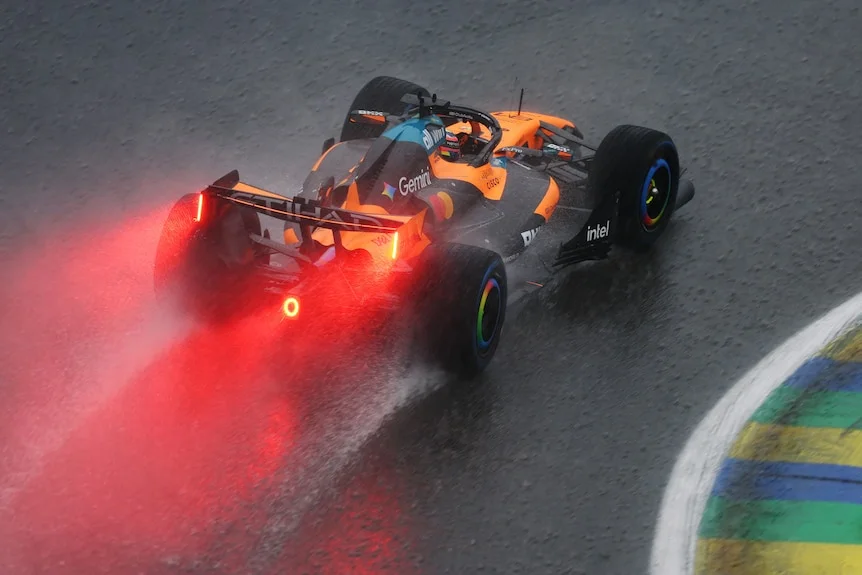
The entire grid dealt with atrocious conditions. (Getty Images: Clive Mason)
Rain and a curtailed run for Piastri
Qualifying at Interlagos was delayed by 80 minutes and stopped twice as torrential rain swept across the circuit. Piastri struggled on wet tyres, then lost time as conditions shifted toward intermediate tyres. A crash by debutant Rafael Camara brought Q2 to an early end, leaving Piastri outside the top 10 and unable to contest the final session.
The interruptions narrowed the time available to respond to changing conditions. Wet tyres and intermediates suit different levels of standing water and grip, so a transition between them can turn tyre choice into a high-stakes judgment. Piastri’s difficulty wasn’t simply a matter of setting a slower lap: the conditions changed, and then the crash ended the session before he could try again in the final segment.
That’s a frustrating outcome for a driver who’d qualified 12th, especially when the gap between a place outside the top 10 and a shot at the final session is decided in a brief, disrupted run. There’s no way to know from the result what Piastri might have managed with more time. The measurable fact is that he didn’t get another opportunity to improve before Q2 ended.
This is more significant than it looks. In a normal session, a disappointing lap can sometimes be corrected; here, the delays, tyre transition and red flag compressed the available chances. The qualifying order therefore captures both pace and timing. Piastri’s starting position benefits from penalties elsewhere, but that doesn’t erase the lost chance to set a stronger time himself.
Back-row starts for Verstappen and Hamilton
Max Verstappen and Lewis Hamilton will start on the back row after taking grid penalties. With wet weather forecast for race day, both face a difficult climb through the field, though the conditions could make the race unpredictable.
A back-row start leaves little room for a cautious opening if either driver wants to make up ground, but wet conditions can complicate any attempt to pass. Spray can reduce visibility, and grip can vary across the circuit; those are common challenges in wet racing, not guarantees about what will happen here. The forecast adds uncertainty to their task. It doesn’t promise that the rain will help them.
And this is the part most people overlook: a disrupted qualifying session can make a grid look more settled than the race itself will be. The penalties are clear, and the starting positions are set, but the conditions that shaped qualifying may continue to affect how drivers manage the opening laps and their chances to move forward. That said, a wet forecast doesn’t make every position equally recoverable. The front row still gives Norris and Antonelli a very different starting problem from the one facing the drivers at the back.
What the grid means for race day
The start will test two kinds of advantage: the clean air and track position that come with starting near the front, and the opportunity to gain places from a grid reshaped by penalties. Norris has pole, while Antonelli moves onto the front row; behind them, Lawson and Hülkenberg inherit elevated starts. Piastri begins 10th after qualifying 12th, while Verstappen and Hamilton face the steepest recovery from the back row.
If you’re following the race, the useful distinction is between what each driver earned in qualifying and where they’ll actually start. Those aren’t the same story this weekend. Rain could add another variable, but it won’t remove the consequences of the grid penalties or restore the laps Piastri didn’t get to run.
The São Paulo Grand Prix starts at 4am AEDT on Monday. ABC Sport will provide live coverage.


