Tariff shock leaves markets split
Australian shares looked set to start higher on Thursday, despite losses across Wall Street after US President Donald Trump announced sweeping tariffs affecting more than a dozen trading partners. That split is the story: futures point to a firmer local open, but the announcement has unsettled markets overseas. The data doesn’t yet show how investors will price the tariffs once trading begins in Australia, and futures can’t guarantee where the market will finish the session.
At about 7am AEDT, ASX 200 futures were up 0.7 per cent at 8,729 points. The Australian dollar slipped 0.1 per cent to 66.30 US cents. US markets were mixed: the S&P 500 fell 0.1 per cent, the Dow rose 0.5 per cent and the Nasdaq lost 0.6 per cent. That divergence suggests investors weren’t treating the announcement as a uniform signal to sell; different sectors and markets were reacting in different ways.
Europe’s major indexes fell more sharply, with Germany’s DAX down 1.3 per cent, the Euro Stoxx 50 off 1.1 per cent and Britain’s FTSE lower by 0.4 per cent. Elsewhere, Brent crude climbed 3.2 per cent to $US94.31 a barrel, while spot gold edged down 0.1 per cent to $US3,552 an ounce. Iron ore slipped 0.5 per cent to $US88.30 a tonne; bitcoin rose 0.3 per cent to $US60,009. These moves don’t line up neatly as a classic flight to safety: oil rose, gold eased and the major European indexes fell.
Bond yields stood at 4.85 per cent for US 10-year bonds and 4.79 per cent for Australian 10-year bonds. The snapshot captures an uneven response to the tariff announcement, rather than a single clear market signal. That matters because a tariff announcement can affect expectations about trade, prices and business decisions before its full economic effects are visible. For now, though, the figures show uncertainty more clearly than they show a settled view.
Follow the live financial updates from business reporters Adelaide Miller and Alison Branley. This blog is for news and information, not investment advice.
China rejects Washington’s case for tariffs
China is pushing back on the rationale for new US tariffs while trying to keep the current trade truce intact. The stakes are high: the country is on course for a record trade surplus of more than US$1 trillion in 2026, and renewed tariff increases could hurt both economies. A large surplus has become part of Washington’s argument, but Beijing rejects the framing that it proves Chinese overcapacity.
Foreign ministry spokesperson Guo Jiakun called claims of Chinese “overcapacity” a false issue and said Beijing opposed using them for political purposes. He didn’t threaten retaliation. China has also reiterated its opposition to trade wars after Trump imposed new tariffs on major trading partners, including China. The tariff rate is expected to stay within the range set by the truce agreed between Trump and Chinese President Xi Jinping. That expectation offers some near-term restraint, although it doesn’t resolve the disagreement over why the tariffs were imposed.
The truce runs until January 10. Many expect an extension, possibly as soon as next month, when Trump and Xi are scheduled to meet at a G20 gathering in Miami. That expectation reflects the economic costs of another round of tit-for-tat tariff increases like those seen in 2025. Still, the timing and terms of any extension remain uncertain. A meeting can create an opening for talks, but it doesn’t by itself establish that either side will accept the other’s position.
Markets retreat as the tariff dispute raises legal questions
The market reaction was cautious, with technology shares under pressure and investors shifting toward US government debt. The Nasdaq fell 0.8% to 23,541 as its tech sell-off continued; the S&P 500 slipped 0.36% to 7,173. Those declines add detail to the earlier mixed snapshot: markets can move during a session, and a single index reading doesn’t capture how investors are reassessing the policy.
US 10-year Treasury yields dropped 12 basis points to about 4.81%, suggesting investors sought safety in government bonds. The dollar’s gains faded late in the session. AUD/USD stood at 66.29 at 7:24am. That’s a modest change from the earlier Australian dollar quote, but the timing matters: this is a fast-moving story, and the figures describe different moments in trading. 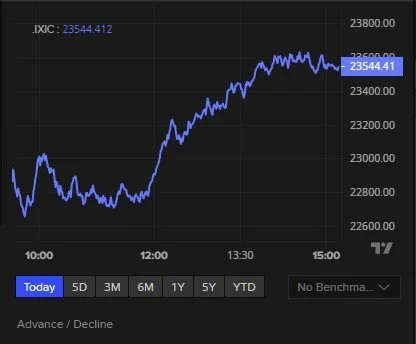
Here’s the more consequential question: whether the tariffs can stand legally. The US Constitution gives Congress authority over taxation, including tariffs. Trump sought to justify his authority by declaring two national emergencies and arguing they allowed him to impose “emergency tariffs.” That argument doesn’t settle the matter; the available information points to limits on the tariffs’ legal footing, but doesn’t explain which measures those limits affect. The distinction is important: uncertainty about legal authority can make it harder for companies and trading partners to judge how long a policy will remain in force.
What the split reaction means for investors
The numbers here are underwhelming as a guide to what happens next. They show a divided response across regions and assets, while the details that would clarify the tariffs’ reach and durability remain unresolved. A higher Australian futures reading may reflect expectations for the local session, but it doesn’t erase the weakness in Europe or the pressure on US technology shares.
If you’re working in this space, the signals to watch are the policy’s implementation, Beijing’s response and the course of talks around the truce. (And this is the part most people overlook.) Markets are reacting not only to the cost of tariffs, but to how predictable the rules will be for businesses making trade and investment decisions. When policy changes are contested or subject to negotiation, uncertainty itself can weigh on planning.
This is more significant than it looks. A temporary truce can limit immediate escalation, yet leave the underlying dispute unresolved; a legal challenge can add another source of uncertainty without determining the final outcome. Investors may keep switching between concern about trade disruption and hope for an extension. For now, the market data offers no clean verdict. Just a split screen.


