
A treatment changes the outlook
The US approval of ribitol gives people with limb-girdle muscular dystrophy type 2I/R9 a treatment option for the first time. That distinction matters: for patients and families who have been told there’s no medicine to address the disease, an approved therapy changes the choices they can consider, even when access remains uncertain. For Matt Butler, a 48-year-old father from Toowoomba who took ribitol in a clinical trial, the change has been personal. He says he can now live a normal life.
Butler was diagnosed in 2019, when his children were three and six. The disease affects muscles in his legs and shoulders, as well as his heart and lungs, so the consequences reach beyond walking or getting around. At diagnosis, he was told to expect worsening mobility, life in a wheelchair and an early death. That prognosis gave the family a stark picture of what might lie ahead, though Butler’s later experience in the trial would give him a different reference point.
“Your life and your dreams just get sucked into a pretty ordinary web of disaster,” he said. Before joining the trial, Butler’s mobility had been deteriorating rapidly. Three years ago, he became one of the first Australians to receive ribitol. For someone facing a progressive condition, that timing is part of the story: the treatment entered his life when his expectations had narrowed around the prospect of further decline.
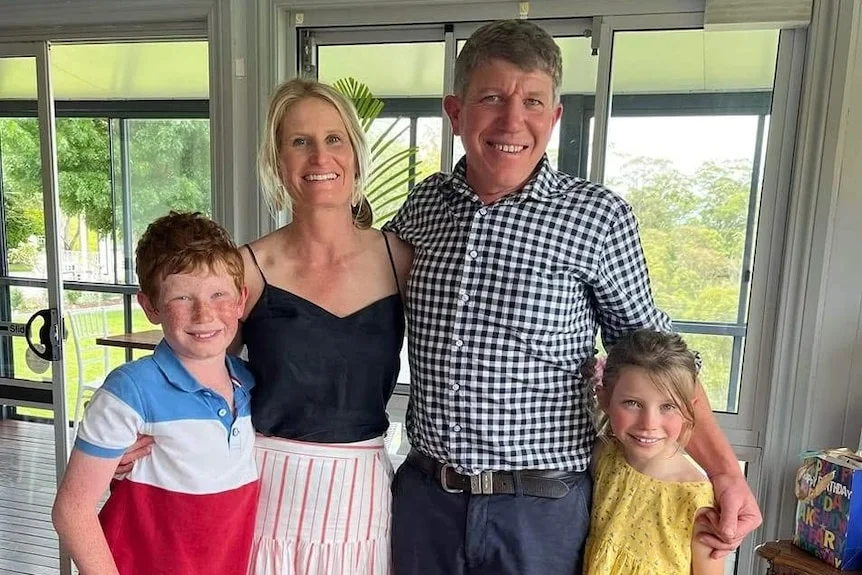
Matt Butler says he can now live a "normal life" thanks to the treatment. (Supplied: Matt Butler)
“I’m living a very normal life now, [with a] spring in my step,” Butler said. He described the effect as “like having two lives.” That’s a striking account of what treatment can mean when the alternative has been framed as a steady loss of function. His experience is personal, though, and the broader case for ribitol rests on clinical evidence as well as the stories of trial participants.
Trial results and access questions
Neurologist Robert Henderson leads the ribitol trial at Royal Brisbane and Women’s Hospital and the Frazer Institute in Brisbane. He said the US decision was exciting because it brings a therapy to a disease that previously had none. The approval gives the treatment a formal foothold in the United States; it doesn’t, by itself, settle how patients elsewhere will obtain it or how quickly the evidence will translate into care.
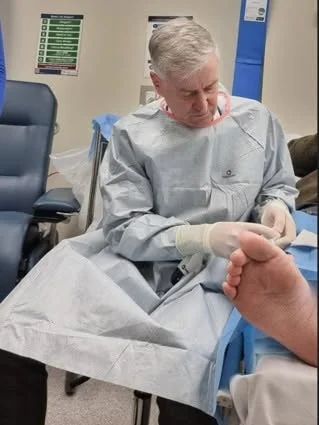
Robert Henderson had to take a muscle biopsy as part of the clinical trial. (Supplied)
Henderson said participants assigned to a placebo may be able to receive ribitol through an open-label extension. That could offer a route for people who took part in the trial but weren’t initially given the drug, although the possibility depends on the extension being available to them. For patients outside the study, the immediate question is more basic: whether the treatment can be obtained at all.
Ribitol isn’t approved or commercially available in Australia, leaving access there uncertain. Henderson plans to advocate for Australian patients to receive treatment, but near-term access may depend on the company producing enough medicine for compassionate use, he said. That route could matter to patients waiting for a local decision, yet it depends on supply and doesn’t amount to broad availability.
Broader access would require an Australian approval process that Henderson expects could take a year or two. That gap between a US approval and Australian availability is a practical problem for patients whose disease continues while decisions are pending. If you’re working in this space, the distinction between a treatment being approved somewhere and a patient being able to receive it at home is the one to watch.
What the approval means
The FDA said clinical data showed meaningful improvements in walking speed and lung function. Laura Jawidzik, director of the Division of Neurology 2 at the agency’s Center for Drug Evaluation and Research, said those changes could matter in patients’ daily lives. The measures speak to functions closely tied to independence and health, but the reported findings don’t tell readers here how large the changes were or how they varied between participants. The approval is a meaningful step; the available details still leave room for questions about what patients can expect.
This is more significant than it looks. In a disease with no previous treatment option, evidence of improvement in walking and lung function can alter how patients and clinicians discuss the future. It can also sharpen the questions families ask: who can access the drug, under what arrangements, and when? The answer in Australia remains unsettled.
For Butler, the trial has also strengthened his commitment to research. As an ambassador for the Nerve Connection Foundation, he has helped raise almost $600,000 over 15 months for muscular dystrophy and motor neurone disease research. His experience has made him a public advocate, linking the personal effect he describes with a wider effort to support research. A treatment can change one person’s daily life; turning that possibility into an option for more patients requires further work.

Matt Butler and Robert Henderson in Toowoomba. (Supplied)
The next test is access
US approval marks a significant shift for people with this rare inherited disease, but approval is only one part of the path from trial to treatment. The next test will be whether trial participants and other patients in Australia can access ribitol while the country’s approval pathway runs its course. In the nearer term, compassionate use may offer a possibility if enough medicine is produced; wider availability depends on the Australian process Henderson described.
And yet, the approval gives patients and clinicians something new to work with: evidence that a treatment can improve measures tied to everyday function, alongside Butler’s account of a changed life. Neither resolves the practical uncertainty facing Australians who need access. For families following the decision, the distance between promise and availability is still the central fact. Not a small gap.


