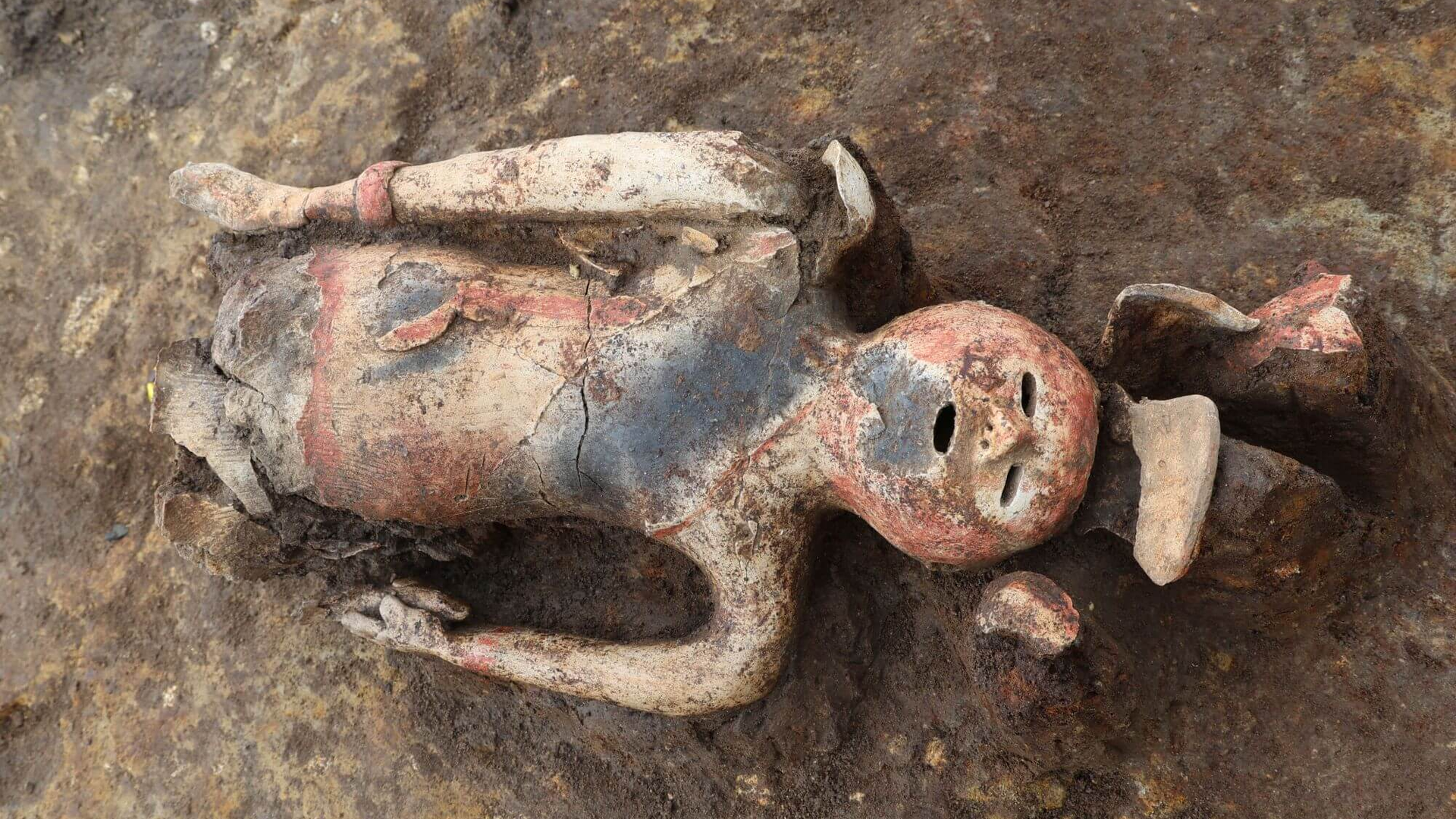
A finely modeled clay figure from a fifth-century Japanese tomb may offer a rare glimpse of the people who carried out funeral rites. Archaeologists believe the haniwa depicts a miko, or shrine maiden, whose role connected the human and spiritual worlds. The identification is based on the figure’s clothing, hairstyle and ritual object, rather than on an inscription or other direct evidence. That makes the interpretation persuasive, but still an interpretation.
A figure recovered from the moat
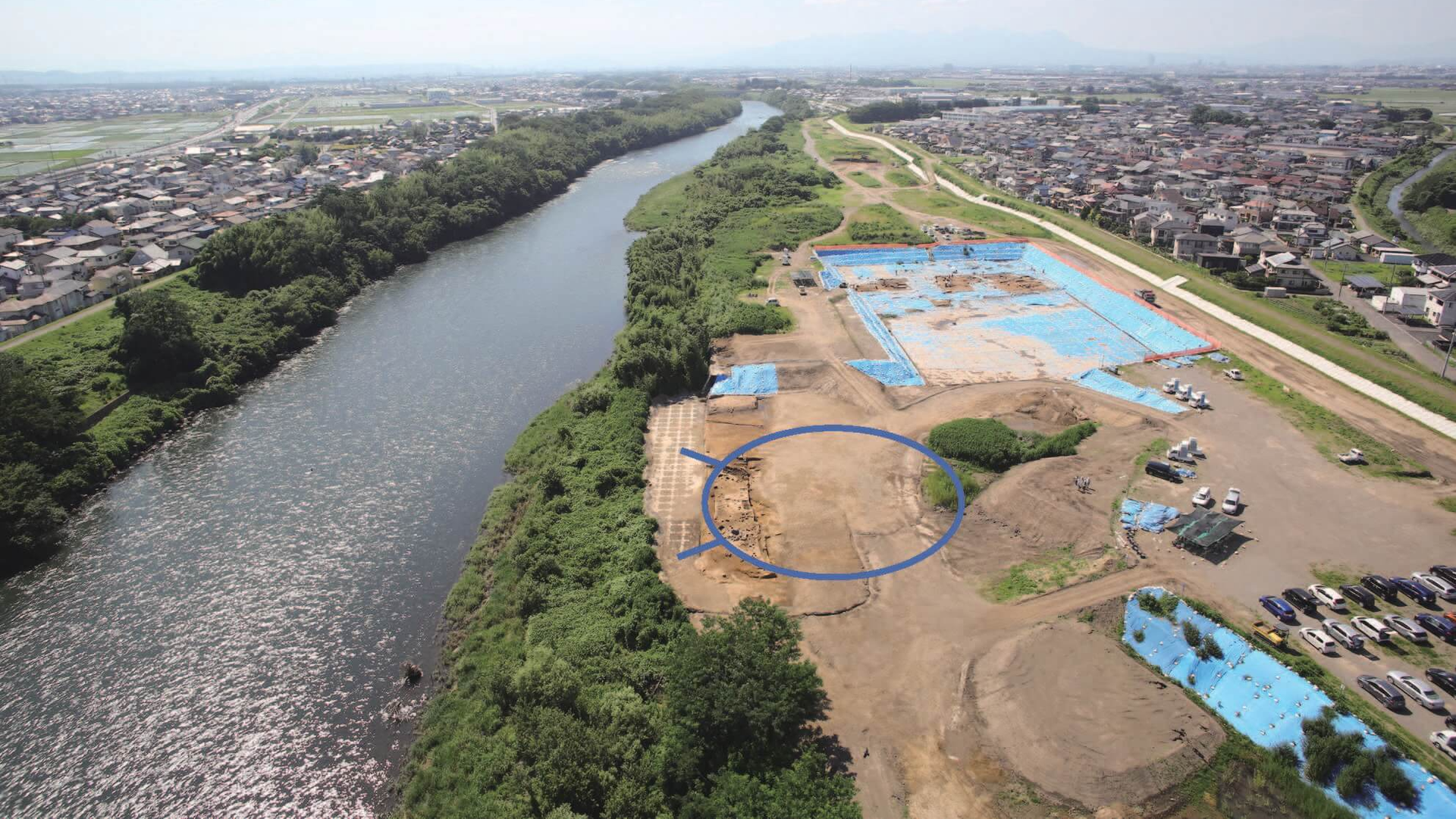
The artifact was found this year at Nishikaminomiya, an archaeological site northwest of Tokyo where researchers have been excavating since 2020. The site contains nearly a dozen burial mounds, or kofun, dating to the fifth and sixth centuries. That wider setting matters: the figure wasn’t recovered in isolation, but from a landscape organized around tombs and the ceremonies associated with them.
Only the figure’s head and torso survive. The remaining piece stands about 16 inches (40 centimeters) tall, though the original sculpture would have been larger. It was recovered from the moat surrounding a burial mound roughly 145 feet (45 meters) across. Researchers think it may have stood near a boat-shaped sarcophagus inside the mound before slipping down the slope into the moat.
If that reconstruction is right, the figure’s current location reflects what happened after it was placed, rather than where it was meant to be seen. Its fall may also explain why part of the sculpture is missing, though the available evidence doesn’t establish when or how the damage occurred. Archaeological context can narrow the possibilities; it doesn’t always settle them.
Clues to the figure’s identity
Its hairstyle and ritual objects support the miko interpretation. The figure wears a topknot known as a shimada, clay bracelets marked with red pigment, and a red sash painted across its torso. Its carefully shaped fingers and prominent nose add detail, while its left hand holds a rod-shaped ritual implement. Taken together, these features give researchers a basis for identifying a ceremonial figure, though no single feature proves the person’s role.
“These details suggest that considerable care was taken in making the figure, even in features that would not be visible from a distance,” Gunma prefectural government representatives said in a translated statement. The observation points to the work involved in shaping and decorating the sculpture. It also raises a practical question: if some details were hard to see from afar, they may have mattered to the makers or to the ritual setting, even when they weren’t prominent to an audience.
During the Kofun period, which ran from about A.D. 300 to 710, haniwa clay sculptures were placed in and around tombs as offerings to the dead. Some were believed to contain the spirits of the deceased. Miko performed funeral rituals and offered spiritual guidance, making the figure’s apparent ceremonial role a meaningful fit for the burial setting. Here's the thing: the haniwa gives a material form to a religious role that might otherwise be difficult to trace through a tomb alone.
This is more significant than it looks. Much of the story rests on a head, torso, painted details and one held object, so the figure can’t tell us exactly what a particular funeral ceremony involved. But it does suggest that people associated with ritual were represented alongside the dead. A striking image, and a careful inference.
On display in Shibukawa
The discovery was made at a site with several kofun from the fifth and sixth centuries, a period when these large tombs were a defining feature of Japanese burial practice. The surviving figure is now on view at the Gunma Prefectural Archaeological Research Center’s Excavation Information Museum in Shibukawa. Seeing the object in person may make its scale and workmanship easier to judge than a photograph can.
For visitors, the display offers a chance to examine the details behind the proposed identification, including the sash, bracelets and carefully rendered hands. If you're working in this space, the find also illustrates how an object’s location, condition and decoration have to be considered together. The miko reading may prove useful, but the evidence should remain visible in the discussion.
What the find can tell us
The figure adds a human role to the familiar outline of a burial mound: not only the person buried there, but potentially someone who helped guide rites around death. That possibility gives the sculpture significance beyond its craftsmanship. And yet, the find doesn’t establish whether it depicts a specific individual, represents a broader ritual office or was understood in another way by those who made it.
Further study of the site and the surviving object may sharpen those interpretations, especially by placing the figure’s original position and associated objects in clearer context. For now, its value lies in the combination of physical detail and archaeological setting. A damaged sculpture, but a revealing one.


