
Three artists, one room
The exhibition brings together almost 70 works by three internationally celebrated contemporary artists. The headline name is two-time Archibald Prize winner Del Kathryn Barton, whose extravagant work was an early inspiration for Emily Hunt. Hunt's practice is built around magic and folklore. Jess Johnson completes the line-up with a colourful, geometric style rooted in a science fiction world.  *The Daughter (2012) by Del Kathryn Barton. (Supplied: National Portrait Gallery)* Here's the detail that matters most for anyone who follows contemporary art: this is the first time the three have shown their work together. Three strong, distinct practices meeting for the first time in one exhibition is a bigger deal than a themed group show usually is, and it's the reason the show feels less like a survey and more like a collision."The unbridled messiness of femaleness"
Gallery director Bree Pickering argues that craft and the handmade hold the whole thing together. Across the exhibition, she says, those materials carry both conceptual and spiritual challenges to age-old stereotypes about women. Textiles do a lot of that heavy lifting. 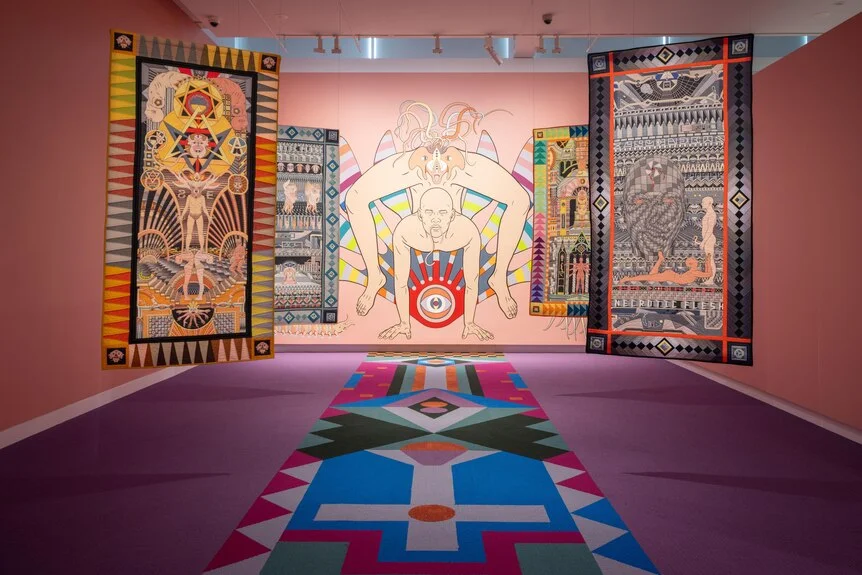 *Along with artworks on paper, Jess Johnson's textiles are also on display at the exhibition. (Supplied: National Portrait Gallery)* "Maiden Mother Crone is an exhibition that is both intricate and intimate, as well as maximalist and expansive," Ms Pickering said. She was also keen to stress that each artist has a fixed, recognisable voice. "Each of these artists had a very defined practice, and you'll see that they have their own visual language." The range of media is wide. Pickering lists "drawing, painting, textiles, ceramics, jewellery, sculpture, and video," with each artist given a distinct presentation. Those presentations still bleed into one another, and that's the point. The show, she says, "revels in the unbridled messiness of femaleness."The crone as a force for change
For Hunt, everything starts with "the question of magic," and the crone figure keeps turning up in her work. She doesn't hedge about where she stands. "I think as a mature artist now, I'm in a position where I can put my credibility on the line and say, 'Magic is real, and magic works,' so I find that's kind of at the core of everything I do," Hunt said.  *No. 11 from The Pandemonium Series (2026) by Emily Hunt. (Supplied: National Portrait Gallery)* She reframes the witch and the crone as something other than villains. "The figure of the witch, or the crone, is — I think — a figure for redemption." Her reasoning is pointed. "Often old women are invisible in society, but there's an inherent kind of wisdom and power that is held in this position, and I often focus on this crone figure in my work as a kind of powerful force that can also create change." That's a sharp corrective to how older women usually show up in culture, and it's the strongest through-line in Hunt's contribution.Interrogating inherited roles of womanhood
Johnson comes at the same questions from another direction. Her maximalist practice runs through a science fiction world she has been drawing for more than a decade. Rather than making up new symbols, she took archetypes from history and mythology, alongside modern ones, and reworked them inside that universe. 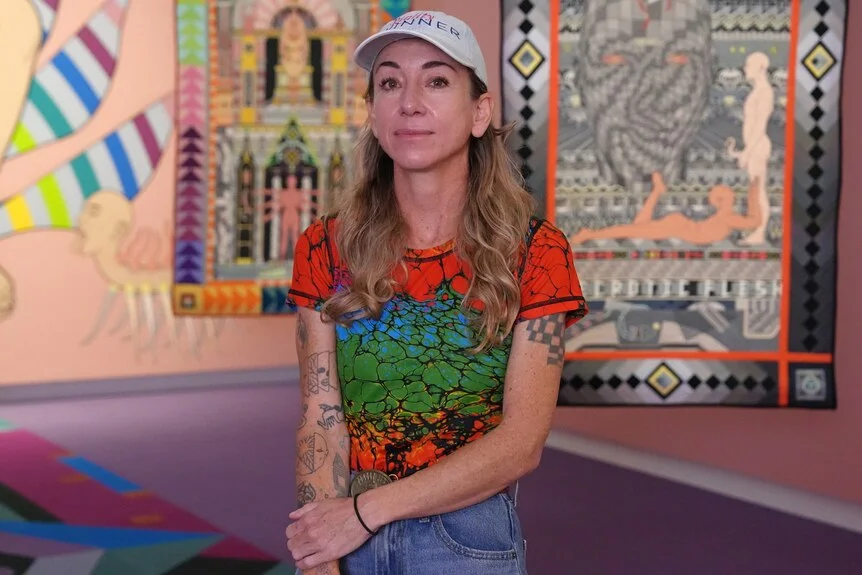 *Jess Johnson says the colourful, geometric nature of her work helps audiences look deeper at the themes of a piece. (ABC News: David Scasci)* Her description of the surface-level appeal is worth reading slowly. "On the surface it's quite geometric and brightly coloured and really detailed, and so I think it's almost like that's the candy-coloured coating that people can access into these deeper, more subversive ideas underneath the work," Johnson said. The bright colours are bait, in other words, and the hard material is underneath.  *Maw (2023) by Jess Johnson is on display at the National Portrait Gallery. (Supplied: National Portrait Gallery)* She also thinks that accessibility is what makes the work land. "I think it's quite accessible for people because it's very graphic and detailed, and there are these hints of story and narration and mythology and symbology in it." The darker thread runs through the whole thing. "Power, and control, and systems of authority and how power is exerted on a population, those are running themes in my work." Senior curator Serena Bentley, who put the exhibition together with the gallery's team, says it celebrates women who resist easy categorisation. She was candid about her own reaction. Seeing the finished show for the first time, she said, left her incredibly moved. 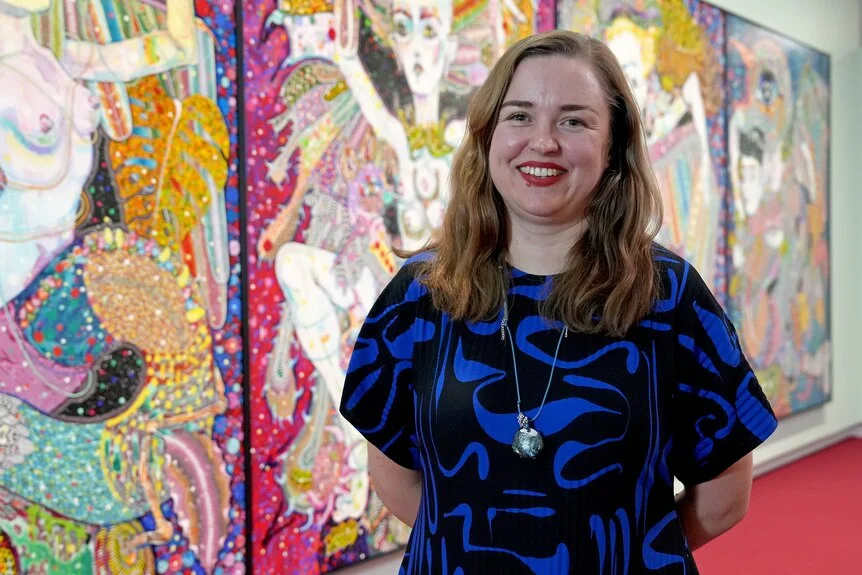 *Serena Bentley says the exhibition celebrates women who defy easy categorisation. (ABC News: David Scasci)*Taking the archetypes apart
Emily Hunt's exhibition starts with three old stock characters of womanhood: the maiden, the mother and the crone. Her goal isn't to celebrate them. "We've used the tropes of the maiden, the mother, and the crone as a means of interrogating these inherited roles of womanhood, and how we chose to inhabit them," she said.
The second half of that idea matters more. "But also, how we chose to tear them apart."
That's where the show gets interesting. Plenty of art draws on feminine archetypes. Far fewer set out to pull them apart. The exhibition's own description says it celebrates women who resist easy categories, exposing and dismantling the contradictions that shape how women live and how they're imagined.
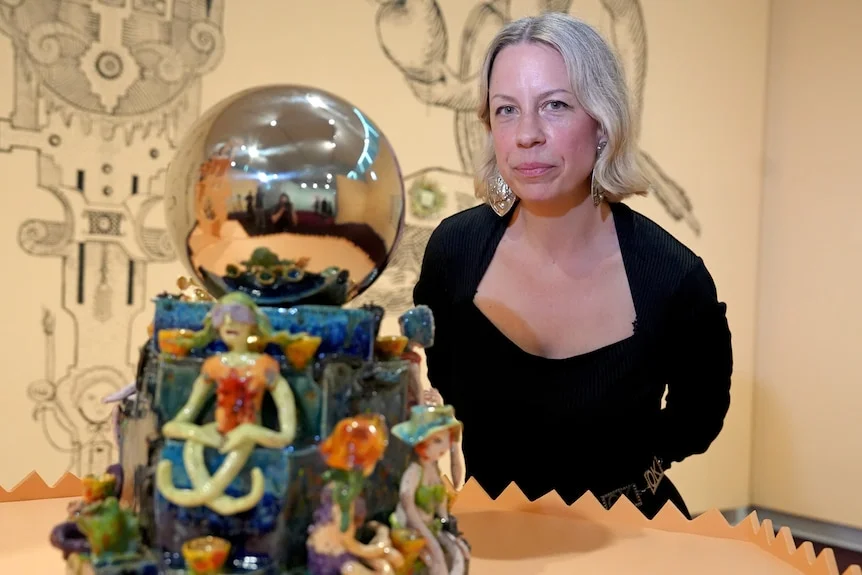
The crone is the most provocative of the three. Hunt reads her as a figure of redemption and change, not decline, which flips the usual reading of an older woman as the end of the story. It's a reframing that asks more of the viewer than a pretty set of mythological portraits would.
Not for everybody
Hunt hopes visitors arrive with an open mind. She describes the show as unapologetic and "deeply uncynical," and she's clear that it won't land with everyone. "I do care about my audience, but it's not for everybody," she said.
"Magic isn't for everybody. Feminine ornamentation, decoration, isn't for everybody.
"But I think the work, this particular exhibition, is so overwhelming and so powerful and so open and so generous that people will react very strongly to it.
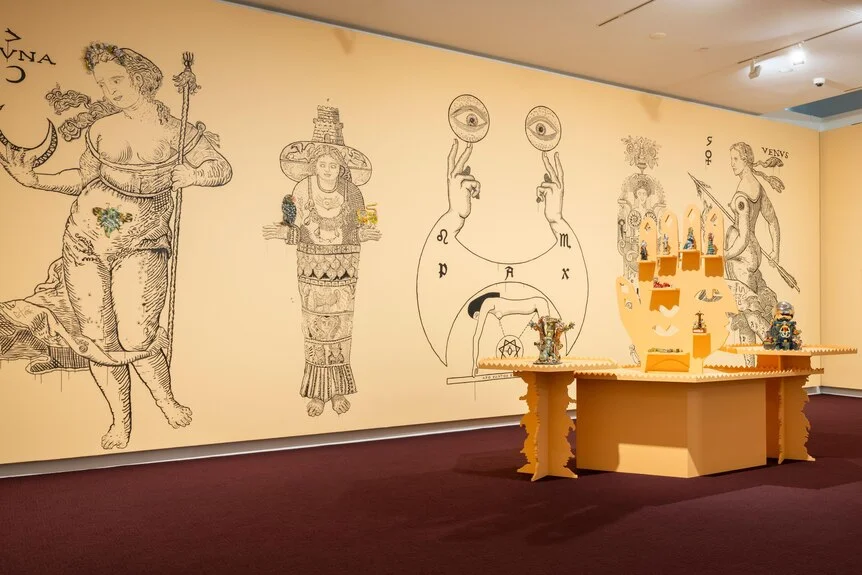
That openness is the bet. Hunt doesn't think visitors will arrive neutral, and she says so. "Everyone does have a little bit of an open mind to the subjects that are in this show."
Here's the tension: the subjects of witchcraft, ritual and feminine decoration have long sat on the fringes of mainstream art institutions. "It's kind of on the periphery, but we're bringing it a little bit to the front and centre, and bringing it to attention."
Whether a national institution can pull that off without diluting it is the real test. The Maiden Mother Crone exhibition is on display at the National Portrait Gallery until May 2027.


