Weipa's relentless heat sets records as Cape York waits for the monsoon
Weipa has now logged 39 consecutive days above 36 degrees Celsius, and the Far North Queensland town is still climbing. It recorded its hottest November day on Tuesday, when the mercury hit 39.9C, and its hottest November on record overall. The heat isn't a one-off spike. It's a sustained run that has now lasted nearly six weeks, and it's still going.
Records falling one after another
A severe heatwave warning has covered parts of Cape York Peninsula and the neighbouring Gulf Country since the end of October. For more than two weeks the conditions have been relentless, and for about a week from November 5 they escalated from "severe" to "extreme."
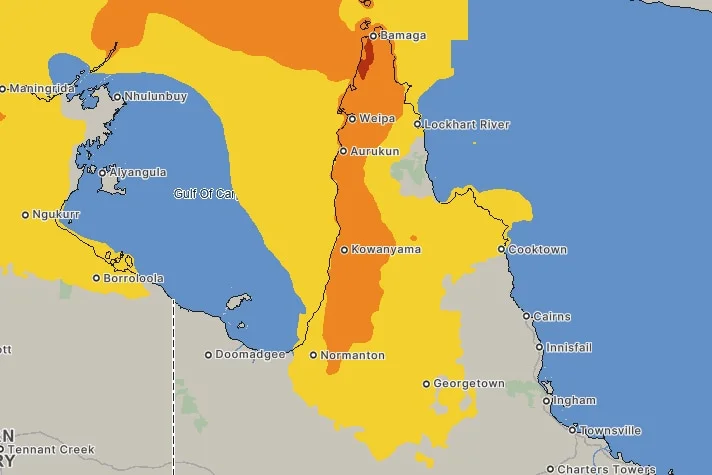
Heatwave severity map of Far North Queensland on Friday. (Supplied: Bureau of Meteorology)
Weipa also matched its 2024 record of 17 consecutive days above 37C on Friday. That's a benchmark the town had set just last year, so matching it this quickly says more about the run's intensity than its novelty. Weipa could surpass that mark on Saturday, which would make this the town's longest such streak on record.
Locals feel the squeeze
Long-term residents of Cape York are used to hot weather. Even so, many say this spell is a different kind of hard. Weipa baker Josh Lyon, who has lived in the town for more than 20 years, described the "relentless" heat sending sales of water and cold drinks "through the roof." It has also disrupted his work. Bread dough, he said, is the first thing to feel it.

Josh Lyon has lived in the town for more than 20 years. (Supplied: Josh Lyon)
"Once the dough is out, it's rising incredibly quickly, so there's a really short time frame to get it into the oven," he said.
The heat is also reshaping routines for people and animals alike. The Cape Animal Protection Shelter has changed its opening hours to keep its dogs and volunteers safe. President Shayna Reeves said the hot, sticky conditions have persisted "from sun-up to sundown" with no break. Staff are working around the clock on cooling, with frozen treats like bones and frozen kongs, and they keep water buckets topped up. Even so, "the water just goes hot," she said. Cooling a dog's water bowl is a losing battle when the ambient air is already well above body temperature.
Water running critically low
The heat is hitting hardest near the tip of the peninsula, where several Indigenous communities are already short on water. Residents of Bamaga, Injinoo, Umagico, Seisia and New Mapoon have endured two months of rolling, scheduled overnight water outages.

The Northern Peninsula Area Regional Council regularly shuts off water to its communities from 9pm to 6am. (ABC Far North: Brendan Mounter)
The Northern Peninsula Area Regional Council says the problem is structural. Its water-treatment plant can't keep up with demand, and reservoir levels are "critically low." The fix is a new treatment plant that would lift capacity by 50 per cent, but the council is still working to secure the funding. Until that money arrives, the outages look set to continue, and the heat makes every shortfall more dangerous.
Indoors offers little relief
Going inside doesn't guarantee much comfort either. Of the 3,500 social and community homes across Cape York, only 11 have air-conditioning units supplied by Queensland's Department of Housing. A department spokesperson said those units were generally installed to support tenants with health conditions. Installing air conditioners, the spokesperson added, "is not standard practice in social housing," though tenants can apply to install their own at their own cost. That's a hard sell in a region where many households can't easily afford it. And the problem isn't limited to older stock. Newly built social homes on Cape York don't come with air conditioning either.
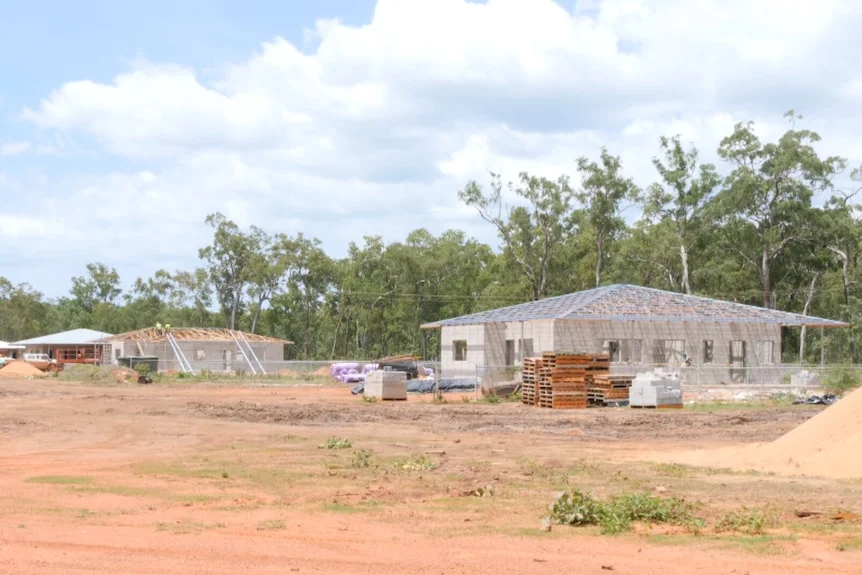
Even newly built social homes on Cape York don't come with air conditioning. (ABC News: Brendan Mounter)
A $213 million program funded by the Queensland and Australian governments aims to improve "thermal comfort and energy efficiency" in up to 40,000 social homes by 2031. The upgrades include energy-efficient fans and ceiling insulation. That's a meaningful investment, but fans don't do much when the air itself is hot and sticky, and the timeline runs years past this summer. Bill Guivarra, business services manager at the Mapoon Aboriginal Shire Council, argues air conditioning should be standard in social housing in Cape York's climate. "A lot of our elders don't have air-conditioning units, so, in this weather, it can become unbearable," he said.
"The summers seem to be getting hotter every year. Whether it's climate change, I don't have the answers for that, but personally, I feel that it's getting hotter every year."
Some reprieve, but not much
Queensland Health has urged people in the heatwave-warning zone to take extra care. In the past week it treated just one person for heat stress on Cape York, a low figure given how long the conditions have lasted. Whether that reflects good luck, good habits or underreporting isn't clear from the data available. Bureau of Meteorology senior meteorologist David Crock said heatwaves are common at this time of year, since the period before the monsoon is typically the hottest stretch for Northern Australia. What stands out is the length of these heatwaves across such a large area. A heatwave warning is also in place for the Top End of the Northern Territory.
The warning for the Gulf Country and Cape York Peninsula will continue through the weekend and into next week. There is some good news. "It does look like the heatwave signal eases off a bit towards the latter half of next week," Mr Crock said. "Of course, it will still be hot, just a little less hot than it has been." Don't expect the rain to arrive on schedule. Mr Crock said monsoonal rain and storms may not show up until after Christmas. "There's certainly no sign in the short term of the monsoon arriving in Northern Australia, so we'll be waiting a little while yet to get proper relief."


