A shift in the military priority
The redeployment of Yemen’s Southern Armed Forces shifts the immediate focus from western front lines near the Bab el-Mandeb Strait to Aden, the seat of the internationally recognised government. Houthi fighters are reportedly as close as 60 kilometres from the port city, raising pressure on forces already facing missile attacks there. The move puts a difficult choice in view: commanders must weigh the defence of the government’s principal base against the risk of leaving other contested areas more exposed.
That choice matters because Aden’s security carries political weight as well as military value. The government has relied on the city as its de facto capital since losing Sana’a, and pressure on Aden could complicate its ability to operate from the territory it still holds. The redeployment is therefore more than a change of position on the western front. It’s a test of how much the anti-Houthi coalition can protect at once.
Forces pull back from the western front
The Saudi-backed Southern Armed Forces said on Sunday they were withdrawing from parts of western Yemen. In a statement, the group said the move would prioritise Aden and neighbouring governorates, reinforce front lines and address existing threats. Those stated aims describe a redistribution of forces, though they don’t establish how many troops are moving or how the change will affect the units remaining in the west.
The withdrawal follows fierce fighting with the Iranian-backed Houthis along a mountain range overlooking the Bab el-Mandeb, a key passage between the Red Sea and the Gulf of Aden. Control and security around this corridor matter beyond the local front because ships passing between those waters depend on access to the strait. Still, the immediate military question is whether forces pulled back from the area can strengthen Aden without giving the Houthis room to press elsewhere.
Yemeni military spokesman Colonel Majid Abdullah Al-Nuzaili welcomed the redeployment, describing it as a “heroic stance” to protect Aden and help break the Houthi siege of Taiz. His statement presents the shift as serving both objectives, but those goals may compete for personnel and attention. A force sent to reinforce Aden can’t be committed to Taiz at the same time.
Taiz, Yemen’s third-largest city, has been encircled by Houthi forces in recent weeks. The redeployment therefore puts pressure on commanders to defend Aden while also confronting the threat to Taiz. If you’re following the military balance, the key question is how the coalition manages that split demand, not simply where its troops are headed.
Aden remains exposed
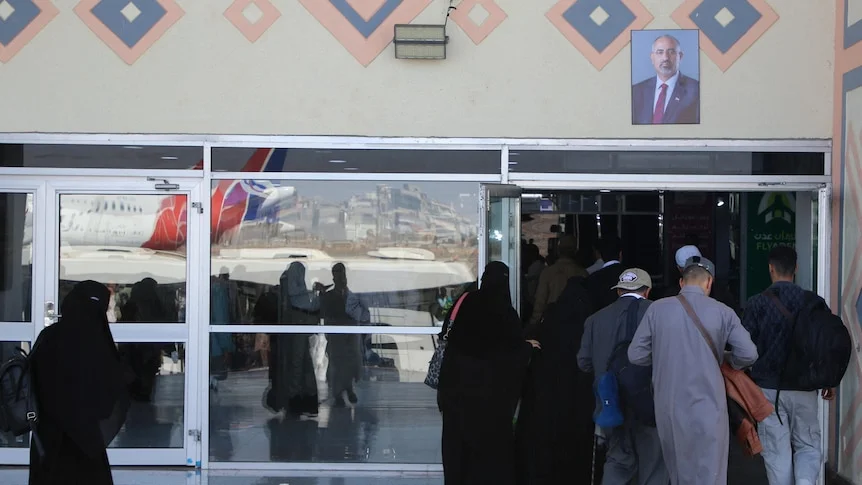
Aden has served as the government’s de facto capital since the Houthis took Sana’a in 2014. The city has faced repeated Houthi missile fire in recent weeks, and its airport has reportedly been targeted. That combination leaves the government’s main base exposed to attacks that can disrupt both movement and the ordinary work of governing.
Reports that Houthi forces are within 60 kilometres of Aden add urgency, but distance alone doesn’t tell readers how imminent an assault may be. Terrain, supply routes and the strength of forces on either side can all shape what a reported position means in practice. The distance is a warning about proximity, not a complete account of the threat.
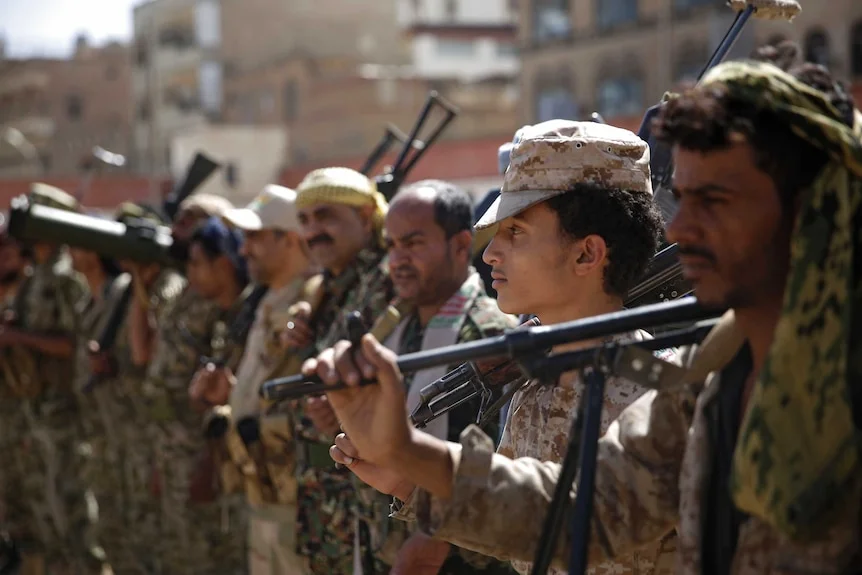
The war in Yemen has been frequently called the world's worst humanitarian crisis. (AP: Hani Mohammed)
The conflict’s civilian toll remains severe. The World Food Programme warned last month that more than 18 million people in Yemen faced acute food insecurity, while 2.2 million children under five were acutely malnourished. Those figures give the military choices around Aden and Taiz a human dimension: prolonged fighting and disrupted access can compound needs that are already extensive.
The International Committee of the Red Cross also confirmed that the Houthis had released 600 prisoners in Sana’a as the pullback was underway. The release is a separate development, and the available information doesn’t establish a connection between it and the redeployment. Its timing does, however, show that military movements and humanitarian concerns are unfolding in parallel.
Regional escalation adds strain
Fighting has intensified since a fragile ceasefire between the Houthis and Saudi Arabia collapsed in July. An Iranian plane’s attempted landing at Sana’a airport prompted attacks on the facility by Saudi-backed forces. The Houthis then launched strikes across Saudi Arabia, targeting energy infrastructure and commercial airports.
Riyadh has repeatedly faced missile and drone fire, while the Houthis have tried to block ships bound for Saudi Arabia from transiting the Bab el-Mandeb. Saudi Arabia uses the Red Sea route to move millions of barrels of oil to global markets as passage through the Strait of Hormuz remains constrained by Iran. The conflict thus carries risks for shipping and energy movements alongside its direct costs for Yemeni communities.
That said, the regional stakes don’t erase the local military problem. Forces redeployed to protect Aden may have less capacity for other fronts, while leaving western positions could create openings the Houthis might exploit. The source information doesn’t show whether the coalition has reserves or a plan to cover those gaps. A shift in deployment can reduce one danger while increasing another.
Iran supports the Houthis, though analysts say the group also acts independently and opposes Saudi Arabia on ideological grounds. That distinction cautions against treating every Houthi action as a direct expression of Iranian policy. The group has its own motivations and military choices, even as the conflict remains tied to wider regional tensions.
What the redeployment could signal
With Houthi forces reportedly within 60 kilometres of Aden, the redeployment makes the defence of the government’s principal base an immediate test of the anti-Houthi coalition’s capacity. The measure of success won’t be the announcement itself, but whether Aden is better protected while pressure on Taiz and the western front remains manageable. This is more significant than it looks: a force shift can reveal where commanders believe the next serious threat lies.
Here’s the thing: the coalition has stated its priorities, but the available account leaves practical questions unanswered. It doesn’t specify the size of the redeployed force, the positions it has left, or whether the move has changed the threat to Aden. Those gaps make firm predictions unwise, while leaving the core dilemma plain.
For residents, the immediate concern is whether attacks and fighting will intensify around populated areas and essential infrastructure. For the government, the task is to preserve Aden as a working base while responding to threats elsewhere. And for the coalition, the redeployment will only ease pressure if it can defend more than one front with the forces it has.
Hard choices, with civilians bearing the consequences.


